Dal’negorsk siderite is one of those locality subtypes that looks improbable until you have handled a good one: sandy-tan to golden-brown spheres, radiating “balls,” sparkly brown pseudomorphs after calcite, and greenish-brown casts after aragonite needles, often set against the classic Dal’negorsk suite of quartz, calcite, pyrite, sphalerite, galena, fluorite, pyrrhotite, and ilvaite. The appeal is not that siderite is rare as a species; it is that Dal’negorsk made siderite sculptural.

Photo: Wikimedia Commons
The best-known material comes from the Nikolaevskiy Mine, part of the Dal’negorsk ore district in Primorsky Krai, in the southern Sikhote-Alin region of the Russian Far East. Mineralogically, Dal’negorsk is not a single-species locality but an entire specimen-producing district built on skarn and polymetallic mineralization. In the Nikolaevskiy system, sulfide and carbonate assemblages developed in and around skarn bodies hosted by carbonate rocks, and open cavities gave crystals room to grow. That is the critical collector’s fact: many Dal’negorsk specimens are not massive ore fragments, but pocket-grown combinations in which gangue carbonates and sulfides became specimens in their own right.
For collectors, siderite from Dal’negorsk is most desirable in three overlapping categories. The first is the spherical habit: complete tan to golden-brown balls, sometimes single and nearly perfect, sometimes clustered on quartz, calcite, or sulfide matrix. The second is pseudomorph material, especially siderite after calcite and siderite after elongated aragonite or ilvaite forms. The third is combination material, where siderite acts as a warm-textured counterpoint to Dal’negorsk’s glossy black ilvaite, bright pyrite, silvery galena, dark sphalerite, milky quartz, or translucent calcite.
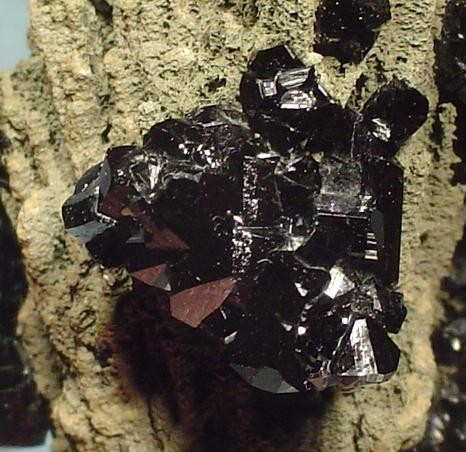
Photo: Wikimedia Commons
Dal’negorsk’s broader fame rests on crystallized sulfides, fluorite, calcite, quartz, datolite, danburite, axinite, ilvaite, and related skarn minerals, but siderite occupies a distinctive niche within that pantheon. It is often less flashy than a glassy fluorite or a pyrrhotite rosette, yet the finest siderites have a locality look that is almost unmistakable: matte to subtly sparkling, rounded rather than rhombic, and frequently tied to the complex replacement textures that serious pseudomorph collectors prize.
Search for specimens: View all siderite specimens from Dal’negorsk, Russia
The collector label “Dal’negorsk” usually refers to the Dal’negorsk mining district of Primorsky Krai, Russia, and for siderite the most important specific source is the Nikolaevskiy Mine. The mine lies near Dalnegorsk at roughly 44°35′ N, 135°40′ E, and is part of the long-lived Pb-Zn-Ag polymetallic mining camp historically associated with the old Tetyukhe name.
Geologically, the district is a skarn and polymetallic ore environment rather than a simple vein locality. The Dal’negorsk ore field includes base-metal skarn deposits around the central borosilicate skarn system. Published work on the Nikolaevsky base-metal skarn deposit recognizes sulfide-hedenbergite, quartz-carbonate-sulfide, and sulfide ore types, with vertical zoning from Pb-Zn mineralization at lower levels to Ag-Pb-Zn assemblages higher in parts of the system. In the specimen-producing portions, cavities in limestone and skarn-related ore allowed sulfides, quartz, calcite, fluorite, and carbonates such as siderite to crystallize in open space.
The broader Dal’negorsk borosilicate skarn deposit is a giant calcic-skarn boron system hosted by skarnized limestones of the Upper Triassic Tetyukha Formation. Its mineralization is described in stages that include skarn assemblages of wollastonite, hedenbergite, and andradite; borosilicate assemblages with danburite, axinite, datolite, and quartz; and later quartz-carbonate assemblages with quartz, calcite, apophyllite, and fluorite. That multi-stage environment helps explain why Dal’negorsk specimens commonly combine silicates, sulfides, carbonates, fluorite, and quartz in ways that look unusually complex even among classic skarn localities.
Mining history in the district reaches back to the end of the nineteenth century. Dalpolimetall traces its origin to April 2, 1897, when Vladivostok businessman Julius Joseph Bryner staked a silver-lead-zinc claim in the Tetyukhe, or Rudnaya, river valley. The first 97 tons of ore were mined in 1902, commercial development began in 1907, and the Tetyukhe Industrial Mining Stock Corporation was organized in 1909. From 1911 to 1916, more than 100,000 tons of ore were mined at the Verkhniy mine, then the only operating mine in the company’s system.
Nikolaevskiy is a later, modern mining development. The Nikolaevskiy Mine was commissioned in 1982 and became one of the defining specimen sources of Dal’negorsk’s modern collector era. Dalpolimetall describes the mine as working the Vostok-I and Kharkovskaya skarn-polymetallic bodies, with ore bodies of complex sheet-like geometry and a design capacity of 500,000 tons of ore per year. The mine infrastructure includes deep shafts and multiple working horizons, underscoring that this is an industrial underground mine, not a public collecting site.
Collecting access should be understood accordingly. Dal’negorsk specimens on the collector market have historically come through miners, local contacts, dealers, mine-related recoveries, and older collections; it is not a locality where visiting collectors should assume legal or safe access. Open cavities in ore can yield superb specimens, but active underground workings, industrial ownership, ventilation, ground support, and Russian permitting make casual collecting inappropriate. For modern collectors, the safest and most realistic route is acquisition through established dealers, old collection dispersals, and well-documented specimens with specific mine names retained.
Notable finds span several decades. Older 1990s finds are especially associated with the distinctive siderite spheres and pseudomorphs that circulate today. Some auction descriptions specifically tie spherical radiating siderite “balls” to early-1990s pocket material, and several pseudomorph styles after calcite are also described as 1990s material that is now only intermittently available. Dal’negorsk continues to appear on the market because large old collections and dealer inventories are still being dispersed, but the best siderite forms are no longer routine field-fresh material.
The signature Dal’negorsk siderite habit is spherical to botryoidal-radiating. Good examples appear as tan, beige, sandy-gold, or golden-brown balls made of innumerable small crystals. On close inspection, many are not smooth concretions but radiating crystalline aggregates, sometimes with a finely granular or velvety surface. The finest single spheres are complete, balanced, and free of flat contact marks; clustered examples can be more visually dynamic, especially when several balls sit on quartz or carbonate matrix.
Rhombic siderite also occurs, but it is not what made the locality famous. When rhombs are present, they may appear as tan-brown blocky crystals or as later generations on earlier siderite masses. Some specimens show multiple generations: a large siderite ball partly coated by drusy calcite or later siderite, then peppered with still smaller siderite aggregates. Those multi-stage examples are particularly satisfying under magnification because the piece reads like a paragenetic diagram rather than a simple hand specimen.
Pseudomorphs are a major part of the locality’s appeal. Siderite after calcite can preserve flattened, stacked, compressed rhombic or trigonal calcite forms, often as brown sparkling microcrystalline replacements. Some show hollow or cast-like backs where the original calcite has been dissolved out after replacement or coating. Siderite after aragonite is very different: long, diverging needle-like forms can be preserved as greenish to brown siderite, and the best-known combinations may be overgrown by brilliant black ilvaite. Siderite after ilvaite is another prized style, especially where the original prismatic form remains readable.
Colors range from pale beige and sandy tan to golden brown, dark brown, olive-brown, and greenish-brown. Fresh-looking material may have a warm tan or honeyed cast; older or iron-stained surfaces may look darker and more matte. Sparkle matters: an even, fine crystalline surface gives a much richer appearance than a dull earthy crust.
Size ranges vary by habit. Fine miniature spheres may be only a few centimeters across, while small-cabinet and cabinet pieces can carry multiple balls from millimeters to more than 2 cm across. Published and dealer-documented examples include single spheres around 3 to 4 cm, clustered small-cabinet pieces around 7 to 8 cm, and larger cabinet plates over 15 cm across. For display, form and completeness usually matter more than raw size: a perfect, undamaged miniature sphere can be more desirable than a larger but bruised cluster.
Associated minerals are central to identification and value. Common and characteristic companions include quartz, calcite, pyrite, sphalerite, galena, pyrrhotite, fluorite, chalcopyrite, dolomite, ilvaite, and locally aragonite as a precursor form in pseudomorphs. Siderite with white or pinkish calcite provides strong color contrast. Siderite on quartz gives a classic skarn-pocket look. Siderite with pyrite adds metallic brilliance. Siderite with ilvaite is one of the sharpest Dal’negorsk associations, especially where black ilvaite crystals sit on or around pseudomorphed carbonate forms.
The quality factors are specific and unforgiving. For spheres, look for completeness, symmetry, absence of flat contacts, no bruised high points, and a pleasing relationship to matrix. For pseudomorphs, look for faithful preservation of the precursor crystal shape: stacked calcite rhombs should still read as calcite; aragonite casts should retain their radiating needle architecture; ilvaite pseudomorphs should remain sharply prismatic. For combinations, balance is everything. The best Dal’negorsk pieces do not merely contain siderite; they use siderite as the visual anchor for the entire composition.
Authentic Dal’negorsk siderite is usually recognizable by habit and association, but locality precision still matters. A label reading only “Dalnegorsk” is acceptable for some older material, yet a specimen with “Nikolaevskiy Mine” is more desirable when the style supports it. Because Dal’negorsk is a district with several important mines, older labels may use variant spellings such as Dalnegorsk, Dal’negorsk, Tetyukhe, Tjetjuche, Nikolaevsky, Nikolayevsky, or Nikolaevskiy. Do not discard old labels simply because the transliteration looks dated; those spellings often preserve useful provenance.
The main authenticity concern is misidentification rather than treatment. Spherical Dal’negorsk siderite can be confused with drusy calcite, dolomite, iron-stained carbonate, or limonitic aggregates if examined casually. A good specimen should show the expected carbonate behavior, iron-rich heft, locality-appropriate associations, and crystal texture under magnification. Pseudomorphs need more scrutiny: a “siderite after calcite” should preserve calcite morphology convincingly, and a “siderite after fluorite” or “after ilvaite” claim should be treated as more specialized and should ideally come with strong provenance or expert attribution.
No widely cited, locality-specific treatment problem is associated with Dal’negorsk siderite in the standard collector literature. Cleaning, trimming, and stabilization are more relevant issues. Some specimens have been trimmed closely to isolate a sphere or improve display. That is not inherently a defect if disclosed, but a sphere perched on a small sawn or broken base should be judged differently from a true undamaged floater. Watch for glued repairs where a ball meets matrix; the junction is a natural stress point, and spherical aggregates can detach cleanly.
Condition issues are predictable. High points on spheres bruise easily, producing pale scuffed patches or flattened spots. Drusy surfaces can be abraded by careless wrapping. Pseudomorphs after calcite may have delicate edges where the replaced crystal forms are thin or hollow. Specimens with pyrite, marcasite, or pyrrhotite associations should be stored dry and monitored, because iron sulfides from many localities can be sensitive under poor humidity conditions. Dal’negorsk pieces are not automatically unstable, but sulfide-rich combinations deserve normal conservative storage.
Rarity is habit-dependent. Ordinary siderite as an accessory carbonate is not rare in the district. Distinctive spherical siderite, complete display-quality siderite balls, and convincing pseudomorphs after calcite, aragonite, fluorite, or ilvaite are much less common. The best examples are usually older pieces, and several market records describe classic styles as 1990s finds. That age does not make every piece valuable, but it does explain why fresh-looking, well-provenanced specimens with old collection labels are increasingly attractive.
Current market availability is intermittent rather than abundant. Dal’negorsk siderites appear regularly enough that patient collectors can find one, but the strongest forms tend to surface through auction dispersals and established dealer inventories rather than as large new lots. Recent public auction records show small-cabinet to cabinet Dal’negorsk siderites selling across a broad range, from under $100 for simpler rhombic material to several hundred dollars for spherical or pseudomorph examples, with larger and more aesthetic spherical cabinet pieces reaching higher. For a serious collection, it is worth paying for form, condition, and provenance rather than simply buying the first “siderite from Russia” label encountered.
The Dal’negorsk story begins not with a specimen cabinet but with a claim stake in the Rudnaya valley. On April 2, 1897, Julius Joseph Bryner, a Vladivostok businessman, staked a rich silver-lead-zinc deposit and named it Verkhniy. The numbers from the first years are modest enough to feel almost intimate: four mineral land patents in 1902, then the first 97 tons of ore mined that same year. Commercial development did not begin until 1907, and in 1909 the Tetyukhe Industrial Mining Stock Corporation was formed in partnership with Bryner & Co. and German and English capital. Between 1911 and 1916, that one operating mine produced more than 100,000 tons of ore.
The later Nikolaevskiy chapter has a different feel: shafts, horizons, and mechanized underground development. The mine was commissioned in 1982, and company history photographs record construction in 1981 and self-propelled mining-machine development at the first stage of the Nikolayevskiy deposit in 1983. That early-1980s opening matters to collectors because it coincides with the modern era of Dal’negorsk specimens reaching the international market. The mine was not just producing ore; it was opening the cavities that would eventually give collectors pyrrhotite, galena, fluorite, calcite, quartz, ilvaite, and siderite specimens with the now-classic Dal’negorsk look.
The specimen story is also a story of open space. Russian geological summaries describe mineralized open cavities in the Dal’negorsk ore bodies and their margins, including gaping mineralized fractures up to 20 meters long with swellings up to 2 meters wide, and roughly equidimensional karst cavities up to 10 meters across. Those are not abstract dimensions. They explain why Dal’negorsk specimens can feel so three-dimensional: crystals had room. In a district where sulfides, quartz, calcite, fluorite, and carbonates all entered those spaces, siderite could become a ball, a cast, a lining, or a replacement rather than merely a dull brown gangue mineral.
Raymond W. Grant and Wendell E. Wilson, “Famous Mineral Localities: Dal’negorsk, Primorskiy Kray, Russia,” The Mineralogical Record, Vol. 32, No. 1, 2001, pp. 3–30. A key English-language collector reference for the district and its classic specimen suites. Mindat reference record
L. I. Rogulina and O. L. Sveshnikova, “The Nikolaevsky Base-Metal Skarn Deposit, Primorye, Russia,” Geology of Ore Deposits, Vol. 50, No. 1, 2008, pp. 60–74. Technical study of the Nikolaevsky skarn ore system, including ore types, zoning, and mineral assemblages. Mindat reference record
V. A. Baskina, V. Yu. Prokof’ev, V. A. Lebedev, S. E. Borisovsky, M. G. Dobrovol’skaya, A. I. Yakushev, and S. A. Gorbacheva, “The Dal’negorsk Borosilicate Skarn Deposit, Primorye, Russia: Composition of Ore-Bearing Solutions and Boron Sources,” Geology of Ore Deposits, Vol. 51, No. 3, 2009, pp. 180–194. Important for the wider district setting, skarn stages, and borosilicate system. ResearchGate article page
V. Yu. Prokof’ev, M. G. Dobrovol’skaya, F. G. Reif, Yu. M. Ishkov, and T. B. Zhukova, “Composition of Ore-Bearing Fluids in the Dal’negorsk Borosilicate Deposit, Russia,” 2003. Useful for the fluid-inclusion and mineralizing-stage context of the Dal’negorsk borosilicate deposit. Repository record
Tomasz Praszkier and Rafał Siuda, “Un voyage à Dalnegorsk, Monts Sikhote-Alin, Primorié, Russie,” Le Règne Minéral, No. 68, 2006, pp. 22–49. Field-and-collector article on Dal’negorsk’s mines and mineral specimens. Spirifer Minerals article notice
V. V. Ponomarenko, “Calcite of Dalnegorsk: review of finds for 2003–2008,” Mineralogical Almanac, Vol. 14, No. 1, 2009, pp. 41–54. Focused on calcite rather than siderite, but important for understanding carbonate specimen production in the same district. Webmineral locality bibliography
Dmitriy I. Belakovskiy, “New acquisitions to the Fersman Mineralogical Museum RAS: the review for 2009–2010,” New Data on Minerals, Vol. 46, 2011. Notes Dal’negorsk acquisitions, including quartz associated with calcite and siderite from the Nikolayevskiy Mine and other important district specimens entering the Fersman Museum collection. PDF
Wikimedia Commons specimen record for a 4.1 × 3.4 × 3.4 cm spherical siderite with calcite from the Nikolaevskiy Mine, photographed by Rob Lavinsky / iRocks.com and released under CC BY-SA 3.0. Wikimedia Commons
Wikimedia Commons specimen record for a 5.0 × 3.6 × 3.1 cm ilvaite-siderite-aragonite pseudomorph combination from the Nikolaevskiy Mine, from 1990s finds, photographed by Rob Lavinsky / iRocks.com and released under CC BY-SA 3.0. Wikimedia Commons
Mindat: Nikolaevskiy Mine, Dalnegorsk, Primorsky Krai, Russia — Core locality page with coordinates, mineral list, references, and specimen photos.
Mindat photo: Siderite from Nikolaevskiy Mine — Large cabinet siderite specimen record with dimensions and locality attribution.
Mindat photo: Siderite with Calcite from Nikolaevskiy Mine — Classic spherical siderite specimen, useful for recognizing the locality’s best-known habit.
Wikimedia Commons: Siderite-Calcite-119136.jpg — Openly licensed image record for the spherical siderite with calcite specimen.
Wikimedia Commons: Ilvaite-Siderite-Aragonite-191713.jpg — Openly licensed image record for the ilvaite on siderite-after-aragonite pseudomorph combination.
Dalpolimetall: About company — Company history for the Dal’negorsk mining enterprise, including the 1897 Bryner claim and early Tetyukhe mining.
Dalpolimetall: Nikolaevskiy Mine — Russian-language company page describing the modern Nikolaevskiy Mine, its ore bodies, capacity, shafts, and underground infrastructure.
Webmineral.ru: Dal’negorsk ore field — Russian-language geological and specimen summary, including the open mineralized cavities that made the district so productive for collectors.
Webmineral.ru: Nikolaevskiy Mine — Russian-language locality page listing notable minerals and references for the Nikolaevskiy Mine.
MineralAuctions: Siderite from Nikolaevskiy Mine, sold December 2023 — Market record for a multiple-ball siderite specimen, with description of early-1990s pocket material.
MineralAuctions: Siderite pseudomorph after Calcite, sold November 2025 — Market record illustrating the Dal’negorsk siderite-after-calcite pseudomorph style.
MineralAuctions: Siderite pseudomorph after Fluorite, sold December 2025 — Rare pseudomorph example from the Nikolaevskiy Mine.
MineralAuctions: Siderite rare spherical habit, February 2026 — Recent market example of the small spherical habit collectors seek.
 Amethyst
 Quartz
 Fluorite
 Tourmaline
 Malachite
 Azurite
 Rhodochrosite
