Scheelite from the Huanggang Mine is a modern Chinese skarn classic: not the orange, gemmy “pseudo-octahedrons” that made Mount Xuebaoding famous, but pale, sculptural, high-contrast crystals born in a ferrous, arsenic-rich, fluorine-bearing iron-tin system. The best Huanggang scheelites are bright white to silvery gray, sometimes with greenish, bluish, reddish, or smoky gray zones, and they usually show the sharply dipyramidal tetragonal form collectors expect from the species. What makes them unmistakably Huanggang is the company they keep: black magnetite, metallic löllingite and arsenopyrite, bluish molybdenite inclusions, quartz, calcite, and fluorite.
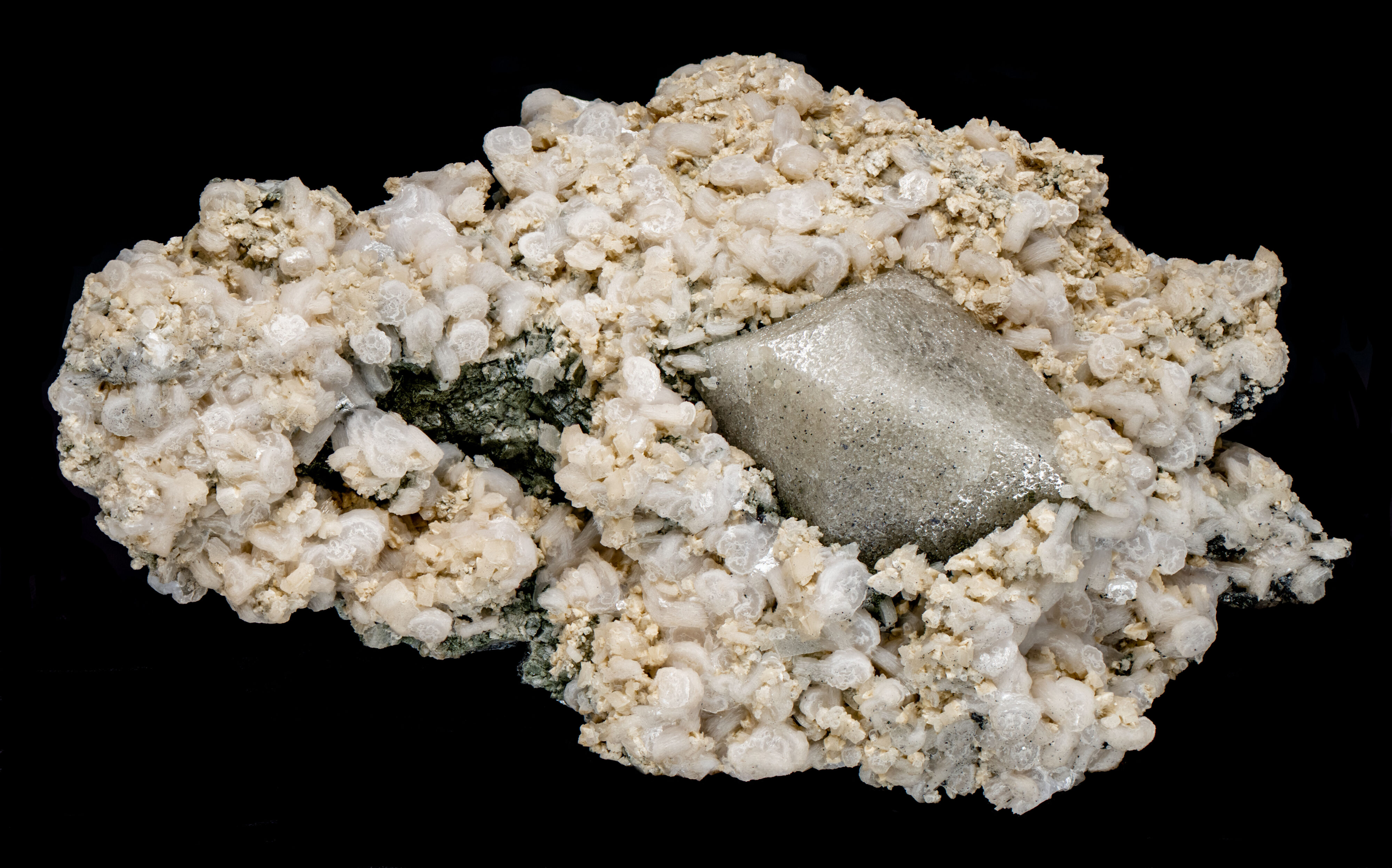
Photo: Fluorescent Mineral Society
Under ultraviolet light, good Huanggang pieces can become far more dramatic than they appear in daylight. A documented scheelite-and-calcite specimen from the Huanggang Fe-Sn deposit shows a white shortwave response from the scheelite, red-orange fluorescence from the calcite, and a measured scheelite shortwave emission maximum shifted to 447 nm, broader and longer-wavelength than the 428 nm peak expected for relatively pure scheelite. That shift is consistent with molybdenum substituting for tungsten in the scheelite-powellite solid-solution series, a particularly apt signature for a locality where molybdenite inclusions are a recurring visual feature.
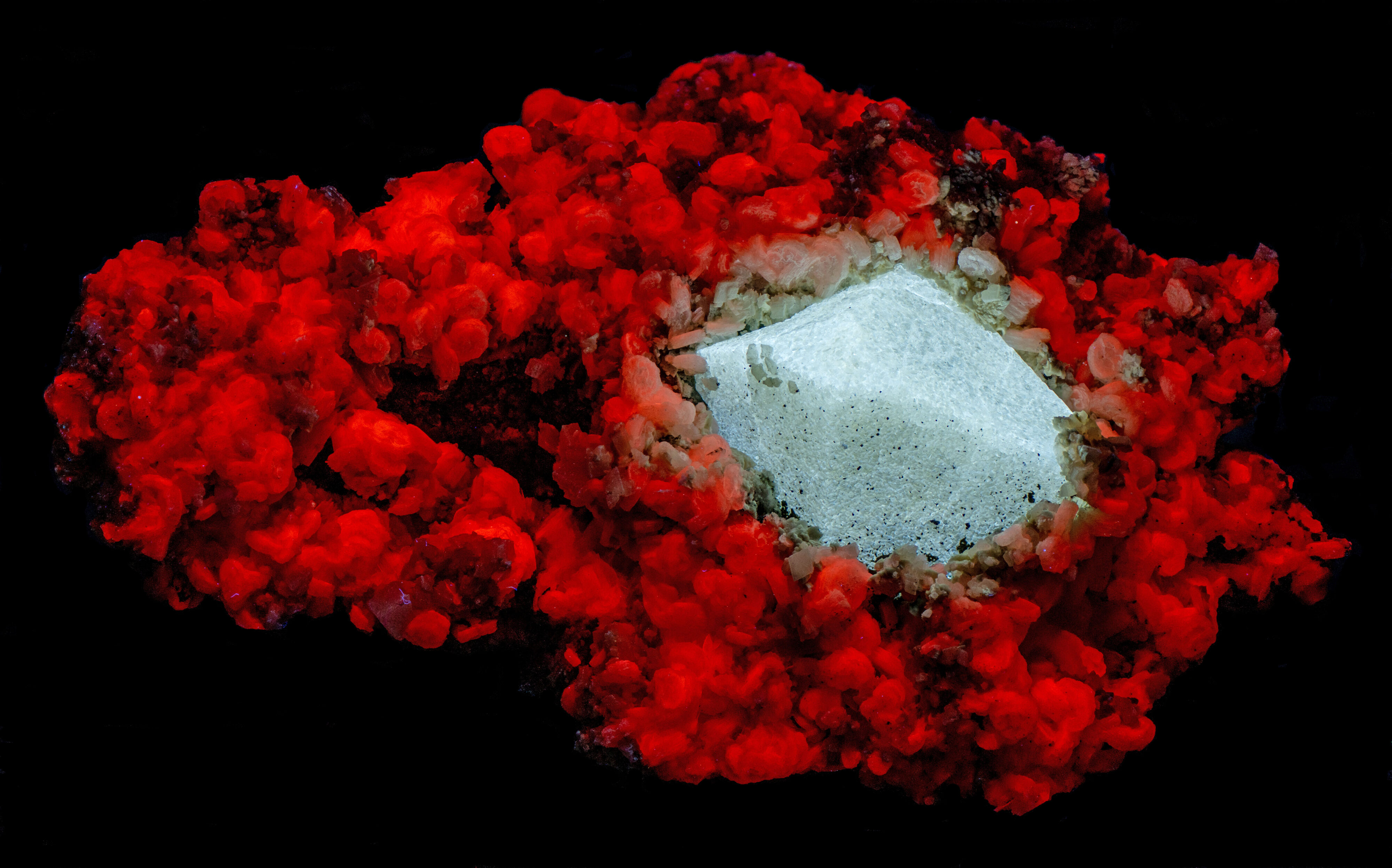
Photo: Fluorescent Mineral Society
Geologically, Huanggang is not a narrow single-pocket occurrence but a large skarn-type iron-tin-polymetallic deposit in Hexigten Banner, Chifeng, Inner Mongolia. It sits in the southern Great Xing’an Range, where granitoid intrusions reacted with carbonate-rich Permian rocks to build skarns rich in garnet, diopside, amphibole, magnetite, cassiterite, sulfides, fluorite, calcite, and scheelite. The collector story began in earnest around 2010, when superb ilvaite and other minerals from Huanggang began appearing internationally and the locality quickly proved to be far richer than a single-species sensation.
For scheelite collectors, Huanggang is appealing because it offers an unusual combination of form, associations, and fluorescence. The finest examples are not merely isolated white bipyramids; they are locality portraits, with dense black iron-oxide matrix, silvery arsenides, molybdenite freckles or veils, and calcite or quartz providing visual relief. A specimen with a sharp 2–5 cm scheelite crystal can be very satisfying; a well-balanced piece with intact terminations, strong luster, attractive fluorescence, and diagnostic associated minerals is decidedly scarcer.
Search for specimens: View all scheelite specimens from Huanggang Mine, Inner Mongolia, China
The Huanggang Fe-Sn deposit, also known as the Huanggangliang Mine or Huanggang Mine, lies in Hexigten Banner, Chifeng City, Inner Mongolia, at roughly 43°36'37" N, 117°25'37" E. In older specimen labels the locality may appear in several forms, including Huanggang, Huanggangliang, Keshiketeng, Hexigten, Chifeng, Ulanhad, and, incorrectly, “Baotou District.” For modern labeling, “Huanggang Fe-Sn deposit, Hexigten Banner, Chifeng City, Inner Mongolia, China” is the most precise parent locality, with “No. 5 Mine” added when the source is known.
The deposit is a skarn-type tin-iron system developed where carbonate rocks of the Early Permian Dashizhai and Huanggangliang formations were intruded and metasomatized by granitic bodies. Garnet-diopside skarn and garnet-amphibole-biotite skarn are strongly developed at the intrusive contacts. Ore occurs as massive bodies, breccias, veinlets, disseminations, and smaller fissure-controlled veins within the skarn. Later sulfides, amphibole, and epidote overprint and replace earlier skarn and magnetite.
Huanggang is a large mining district rather than a single simple shaft. The deposit area is roughly 0.5–2.5 km wide and 19.5 km long and is worked by seven mines. The western part contains isolated iron-rich skarn orebodies worked by Mines 1–4; the eastern part contains a roughly 6 km band of tin-rich skarn lenses in marble, worked by Mines 5–7. Scheelite is specifically recorded from the deposit and from the No. 5 Mine, which is also prominent in specimen-market references for scheelite, calcite, fluorite, and tin-rich associations.
Economically, Huanggang is an iron-tin-polymetallic deposit with recorded iron and tin commodities and additional W, Mo, Pb, Zn, Cu, and fluorine-bearing mineralization. A modern geologic synthesis describes 185 ore bodies divided into seven ore zones, with individual bodies 10–1475 m long, 2–118 m thick, and extending to plunge depths of as much as 500 m. The mineralization sequence is commonly described in six stages: anhydrous skarn, hydrous skarn, cassiterite-quartz-calcite, pyrite-arsenopyrite-quartz-fluorite, polymetallic sulfides-quartz, and late carbonate.
The mine’s collector history is much shorter than its geological history. Huanggang began to matter internationally to specimen collectors around 2010, when excellent ilvaite and then a rush of other species appeared on the market: fluorite, arsenopyrite, löllingite, hedenbergite or amphibole, quartz, calcite, aquamarine, garnet, and eventually notable scheelite. A 2011 field report by John Chen described the locality as a newly recognized specimen source, with about eight mining areas and early collecting information that assigned hedenbergite, garnet, quartz, ilvaite, and fluorite to No. 1; arsenopyrite, hedenbergite, and ilvaite to No. 2; and calcite and fluorite to No. 5. Later published and dealer records refined that picture, but the early market moment was clear: Huanggang had suddenly become one of China’s important modern specimen localities.
For collectors, Huanggang should be treated as a working commercial mining complex, not a recreational collecting site. Specimens enter the market through miners, local handlers, Chinese dealers, and international dealers, often with mine-number precision lost or simplified along the way. The best scheelite labels preserve not only “Huanggang” but the mine number when known, the year or find period when supplied, and the associated minerals. That information matters, because Huanggang specimens from different ore zones can look convincingly related while belonging to different parts of the system.
Huanggang scheelite is most often seen as tetragonal dipyramids, from simple pseudo-octahedral crystals to richer, multi-faced bipyramidal crystals with bright faces and sharp ridges. Documented collector specimens show individual scheelite crystals around 2.0 cm, 2.5–2.6 cm, 4.2 × 3.1 cm, 4.5 × 2.3 cm, and as large as about 5.6 × 4.2 cm on matrix. Some specimens consist of a single dominant scheelite on magnetite or quartz; others show grouped crystals or scheelite as a subordinate but important accent on löllingite, arsenopyrite, molybdenite, magnetite, fluorite, and calcite combinations.
The color range is one of the locality’s charms. Typical pieces are white, grayish white, or silvery white, but examples have been described as light bluish, bright greenish, white with reddish areas, or gray-zoned by included molybdenite. Translucency varies from nearly opaque-looking milky crystals to translucent, lustrous faces with a soft internal glow. The best surfaces are glassy to resinous and crisp; dull, etched, chalky, or bruised faces reduce value sharply.
Molybdenite inclusions are especially important in Huanggang scheelite. They may appear as bluish gray specks, patches, or internal veils, and they can affect both the daylight appearance and the fluorescence. Dealer records repeatedly note scheelite with molybdenite inclusions, sometimes with analysis offered to the buyer; the Fluorescent Mineral Society’s measured example supports the same general mineralogical theme by documenting a broadened, longer-wavelength shortwave response consistent with molybdenum-bearing scheelite.
Fluorescence is strong but not absolutely uniform from specimen to specimen. Huanggang scheelite may fluoresce white under shortwave ultraviolet light; some dealer records describe intense shortwave response and minor or noticeable longwave fluorescence, while a measured FMDB specimen was non-fluorescent under longwave, yellow under midwave, and white under shortwave. The associated calcite can add a striking red to orange-red response, often making mixed scheelite-calcite specimens much more dramatic under UV than in daylight.
The most characteristic associations for collectible scheelite are magnetite, arsenopyrite, löllingite, molybdenite, quartz, calcite, and fluorite. Magnetite gives black, dense, heavy matrix and excellent contrast. Löllingite contributes silvery, flattened, foliated or polycrystalline metallic crystals. Arsenopyrite adds bright, sharp metallic forms and reinforces the locality’s arsenide-sulfide character. Quartz and calcite soften the composition visually, and fluorite, when present, can raise both aesthetic and locality interest.
Quality is judged by the same high standards applied to any important scheelite locality, but with Huanggang-specific priorities. Look first for undamaged terminations and lustrous faces, because white scheelite shows bruising, edge chips, and contact marks plainly. Next, judge the balance of the crystal on matrix: a sharp white bipyramid on black magnetite or metallic löllingite is more desirable than a loose or visually crowded crystal. Finally, test fluorescence if possible and examine inclusions carefully; molybdenite-rich, UV-active crystals with attractive zoning or contrast are often more distinctive than plain white crystals of comparable size.
Huanggang scheelite is available often enough that serious collectors can be selective, but the truly fine pieces are not common. Small and medium cabinet examples have appeared in the international trade since the early 2010s, with better pieces usually tied to the 2012–2015 production window documented by major dealers. Fresh material still appears intermittently, but the market is uneven: many specimens labeled Huanggang are fluorite, quartz, calcite, ilvaite, löllingite, or arsenopyrite, while scheelite is a smaller and more specialized subset.
The first authenticity issue is locality precision. “Inner Mongolia scheelite” is not enough; “Huanggang” is better; “Huanggang Fe-Sn deposit, No. 5 Mine” is best when supportable. Labels reading “Baotou District” should be treated as old or erroneous shorthand rather than accurate geography. Be cautious with vague labels that conflate Huanggang with other Inner Mongolian mines, especially because Inner Mongolia has produced multiple visually similar skarn and fluorite assemblages in recent years.
The second issue is species confirmation and associated-mineral naming. Huanggang has a history of specimen-label problems: some “hedenbergite” material has analyzed as amphibole, some garnets sold as andradite may be grossular-rich or part of the andradite-grossular series, and some datolite attributed to Huanggang has been noted as coming from a mine near Linxi instead. These concerns do not invalidate good scheelite pieces, but they do argue for caution when a label promises a complicated association. On better scheelite specimens, particularly those involving molybdenite inclusions or unusual fluorescence, analytical confirmation is a meaningful plus.
There is also a documented treatment concern specific enough to matter. One Huanggang scheelite described by Fabre Minerals had an artificial greenish patina, identified as an amorphous iron arsenate produced by a previous chemical attack on former calcite; the dealer described the natural white color as having been recovered after eliminating that patina. This is an important warning: greenish or altered-looking coatings on Huanggang scheelite are not automatically natural color, and specimens with removed calcite, etched surfaces, or suspicious coatings deserve close inspection.
Condition problems are predictable. Scheelite is dense and moderately hard but not tough; exposed bipyramidal points and ridges chip easily. White crystals show bruises, edge wear, and contact marks more visibly than dark scheelite. Calcite-rich matrix can be etched, dissolved, or mechanically reduced, sometimes leaving odd cavities, rough borders, or altered residues around the scheelite. Metallic associates such as arsenopyrite and löllingite can oxidize or dull if stored poorly, and arsenic-bearing minerals should be handled sensibly: wash hands after handling, avoid creating dust, and keep friable pieces away from children and pets.
A strong Huanggang scheelite should offer at least three of the following: a sharp crystal, good luster, clean white to subtly zoned color, attractive black or metallic matrix, documented molybdenite inclusions, good fluorescence, and reliable provenance. A specimen that has all of those attributes belongs in a serious modern Chinese skarn suite.
In June 2011, John Chen visited Huanggang during a China minerals trip that ran from June 6 to June 17. His short field note captures the mine at the moment it was becoming known to collectors outside China. He wrote that the locality had been recognized as a good specimen source around June 2010, first because of interesting ilvaite, and then because more species began to appear: transparent octahedral fluorite, arsenopyrite with pink or red fluorite, quartz, hedenbergite, pyrite, aquamarine, and pink calcite. The excitement in the report is plain; Huanggang was not being introduced as a one-pocket curiosity, but as a locality whose “minerals species looks so many” and whose specimen quantity looked substantial.
The early mine-area notes in that report are especially valuable because they show how quickly collectors and dealers were trying to organize a complicated district. Chen described about eight mining areas and gave a preliminary breakdown: No. 1 area for hedenbergite, garnet, quartz, ilvaite, and fluorite; No. 2 for arsenopyrite, hedenbergite, and ilvaite; and No. 5 for calcite and fluorite. That last point matters to scheelite collectors because later Mindat records place scheelite specifically at the No. 5 Mine, and many of the most desirable scheelite specimens are tied visually to the calcite-fluorite-arsenide-magnetite assemblages that made Huanggang famous.
The market tells its own story. By July 2013, a miniature scheelite and löllingite specimen from Huanggang was already notable enough to be offered as a distinct recent-find combination: a 2.6 cm lustrous grayish-white tetragonal scheelite attached to flattened, foliated, silvery-bright löllingite, with “ghostly white fluorescence.” Around the same period, European dealer records documented increasingly sophisticated descriptions: scheelite with molybdenite inclusions, analyzed examples, white dipyramids on magnetite, greenish dipyramidal groups, and combinations with arsenopyrite and fluorite. In just a few seasons, Huanggang scheelite had moved from “what else is coming out of this mine?” to a recognizable locality style.
 Amethyst
 Quartz
 Fluorite
 Tourmaline
 Malachite
 Azurite
 Rhodochrosite
