Mogok sapphire has a reputation that is quieter than Mogok ruby’s, but among serious collectors it carries the same locality magic: old Burmese provenance, high-grade metamorphic geology, and a color palette that can run from pale, silky blue through saturated royal blue to violetish and gray-blue tones. The finest gems are valued for a velvety blue bodycolor, relatively even color distribution, and the prestige of a classic metamorphic sapphire source. The mineral-specimen collector, however, often looks for something different: a sharp hexagonal corundum crystal with enough translucency to glow at the edges, a natural surface rather than a polished window, and a locality history that ties the piece to one of the world’s most storied gem tracts.
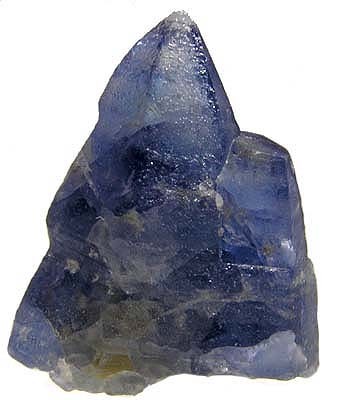
Photo: Wikimedia Commons
Mineralogically, Mogok sapphire is corundum, Al2O3, colored chiefly by iron and titanium in the blue stones, with local contributions from chromium, vanadium, and other trace elements in violetish or unusual material. Its geological setting is not a simple basalt-field sapphire story. Mogok belongs to the Mogok Metamorphic Belt, where coarse marbles, calc-silicate skarns, gneisses, syenites, charnockites, granites, and pegmatites are packed into a complex high-grade metamorphic terrain. Ruby and spinel are the headline gems of the marbles; blue sapphire is especially tied to skarn and syenite-related environments, secondary byon gravels, and local primary workings such as Baw Mar and Thurein Taung.
That geological mixture is part of the charm. A Mogok sapphire specimen may carry the hard-won geometry of corundum—a hexagonal barrel, bipyramidal termination, or thick blocky form—but it is rarely the clean, glassy, display-perfect crystal familiar from some Sri Lankan or Malagasy corundum lots. Many are dark, abraded, fractured, or partly altered from their passage through weathered host rocks and gravels. A good Mogok specimen is therefore prized not merely for size or brightness, but for the combination of locality, form, surface, color, and honest evidence of origin.
Historically, Mogok has been worked for centuries, with sapphire always in the shadow of ruby but never absent from the story. Early travelers described a trade in rubies, sapphires, and spinels; Burmese kings treated the gem fields as royal property; the British-era Burma Ruby Mines company tried to mechanize the tract; and late twentieth- and twenty-first-century studies have returned to the valley to understand why so much gem corundum formed in such a compact district. For modern collectors, a Mogok sapphire is best approached as both a mineral specimen and a document: a piece of Al2O3 from a locality where geology, trade, politics, and myth are inseparable.
Search for specimens: View all sapphire specimens from Mogok Valley, Myanmar
Mogok Valley lies in Mogok Township, Pyin-Oo-Lwin District, Mandalay Region, Myanmar. The old “Mogok Stone Tract” is a broader mining district rather than a single pit, and sapphire has been recovered from many named areas in and around the valley: Kyatpyin, Kyauk-Pyat-That, Kabaing, Kin, Chaung Gyi, Bernard-Myo, Pein-Pyit, Thurein Taung, Yadanar Kaday-Kadar, Mintada, and Baw Mar are among the localities that appear repeatedly in modern gemological and locality records.
The town of Mogok sits high in mountainous country north-northeast of Mandalay. The region is deeply weathered, densely vegetated, and seasonally wet, which helps explain why so much of the gem production has historically come from secondary deposits. Corundum, spinel, zircon, garnet, and other resistant minerals survive weathering and concentrate in gem gravels known locally as byon. These byon layers may be eluvial, lying close to the decomposed source rock, or alluvial, moved and concentrated by water in valleys and stream systems. For much of Mogok’s history, miners pursued these gem gravels rather than the primary sapphire-bearing rock.
The primary geological environment is more complex. Mogok is part of the Mogok Metamorphic Belt, a high-grade metamorphic belt whose gem-bearing rocks include coarse marbles, calc-silicate skarns, garnet-biotite gneisses, graphite marbles, syenites, charnockites, granites, and pegmatites. Modern geological work has emphasized the spatial relationship between ruby-sapphire mineralization and charnockite-syenite intrusions. Around these intrusions, skarn and metasomatic zones created aluminum-rich, silica-poor conditions favorable for corundum. Sapphire appears especially connected with skarn and syenite-related settings, while the broader valley system distributed crystals into byon gravels over long periods of tropical weathering and erosion.
Mining methods range from the ancient to the mechanized. Traditional twin-lon workings are narrow vertical shafts sunk to the byon, with lateral tunnels following the gem-bearing layer. Hmyaw-dwin workings use open trenches and water to wash gravels. Loodwin workings exploit gem-rich cavities in weathered marble, locally among the richest but also among the most dangerous styles of mining. In the late twentieth century, open-pit operations, hydraulic washing, jigs, pumps, bulldozers, excavators, and hard-rock tunneling became increasingly important, especially as accessible secondary deposits were depleted.
Baw Mar, near Kyatpyin west of Mogok, is especially important for modern sapphire. Earlier small-scale operations in the area mostly yielded low-quality material, but from about 2008 onward Baw Mar began supplying significant quantities of gem-quality blue sapphire. The mine has been described as using both open-pit mining and tunneling, with heavy machinery, an in-house sorting and cutting operation, and sapphire recovered from syenite-related material and clay pockets produced by alteration of feldspar to kaolinite. The mine’s output helped gemologists define a somewhat distinct Baw Mar sapphire suite, separate in some features from older “classic” Burmese sapphires from alluvial deposits.
Thurein Taung is another important sapphire locality west of Mogok. In the early 1990s, it was described as a primary sapphire occurrence where sapphires were found in unusual alkali-rich mafic igneous rocks intruded into marble and in biotite-bearing gneiss. Production statistics from the Myanma Gems Enterprise listed Thurein Taung as a major blue sapphire producer in the 1989–1992 period, though those figures mixed gem and non-gem rough and represent only part of the total Mogok production.
Access has never been straightforward. Mogok has long been politically sensitive and commercially controlled. Foreign visits have historically required authorization, and even professional gemological expeditions in the 1990s and 2010s were exceptional, organized events rather than casual field collecting. Current collecting access for private mineral collectors should be considered effectively closed unless arranged through legal, local, and officially permitted channels. Specimens on the collector market are therefore almost always old-stock, dealer-sourced, recovered by miners, or separated from gem parcels rather than field-collected by visiting hobbyists.
Mogok sapphire crystals are corundum, Al2O3, and their best specimen expression is hexagonal: blocky barrels, tapered bipyramidal or pyramidal forms, thick prismatic crystals, and compact crystal groups. Complete, sharp, translucent blue crystals are much scarcer as mineral specimens than Mogok rubies and spinels, which is why even modest-sized sapphire crystals with good form can attract serious collector attention.
Colors range widely. Fine cut stones may show rich saturated blue; Baw Mar material includes medium-to-dark blue stones from northern parts of the mine and generally lighter-toned stones from southern areas; other Mogok sapphires may be pale blue, gray-blue, violetish blue, greenish blue, or so dark that they are unsuitable for faceting except as beads or cabochons. Dealer lore in Mogok distinguishes rough by area: western material is often said to hold rich blue color in more orientations, while some eastern material is said to take on a greenish cast if cut in an unfavorable orientation. Those observations are useful market knowledge, but they should be treated as field tradition rather than a rigid scientific rule.
The best faceting material is transparent, evenly colored, and not overly dark. Documented Baw Mar study stones include faceted examples in the several-carat range and stones studied up to about 15 ct. A Baw Mar necklace examined by the Gübelin Gem Lab contained sapphires reportedly from that mine ranging from 2.4 to 6.7 ct. At other localities such as Mintada, reported high-quality stones seldom exceed roughly 2–3 ct. Large rough crystals do occur, but very large Mogok sapphires are commonly too dark, fractured, included, or uneven for high-end faceting.
For mineral specimens, size and transparency compete with form. A 2–4 cm crystal or cluster from Mogok with recognizable hexagonal morphology, natural faces, and blue translucency is already a desirable specimen. Many pieces are waterworn, contacted, fractured, or dull from weathering. Fine collector specimens may show doubly terminated or nearly complete crystals, gray-blue to blue color, and edge translucency when backlit. The best are not simply “gem rough”; they are crystallized corundum specimens with locality character.
Internal features are important because they help separate Mogok sapphire from look-alikes and support origin determination. GIA’s study of Mogok blue sapphires found silk to be the dominant inclusion scene, with rutile needles occurring in many forms: dense short needles, mixed short and long needles, discrete bands, arrowhead patterns, and reflective or iridescent platelets. Twinning is common, especially polysynthetic twin planes, and growth tubes may follow twin planes. Healed fissures, fingerprints, negative crystals, diffuse blue zoning, mica, feldspar, apatite, calcite, corundum, monazite, nepheline, rutile, scapolite, spinel, and zircon have all been documented in Mogok sapphires.
Color zoning in Mogok sapphire tends to be less sharp than in many basalt-related sapphires. A large GIA study found that only a minority of samples showed visible color zoning, and the typical zoning was diffuse blue-to-colorless rather than crisp, straight banding. This relative evenness of color is one reason fine Mogok stones can be visually compelling after cutting.
Associated minerals depend on the exact mine and host. In marble- and skarn-influenced areas, calcite, dolomite, spinel, ruby, forsterite, phlogopite, amphibole, garnet, diopside, scapolite, apatite, and titanite may be part of the broader assemblage. In byon gravels and pegmatite-influenced districts, sapphire may be recovered with spinel, moonstone or feldspar, topaz, tourmaline, garnet, zircon, quartz, and other resistant gem minerals. Baw Mar in particular is associated with altered feldspathic material, syenite, clay pockets, biotite mica, chlorite, and soft white nepheline-rich material.
Gemologically, Mogok sapphires sit in the metamorphic sapphire family with Sri Lanka, Madagascar, and Kashmir rather than the basalt-related family represented by many Thai, Cambodian, Nigerian, and Australian sapphires. This distinction matters to collectors because metamorphic sapphires often have lower iron than basaltic sapphires, may show a softer blue appearance, and can overlap strongly with other classic sources in chemistry. Origin determination therefore depends on the whole evidence package: inclusions, spectroscopy, trace elements, fluorescence, growth structure, and reliable provenance.
Mogok sapphire should be bought with a disciplined eye. The locality name carries a premium, and that premium invites loose attribution. A blue corundum crystal from an old gem parcel is not automatically Mogok because it was bought in Myanmar, Thailand, or from a dealer who handles Burmese goods. For important stones, especially faceted sapphires sold as “Mogok,” “Burmese,” or “Burma no heat,” a report from a major laboratory is not a luxury; it is part of the value structure.
Origin determination is particularly challenging for blue sapphire because metamorphic deposits overlap. Mogok can resemble Sri Lanka, Madagascar, and other metamorphic sources in trace-element chemistry. Laboratory origin calls rely heavily on inclusion scenes—silk, twin planes, healed fissures, fingerprints, mineral inclusions—combined with UV-Vis-NIR, FTIR, and LA-ICP-MS data where needed. A specimen with old labels, collection history, or direct mine attribution may be compelling, but high-value gemstones should not rest on paper labels alone.
Treatments are a major issue in the sapphire market. Heating is common in sapphire generally, and Mogok material is no exception. Heat can improve color or clarity by altering silk and other inclusions. Beryllium diffusion is a more serious value concern because it can alter color and may penetrate deeply; importantly, natural beryllium has also been detected in untreated Burmese sapphires in particle-rich areas, so advanced testing and careful interpretation are required. For blue Mogok sapphire, a credible report should state whether heat or diffusion treatment is detected, not merely identify the stone as sapphire.
For mineral specimens, the most common condition issues are broken terminations, contacted bases, bruised edges, stream abrasion, iron staining, weathered surfaces, and internal fractures. Many sapphires from secondary deposits have been battered in byon gravels before recovery. Others from primary weathered zones may be coated or partly embedded in altered feldspathic or clayey material. Collectors should not expect Mogok sapphire crystals to have the glassy perfection of a fresh pegmatite beryl; their surfaces often record tropical weathering and mining history.
Crystal form is a stronger value driver than sheer size. A large, blackish, opaque corundum lump from Mogok is less desirable than a smaller blue crystal with sharp hexagonal habit and translucency. The most collectible pieces show natural faces, recognizable terminations, blue color visible without extreme backlighting, and minimal repair or restoration. Matrix specimens are uncommon and should be assessed carefully, since loose corundum crystals can be glued or staged onto carbonate matrix. Any “matrix” sapphire from Mogok deserves close inspection for attachment, glue lines, mismatched weathering, or suspiciously convenient presentation.
Ethical and legal sourcing require attention. The Myanmar gemstone sector has been subject to sanctions and trade restrictions in several jurisdictions, and Myanma Gems Enterprise was designated by the U.S. Treasury in 2021. Collectors in the United States and other regulated markets should ask for documentation of legal import, old-collection status, or supply-chain history, especially for recently mined material. The safest collectible Mogok sapphires are often older specimens with established provenance, pre-existing collection labels, or a transparent chain of custody.
Availability is uneven. Small faceted Mogok sapphires and treated commercial stones appear in the trade more often than fine mineral specimens. Good crystallized Mogok sapphire specimens are genuinely scarce, particularly when compared with ruby and spinel from the same region. Baw Mar material has added modern supply, but much of it is cuttable rough, dark bead material, or study-grade corundum rather than display-quality crystals. When a sharp, blue, translucent Mogok sapphire crystal appears with credible provenance, it should be treated as a serious locality specimen rather than ordinary sapphire rough.
One of Mogok’s oldest stories begins not with miners, but with birds. Ancient legends described a deep valley in “Old Cathay” strewn with red gems. People were said to throw meat onto the valley floor so that stones would stick to it; vultures carried the meat away, and the gems were recovered after the birds were killed. The tale is plainly legendary, but it captures something true about Mogok: for centuries the stones seemed to come from a place remote enough to invite fable.
By the sixth century, written records connected the region with tribute. A son of Kun-Lung, founder of the Shan dynasty of Chinese emperors, governed near a ruby-mining area and reportedly sent an annual tribute of “2 viss” of rubies—about seven pounds—to the central government. By the fifteenth and sixteenth centuries, European travelers were reporting a flourishing trade. Caesar Fredericke, writing in 1569, called the King of Pegu the “Lord of the Mines of Rubies, Safires and Spinels.” That phrase still feels like an inventory of Mogok’s essential magic: corundum in two colors, and spinel glowing beside it.
Royal control sharpened the drama. In 1597 the Burmese monarchy took direct command of the ruby-mining areas and leased mines to operators. Large stones above a certain size belonged to the king, and a rich mine could be seized. The consequence was exactly what a collector fears most: large stones were reportedly broken up so they would not attract royal attention. Somewhere in that history, one imagines corundum crystals—ruby, sapphire, and intermediate colors—fractured not by geology but by law.
The British arrived with machinery and optimism, and Mogok answered with mud, water, and expense. After the British took the region in 1886, a concession was granted in 1887 to the London jeweler Charles Streeter, who formed Burma Ruby Mines, Ltd. The company agreed to pay £30,000 per year plus 30% of profits for mining rights. Local miners were allowed to continue traditional work, at first paying the company 30% of recovered value, and later working under a 20-rupee monthly license. Burma Ruby Mines brought hydroelectric power, washing plants, pumps, and tunneling equipment. It also left one of Mogok’s most visible scars: an early twentieth-century open-pit operation that flooded and became the lake around which homes now stand.
The ground did not cooperate with British mining plans. One report described rock that began as “very hard rock” and then changed into wet micaceous schist so soft it was almost mud, requiring careful timbering at every step. Drainage tunnels collapsed, excavations filled with water, and the cost of imposing European hard-rock methods on Mogok’s decomposed tropical geology proved punishing. Burma Ruby Mines was profitable only in its early years. Synthetic ruby depressed European prices after 1908, World War I worsened the market, and the company went into voluntary liquidation in 1925 before finally surrendering its leases in 1931.
When Robert E. Kane visited Mogok in February 1991 and returned with Robert C. Kammerling in March 1992, they were the first research gemologists to make a documented visit there since Dr. Edward Gübelin’s 1963 trip. They found a mining world that mixed centuries-old methods with a new mechanized boom. More than 165 authorized operations were active in 1991–1992; the gemologists visited 11 of them, including government mines and joint ventures. They also noted that foreign access was rare and traveled with an armed escort, a reminder that Mogok’s romance has always existed beside restriction and control.
The traditional methods they saw were ingenious in their simplicity. A twin-lon shaft was just wide enough for a man to descend, sometimes as deep as 30 m, with footholds cut into the sides. Light could be directed down the shaft by reflective scraps at the surface—aluminum foil, even a tin pail. Once miners reached the byon, they tunneled sideways into the gem layer until air and light failed them. A three-person crew could run a pit: two men digging below, one hauling buckets to the surface. In weaker ground, the square lebin version was reinforced with timber and large leaves, the whole operation lit by reflected sunlight and powered by hand cranks, bamboo buckets, muscle, and nerve.
At Than Ta Yar in 1992, the story darkened. Kane and Kammerling entered through a downward-sloping tunnel, reached a vertical shaft about 100 m deep, and descended on damp wooden ladders and scaffolding. At the bottom stood about a meter of water. Workers hauled debris by hand winch while gem-bearing gravel and water traveled through a plastic tube to a washing plant near the entrance. The leaseholder showed them two days’ production: several thousand carats, predominantly ruby, with red spinel, moonstone, and other minerals. A few days before the visit, they were told, several workers had died in a cave-in at the mine.
Baw Mar brought a different kind of drama: the speed with which a modern sapphire mine could change the landscape. GIA observers described the mine in 2013 as a serious operation with heavy machinery, open-pit workings, tunneling, and an in-house sorting and cutting plant. In August of that year, small huts marked the entrances to underground shafts. By November, the shafts had been closed and the rock largely removed to reach lower sapphire-bearing levels. The gem layer might sit below 10–20 m of overburden, and the byon itself could be only 2–3 m thick. In one photographed pocket, sapphire-bearing clay in a weathered skarn zone was about 60 cm long—a modest seam in earth terms, but enough to draw machinery, miners, gemologists, and buyers to a hillside west of Mogok.
GIA’s June 2014 field expedition added another vivid underground chapter. Vincent Pardieu, Dr. Aaron Palke, geologists, and cameraman Didier Gruel went into Mogok’s mines to collect reference samples and document the geology. The expedition account describes handmade ladders, ropes, pulleys, and a descent that at one point put the team 1,200 ft, or 365 m, below the surface. Pardieu’s line from the field has become one of the better modern summaries of Mogok’s hold on gem people: “There’s something absolutely amazing about Mogok.”
The GRS expedition account from 2013 gives the same world a more mechanical image. At Bawmar, Anong Kanpraphai-Peretti climbed out of a 40 m vertical shaft with a 3D camera system on her back, recording the underground ascent of Dr. Adolf Peretti. At Bawpadan, west of Mogok, Peretti described descending through a marble mountain by three 100 m elevator systems—a total vertical depth of 300 m—to study ruby-bearing gray marble layers about 900 ft below the surface. At Baw Mar, the most productive sapphire mine in the valley, GRS noted that extensive surface and underground work had transformed the mining area into a desert-like landscape, with reforestation and slope-stabilization efforts visible as countermeasures.
These stories matter to collectors because they change the way a sapphire specimen is seen. A gray-blue corundum crystal from Mogok is not only a hexagonal oxide with a famous label. It belongs to a landscape of royal monopolies, flooded British pits, narrow shafts lit by reflected sunlight, wet ladders descending into marble, syenite hills cut by machinery, and parcels of blue stones argued over in traders’ yards. The specimen is the small, durable survivor of all that movement.
 Amethyst
 Quartz
 Fluorite
 Tourmaline
 Malachite
 Azurite
 Rhodochrosite