Ruby from the Jegdalek Ruby Deposit has the kind of contrast collectors remember: saturated pink-red to red corundum set against pale calcite-dolomite marble, often with mica or pyrite accents, and with a lively red fluorescence under long-wave ultraviolet light. The best specimens are not just “ruby in rock”; they show well-formed corundum crystals perched or partly embedded in white to gray marble, a classic marble-hosted ruby association that immediately places Jegdalek in the same broad geological family as the great Asian ruby belts of Myanmar, northern Vietnam, Pakistan, Nepal, and Tajikistan.
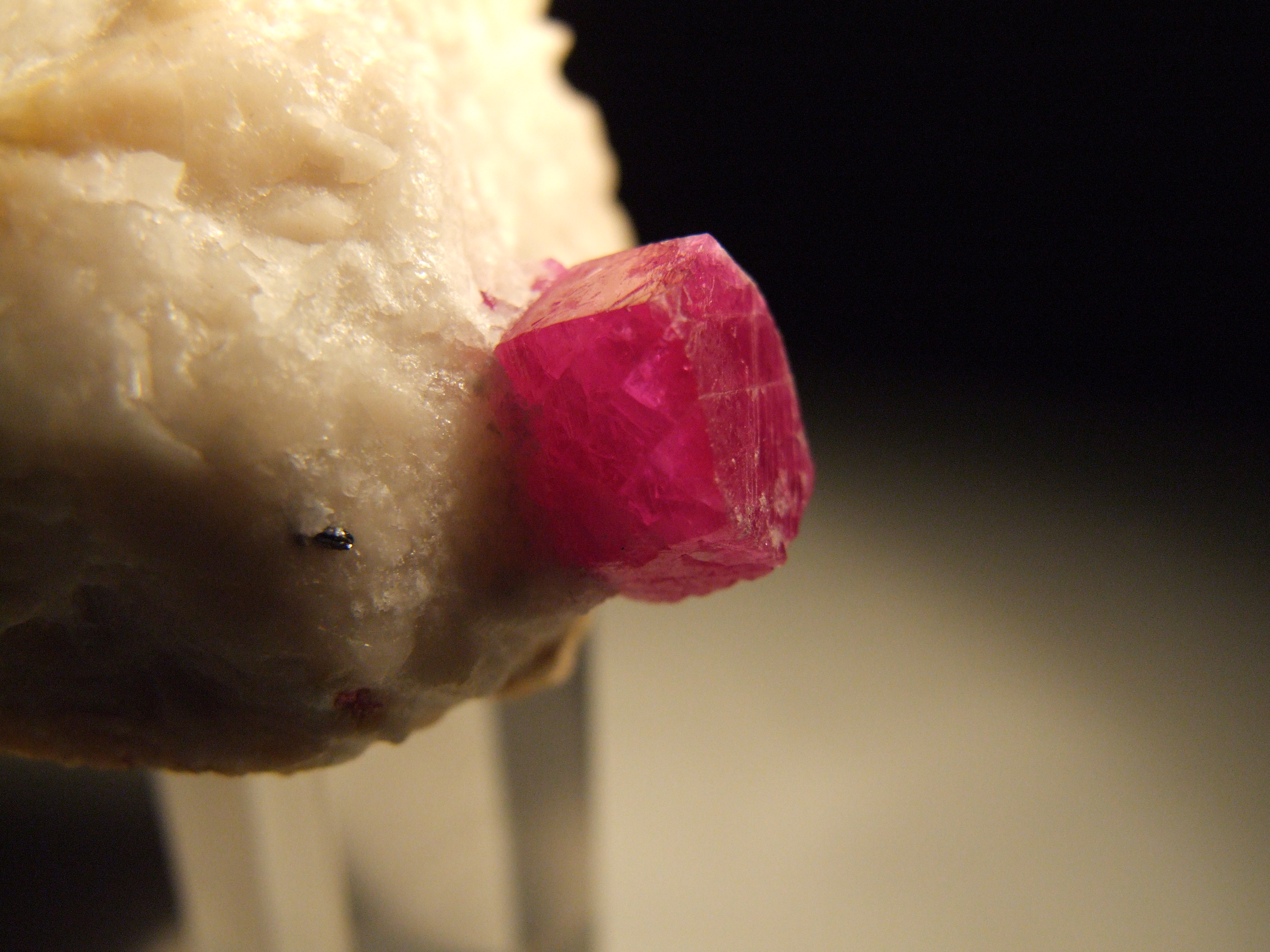
Photo: Wikimedia Commons
The deposit lies in the Surobi District of Kabul Province, east of Kabul, in the East Hindu Kush. Geologically, it is a marble-hosted corundum deposit developed in interstratified Proterozoic gneisses and marbles of the Nuristan series, later affected by granitic and pegmatitic intrusions. Ruby occurs in narrow lenses, veins, and pocket-like concentrations within the marble rather than in broad continuous ore bodies. This helps explain the collector’s paradox of Jegdalek: the field has produced large volumes of corundum, yet fine crystallized ruby specimens remain genuinely selective.
The visual personality of Jegdalek material is broad. Much of the mine output is pink sapphire or semitransparent cabochon-grade corundum, but the finest ruby crystals can show a pure red to purplish red body color, sharp dipyramidal or pseudo-hexagonal form, translucent edges, and a hot glow when backlit. Blue zoning is common enough to be part of the locality’s identity; in some crystals it appears as narrow lamellar bands or larger blue patches that cut through otherwise red material.

Photo: Wikimedia Commons
Historically, Jegdalek is one of Afghanistan’s great gem localities. The mines have been worked for more than 700 years, with medieval trade references linking Afghan rubies to wealthy Muslim merchants and Asian courts. Modern gemological literature brought the locality into sharper focus in the late twentieth century, especially through field and laboratory work by Gary Bowersox, Eugene Foord, Brendan Laurs, James Shigley, and Christopher Smith. For collectors today, Jegdalek stands at the intersection of gem history, difficult field access, and a highly recognizable specimen style: red corundum, pale marble, strong fluorescence, and often a rugged but elegant crystal form.
Search for specimens: View all ruby specimens from Jegdalek Ruby Deposit, Afghanistan
The Jegdalek Ruby Deposit is in Surobi District, Kabul Province, Afghanistan, roughly east to east-southeast of Kabul in the southern part of the broader Nuristan crystalline terrain. The locality is also encountered under the spellings Jagdalek, Jagdalak, and Jagdalik. Mindat records the deposit near 34°25'59" N, 69°49'00" E and classifies it as an active deposit.
The deposit is a marble-hosted corundum occurrence. The ruby-bearing rocks are interlayered gneiss and marble, with the marbles dominantly calcitic and locally dolomitic. Published descriptions place the main gneiss-marble strata over a strike length of about 1.5 km, while the larger marble horizons in the area can be hundreds of meters thick and several kilometers long. The corundum mineralization occurs in two principal zones of mineralized marble, north and south, separated by several hundred meters and joined toward the west. The vertical extent of mineralization has been reported at more than 400 m.
Ruby and sapphire are not evenly distributed through this marble. They occur in thin, irregular lenses and veins, commonly only a few centimeters wide, oriented within the marble beds. The host marble is notably coarse-grained where corundum is present. The ruby-bearing assemblage reflects a marble-hosted, metamorphic to metasomatic environment: regional metamorphism of marble and gneiss provided the broad setting, and later granitic or pegmatitic intrusions of the Laghman complex likely contributed local contact-metasomatic effects. The aluminum, chromium, and magnesium needed for ruby and its associated minerals are interpreted as having been present as impurities in the original carbonate sequence before metamorphism.
Mining has been small-scale for as long as the deposit has been described by Western geologists. In the late nineteenth century, C. L. Griesbach recorded about 300 men extracting rubies with hammers and chisels. More than a century later, field descriptions from the 1990s still showed essentially similar hand-mining: hammers, picks, prybars, simple pulley systems, and only limited use of pneumatic drills or dynamite. Broken marble was lifted from pits, stacked nearby, and even used to build rudimentary shelters where corundum was sorted from the marble.
About 20 named mines are recorded within the Jegdalek area, along with many smaller unnamed pits and trenches. Mindat notes more than 2,000 open pits and trenches across the deposit area. Named sublocalities include Lal-Poor, Warmankai, Mirkalwat, Chak, Chongay, Karoon-Sapara, Loy-Khan, Njoni-Ghala-Spai, Pahra-Dar-Khana, and Taghar. These names matter to advanced collectors only when attached to reliable old labels or field documentation; most specimen trade labels simply read “Jegdalek” or “Jagdalak.”
The mines have had several production phases. They have been worked for more than 700 years, were owned and operated sporadically by the Afghan government during much of the twentieth century, and were reportedly run by Soviet interests for only five or six months after the 1979 invasion. By the 1990s, local tribal miners were exploiting the deposit year-round. The altitude is lower than many Afghan gem mines, making access and winter work more practical than at high Himalayan or Hindu Kush pegmatite localities, but security, political instability, and the rugged road network have repeatedly limited systematic mining and geological work.
Published production estimates show why specimen-grade pieces are only a small subset of the material. One detailed study reported about 75% pink sapphire, 15% ruby, 5% mixed blue and red-to-pink corundum, and 5% blue sapphire. Most production is semitransparent and suitable for cabochons, carving, or bead material rather than faceted stones. Only a small percentage is clean enough to facet, though excellent stones have been cut. Notable reported material includes a 174 ct crystal observed by Gary Bowersox, faceted rubies up to about 32 ct, and a 32.22 ct Jegdalek ruby illustrated in a carved 18K gold pendant in Gems & Gemology.
Collecting access should be understood realistically. Jegdalek is not a casual field-collecting destination. It is an active mining district in a region with a long history of conflict, difficult roads, and local control of workings. Serious collectors generally encounter specimens through Afghan, Pakistani, European, and North American gem and mineral dealers, often with the material having passed through Peshawar before entering the wider market.
Jegdalek ruby is corundum, Al2O3, colored by chromium. In specimen form it is most prized when the ruby crystal is exposed on pale marble matrix and shows enough translucency to glow at the edges. The most attractive pieces combine three features: a well-defined red to purplish red crystal, visible natural attachment to marble, and fluorescence strong enough to give the stone a second life under long-wave UV.
Crystal morphology is one of the locality’s strengths. Jegdalek corundum is typically subhedral, but attractive euhedral crystals occur. Smaller crystals are often better formed, with sharper edges and clearer crystal faces, while larger crystals tend to be more modified and irregular. The classic forms are dipyramidal habits dominated by hexagonal dipyramidal faces, with subordinate basal pinacoid and rhombohedral faces. Some specimens appear pseudo-octahedral to the eye, a form that can confuse less experienced buyers because spinel also occurs in Afghan marble environments. On close inspection, corundum parting, growth features, and twin lamellae usually tell the story.
Typical specimen crystals range from a few millimeters to around 1–2 cm, with crystals in the 2–3 cm range already important when well exposed, richly colored, and unrepaired. Published gemological work describes semitransparent rough commonly up to 1.5–3.0 cm. Gemdat records ruby crystals in pocket-like accumulations up to about 2 cm long, with small crystals and portions of larger crystals sometimes transparent and less fractured. Dealer and museum-quality examples occasionally exceed these sizes, but such pieces are exceptional and require close scrutiny for repair or artificial assembly.
Color spans pink, red, deep red, cherry red, and purplish red, sometimes with violet influence. Much material from the deposit falls on the pink sapphire side of the ruby/sapphire boundary, which is why labels that simply say “ruby” should be judged by the actual color and by the standard being used. Fine red crystals exist, but the deposit produces far more pink, violet, and mixed-color corundum than top ruby.
Blue color zoning is a diagnostic-looking feature in many stones. In faceted or cabochon material, the blue zones can appear as sharply defined lamellar bands, geometric patches, or growth-related zones following rhombohedral and dipyramidal planes. In specimens, blue zoning may be less obvious until the crystal is backlit. Collectors should not automatically penalize blue zoning; in a matrix specimen it can be part of the locality character, though in a gem ruby it may reduce face-up red saturation if poorly oriented.
The common matrix is white to gray calcite-dolomite marble. Associated minerals reported from the deposit and from specimen photo data include calcite, dolomite, phlogopite, muscovite, margarite, chlorite, graphite, pyrite, albite, diaspore, amphibole-group minerals, garnet-group minerals, spinel, titanite, and tourmaline. Literature on the occurrence also records pink spinel, fuchsite, clinohumite, pargasite, diopside, chlorite, and white clay in the ruby-bearing marble environment. Inclusions identified in polished Jegdalek ruby and sapphire include calcite, apatite, zircon, mica, rutile, graphite, boehmite, pyrite, marcasite, and pyrrhotite, along with healed and unhealed fractures, lamellar twin planes, negative crystals, bluish white clouds, and flake-like or brush-stroke inclusion patterns.
Fluorescence is a major appeal. Jegdalek rubies typically show medium to strong red fluorescence under long-wave UV and weaker red fluorescence under short-wave UV. Blue zones may be inert, while bits of remaining marble matrix can produce a chalky blue response. In a display cabinet, this makes a good Jegdalek specimen unusually rewarding: by daylight it is a red crystal on marble; by UV it can become a glowing red ember against a pale host.
Quality is judged differently for specimens and cut gems. For a specimen, the hierarchy is natural attachment, crystal form, color, translucency, aesthetics on matrix, and condition. For a gem, clarity and cutting orientation matter more, because fractures, twin planes, and color zoning reduce transparency and yield. The very features that make many Jegdalek stones poor faceting candidates—fractures, zoning, marble remnants, and inclusions—can make matrix specimens more interesting when the crystal remains sharp and visibly natural.
Jegdalek ruby sits in a market where beauty, geography, and risk all overlap. The locality is famous enough that the name adds value, but its supply chain has historically run through informal mining and trade networks, especially via Peshawar. That makes provenance and physical examination important.
The most serious specimen concern is artificial assembly. Recent gemological reporting from Pakistan documented reconstructed mineral specimens in which natural crystals were glued onto host rock, and specifically noted a “Jegdalek” ruby in the Peshawar Namak Mandi market that proved to be a synthetic crystal mounted on natural host rock. The same reporting described a 77 ct parcel of melee-size red stones labeled as natural Jegdalek ruby that contained a mixture of natural unheated, heated, glass-filled, and synthetic ruby. This is directly relevant to collectors: a ruby crystal on white marble is an easy object to fake if the buyer does not inspect the contact.
For matrix specimens, study the junction between ruby and marble under magnification. Look for resin sheen, bubbles, suspiciously smooth adhesive menisci, ground or powdered marble packed around the base, mismatched dirt, or a contact that does not follow natural intergrowth. Repairs are also common in mineral specimens generally, and Jegdalek is no exception. A repaired but otherwise fine specimen can still be collectible if disclosed and priced accordingly; an undisclosed glued-on crystal is a different matter.
Spinel confusion is another locality-specific issue. Spinel and ruby can both occur in Afghan marble settings, and both can be red to pink. Ruby is much harder, has different crystallography, and may show corundum parting, growth, and twin features, but a pseudo-octahedral ruby can fool the eye at first glance. Conversely, a red spinel sold as ruby is not merely a naming nuance; it is a different mineral species. For valuable pieces, a lab report, Raman confirmation, or at least knowledgeable dealer documentation is appropriate.
Treatment concerns are greatest for cut stones and parcels, not intact cabinet specimens. Heat treatment of ruby is widespread in the gem trade, and lower-grade ruby from many sources may be glass-filled. Jegdalek material has been sold both untreated and treated. Because the deposit naturally produces fractured, semitransparent material, clarity enhancement is a real concern in gems. Buyers of faceted Jegdalek ruby should request laboratory reports that address treatment and, where value depends on it, geographic origin. Buyers of specimens should be alert for surface oils, dyes, resin repairs, and artificial brightening around fractures or matrix contacts.
Condition issues are predictable for corundum in marble. Ruby itself is hard, but crystals can be fractured, cleaved or parted, bruised at terminations, or broken and reattached. Marble matrix is softer and can be scratched, etched, or acid-cleaned. Many Jegdalek crystals are naturally rough or modified, so “not perfectly sharp” is not automatically damage. The key is whether the principal faces, termination, and matrix attachment are intact and whether any repair is disclosed.
Market availability is intermittent. Small thumbnails and miniatures appear regularly enough that the locality is attainable, but genuinely fine matrix specimens with sharp, translucent, richly red crystals are scarce and bring strong competition. Recent auction and dealer records show a wide range: modest thumbnails can trade in the low hundreds of dollars, while especially sharp, gemmy, well-perched examples or larger matrix pieces can run into the thousands. The best examples are often old-stock or ex-collection pieces, and fine unrepaired crystals on marble are notably harder to replace than loose, massive, or cabochon-grade material.
In the old accounts, Jegdalek reads less like a tidy mine name than a place repeatedly rediscovered through war, trade, and difficult travel. The mines were already ancient by the time modern gemology began to describe them. Gems & Gemology recorded that wealthy Muhammadan merchants were selling rubies to Kublai Khan and other historical figures in the 1200s, and that these merchants reportedly knew ruby from spinel—a distinction that would not become routine in European gem science until much later. For a collector, that is one of Jegdalek’s quiet fascinations: it belongs to the long Asian history of “red stones,” but it is not merely legendary. It is a real marble-hosted corundum deposit with mappable workings, mineral assemblages, and identifiable inclusions.
The nineteenth-century picture is wonderfully direct. In 1886, Griesbach described about 300 men extracting rubies in the Jegdalek region with hammer and chisel. More than a century later, Gary Bowersox saw much the same kind of work in 1992, 1996, and 1998. The tools had changed only slightly: hammers, picks, prybars, a few pneumatic hand drills, occasional dynamite. Broken marble came up from the pits by a simple pulley system, and some of the waste rock was stacked into rough shelters. Inside those shelters, miners sorted ruby and sapphire from the marble. In a gem world that often turns deposits into brand names, Jegdalek remains stubbornly physical: marble blocks, hand tools, dust, pulleys, and red crystals picked from pale carbonate.
Access to the mines has its own lore. From Kabul, the route could take four to six hours by four-wheel-drive vehicle; from Jalalabad, about eight hours by either of two routes. One southern route was reported unused for years because of land mines. The route via Sorobi followed the war-torn Kabul-Jalalabad road before turning south onto a Jeep trail. Near the mining area the track alternated between dirt road and streambed, slowing travel to a crawl. These details matter because they explain why a deposit so close to Kabul in map distance could remain so irregularly studied and so dependent on local miners.
Bowersox’s 1992 visit came under nightly rocket attacks. The line appears almost abruptly in the scientific article, but it says much about Afghan gem work in that era. Many Ministry of Mines and Industry records had already been destroyed by rocket attacks and bombs after 1979. Field geology, specimen collecting, trade, and security were braided together. The acknowledgments of the 2000 study read like a field expedition through a fractured country: commanders, ministers, local field workers, tribal contacts, and gemologists all appear in the chain that allowed a scientific team to reach the deposit and bring back documented samples.
The mining economy was just as improvised as the workings. Around the late 1990s, approximately 400 miners were active. Smaller groups of five or six worked many diggings; larger mines might have 15 to 20 miners. Profits were shared among the members of a group after a commission of about 5% went to local military commanders. The deposit was not a mechanized industrial mine but a social landscape of small teams, local power, and hand labor. When Bowersox estimated annual production, he placed it around US$500,000 in gem corundum. In Peshawar in 1999, he saw more than 100,000 carats of rough ruby and sapphire reportedly from Jegdalek, valued wholesale at nearly US$1 million, though no one knew exactly how long that parcel had taken to mine.
The stones themselves supplied their own field drama. The largest crystal Bowersox reported seeing weighed 174 ct. Good-quality rubies had been faceted up to about 32 ct, but top-quality material rarely exceeded 5 ct. This is the truth behind most classic ruby deposits: legends are built on large stones, while the market is mostly fragments, cabochons, small gems, and matrix pieces. A fine Jegdalek specimen with a 1–2 cm crystal may not sound large to a quartz or fluorite collector, but in ruby it can be a serious object.
A later documentary lens caught the social stakes of the mines in a different way. Al Jazeera’s Crystal Dreams followed ruby miners in the Jegdalek region as foreign troops were withdrawing and Taliban influence was again spreading. The film framed the mines as both local livelihood and contested wealth: villagers chasing red crystals with dynamite and pickaxes, gems moving illicitly toward Peshawar for cutting and sale, and competing forces looking toward the mines as a source of revenue. That is the modern Jegdalek story in miniature: ancient stones, handmade mining, a difficult road to market, and a deposit whose best specimens glow far beyond the circumstances that produced them.
 Amethyst
 Quartz
 Fluorite
 Tourmaline
 Malachite
 Azurite
 Rhodochrosite
