Rosasite from Tsumeb is a connoisseur’s mineral: rarely the loudest species on the specimen, but often the one that makes a Tsumeb piece intellectually irresistible. In the hand it appears as silky blue-green to turquoise mammillary coatings, fine fibrous lawns, sheaflike aggregates, and — most coveted of all — pseudomorphs after earlier copper carbonates. The best examples have the unmistakable Tsumeb look: a tight paragenetic story preserved in color and texture, with rosasite woven among azurite, malachite, cerussite, willemite, smithsonite, duftite, mimetite, calcite, dolomite, and quartz.
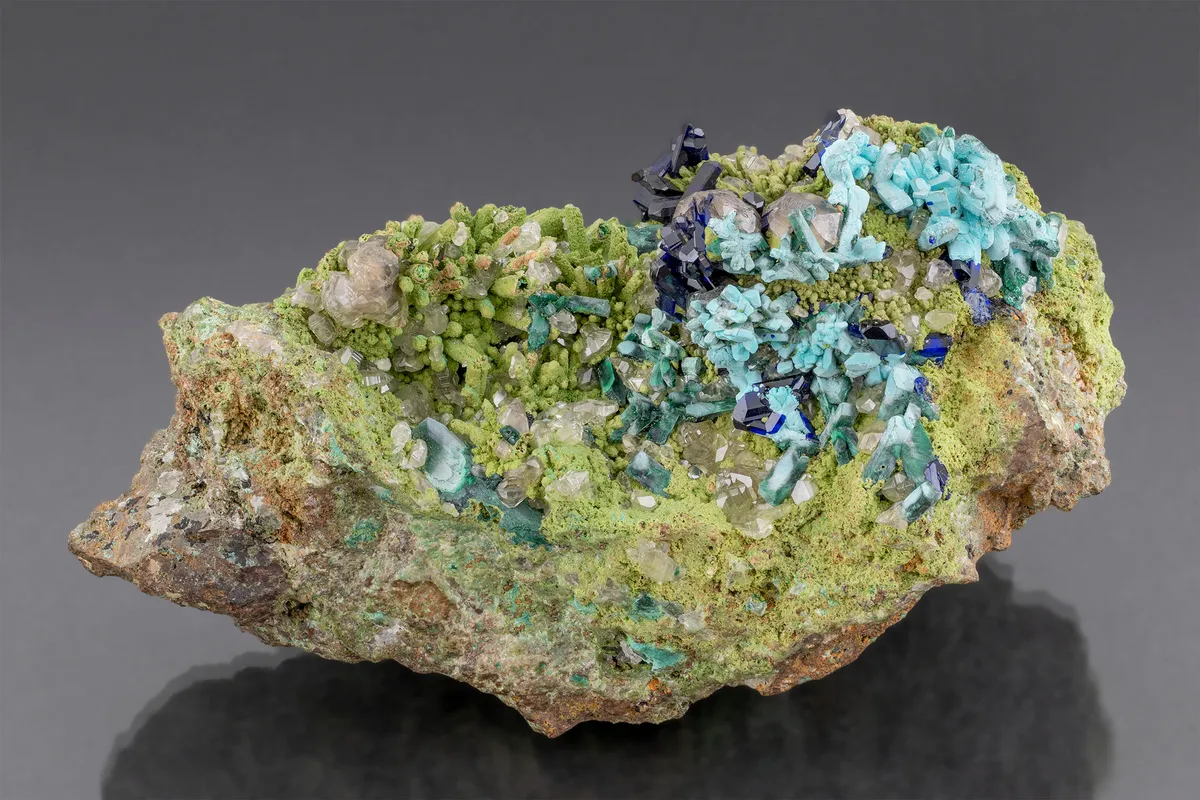
Photo: Tsumeb Mine Notebook
What distinguishes the locality is not rosasite alone, but the depth and precision of its geological context. Tsumeb was a steep, pipe-like, polymetallic Cu-Pb-Zn-Ag-Ge-As deposit hosted in dolomitized carbonate rocks of the Otavi Mountainland. Oxidizing waters moved through a karstic and fractured pipe to remarkable depths, creating multiple oxidation zones and an exceptionally complex secondary mineral suite. Rosasite, a secondary copper-zinc carbonate hydroxide with the formula (Cu,Zn)2(CO3)(OH)2, belongs naturally in that world: it forms where copper and zinc chemistry overlap in carbonate-rich, oxidized environments.
The Tsumeb rosasite collector is usually looking for one of three things. The first is color: the lighter blue-green, teal, or turquoise tone that separates rosasite visually from darker malachite. The second is texture: velvety or silky acicular microcrystals, mammillary crusts, and fine radiating aggregates that catch light differently from the satiny or fibrous surfaces of malachite. The third is paragenesis: specimens that show rosasite replacing malachite that had already replaced azurite, creating the famous Tsumeb “double pseudomorphs” in which the ghost of an azurite crystal survives through two generations of chemical change.
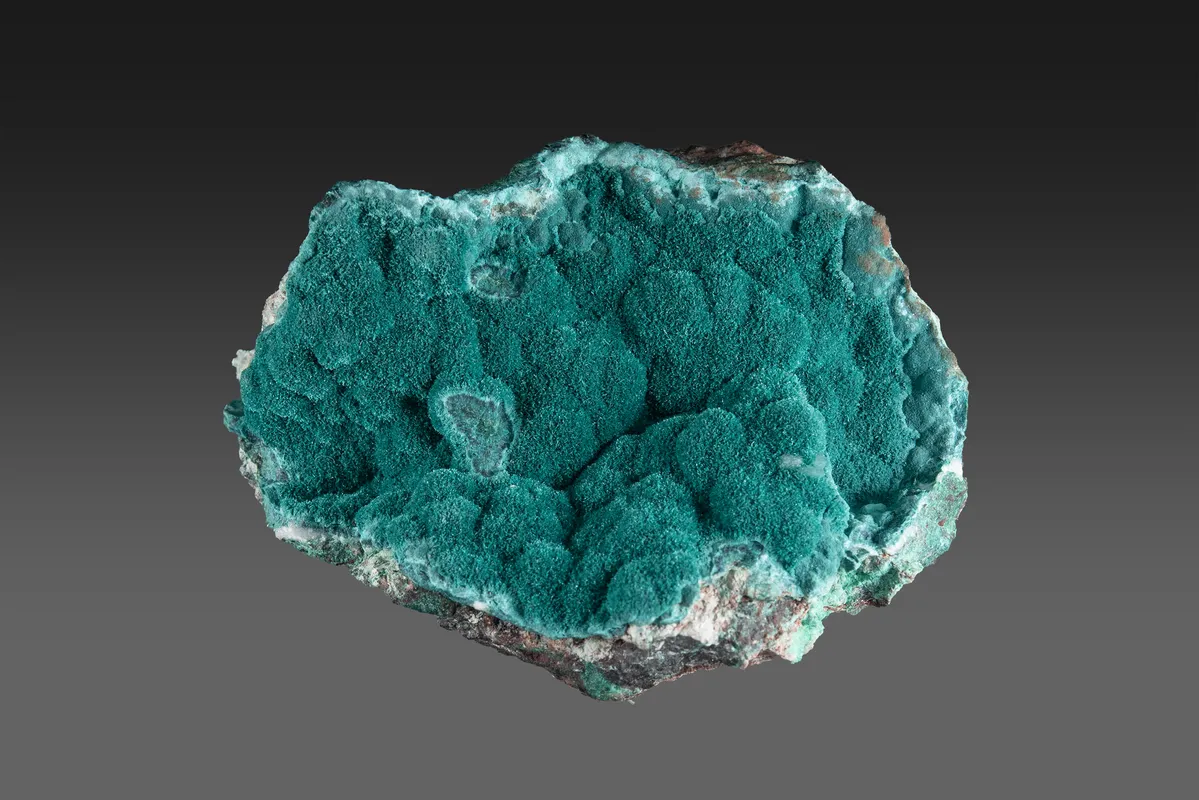
Photo: Tsumeb Mine Notebook
Historically, rosasite at Tsumeb was easy to overlook. Early material was confused with malachite or with names then used for copper-zinc carbonate varieties such as paraurichalcite. That history is part of the charm: a good rosasite from Tsumeb rewards close examination, older labels, and modern confirmation. The finest pieces are not merely attractive blue-green coatings; they are miniature records of the mine’s oxidizing solutions, changing copper-zinc ratios, and repeated replacement events.
Search for specimens: View all rosasite specimens from Tsumeb, Namibia
The Tsumeb Mine, also known historically as the Ongopolo Mine or Tsumcorp Mine, lies at the town of Tsumeb in the Oshikoto Region of northern Namibia. Its fame rests on a compact but extraordinarily rich ore pipe carrying copper, lead, zinc, silver, arsenic, germanium, cadmium, gallium, and other elements through a carbonate host. In mineralogical terms it is one of the world’s great oxidation-zone laboratories: a single deposit where ore, dolomite, karst permeability, groundwater, and time produced hundreds of minerals and a large number of type-locality species.
The deposit is hosted in Neoproterozoic carbonate rocks of the Otavi Group, in the upper part of the Tsumeb Subgroup. The ore body was an irregular, steeply dipping pipe filled with feldspathic sandstone, sandstone breccia, dolomite breccia, massive sulfides, and carbonate-silica alteration. Its shape changed dramatically with depth: narrow and attenuated in some levels, broad and elliptical in others, with important North and South vein structures, manto bodies, breccia plugs, calcite-rich zones, and permeable horizons such as the North Break Zone. Those permeable pathways helped oxidizing waters reach levels far below the usual shallow weathering zone, giving Tsumeb its famous first, second, and third oxidation zones.
For rosasite, that setting matters. It is not just “from Tsumeb”; it is a copper-zinc carbonate hydroxide born where oxidized copper minerals, zinc-bearing solutions, carbonate host rocks, and changing pH conditions interacted. Rosasite is recorded from the first, second, and third oxidation zones. It is considered somewhat rare at the mine, especially compared with the more abundant malachite, cerussite, smithsonite, or willemite. In the second oxidation zone it was noted as uncommon, appearing either as an individual mineral or more often in zoned intergrowths with malachite.
Tsumeb’s mining history begins before European industrial mining. The copper-bearing outcrop — the “green hill” — was known and worked locally before the modern mine. Nineteenth-century European reports described high-grade copper material from the area, and commercial attention followed in the 1890s. Organized mining activity developed around the turn of the twentieth century under German colonial control and the Otavi Minen- und Eisenbahn Gesellschaft. Trial shafts were begun in 1900, and full-scale commercial production followed after railway access was established in 1906.
The mine’s operating life was long and interrupted: early open-pit work and shallow shafts gave way to extensive underground mining; World War I, the Great Depression, changes of ownership, and later labor and economic pressures all shaped production. Tsumeb Corporation Ltd. and its successors developed the mine through much of the twentieth century. Commercial mining effectively ended in 1996 after flooding of the workings, and the main underground mine has been closed to practical collecting ever since. Modern specimens are therefore overwhelmingly from old mine production, old dealer stock, historic collections, or re-examined material from institutional and private holdings.
Notable rosasite finds span the mine vertically. Early upper-zone material produced the classic pseudomorphs after azurite, including double pseudomorphs in which malachite after azurite was later replaced partly or completely by rosasite. These are especially associated with the shallow part of the mine, from the surface down to about 100 meters, roughly the 4 Level. Third oxidation-zone material includes blue-green microcrystals from 44 Level, with sprays to about 2 mm and individual crystals around tenths of a millimeter on dolomite, calcite, goethite, and related assemblages. Other recorded occurrences include blue rosasite on lemon-yellow willemite, rosasite with chudobaite, and blue-green rosasite crusts with blood-red cuprite.
Collecting access today should be treated as closed and controlled. Tsumeb is not a casual field-collecting locality, and the underground mine is not a safe or open collecting site. Serious collectors acquire Tsumeb rosasite through established mineral dealers, old collections, museum deaccessions where applicable, and carefully documented estate material. Provenance is unusually important here, because a small blue-green crust from Tsumeb may be mineralogically far more significant than its size first suggests.
Tsumeb rosasite is typically blue-green, turquoise, bluish green, or pale greenish blue, with color helping separate it from the darker greens of malachite and the clearer blues of azurite. Its luster is commonly silky, velvety, or subtly vitreous on individual microcrystals. Most display specimens show the mineral as coatings, crusts, mammillary surfaces, or fine radiating aggregates rather than as large free-standing crystals.
The classic habit is a fine-grained “crystal lawn” of acicular microcrystals. On some specimens these microcrystals merge into mammillary or botryoidal crusts, producing a soft, plush surface that reads as blue-green from arm’s length and resolves under magnification into countless fine needles or fibers. Other pieces show radiating masses or sheaf-shaped aggregates. On 44 Level material, small sprays may reach about 2 mm, with individual crystals around 0.2 mm; cabinet-size specimens can carry much larger areas of rosasite crust even though the individual crystals remain microscopic to sub-millimetric.
The most prized Tsumeb form is the pseudomorph. Rosasite is recorded as replacing azurite, cerussite, galena, and malachite, but the collector’s classic is rosasite after malachite after azurite. These pieces preserve the blade, prism, or group habit of azurite even after the chemistry has changed. In the best examples, striations, sharp terminations, and crystal outlines still tell the azurite story, while the surface color and texture announce a later rosasite replacement. Partial replacements are especially desirable when they preserve contrasting zones of azurite, malachite, and rosasite in one specimen.
Associated minerals are one of the major quality factors. Rosasite with cerussite is a classic Tsumeb pairing: colorless to white cerussite crystals bring sparkle against blue-green crusts. Rosasite with willemite is especially attractive when the willemite is yellow, blue, or lustrous and when the paragenetic relationship is clear. Rosasite with duftite, mimetite, and calcite can be highly collectible, particularly when the specimen shows multiple replacement events rather than a simple coating. Other documented associates include malachite, azurite, smithsonite, dolomite, quartz, chudobaite, cuprite, otavite, linarite, mottramite, olivenite, wulfenite, zincolivenite, and tsumcorite.
A top Tsumeb rosasite specimen should have convincing color, visible texture, and a readable mineralogical setting. A thin blue-green dusting on massive matrix has limited appeal unless it is analytically significant. A much stronger specimen shows distinct mammillary form, fibrous sparkle under magnification, sharp pseudomorph outlines, or a clear association with named Tsumeb species. Old labels from recognized collections — especially if they preserve level information such as first oxidation zone, 44 Level, or a historic collection name — add real value.
Analytical confirmation can matter. Tsumeb rosasite sits in a visually treacherous zone between malachite, aurichalcite, chrysocolla, cuprian smithsonite, and other blue-green secondary minerals. Because historical labels may use older names or simply call the material malachite, the strongest modern identifications are supported by XRD, Raman, XRF, EDS, or microprobe work, especially for expensive pseudomorphs or unusual associations.
Rosasite from Tsumeb is not common, but it is available often enough that a patient collector can be selective. Most market examples are old pieces, thumbnails to cabinet specimens, or association specimens in which rosasite is one important component rather than the dominant species. Pure rosasite crusts are collectible; rosasite pseudomorphs after azurite are more sought-after; complex association pieces with cerussite, duftite, mimetite, willemite, malachite, and azurite are often the most rewarding.
The central authenticity issue is not usually fabrication, but identification and locality confidence. Tsumeb produced a bewildering suite of green and blue-green secondary minerals, and rosasite was historically confused with malachite or described under older copper-zinc carbonate names. A label saying “malachite” does not rule out rosasite; a label saying “rosasite” does not prove it. For significant purchases, look for a coherent Tsumeb assemblage, old collection history, and, when possible, analytical confirmation.
Be cautious with any specimen whose color looks too even, too bright, or unrelated to the mineral texture. Dyed or coated blue-green material is a general risk in the mineral market, though specific documented Tsumeb rosasite treatment scandals are not a defining feature of the species. The more realistic danger is a vague “Tsumeb” attribution added to a blue-green copper-zinc carbonate from another locality, or a malachite/aurichalcite/chrysocolla specimen upgraded casually to rosasite. Under magnification, real Tsumeb rosasite should show the fine fibrous, acicular, mammillary, or replacement textures expected for the mineral and should fit the matrix and associations of the locality.
Condition matters more than many buyers realize. Rosasite coatings can be delicate; fibrous crusts bruise, rub, and flatten. Pseudomorphs may have contacted areas where crystals were once attached to matrix or neighboring crystals. On partial replacements, the contrast between azurite, malachite, and rosasite may be the most important feature, so abrasion on the outer blue-green surface can reduce both beauty and scientific value. Avoid washing velvety pieces unless you are experienced with Tsumeb carbonates; dusty surfaces are often preferable to damaged fibers.
The best buying strategy is to decide what kind of Tsumeb rosasite you want. For a species collection, a verified blue-green crust with clear rosasite dominance may be ideal. For a Tsumeb suite, a multi-species pseudomorph or association specimen will tell a richer story. For a high-end cabinet, look for sculptural azurite-form pseudomorphs with sharp outlines, strong teal color, and documented provenance. For micromount and thumbnail collectors, 44 Level material with tiny sprays on dolomite or calcite can be superb under magnification and often carries more locality-specific interest than larger but less distinct coatings.
The story of Tsumeb begins with color before it begins with mining. The hill was known for copper long before industrial extraction, and later accounts preserve names that read like field notes from a place where geology had already shaped human memory. One explanation gives the Bushman name Tsomsoub as a reference to digging into loose ground that kept collapsing — an apt description in karstic dolomite. The Nama form Tsumeb has been interpreted as “place of the green rock or hill.” For a collector holding a rosasite pseudomorph after azurite, that phrase feels almost literal: green and blue-green minerals are not decoration here; they are the reason the locality entered history.
When Mathew Rogers reached the hill in the 1890s, he saw what every later mineral collector would understand at once. He wrote that he had “never seen such a sight” as the one before him at Soomep, and doubted he would ever see another like it. The remark has survived because it was not the exaggeration of a dealer describing a pocket. It was the reaction of a mining engineer looking at an exposed ore body so rich and strange that even its weathered surface announced itself as exceptional.
In 1900, a large sample of Tsumeb ore was sent to Germany for metallurgical testing. In many mining districts, such material would have been crushed, assayed, and forgotten. At Freiberg, Wilhelm Maucher recognized that the shipment contained well-crystallized secondary minerals worth preserving. From an ore test — essentially industrial material — came the first serious mineralogical attention to Tsumeb specimens. That detail is one of the great small turns in mineral history: Tsumeb’s specimen legacy did not wait for a collector’s pocket underground; it began in material shipped away to decide how the ore should be smelted.
Charles Palache’s December 1922 visit left a more intimate trace for rosasite collectors. A Harvard specimen from his collection records a first-generation azurite, then malachite, then partial replacement by blue-green rosasite, followed by later azurite and smoky to colorless cerussite. On the same specimen, mimetite crystals were replaced by duftite, in many cases leaving hollow epimorphs. The result is not a simple attractive cabinet specimen but a compact history of replacement: arsenate after arsenate, carbonate after carbonate, azurite surviving in form after its substance changed. Because Palache bought the specimen during that 1922 visit, it can be tied to the upper first oxidation zone, 8 Level or above — a rare case where an old Tsumeb piece still carries a geological address.
The closing chapter of the mine is abrupt. In August 1996, during a strike, essential services stopped and the famous De Wet Shaft flooded within days. Later accounts place the water level around 300 meters below surface, approximately level 5. For collectors, this matters because Tsumeb did not simply fade away as a specimen source; it was cut off. The rosasite now circulating is the residue of a century of mining, dealer handling, and collection building. Every old label, every level notation, and every analytical note on a blue-green crust has become more important because the mine that made it is no longer accessible in the way it once was.
The afterlife of Tsumeb is still active in museum drawers. In 1996, a major donation moved thousands of rocks, minerals, thin sections, polished sections, cores, reports, cabinets, thumbnail specimens, and mineral separates into the Geological Survey of Namibia’s National Earth Science Museum. Historic material collected or studied by Hans Schneiderhöhn and Gerhard Söhnge became part of that institutional record. That is why Tsumeb keeps producing discoveries even after mining: not from fresh blasting, but from the patient re-examination of old specimens with modern instruments.
Andrew C. Roberts, John L. Jambor, and Joel D. Grice, “The X-Ray Crystallography of Rosasite From Tsumeb, Namibia,” Powder Diffraction 1(1), 56–57, 1986 — The key crystallographic paper on Tsumeb rosasite, giving unit-cell data, optical data, microprobe results, and an analytical formula for studied material.
Tsumeb Mine Notebook: Rosasite species entry — The most useful modern collector-facing synthesis of rosasite at Tsumeb, including abundance, distribution, paragenesis, associations, pseudomorphs, and historical references.
Tsumeb Mine Notebook: Rosasite after azurite with duftite after mimetite and cerussite, MGMH 87530 — A documented Harvard specimen from the Charles Palache collection, purchased during his December 1922 visit to Tsumeb and tied to the upper first oxidation zone.
Tsumeb Mine Notebook: Rosasite, MGMH 2020.7.2039 — A cabinet specimen from the Pinch Collection showing mammillary acicular blue-green rosasite on altered dolostone, with X-ray analysis noted on the old Pinch label.
Tsumeb Mine Notebook: Rosasite on dolomite with goethite, MGMH 2022.4.4407L — A 44 Level third oxidation-zone specimen with blue-green rosasite sprays to 2 mm on dolomite, purchased by Mark Feinglos from Julius Zweibel in February 1990.
Wendell E. Wilson and William W. Pinch, “[Tsumeb, Namibia] Minerals: a Descriptive List,” The Mineralogical Record 8(3), 17–37, 1977 — The classic descriptive list in the 1977 Tsumeb issue of The Mineralogical Record, foundational for collector mineralogy at the locality.
The Mineralogical Record, “Tsumeb [Namibia]!”, Vol. 8, No. 3, May–June 1977 — The landmark Tsumeb special issue, including history, geology, descriptive mineralogy, paragenesis, classic specimens, and research papers.
Paul Keller, “Paragenesis: Assemblages, Sequences, Associations,” The Mineralogical Record 8(3), 38–47, 1977 — The paragenetic framework that places rosasite among Tsumeb’s secondary mineral sequences.
A. F. Lombaard, A. Günzel, J. Innes, and T. L. Krüger, “The Tsumeb lead-copper-zinc-silver deposit, South West Africa/Namibia,” in Mineral Deposits of Southern Africa, Vol. 2, 1761–1787, 1986 — A major geological account of the deposit, frequently cited for the structure, ore zones, and genesis of the Tsumeb pipe.
Rob Bowell and Helke Mocke, “Minerals New to Tsumeb,” Communications of the Geological Survey of Namibia 19, 20–46, 2018 — A modern review of newly recognized Tsumeb minerals and the continuing scientific value of historical collections.
IUGS Geoheritage: Tsumeb Ore Deposit — A concise geoheritage summary of Tsumeb’s geological importance, mineral diversity, oxidation zones, and scientific tradition.
Tsumeb Mine Notebook: About — A concise introduction to the mine’s importance, closure, byproduct metals, and specimen legacy.
Tsumeb Mine Notebook: History — The best online narrative of the mine’s historical development, early specimen recognition, and mineralogical significance.
Tsumeb Mine Notebook: Geology — A detailed but accessible geological overview of the Tsumeb pipe, levels, breccias, veins, alteration, and structural setting.
Mindat: Rosasite from Tsumeb Mine — Useful for locality confirmation, associated-mineral photo data, and the Mindat occurrence record.
Mindat: Rosasite mineral data — General mineral data for rosasite, including formula, crystal system, properties, type locality, and classification.
Cambridge Core: Roberts, Jambor, and Grice, “The X-Ray Crystallography of Rosasite From Tsumeb, Namibia” — The primary crystallographic reference for Tsumeb rosasite.
Mineralogical Record: Tsumeb special issue, 1977 — Essential background for the broader Tsumeb collector, including the classic descriptive list and paragenesis article.
Geological Survey of Namibia PDF: “Minerals New to Tsumeb” — Valuable for the post-mining scientific story, institutional collections, and continuing discoveries in old material.
IUGS Geoheritage: Tsumeb Ore Deposit — A high-level geological and heritage summary of why Tsumeb is internationally significant.
 Amethyst
 Quartz
 Fluorite
 Tourmaline
 Malachite
 Azurite
 Rhodochrosite