Neptunite from the California State Gem Mine is one of the great black-crystal classics of American mineral collecting: sharp, monoclinic prisms with a lacquered, almost metallic-looking luster, rising from white natrolite and, on the most coveted pieces, accompanied by blue benitoite and tiny honey- to orange-brown joaquinite-(Ce). Thick crystals read as jet-black across the room, but fine edges and broken splinters can flash deep reddish brown to maroon, a color clue that separates neptunite from the tourmaline-like impression it can give at first glance.

Photo: Wikimedia Commons
The locality’s fame is inseparable from benitoite. The mine, historically known as the Dallas Gem Mine, Benitoite Gem Mine, Gem Mine, and later California State Gem Mine, lies near Santa Rita Peak in San Benito County, in the New Idria district of the Diablo Range. Benitoite was recognized as a new mineral species from this district in the first years of the twentieth century, and neptunite quickly became part of the scientific story: the San Benito neptunites were described and analyzed in 1909, placing the mine’s black prisms into the mineralogical literature almost as soon as the blue gem had astonished collectors and academics.
The geological setting is compact but unusually rich. The collectible minerals occur in veins and cavity fillings in altered blue amphibole-rich schist within serpentinite of the Franciscan Complex. White natrolite is the essential stage on which the show takes place. Benitoite and neptunite grew with the natrolite in fissures, openings, and geode-like cavities rather than as isolated crystals in unaltered wall rock. That is why the best specimens so often look like carefully composed mineral sculpture: black neptunite blades and prisms standing against snow-white natrolite, with blue benitoite adding a vivid complementary color when present.
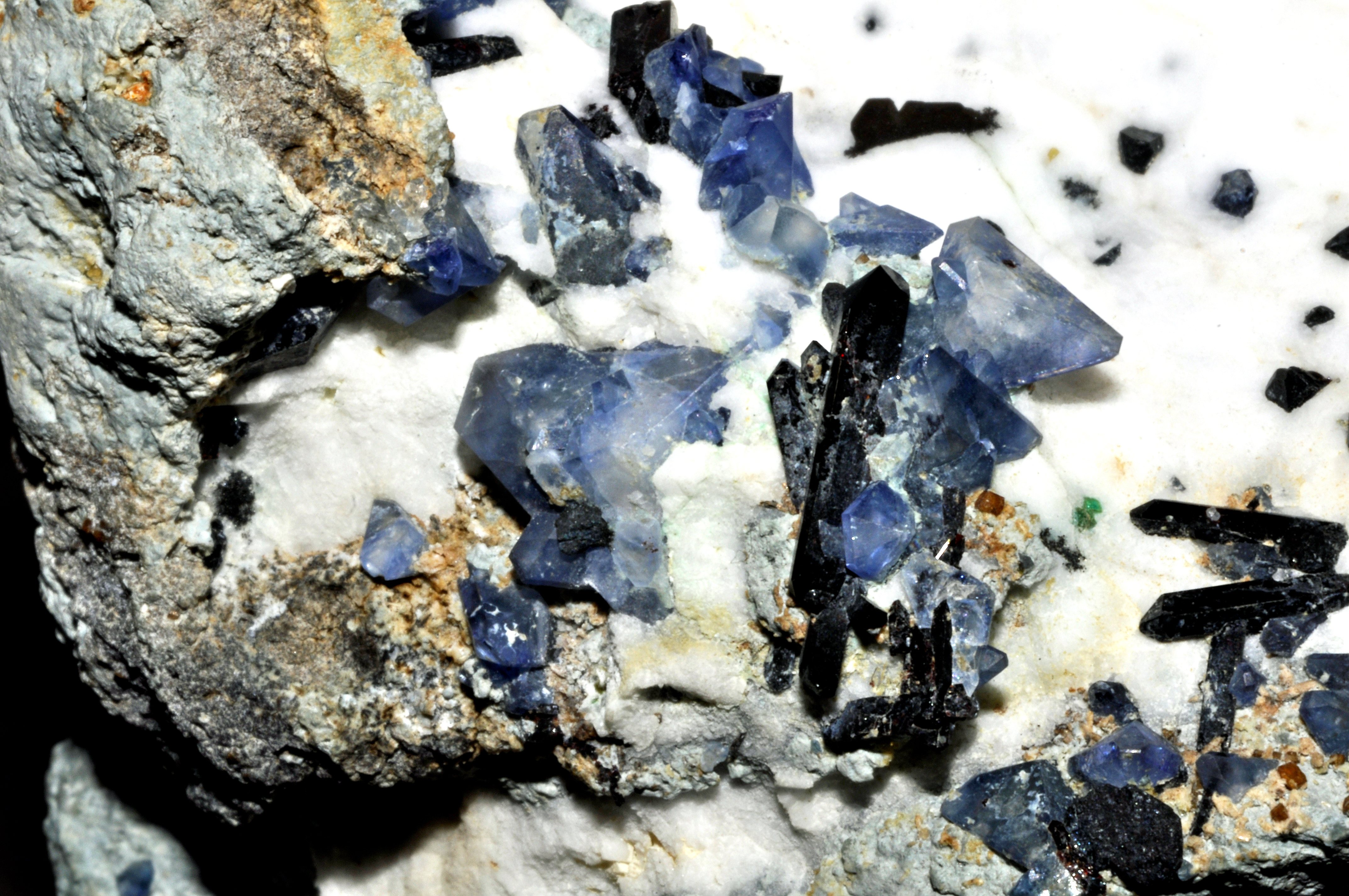
Photo: Wikimedia Commons
For collectors, the locality’s neptunite appeal rests on three things. First is form: well-terminated prisms, often several times longer than thick, with crisp faces and chisel-like or wedge-like terminations. Second is contrast: the finest examples are displayed on clean natrolite rather than lost in dark schist. Third is association: a specimen with sharp neptunite, a visible blue benitoite, and even a small joaquinite-(Ce) crystal carries the full identity of the deposit in one hand specimen. Large, undamaged, freestanding neptunite crystals from this mine are far scarcer than the number of old labels might suggest, because many crystals were partly enclosed in natrolite, damaged during extraction, or detached during preparation.
Search for specimens: View all neptunite specimens from California State Gem Mine, USA
The California State Gem Mine is located near Santa Rita Peak, in southeastern San Benito County near the Fresno County line. Historical descriptions place the deposit about 35 miles by road northwest of Coalinga, roughly three-fourths of a mile south of Santa Rita Peak, near the headwaters of the San Benito River. The workings sit high in the Diablo Range, around 4,800 feet elevation, in rugged serpentinite country long associated with the New Idria district.
The deposit is best understood as a narrow, irregular, hydrothermal-metamorphic vein and cavity system hosted by blue amphibole-rich schist enclosed in serpentinite. Early geological descriptions emphasized a schist body within Coast Range serpentinite, altered by mineral-bearing solutions. Albite was introduced first and penetrated the rock more broadly; natrolite followed as coatings, seams, and cavity fillings. Benitoite and neptunite formed with the natrolite in open spaces and fissures. Later weathering and circulating waters leached parts of the wall rock and stained some natrolite surfaces with iron and manganese oxides, which explains why some specimens show rusty or darkened matrix while the most carefully prepared examples display fresh white natrolite.
The discovery story began with J. M. Couch of Coalinga, grubstaked by R. W. Dallas, while prospecting in the district. Early material was mistaken for sapphire or considered valueless by some observers before George D. Louderback of the University of California recognized benitoite as a new species and named it after San Benito County and the San Benito River. Neptunite, already known as a mineral species from Greenland, became one of the hallmark associated minerals from the new California gem locality, and the San Benito crystals were important enough to receive crystallographic and chemical study in 1909.
Mining in the early years included open cuts, a tunnel, a crosscut, and an incline shaft. The famous “glory hole” was described as an open cut 85 feet long, 20 to 45 feet wide, and up to 35 feet deep, excavated into a large pocket or bulge in the mineralized vein. Early observers also recorded a 120-foot prospect tunnel, a 45-foot crosscut, and a 35-foot incline shaft. Mineralization was not a simple continuous vein; it pinched, bulged, changed dip, and occurred in seams, cavities, and lenticular shoots, which made mining unpredictable.
The mine’s names have shifted with ownership and use. “Dallas Gem Mine” and “Benitoite Gem Mine” are the classic label names. “California State Gem Mine” became widely used after benitoite’s designation as California’s official state gemstone in 1985. The present operating business is Benitoite Mining Company; the company states that current owners purchased the property in 2005, opened a mining camp for public collecting in 2015, and transitioned the business name from California State Gem Mine to Benitoite Mining Company in 2020.
Current collecting access is controlled and fee-based through the operating company, not open casual collecting at the mine workings. The company’s public digging program uses ore from the mine dumped into a screening field, with reservations normally offered on selected weekends and holidays. The actual mine itself is not open to the public for underground or workings access because of safety concerns. For collectors, that distinction matters: modern self-collected material may be real mine ore, but it generally comes from a managed screening operation rather than unrestricted collecting in the old cuts.
The production periods most meaningful to collectors fall into three broad categories. The first is the early discovery and mining period of the 1900s, when the locality entered the mineralogical literature and specimens began circulating under Dallas Gem Mine labels. The second is the long classic-specimen era, especially mid- to late-twentieth-century material, during which many of the best cabinet and miniature specimens entered private collections and dealer stocks. The third is the modern fee-dig era, which has kept small specimens, loose crystals, and occasional matrix pieces available to new collectors, even while truly fine undamaged neptunite-on-natrolite combinations remain scarce.
Notable finds range from small thumbnails with a single perfect black prism to large plates of natrolite dotted with upright neptunites and blue benitoites. Early descriptions mention slabs 2 to 3 feet or more across coated with natrolite and carrying both benitoite and neptunite. Modern collector and dealer records document neptunite crystals commonly around 1 to 3 cm on display specimens, with 3 to 4 cm crystals considered common enough at San Benito to be specifically noted in collector literature, but genuinely aesthetic, undamaged, well-positioned crystals of that size are still prized.
California State Gem Mine neptunite is monoclinic and typically prismatic, with crystals elongated several times their thickness. The classic habit is a sharply terminated black to reddish-black prism, commonly with a square-ish or rectangular cross-section to the eye, glassy to submetallic luster, and clean planar faces. The best crystals look almost enamel-coated: black in reflected light, but capable of showing red-brown internal flashes at thin edges, chips, or when strongly backlit.
On matrix, the crystals occur in several display styles. Some lie partly embedded in white natrolite, with only terminations and upper prism faces exposed. Others stand upright or diagonally across vugs, creating the most sculptural thumbnails and miniatures. Etched specimens may show neptunite protruding dramatically from a reduced natrolite groundmass. Less commonly, clusters of intergrown neptunite crystals survive as partial floaters or networks after host material has been removed.
The dominant color is black, but “black” undersells the material. Fine crystals may show dark maroon, brownish red, or reddish-black tones along edges. Thin splinters and powder reveal the underlying reddish-brown color more clearly. This behavior is tied to the mineral’s iron-titanium electronic structure: thick crystals absorb so efficiently that they appear black, while thin zones transmit warm reddish tones.
Typical visible crystal sizes on collectible specimens range from a few millimeters to 2 cm. Good miniatures may carry neptunites around 1 to 2.5 cm; larger crystals of roughly 3 to 4 cm are known and are a major quality point when sharp and undamaged. A single complete, lustrous, well-terminated 2 cm crystal positioned upright on natrolite can be a serious thumbnail. A plate with several lustrous crystals to 3 cm, especially with benitoite, is a classic cabinet-level locality specimen.
The associated minerals define the locality’s identity. Natrolite is the usual white matrix and the key contrast mineral. Benitoite, when present, appears as blue, often triangular to tabular crystals and may fluoresce blue under short-wave ultraviolet light. Joaquinite-(Ce) appears as tiny orange-brown to honey-brown crystals and is easy to miss without magnification. Other recorded associated minerals from the mine include albite, glaucophane or crossite-type amphiboles, actinolite, aegirine, djurleite, pyrite, and a suite of rarer barium-titanium silicates and related species such as jonesite and bario-orthojoaquinite.
Quality is judged differently for neptunite here than for many more abundant black minerals. Luster is paramount; top crystals should be bright, not dull, abraded, or satiny. Terminations should be complete, with the steep terminal faces intact. Position matters enormously: a sharp crystal lying flat and partly swallowed by matrix is less desirable than one isolated against white natrolite with open space around it. Association with benitoite increases locality appeal, but not every benitoite-bearing specimen is automatically better; a damaged or muddy combination can be less desirable than a pristine, elegant neptunite-only thumbnail.
Preparation is part of the locality’s look. Natrolite commonly encloses or partly encloses the crystals, so acid etching and careful mechanical work have long been used to reveal benitoite and neptunite. Well-prepared pieces retain enough natrolite to provide contrast and structural support. Over-etched pieces may look skeletal, with detached or unsupported crystals, while under-prepared pieces may hide much of the neptunite in lumpy white matrix.
Authenticity for this locality usually depends on the full visual and contextual package: black to reddish-black neptunite, white natrolite, blue benitoite when present, and San Benito-style amphibole or serpentinite matrix. The association is so distinctive that well-labeled old specimens are generally recognizable, but labels still deserve scrutiny because “San Benito” has been used loosely for several nearby localities. The California State Gem Mine, Dallas Gem Mine, Benitoite Gem Mine, and Gem Mine names can all refer to the same classic source; “Mina Numero Uno” and other San Benito County occurrences are separate localities and should not be casually folded into the State Gem Mine label.
Documented locality-specific fakery is not a major theme in the published record for neptunite from this mine in the way it is for some gem crystals or high-value metallic minerals. The more realistic concerns are mislabeling, repaired crystals, reattached crystals, and over-prepared specimens. Because neptunite crystals can detach during natrolite removal, always inspect the base of prominent crystals under magnification. Look for glue meniscus, unnatural gaps, mismatched luster at the contact, or white natrolite powder trapped in adhesive.
Treatments are mostly preparation rather than enhancement. Acid removal of natrolite has been practiced for more than a century and is normal for many specimens from the deposit. It is not a deception when disclosed or when the specimen clearly represents the standard prepared style of the locality. The problem is over-etching: acid can leave crystals isolated, loosened, or detached, and prolonged or careless preparation can make a piece look artificially stark. Collectors should favor specimens where the neptunite is well supported and the natrolite retains a natural, locality-consistent texture.
Condition issues are common. Neptunite is brittle, has cleavage, and its sharp terminations chip easily. Black crystals also hide small bruises until light catches them, so rotate the specimen under a strong light rather than judging from a single display angle. Edge wear, broken terminations, missing crystal tips, and contact damage along the periphery of plates are typical. Matrix trimming can also leave truncated crystals at specimen edges. On combination pieces, benitoite may have its own condition issues: internal fractures, etched faces, missing corners, and partial concealment in natrolite.
Rarity is nuanced. Small neptunite crystals and modest matrix pieces from San Benito are available often enough that the species is attainable. Fine specimens, however, are far from common. The market strongly rewards bright luster, undamaged terminations, crystals over about 2 cm, upright presentation, and clean natrolite contrast. Add a good blue benitoite crystal and the specimen enters a more competitive category; add multiple sharp neptunites, benitoite, and visible joaquinite-(Ce), and the piece becomes a full locality association specimen rather than simply a neptunite.
Current market availability is steady but selective. Modern fee-dig activity helps keep small pieces and loose finds in circulation, while many of the best cabinet specimens are older collection pieces that surface through auctions, estate dispersals, and specialized mineral dealers. Prices can vary dramatically: a small, damaged or partly embedded specimen may remain accessible, while a pristine thumbnail with one architectural crystal can outperform a larger but less aesthetic piece. For this locality, buy the crystal, the contrast, and the condition—not just the species name on the label.
The first great story from the mine is one of mistaken identity. J. M. Couch of Coalinga, working under a grubstake from R. W. Dallas, helped bring the deposit to attention while prospecting in the rugged San Benito country. The blue crystals were not immediately understood. Material carried to Los Angeles by L. B. Hawkins was reportedly dismissed as volcanic glass and valueless. Other specimens reached Harry U. Maxfield of Fresno and then jewelers and mineralogists; cut stones were thought to be sapphire. George D. Louderback saw what others had missed: the blue gem was a new mineral species, benitoite. Neptunite, the dark companion in the same white natrolite, soon became part of the locality’s identity.
By 1909, the mine was no longer just a curiosity; it was a small but serious working. Douglas B. Sterrett’s account describes a place already cut open and probed from several directions. The large open cut, known as the “glory hole,” was 85 feet long, 20 to 45 feet wide, and as much as 35 feet deep. A smaller open cut nearby ran about 60 feet. A prospect tunnel had been driven 120 feet into the hill, with a 45-foot crosscut, and an incline shaft dropped 35 feet from the north side of the open cut. For a deposit famous today for thumbnail and miniature specimens, the early workings were surprisingly ambitious.
The mine did not give up its minerals evenly. The glory hole had been opened in a bulging pocket of vein material, but the incline shaft apparently failed to hit benitoite. The prospect tunnel cut hornblende schist and decomposed serpentinite; vein material appeared in some places and vanished in others. Sterrett and Louderback differed on the dip of the mineralized zone, which was understandable in a fracture system that pinched, changed attitude, and presented irregular masses rather than a neat vein. One early interpretation was that the deposit formed an ore shoot pitching west, thickest in a lenticular bulge more than 25 feet across, with its upper edge already removed by erosion.
One of the most vivid early mining details has little to do with crystals and everything to do with the ground itself. In the crosscut tunnel, 40 feet below the surface and 30 feet north of the main tunnel, miners met large loose spheroidal boulders of altered gabbro or diabase, some several feet thick, with open spaces between them. The material was difficult to mine and demanded careful timbering. A strong draft of air came through the openings, evidence that the cavities communicated upward toward the surface. It is an image worth keeping in mind when looking at a perfect little neptunite on natrolite: the specimen came from a deposit where mineralized seams, open cavities, decomposed rock, and unstable blocks were all part of the same small mountain.
The old preparation descriptions are equally memorable. The crystals were not always waiting cleanly exposed. Benitoite and neptunite might be visible on a drusy natrolite surface, or they might be completely covered. Their positions could be betrayed only by lumps or thickened areas in the white natrolite crust. Workers cut into those swellings and sometimes found beautiful crystals hidden inside. In favorable cases, the natrolite shell could be split away from a crystal in two or three large pieces, almost like removing and replacing a protective casing. The early writers understood the aesthetic immediately: bluish hornblende rock, pure white natrolite, brilliant reddish-black neptunite, and blue benitoite made specimens unlike anything else in American mineralogy.
Modern field collecting has a very different rhythm. The current public program is not an underground adventure in the old workings; ore from the mine is brought to a screening field, and collectors work through it during reserved dig days. The operating company emphasizes that most people find something, but that “something good” is the challenge, estimating that about one in twenty visitors walks away with a stone of value. That statistic captures the modern experience well: the locality is famous, the minerals are real, but the mountain still makes collectors work for every flash of blue benitoite or black-red neptunite.
George D. Louderback and Walter C. Blasdale, “Benitoite, a new California gem mineral,” University of California Department of Geological Sciences Bulletin 5, 149–153, 1907 — The first formal scientific description of benitoite, the discovery that made the locality famous.
Ralph Arnold, “Notes on the occurrence of the recently described gem mineral, benitoite,” Science, new series 27, 312–314, 1908 — Early field notes on the occurrence of the new gem mineral.
William E. Ford, “Neptunite crystals from San Benito County, California,” American Journal of Science, 4th Series 27, 235–240, 1909 — The classic crystallographic paper on the San Benito neptunite crystals.
William M. Bradley, “On the analysis of the mineral neptunite from San Benito County, California,” American Journal of Science, 4th Series 28, 15–16, 1909 — Early chemical work on the California neptunite.
George D. Louderback and Walter C. Blasdale, “Benitoite, its mineralogy, paragenesis and mode of occurrence,” University of California Department of Geological Sciences Bulletin 5, 331–380, 1909 — The foundational paragenetic account of benitoite, neptunite, natrolite, and the host-rock setting.
Douglas B. Sterrett, “Benitoite,” in Mineral Resources of the United States, Calendar Year 1909, Part II, Nonmetals, U.S. Geological Survey, 1911 — A detailed early account of discovery, workings, geology, specimen recovery, and gemology, reproduced by Geology.com.
W. S. Wise and R. H. Gill, “Minerals of the Benitoite Gem mine,” Mineralogical Record 8, 442–452, 1977 — A key modern collector-mineral reference for the mine’s species and associations.
George Rossman, “Interesting Minerals, A to Z. Round 2, installment 14, the letter ‘N’,” Bulletin of the Mineralogical Society of Southern California 94(5), 2–5, May 2021 — A concise, collector-friendly discussion of neptunite chemistry, color, structure, and the San Benito occurrence.
California Geological Survey, “Benitoite: California State Gem,” CGS Note 11, revised 2002 — State geological summary noting the San Benito occurrence, natrolite matrix, and association with neptunite and joaquinite.
Mindat locality page: California State Gem Mine, Santa Rita Peak, San Benito County, California, USA — The most useful online locality index for synonyms, coordinates, species list, references, and photo records.
Mindat gallery: neptunite from California State Gem Mine — A broad visual record of specimen styles, crystal sizes, associations, and historic labels from the locality.
Mindat: California State Gem Mine locality page — Best single reference for locality synonyms, coordinates, mineral list, and bibliography.
Mindat: neptunite photo gallery for California State Gem Mine — Excellent visual comparison set for crystal habit, matrix style, associations, and specimen quality.
Benitoite Mining Company: About — Current operator’s summary of ownership, public collecting history, and the transition from California State Gem Mine branding.
Benitoite Mining Company: Dig for Gems FAQ — Practical current information on reservations, collecting format, access limits, and what minerals visitors may find.
California Geological Survey: Benitoite, California’s State Gem — State-level overview of benitoite and its San Benito mineral association with neptunite, joaquinite, and natrolite.
California Geological Survey Note 11 PDF: Benitoite — Downloadable state factsheet with occurrence, formation environment, and physical properties.
Geology.com: Benitoite discovery, geology, mine, and gemstones — Accessible reproduction and discussion of Sterrett’s early U.S. Geological Survey account.
Mineralogical Society of Southern California Bulletin, May 2021 — George Rossman’s concise article on neptunite, including the San Benito occurrence, crystal sizes, chemistry, and color.
Wikimedia Commons: Neptunite from Dallas Gem Mine — High-resolution image of a classic black neptunite crystal on white natrolite.
Wikimedia Commons: benitoite, neptunite, joaquinite-(Ce), natrolite, serpentine — Useful image of the full iconic mineral association from the Dallas Gem Mine.
 Amethyst
 Quartz
 Fluorite
 Tourmaline
 Malachite
 Azurite
 Rhodochrosite
