Tsumeb linarite is a connoisseur’s blue: not the large, showy, pocket-filling azurite for which the mine is famous, but a rarer lead-copper sulfate whose best examples reward close looking. In fine specimens it appears as electric to royal-blue bladed crystals, tufts, and sparkling aggregates set against the white of cerussite or the green of malachite and brochantite. Its color can be vivid enough to make small crystals dominate a cabinet specimen, yet the species was often overlooked at Tsumeb because the crystals are usually only a few millimeters long and can be mistaken at a glance for azurite.

Photo: Wikimedia Commons
The locality matters as much as the color. Tsumeb was a compact but exceptionally rich copper-lead-zinc-silver deposit developed in a steep, pipe-like body within the Otavi Group carbonate rocks of northern Namibia. The same geological “plumbing” that made the mine legendary for azurite, cerussite, dioptase, mimetite, smithsonite, and dozens of type minerals also produced linarite in the oxidized portions of the orebody. Linarite formed as a supergene mineral where copper- and lead-bearing sulfides and carbonates interacted with oxidizing, sulfate-bearing waters.
For collectors, Tsumeb linarite sits in an appealing middle ground. It is far more locality-specific and less commonly encountered than Tsumeb azurite, but it is visually direct: saturated blue crystals, usually on a classic Tsumeb matrix, often with cerussite, malachite, brochantite, caledonite, or altered primary sulfides. The best specimens show well-defined blades or sprays rather than merely powdery blue staining; strong contrast on white cerussite or pale carbonate matrix is especially desirable. Old labels are meaningful because a significant part of the known material came from the early open pit, outcrop, and upper first oxidation-zone workings.
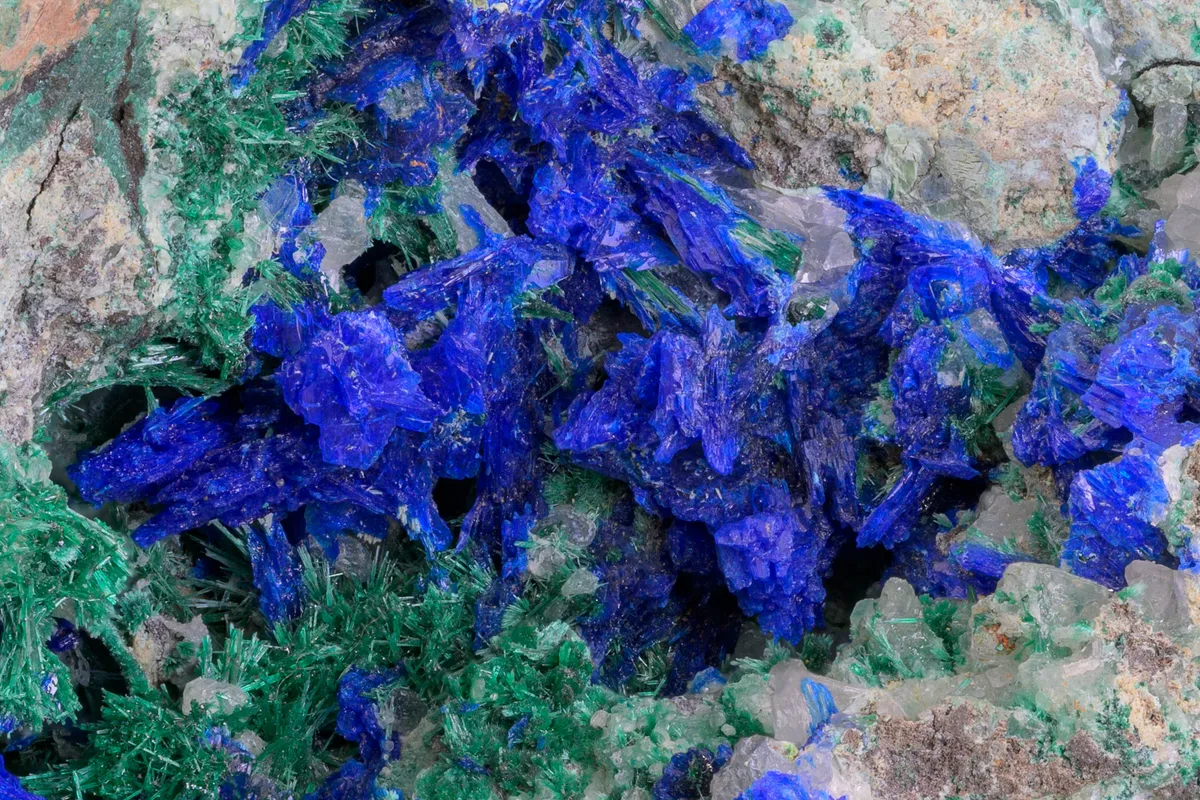
Photo: Tsumeb Mine Notebook
Historically, linarite was present at Tsumeb from the beginning of recorded mineralogical work on the deposit. It was one of the early secondary minerals noted in 1906, and early descriptions placed it in the oxidized ore with malachite, brochantite, anglesite, and sometimes caledonite. One of the most evocative facts in the record is that the earliest Tsumeb specimen acquired by the Natural History Museum in London was a rich linarite specimen purchased from Wilhelm Maucher in 1907. That specimen’s date anchors it firmly in the uppermost first oxidation zone, close to the famous “Green Hill” material that introduced Tsumeb to mineralogists and collectors.
Search for specimens: View all linarite specimens from Tsumeb, Namibia
The Tsumeb Mine, also known in later years as the Ongopolo Mine, lies at the town of Tsumeb in Namibia’s Oshikoto Region. The deposit was hosted by Neoproterozoic carbonate rocks of the Otavi Group, specifically in dolomitized limestones and dolomites of the upper Tsumeb Subgroup. Rather than a broad stratiform body, the ore occurred in a steep, irregular, pipe-like structure that extended to roughly 1,700 meters depth. In plan the orebody was commonly elliptical, locally pinched, offset, and attenuated by shearing, and in places bordered by massive sulfide-rich North and South Vein structures.
The primary ore was polymetallic and chemically fertile: copper, lead, zinc, and silver were the principal economic metals, with important minor and byproduct elements including arsenic, cadmium, gallium, germanium, and silver. The major hypogene ore minerals included bornite, chalcocite, tennantite, enargite, galena, and sphalerite. That primary chemistry is central to understanding linarite. A secondary mineral with the composition PbCu(SO4)(OH)2 requires both lead and copper in the same oxidizing environment, and Tsumeb’s mixed lead-copper sulfide and carbonate assemblages supplied exactly that.
Tsumeb’s secondary mineral wealth is best understood through its oxidation zones. The first oxidation zone extended from the surface down to about 11 Level, with oxide minerals diminishing between 11 and 15 Level. The second oxidation zone lay much deeper, from about 24 to 35 Level, centered near the North Break Zone around 29 Level. A third oxidation zone was recognized still deeper, from about 42 Level downward. Linarite is tied above all to the first oxidation zone and near-surface ore, though reliable modern summaries also recognize it in both the first and second oxidation zones as a supergene species.
The earliest mining story begins before formal colonial development. The copper-stained outcrop, remembered as the “Green Hill,” was known and worked for copper before European commercial mining. European explorers in the 1880s encountered African people transporting and trading copper ores and smelted copper. In January 1893 the British mining engineer Mathew Rogers examined the outcrop for the South West Africa Company and was struck by its scale and richness. Commercial development was undertaken by the German Otavi Minen und Eisenbahn Gesellschaft, which began with trial shafts in 1900. Full-scale commercial production began in 1906 after completion of a dedicated railway connection to the coast.
Mining began in an open pit and shallow shafts, then moved underground as surface ore was exhausted. The mine operated for nearly a century, with interruptions related to the two World Wars and the Great Depression. It became not only a major producer of copper, lead, zinc, and minor metals, but one of the world’s most consequential specimen mines. Pre-war upper-level work produced classic first oxidation-zone minerals, including the setting in which linarite was best established. After operations resumed in 1947 under Tsumeb Corporation Limited, deeper workings entered the second oxidation zone and later the third, generating many of the species and specimen associations that made Tsumeb a permanent benchmark locality.
Linarite’s own distribution within the mine is unusually well constrained by early cataloging. In the upper first oxidation zone, including the outcrop, it occurred in granular cerussite-rich matrix, sometimes with brochantite, malachite, and less commonly caledonite. It is also recorded as coatings on cerussite or as near-surface inclusions in cerussite crystals. Wilhelm Klein recorded linarite-bearing specimens from the open pit, 5 Level West, 8 Level, and 9 Level West; those entries include malachite on linarite, cerussite on linarite, blue-green smithsonite on linarite, and cerussite with linarite. Klein’s 1938 account placed linarite from the surface down to about 250 meters, corresponding to 9 Level.
The mine’s large-scale life ended in the mid-1990s. By that time workings had reached about 1,700 meters below surface, and economic pressure from high mining and pumping costs, weak metal prices, and labor conflict proved decisive. In mid-1996 the pumps were switched off during a strike-related crisis, and the mine flooded rapidly. Small-scale work in upper levels continued for a time, followed by a short-lived specimen-mining effort from 1998 to 2002. Today, normal collector access to the mine is not a practical field-collecting proposition; Tsumeb specimens are obtained through old collections, dealers, museums, and occasional dispersals of historic material.
Collectors working in or buying from Namibia should also remember that mineral collecting and export are regulated. Namibia’s Ministry of Mines and Energy advises that private collectors and researchers need permits for material collected or purchased, and that commercial export also requires a Ministry of Trade and Industry permit. For Tsumeb specifically, the relevant collecting reality is simple: old provenance, legal export, and reputable chain of ownership matter.
Tsumeb linarite is a monoclinic lead-copper sulfate hydroxide, PbCu(SO4)(OH)2, occurring as a supergene mineral in the oxidized ore. Visually it is prized for a deep, saturated blue that can range from bright royal blue to almost azurite-blue. Its best crystals are bladed or elongated, commonly developed along the b-axis, and appear as individual idiomorphic crystals, small tufts, crusts, cavity linings, or sparkling aggregates.
Most Tsumeb linarite crystals are small. Classic descriptions emphasize crystals rarely exceeding a few millimeters, with bladed forms commonly associated with cerussite, tennantite, brochantite, and sometimes caledonite. A documented Tsumeb Mine Notebook specimen shows bright blue aggregates with crystals to 4 mm in a 70 mm specimen associated mainly with cerussite and malachite. Georg Gebhard recorded that the Green Hill outcrop was rich in linarite and could yield crystals to 20 mm, an exceptional size for the locality and a key reason old outcrop specimens are so desirable.
The most characteristic matrix is tied to the upper first oxidation zone: granular or crystalline cerussite, oxidized carbonate matrix, malachite, and brochantite. In the first oxidation-zone assemblages, linarite may partly coat cerussite or be caught as blue inclusions just beneath cerussite surfaces. More complex associations include anglesite, caledonite, posnjakite, devilline, serpierite, langite, namuwite, schulenbergite, munakataite, olsacherite, rosasite, arsentsumebite, aragonite, mimetite, phosgenite altered to cerussite, and tennantite or tennantite pseudomorphs after enargite. Not every association is equally common; for collectors the familiar quartet is linarite, cerussite, malachite, and brochantite, with caledonite as a particularly attractive bonus.
One distinctive Tsumeb habit is linarite in or on cerussite. White, colorless, or pale cerussite can act as an ideal stage for vivid blue linarite, and some specimens show blue-green coatings where microcrystalline malachite and linarite are ingrained into the cerussite surface. Another desirable style shows blue linarite blades in vugs within a dense, oxidized lead-copper matrix. These specimens often look modest without magnification but come alive under a loupe, revealing sharp blue blades lining cavities.
Quality depends first on identification, then on aesthetics. The finest Tsumeb linarites have unambiguous blue bladed crystals rather than mere stains; strong color saturation; visible crystal form under magnification; attractive contrast with white cerussite or green malachite; and enough coverage to read as a linarite specimen rather than a cerussite or malachite specimen with incidental blue flecks. Old provenance is a major plus, especially labels or collection history pointing to early Tsumeb, the Green Hill outcrop, the open pit, or upper first oxidation-zone levels.
The principal authenticity issue with Tsumeb linarite is not a well-documented treatment industry; it is identification. Linarite can be confused with azurite because both may be deep blue, both occur in oxidized copper-lead environments at Tsumeb, and both can form small blades or crusts. This is especially true on mixed Tsumeb specimens where blue microcrystals are scattered among malachite, cerussite, brochantite, and oxidized matrix. For valuable examples, especially those sold as “rich linarite,” analytical confirmation or a highly reliable provenance is worthwhile.
Visual clues help but are not definitive. Tsumeb linarite tends to occur as small, bright blue blades, tufts, or crystalline coatings in lead-rich assemblages, especially with cerussite and brochantite. Azurite more commonly appears in larger, sharper, glassier crystals at Tsumeb and belongs to carbonate rather than sulfate chemistry. A simple field distinction sometimes cited for linarite versus azurite is that azurite effervesces in hydrochloric acid while linarite does not; however, acid testing is destructive and inappropriate for fine specimens, and mixed matrices can mislead the test. For collectible Tsumeb material, microscopy, provenance, and non-destructive analysis are preferable.
Condition is a real concern. Linarite has low hardness and occurs as small, exposed blades or crusts; crystals can be abraded, flattened, or dulled by handling. On Tsumeb specimens, the linarite may sit on fragile cerussite, cellular oxidized ore, or friable malachite-rich matrix. Look for bruising on the blue blades, rubbed high points, broken cavity edges, and old glue or consolidation in porous matrix. White cerussite associated with linarite can also be chipped, and the contrast that makes these specimens attractive can make damage easy to see.
Rarity is relative. Linarite was known from the earliest mining days and was once described as not rare in the oxidized ore, yet later summaries call it somewhat rare, sparse, or easily overlooked. That apparent contradiction makes sense to collectors: the species may have occurred widely in small amounts, but fine, rich, display-quality specimens are much harder to obtain. Tsumeb linarite is not usually abundant on the market, and pieces with strong blue crystal coverage, good aesthetics, and old provenance are exceptional.
Market availability is therefore uneven. Small mixed specimens appear periodically, often as linarite with cerussite, malachite, or brochantite. Rich older pieces are usually sold quickly or remain in specialized Tsumeb collections. Because the mine is closed and flooded, new supply is essentially collection recycling rather than fresh production. Buyers should read labels carefully: a specimen advertised as “linarite from Tsumeb” may be a true linarite specimen, a cerussite with minor linarite, a malachite specimen with blue linarite traces, or a misidentified azurite-bearing piece.
The linarite story begins on the Green Hill, the copper-stained outcrop that drew miners, traders, engineers, and mineralogists to Tsumeb. Its Herero name, Otjisume, is commonly rendered as “the place of the frog,” a reference said to be connected to the appearance of the outcrop. When Mathew Rogers reached Tsumeb in January 1893, he was not looking at a pretty mineral locality in the modern collector’s sense; he was looking at an orebody. Yet his reaction has the astonishment of a collector seeing a great pocket opened for the first time: he wrote that he had never seen such a sight as the one before him at “Soomep,” and doubted he would ever see another like it.
The first linarite specimens entered mineralogical history almost by accident. In 1900, a large sample of ore was shipped to Germany for metallurgical testing. Wilhelm Maucher, the engineer handling the samples at the Bergakademie in Freiberg, recognized that the ore contained well-crystallized secondary minerals worth preserving, not merely assaying. That act of attention mattered. Tsumeb’s early scientific reputation was built from such pieces, and linarite was among the minerals present in that first wave of oxidized material.
By 1906, linarite was already important enough to appear in Schneider’s early list of secondary Tsumeb minerals. Schneider described material received by the Bergakademie and noted linarite in terms that still sound familiar to anyone who has examined old first-zone specimens: it did “not seem rare,” and it was “always associated with coarse fibrous malachite,” often in cellular cavities of the oxidized ore. A year later, the Natural History Museum in London acquired its earliest Tsumeb specimen: a rich linarite purchased from Maucher in 1907, catalogued as BM.1907,1013. That is a remarkable collecting footnote. The first Tsumeb specimen in one of the world’s great museums was not azurite, not dioptase, not cerussite, but linarite.
Klein’s records give the species a miner’s map. Wilhelm Klein, a senior Tsumeb manager between the First World War and the late 1930s, took the unusual care to record levels for his specimens. His catalog entries place linarite from the open pit to 9 Level: malachite on linarite in the open pit, cerussite on linarite at 5 Level West, blue-green smithsonite on linarite at 8 Level, and cerussite with linarite at 9 Level West. Those terse German labels are small pieces of field evidence. They show linarite not as an isolated curiosity but as a recurring companion in the upper oxidized lead-copper assemblages.
One of the most attractive documented old-style specimens is a 70 mm cabinet piece now recorded by the Tsumeb Mine Notebook as linarite with cerussite and malachite. It is a dense intergrowth of secondary lead and copper minerals, with bright blue linarite crystals to 4 mm, mainly on colorless-white cerussite and green malachite. Its reverse has a cavity with especially well-developed linarite crystals. The specimen passed through the Bergakademie Freiberg and later Ian Bruce before entering Malcolm Southwood’s collection in 2010. It is exactly the sort of piece that explains Tsumeb linarite’s appeal: not necessarily large crystals, but a layered history and a close-up world of blue blades in old oxidized ore.
The mine itself ended in a way that changed the collecting landscape forever. By the mid-1990s the workings were about 1,700 meters deep, and the economics had turned against the operation. During a labor crisis in mid-1996, management was denied access to the site, the pumps were switched off, and the mine flooded rapidly. For Tsumeb collectors, that moment divides the locality into before and after. Linarite specimens now come from the accumulated memory of the mine: old open-pit material, first-zone pieces in European and American collections, dealer stock, museum drawers, and labels that still carry level names from an underground world no longer accessible.
 Amethyst
 Quartz
 Fluorite
 Tourmaline
 Malachite
 Azurite
 Rhodochrosite