Libethenite from Phoenix United Mine is one of the classic Cornish expressions of the species: dark bottle-green copper phosphate, most often seen as glassy patches and small vug-linings in iron-rich quartz gossan, but capable—at its best—of forming sharp, pseudo-octahedral to bipyramidal crystals of exceptional size for Britain. The locality’s appeal is not simply that libethenite occurs there; it is that Phoenix United and its Wheal Phoenix workings gave collectors old-time Cornish examples with a distinctive nineteenth-century pedigree, the kind of material that turns up with hand-written dealer labels, museum provenance, and the terse collector shorthand of an earlier mineral trade.
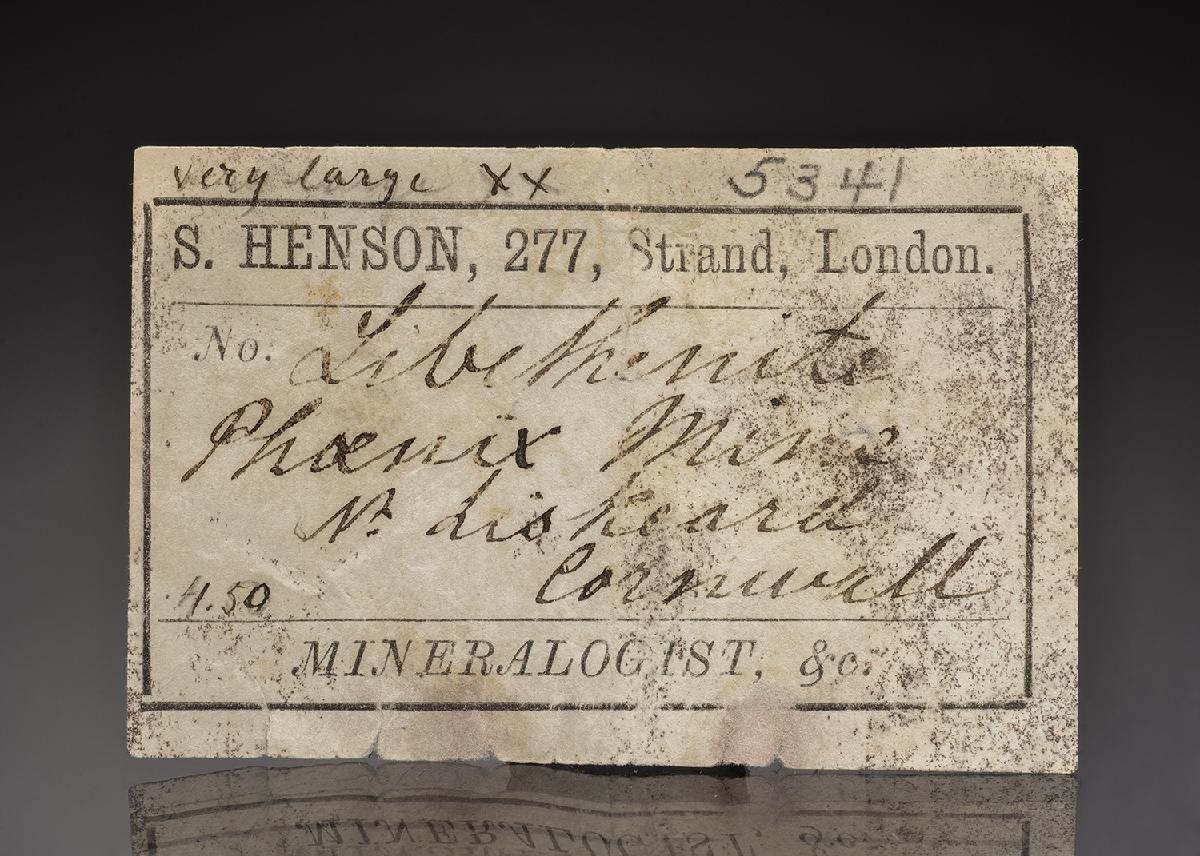
Photo: Crystal Classics
The mine sits at Minions on the south-eastern edge of Bodmin Moor, in the Caradon mining district, where granite is exposed at or near surface and the remaining country rock is strongly altered. Phoenix United is historically a copper-and-tin mine, but mineralogically it is especially interesting because the oxidized copper assemblage produced a suite of secondary copper phosphates, arsenates, carbonates, oxides, and related iron phosphates. In that setting, libethenite occupies the collector’s sweet spot between classic Cornish copper mineralogy and the phosphate-rich alteration suite that also includes pseudomalachite, chalcosiderite, turquoise-group material, rockbridgeite, dufrénite, strengite, gorceixite, and other species recorded from the mine group.
What collectors look for is straightforward but demanding: lustrous, discrete, dark green crystals rather than merely massive green coatings; crystals that show the classic pseudo-octahedral or wedge-topped habit; visible placement in an open vug; and convincing old locality documentation. The most desirable Phoenix United libethenites are not large display pieces in the modern Congo or Zambia sense. They are compact Cornish classics—miniatures and small cabinets in which a 5–10 mm crystal can matter greatly.
Search for specimens: View all libethenite specimens from Phoenix United Mine, Cornwall, UK
Phoenix United Mine lies at Minions, in the civil parish of Linkinhorne, Cornwall, at the north-eastern margin of the Caradon mining district. The recorded grid reference is SX265723, and the mine is centred near 50°31′26″ N, 4°27′1″ W. The workings are part of a broader group that included Wheal Phoenix, West Phoenix, South Phoenix, North Phoenix, Stowes, Clanacombe, Wheal Prosper, West Sharp Tor, and Withybrook or Witheybrook Mine, names that can appear on old labels and should be read with care rather than dismissed as separate far-off localities.
The deposit was worked as a lode system in granite and altered country rock. Contemporary and later descriptions emphasize the unusual closeness of two mineralized lodes, one copper-rich and one tin-rich, effectively “telescoped” so that copper and tin ore bodies occurred side by side. Workings ultimately reached about 250 fathoms, or roughly 1,500 feet, in the older mine system; the later Prince of Wales Shaft reached the 200-fathom level, about 1,200 feet.
Mining first began in 1836 under the name Cornwall Great United Mines, but the first venture was unsuccessful. The mine was reopened around 1844 as Phoenix Mine or Wheal Phoenix, and after West Phoenix was incorporated in 1875 the operation became Phoenix United. The rich copper lode struck in 1852 transformed the mine into one of the great East Cornwall copper producers. Copper dominated the 1850s and early 1860s; tin became increasingly important after 1864, when the mine was re-equipped for tin under the influence of mining engineer William West.
Production figures give the site its historical scale. Between 1848 and 1889 the mine produced more than 84,000 tons of copper ore, and between 1853 and 1898 it produced nearly 16,000 tons of tin. In the boom years the workforce expanded dramatically: 460 people were employed by 1864, rising to about 600 by 1869. Phoenix United used the Liskeard and Caradon Railway to move ore out and bring coal in, tying the mine to the wider industrial landscape of the Caradon district.
The nineteenth-century mine declined as ore values and metal prices fell. The old operation effectively closed at the end of the 1890s, but a major restart was attempted in 1907 with the Prince of Wales Shaft. That reopening was ambitious and expensive, with new machinery, pumping, winding, treatment plant, and a large new vertical shaft. It ultimately disappointed. The shaft reached depth, but the payable ore bodies proved small and sporadic, and the mine finally closed in 1914.
For collectors, the important collecting history belongs chiefly to the old oxidized copper workings and dumps, not to any modern access. Phoenix United is now a protected landscape: the mine lies within a Site of Special Scientific Interest and forms part of the Phoenix United Mine and Crow’s Nest Special Area of Conservation. The metalliferous spoil is ecologically important because rare mosses and liverworts grow on the metal-rich ground, including Cornish path-moss. The site is also part of the Cornwall and West Devon Mining Landscape World Heritage Site. Mineral collecting should therefore be treated as permission-only, and disturbance of spoil, mine structures, stream banks, or vegetated metalliferous ground is inappropriate without formal authorization.
Notable finds include the classic nineteenth-century libethenite crystals for which Phoenix United and Wheal Phoenix are prized, turquoise-group material historically labelled in part as rashleighite or “henwoodite,” and the broader copper secondary suite of malachite, cuprite, chalcotrichite, native copper, pseudomalachite, olivenite, cornwallite, chenevixite, chalcophyllite, and related minerals. Chalcosiderite is especially significant: Phoenix United is recorded as the type locality for that valid phosphate species.
Phoenix United libethenite is typically dark green to blackish green, often so deep in tone that crystal faces need strong light to reveal the green body colour. In attractive examples the luster is glassy, with small but sharply defined crystal faces flashing from recesses in a rusty quartz-gossan matrix. Less aesthetic pieces may show libethenite as massive, dark bottle-green patches, crusts, or irregular glassy areas in vuggy iron-stained quartz.
The best crystals show the classic libethenite morphology: pseudo-octahedral, bipyramidal, or wedge-topped prismatic forms. On a fine Cornish miniature, even a single sharp crystal of 5–6 mm is meaningful; crystals around 9–10 mm are major for the locality and for Britain. A documented Crystal Classics specimen described two crystals of about 1 cm and 0.9 cm, accompanied by a late nineteenth-century S. Henson label calling them “very large xx,” a telling phrase from the old mineral trade.
The usual matrix is iron-rich quartz gossan, commonly with goethite or limonite staining. Libethenite may appear in shallow vugs, along cellular quartz cavities, or as rich dark green areas on fractured quartz. Mindat photo-based association data for libethenite from Phoenix United records quartz, goethite, and pseudomalachite; the broader mine assemblage also includes malachite, azurite, chrysocolla, cuprite, native copper, chalcotrichite, olivenite, cornwallite, chenevixite, turquoise-group minerals, rockbridgeite, dufrénite, strengite, and other phosphate or arsenate species.
Quality is judged less by specimen size than by crystal individuality. A mediocre Phoenix United libethenite may be a large piece with abundant dark green, massive phosphate and little visible form. A good specimen shows identifiable crystals in clean vugs. A very good one combines several features: lustrous crystals, obvious pseudo-octahedral form, rich bottle-green colour under light, minimal bruising, and an old Cornish label or provenance. The finest old pieces have a presence out of proportion to their dimensions because they represent one of Britain’s classic libethenite occurrences.
Phoenix United libethenite should be bought with attention to locality precision. Labels may read Phoenix United, Wheal Phoenix, Phoenix Mine, West Phoenix, Stowes, or Linkinhorne, and older labels may use Liskeard or Caradon district wording. Those variants can be legitimate within the historical mine group, but they should be interpreted carefully. A specimen labelled simply “Phoenix Mine” needs context, because the name is not unique globally.
The main authenticity concern is not sophisticated treatment but confusion: dark green Cornish copper phosphates and arsenates can look similar in hand specimen, especially when massive or microcrystalline. Pseudomalachite, cornwallite, olivenite, libethenite, and dark turquoise-group material can be miscalled if the specimen lacks clear crystals. Massive dark green patches on iron-rich quartz should not automatically be assumed to be crystallized libethenite. For important purchases, the value rests on visible crystal habit, reliable provenance, and, where necessary, analytical confirmation.
Condition is a real issue. The crystals are commonly perched in shallow vugs in hard gossan, so exposed edges may be nicked. Old specimens may have dust, iron staining, or historical handling wear. Some large crystals from classic material are not fully complete, yet still remain important because of size and provenance. Buyers should distinguish acceptable old-time imperfection from modern damage: a partly contacted 1 cm nineteenth-century crystal with a strong label can be far more desirable than a cleaner but anonymous patch of dark green phosphate.
No routine treatment is expected for Phoenix United libethenite. The species is not a usual candidate for dyeing or coating, and Cornish examples are valued for natural patina and documentation. Cleaning should be conservative. Aggressive acid treatment can alter associated iron oxides, damage matrix aesthetics, and erase the very old-surface character that makes these pieces desirable.
Market availability is intermittent. Small massive or partly crystallized examples appear from time to time, especially through British-mineral dealers and collector marketplaces. Sharp, well-crystallized, old-provenance pieces are much scarcer. Specimens with historic labels—especially nineteenth-century dealer labels or major collection histories—belong in a different category from ordinary field-collected fragments and should be evaluated as classic Cornish minerals, not merely as examples of the species.
The story of Phoenix United is a story of repeated gambles. The first came in 1836, when a collection of smaller mines was brought together as Cornwall Great United Mines. The name was grand, but the result was not. One account notes that the venture ran through £50,000 of capital, an enormous sum for a mine that had not yet found its stride. The mine was reborn in the early 1840s as Phoenix, an apt name for a sett that repeatedly rose from failure under new money, new names, and new expectations.
The decisive turn came in 1852, when a rich copper lode was struck. For roughly a decade, Phoenix United’s copper output approached the great South Caradon Mine nearby. Then the pattern changed. Copper declined, but the mine lay in a part of the Caradon landscape where the granite-country rock relationship hinted at tin at depth. William West, a mining engineer already connected with the mine, bought a controlling share and backed the idea that tin would replace copper as the prize. It was a very Cornish wager: geological reasoning, practical mine sense, and risk capital all pointed downwards. The gamble paid. Within a year the workforce had tripled, and in 1877 the mine brought 34,000 tons of tin ore to surface.
The old mine was anything but simple underground. R. Shambrook described Phoenix United as an unusual case where copper and tin lodes occurred in close association, the two ore systems essentially telescoped together. In the Clanacombe portion, gossanized iron oxide descended to 200 fathoms, and the lode reached 12 feet wide. Near surface it included jasperoid iron ore and limonite with drusy quartz and chlorite, cut by black copper oxide, green copper carbonate, chalcocite, pyrite, chrysocolla, massive and crystallized cuprite, and chalcotrichite. Most evocative for collectors are the cavities: cellular quartz lined with malachite, oxides, copper arsenates, and native copper. That is the sort of oxidized architecture in which Phoenix’s small, dark, lustrous secondary minerals earned their place in cabinets.
Then came the 1907 restart, bold enough to read like a prospectus written in steam and optimism. The Prince of Wales Shaft was driven as the new hope of Phoenix United. Shareholders heard that the old mine had produced as much as £1,300,000 in tin and copper and had paid £230,000 in dividends. They were told of plans to haul 12,000 tons a month, producing an estimated £90,000 annual profit. The new shaft was 19 feet by 9 feet overall, 17 feet by 7 feet within timbers, and hundreds of feet deep while pumps, hoists, reservoirs, and treatment works were being prepared. The language was all confidence: big lodes, deep reserves, modern plant, old ground not exhausted but merely undercapitalized.
Reality at depth was less generous. The Prince of Wales Shaft ultimately reached the 200-fathom level. Development found a defined lode, but payable ore was patchy. One promising stretch ran 63 pounds of black tin over a five-foot width for the first 65 feet west on the 1250-foot level, but that was the exception rather than the rule. The mine closed in 1914. Mindat’s summary of the later effort is brutally concise in its economics: over seven years, the Prince of Wales venture produced only 95 tons of black tin.
A much smaller but more intimate survival from the collecting world is the S. Henson label on a Phoenix United libethenite sold by Crystal Classics. Henson’s printed address, 277 Strand, London, dates the label to about 1878–1888. In pencil, the old label calls the crystals “very large xx.” The abbreviation is collector shorthand—“xx” for crystals—but the phrase carries the voice of a nineteenth-century mineralogist who knew that, for Cornish libethenite, a centimetre-scale crystal was not a minor thing. That specimen later passed through the Kay Robertson collection and was recorded as ex U.S. National Museum, Washington A. Roebling collection. In a single miniature, the mine, the London mineral trade, an American engineering-family collection, and modern classic-mineral dealing all meet.
The site’s twentieth-century afterlife was not entirely quiet. In 1980, local concern focused on proposals by Geevor Mine Company to drill around Minions and the Withybrook Valley, including ground associated with Phoenix United, Marke Valley, Craddock Moor, South Caradon, South Phoenix, and Gonamena. A short Westward Television current-affairs film, Drilling for Minions, captured the tension between renewed mineral interest and a village landscape already dense with mining remains, heritage, and rare metallophyte ecology. By then Phoenix was no longer simply an old mine; it had become a protected Cornish landscape where the waste itself—once the by-product of ore—had become habitat.
 Amethyst
 Quartz
 Fluorite
 Tourmaline
 Malachite
 Azurite
 Rhodochrosite