Libethenite from Nchanga Mine occupies a quieter but highly attractive corner of Zambian Copperbelt collecting. The locality is not the legendary 1970s Mindola/Nkana source that produced large, pseudo-octahedral classics; Nchanga material is generally more drusy, more matrix-rich, and more subtle. Its appeal lies in dense carpets and scattered sprays of deep green to nearly black-green dipyramidal crystals flashing from oxidized copper matrix, commonly with malachite and pseudomalachite. The best pieces have a velvety, dark emerald surface under low light, then sharpen into glittering individual crystal faces under magnification.
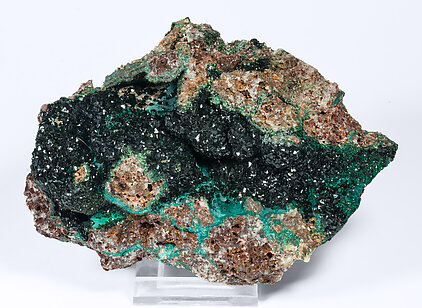
Photo: Fabre Minerals
The Nchanga setting is a classic Central African Copperbelt story: sediment-hosted copper-cobalt mineralization in a structurally complicated part of the Zambian Copperbelt near Chingola. The mine is far more famous as an immense copper producer than as a specimen locality, and that is exactly what gives its libethenite a collector’s edge. These are not showy phosphate-pocket specimens from a specimen mine; they are secondary copper phosphates rescued from one of Africa’s great industrial copper operations, where access, safety, oxidation, wet ground, and the scale of mining all work against careful specimen recovery.
Visually, Nchanga libethenite is a specimen for the collector who appreciates texture. Cabinet specimens are usually not built around a single dominant crystal. Instead, they show hundreds to thousands of tiny, lustrous dipyramids, often only 1–4 mm across, lining vugs, fractures, or uneven surfaces in matrix. When the color is uniform and the crystals are sharp, the effect can be surprisingly rich: a dark green crystalline skin over iron-stained or copper-mineralized rock, with brighter malachite picking out seams and edges.
The historical setting adds weight. Nchanga was explored in the 1920s, struggled early with flooding, resumed underground production in the 1930s, and later became one of the major open-pit copper operations of the Copperbelt. For libethenite collectors, the significance is not volume but survivorship: well-crystallized, locality-secure Nchanga pieces are distinctly less common than generic “Zambia” libethenite, and the best examples preserve the mine’s own mineralogical signature rather than trying to imitate the larger-crystal Nkana style.
Search for specimens: View all libethenite specimens from Nchanga Mine, Zambia
Nchanga Mine is at Chingola in Zambia’s Copperbelt Province, within the Zambian portion of the Central African Copperbelt. It is a copper-cobalt operation with both underground and open-pit components, and its ore is hosted in the Lower Roan stratigraphy of the Katanga Supergroup. The principal copper-cobalt mineralization is arranged in the Lower Ore Body and Upper Ore Body, with locally economic intermediate mineralization between them in the Banded Sandstone horizons. The Banded Sandstone material is important in the mine’s industrial history because some of it is refractory ore, known as Chingola Refractory Ore.
The specimen-producing environment for libethenite is the oxidized copper zone, especially fracture, vug, and joint-plane settings where phosphate-bearing fluids interacted with copper minerals. At Nchanga, libethenite is best understood as a secondary copper phosphate in the oxidized assemblage, not as a primary ore mineral. Its associated collector minerals from the locality include pseudomalachite, malachite, azurite, chrysocolla, brochantite, cuprite, native copper, torbernite, and metatorbernite, though libethenite specimens most often show the green phosphate-carbonate association rather than the entire suite.
Mining history at Nchanga is inseparable from water. Exploration began in 1923 and development followed in 1927. Early underground work was halted in 1931 after flooding and weak copper prices, and underground mining resumed in 1937 after dewatering and reorganization. Open-pit mining belongs to the mid-1950s expansion of the district: technical sources cite the Nchanga Open Pit beginning in 1955, while Konkola Copper Mines gives 1957 for surface operations from the Nchanga Open Pit. Either way, the open-pit era fundamentally changed the scale of exposure and produced the broad oxidized and weathered settings from which mineral specimens occasionally emerged.
The mine is not a public collecting locality. It is an active industrial copper operation with strict access, geotechnical hazards, water-control issues, and security. Any authentic specimen should therefore be viewed as coming through mine personnel, old collections, dealer purchases, or historical recovery rather than casual collecting. Labels that specify “Nchanga Mine,” “Nchanga Open Pit,” or “Nchanga Mine, Chingola” are particularly valuable when they are older, consistent with the specimen style, and traceable through a known dealer or collection.
The mine’s sheer scale should not mislead collectors into thinking specimens are common. Nchanga produced enormous quantities of copper ore, but well-crystallized libethenite is a minor secondary occurrence. The best documented collector pieces are small-cabinet to cabinet matrix specimens with dense druses of sub-millimeter to few-millimeter crystals. A few show-size pieces have appeared publicly, including a large Nchanga libethenite noted at the Tucson show with an approximate dimension of 230 mm by 110 mm, but such pieces are exceptional.
The typical Nchanga libethenite habit is a druse of sharp dipyramidal crystals. Individual crystals are commonly described around 0.15–0.4 cm, with many dealer-documented examples falling near 0.2–0.3 cm. The crystals are usually not isolated, pedestal-like showpieces; instead, they form sparkling crusts and scattered groups across matrix. This is one of the most useful visual distinctions between Nchanga and classic Mindola/Nkana libethenite, where larger, bold pseudo-octahedral crystals from the 1970s are a major part of the locality’s fame.
Color ranges from deep green to blackish green, with the finest surfaces showing a uniform, saturated green rather than a patchy or dull olive tone. Under magnification, even dark crystals may reveal a brighter green edge or internal flash. Luster is an important quality factor: sharp Nchanga crystals should sparkle rather than look sooty. A first-rate specimen has clean, distinct crystal faces, good coverage, and enough matrix contrast to make the green stand out.
The most characteristic associated minerals are pseudomalachite and malachite. Some pieces show malachite sprinkled over darker libethenite, producing a two-tone green association: dark, glassy libethenite below and lighter, softer-looking malachite on top. Pseudomalachite may appear as darker green rounded or botryoidal areas, sometimes difficult to distinguish without close inspection or analysis. Quartz-bearing matrix, iron oxides, goethitic staining, cuprite, chrysocolla, azurite, and brochantite are part of the wider Nchanga oxidized assemblage, though they should not be assumed on every libethenite specimen.
Specimen size varies widely, but documented dealer pieces include small-cabinet examples around 7.0 × 4.0 × 2.7 cm, 7.5 × 5.5 × 3.5 cm, 8.0 × 8.0 × 3.5 cm, and 9.0 × 5.0 × 4.0 cm, as well as a Fabre Minerals example measuring 11.4 × 8.4 × 6.2 cm. Main crystal sizes on those pieces are generally small, from about 0.2 to 0.4 cm. This means the value is often in coverage, luster, color, and locality rather than in one large crystal.
The best Nchanga pieces have four traits working together: dark uniform color, bright luster, sharp dipyramidal crystal form, and attractive matrix coverage. A specimen with a broad sparkling druse and no obvious bruising is much more desirable than a larger but dull, rubbed, or sparse plate. Pieces with obvious pseudomalachite and malachite association have additional mineralogical interest, especially when the relationships are clear and not merely a green crust of uncertain identity.
Nchanga libethenite is a label-sensitive mineral. The word “Zambia” is not enough. Zambia has several copper-phosphate localities that can be confused in the marketplace, especially Nkana/Mindola, Kabwe, and Nchanga. Mindola/Nkana is the source of the most celebrated large-crystal Zambian libethenite. Kabwe has its own complicated phosphate history, including zinc-bearing material and zincolibethenite questions. Nchanga specimens are usually smaller-crystal, matrix-rich druses from the Chingola copper operation. A good label should name Nchanga Mine or Nchanga Open Pit, Chingola, Copperbelt Province, Zambia.
Mislabeling is not theoretical. A documented Nchanga specimen in the marketplace carried an older label placing the locality in Zaire instead of Zambia. That kind of error is understandable in older Central African material, but it matters. Collectors should check whether the mineral style matches the claimed mine, whether the label history is coherent, and whether the specimen has passed through a reputable dealer or known collection.
Condition issues are mostly mechanical. The crystals are small but exposed; edge wear, druse abrasion, and tiny impact points can reduce the sparkle. Dealer descriptions specifically mention micro-chipping on some Nchanga material, and that is exactly the sort of damage to inspect under magnification. Because the specimens often consist of crystal carpets on uneven matrix, damage may hide in high spots and along broken matrix edges. A loupe or microscope is essential for evaluating whether the surface is truly intact.
Treatment is not the main concern with this locality. The more important risks are wrong locality, confused phosphate identity, and over-optimistic descriptions of size or coverage. Dark green pseudomalachite, malachite, and libethenite can occur together, and without visible crystal form or analytical support, green copper phosphate crusts may be difficult to assign confidently. Sharp dipyramidal crystals are the safest visual indicator of libethenite.
Market availability is limited but not nonexistent. Recent dealer listings show Nchanga libethenite appearing as small-cabinet specimens in the low-to-mid hundreds of dollars, with prices influenced by coverage, crystal sharpness, and condition. Better examples with broad, lustrous, uniform druse and secure Nchanga provenance should be treated as locality pieces rather than common species representatives. They are especially attractive to collectors building a serious Zambian Copperbelt suite, where Nchanga adds a different visual chapter from the better-known Mindola/Nkana libethenites.
The earliest Nchanga story is a water story. The mine began as a promising underground venture in the 1920s, but by 1931 the workings had been flooded and development was stopped. A later technical account summarized the moment starkly: mining in Chingola started underground in 1931 and was “catastrophically flooded and closed.” The mine that later produced occasional secondary copper specimens first had to be won back from water. In 1937, Nchanga was dewatered and underground operations resumed, setting the stage for the long-lived industrial mine collectors know today.
Water never left the story. Modern Nchanga still pumps immense volumes to keep mining possible, and the open pits receive additional inflow during the wet months. Technical descriptions of the area emphasize the Nchanga and Chingola streams feeding toward the Kafue River and annual rainfall commonly in the 800–1300 mm range. In a landscape like that, the oxidized copper minerals that collectors prize were formed in an environment that miners had to fight continuously.
There is a specimen story in the contrast between Nchanga’s industrial scale and the fragility of its collector pieces. At the Tucson show in 2017, a visitor recorded seeing a Nchanga libethenite approximately 230 mm by 110 mm and wrote simply: “Wow!! Love the color and the crystals.” That reaction captures why Nchanga pieces matter. They are not famous because the mine is obscure or romantic; they are striking because, against the vast machinery of a copper operation, a plate of tiny dark-green phosphate crystals can still stop a seasoned mineral-show visitor in mid-aisle.
Nchanga also has one of the Copperbelt’s stranger specimen-market episodes, though it involves metatorbernite rather than libethenite. In the early 1970s, two pockets of brilliant Nchanga metatorbernite produced crystals so startling that the market reportedly called them “green wulfenite” at first. One 1972 pocket yielded electric-green material of a quality that later dealers described as never equaled. The story matters for libethenite collectors because it reminds us that Nchanga was never merely an ore locality: when its oxidized zones opened the right cavity, they could produce minerals with a visual impact completely out of proportion to their rarity.
 Amethyst
 Quartz
 Fluorite
 Tourmaline
 Malachite
 Azurite
 Rhodochrosite