Paprok lepidolite is best understood as the lavender-to-pink mica accent that gives many of Afghanistan’s finest Paprok pegmatite specimens their depth and color contrast. The locality is famous first for gem elbaite tourmaline—pink, green, cranberry-red, blue-capped, and “watermelon” zoned crystals—but the lepidolite is not merely background. In the best pieces it forms pearly plates, rosettes, layered fans, and soft lilac masses that wrap tourmaline, sit with smoky quartz and cleavelandite, or carry rarer pegmatite minerals such as microlite and beryllonite.
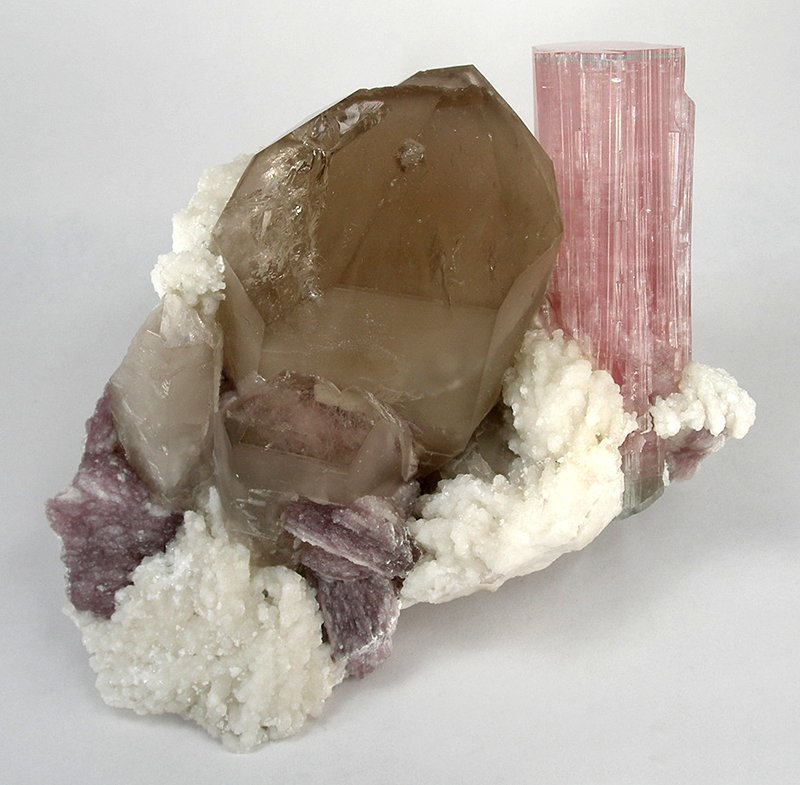
Photo: Wikimedia Commons
The look of Paprok is unmistakably that of a highly evolved lithium pegmatite: snow-white albite or cleavelandite, smoky or colorless quartz, gem tourmaline, and mica in lavender, mauve, pinkish purple, pale gray, or off-white tones. The mica commonly acts as a visual hinge between the hard glass of tourmaline and the granular white feldspar matrix. Collectors who know the locality often judge a Paprok specimen not by lepidolite alone, but by how convincingly the lepidolite belongs: whether it is intergrown, whether it cradles the tourmaline naturally, whether its pearly flakes are fresh rather than rubbed, and whether the whole association reads as one pocket assemblage rather than a rebuilt composition.

Photo: Wikimedia Commons
Mineralogically, Paprok sits among the rare-metal pegmatites of Nuristan, a belt known for lithium minerals, colorful tourmaline, beryl, phosphates, tantalum-niobium oxides, and tin minerals. The locality usually called the Paprok mine is not a single neat opening but a set of workings in pegmatites on the right side of the Kéhi Dara Valley, south of Paprok village. Published locality data record gem-bearing pegmatites hosted in Late Triassic slate, with named workings including Me Tunnel Madan, KAL Tunnel Madan, GUL Tunnel Madan, and Al Madan. The result for collectors is a locality where lepidolite is both aesthetically important and mineralogically diagnostic: a soft lithium-mica signal in a pegmatite system capable of producing elbaite, spodumene, pollucite, petalite, beryllonite, microlite-group minerals, and rare phosphates.
Strictly speaking, “lepidolite” is a traditional collector and field name for lithium mica material rather than a single modern IMA-approved species name in the narrow sense. In the specimen trade and in older literature it remains the practical name used for Paprok’s lavender mica. On a careful label, it is acceptable to retain “lepidolite” in quotation marks or as a series-style collector term unless the mica has been analytically resolved.
Search for specimens: View all lepidolite specimens from Paprok, Afghanistan
Paprok is in Kamdesh District, Nuristan Province, northeastern Afghanistan, in the high Hindu Kush region close to the famous pegmatite districts that have supplied the international mineral trade for decades. Mindat records Paprok as a pegmatite field with coordinates near 35° 30' 20'' N, 71° 4' 50'' E, and alternate historical spellings including Papruk Mine and Paprowk Mine. A U.S. Geological Survey summary of the Nuristan rare-metal pegmatite area lists Paprok, or Papruk, among pegmatites whose significant minerals include spodumene, lepidolite, albite, microcline, polychromic tourmaline, columbite-tantalite, and cassiterite.
The deposit type is a rare-metal, lithium-rich granitic pegmatite system of the sort collectors commonly describe as LCT affinity. The field expression is not a simple quarry wall but a group of pegmatite workings in rugged valley terrain. Published locality notes place the Paprok workings on the right side of the Kéhi Dara Valley, south of Paprok village, with “Madan” used locally for mine or working. The important named workings are Me Tunnel Madan, KAL Tunnel Madan, GUL Tunnel Madan, and Al Madan.
Mining history at Paprok is inseparable from the wider history of Nuristan gem pegmatites. Soviet and Afghan geological work documented numerous rare-metal pegmatite fields in eastern Afghanistan during the second half of the twentieth century, while collector-quality gem tourmalines, kunzites, beryls, and rare species entered Western collections in increasing numbers through the late twentieth and early twenty-first centuries. By the time Peter Lyckberg’s dedicated 2011 article on Paprok appeared, the locality was already well established among serious collectors as a source of gem tourmaline and rare pegmatite minerals; his later 2017 Mineralogical Record article placed Paprok in the broader context of northeastern Afghanistan’s most important gem pegmatites.
Access should be treated as mining access, not recreational collecting access. Paprok is remote, high, and logistically difficult; its specimens reach collectors through miners, local dealers, the Peshawar trade, international dealers, auctions, and older private collections. Labels may vary between Paprok, Papruk, Paprowk, Paprok Mine, Paprok Valley, Nuristan, and Kamdesh District. The best documentation preserves the full locality chain: Paprok, Kamdesh District, Nuristan Province, Afghanistan.
Notable Paprok finds involving lepidolite include elbaite crystals wrapped or belted in pale mica, microlite-group crystals perched on purple lepidolite with elbaite, beryllonite with lepidolite, and a published 17 cm Vienna Museum specimen described as a viitaniemiite crystal on lepidolite. The locality is also scientifically notable for chemically zoned “watermelon” tourmaline, including work identifying fluor-elbaite in the Paprok material and Raman studies of inclusions in zoned elbaite.
Paprok lepidolite is most often encountered as a matrix or accessory mineral rather than as a freestanding show species. Its best habits are pearly tabular plates, micaceous layered aggregates, rosettes, and fanlike masses. On some specimens the mica forms a soft rind around tourmaline; on others it occurs as discrete purple plates among albite, quartz, and green or pink elbaite. Dealer and museum descriptions record colors from pinkish purple and lavender to mauve-gray, pale lilac, soft golden at the base of layered aggregates, and off-white where the mica is pale or altered.
Display-quality lepidolite-dominant Paprok specimens are much less common than tourmaline-dominant Paprok specimens. A documented small-cabinet example measured 7.2 x 5.6 x 3.7 cm and carried a 5.2 cm long layered lepidolite group flaring from green tourmaline and colorless quartz. This is a useful scale reference: Paprok can produce cabinet-size assemblages, but the attractive lepidolite component is often a few centimeters across and judged by placement, freshness, and association rather than by sheer mass.
The classic association suite is elbaite, albite or cleavelandite, quartz, smoky quartz, and lepidolite. More complex pieces may add microcline, microlite-group minerals, beryllonite, topaz, beryl, petalite, pollucite, spodumene, phosphates, and tantalum minerals. One well-known Wikimedia specimen shows two lustrous brown octahedral microlite crystals at the base of pastel-pink elbaite with pearly purple lepidolite. Another large cabinet association shows smoky quartz, pink tourmaline, albite, and purple lepidolite in the kind of high-contrast pegmatite composition that made Paprok famous.
Quality in Paprok lepidolite is about texture and integration. Fresh mica should have a pearly sheen rather than a dull, clayey surface. The plates should not be crushed flat or abraded to powder along exposed edges. Color is best when it contrasts visibly with white albite or green-pink tourmaline: lilac, lavender, rose-purple, or mauve tones are more desirable than nondescript gray. The most collectible pieces show lepidolite as a natural part of the pocket architecture—tourmaline emerging from it, quartz nestled against it, or rare minerals sitting on it—rather than as a loose mica mass with little context.
For collectors building a Paprok suite, the hierarchy is usually: first, matrix association with gem elbaite; second, fresh and colorful lepidolite with quartz or albite; third, rare species on lepidolite; and fourth, lepidolite-dominant display specimens, which are uncommon for the locality and often overlooked when they appear. A pure lepidolite specimen from Paprok may be rarer in the market than a tourmaline specimen with a lepidolite accent, but the finest values still follow aesthetics, condition, and confidence in locality.
The chief authenticity issue with Paprok lepidolite is not normally dyeing; it is association integrity. Paprok tourmaline crystals are valuable, brittle, and commonly repaired or reattached. Because lepidolite is soft, fissile, and easy to disturb, the mica-tourmaline contact deserves careful inspection. Look for glue fluorescence under longwave and shortwave UV, mismatched dust in crevices, unnatural gaps at the base of tourmaline crystals, and mica plates that appear smeared into adhesive. Repaired Paprok tourmalines can still be fine collectible specimens if the work is disclosed, but undisclosed reattachments sharply affect value.
There are documented modern listings of Paprok elbaite with lepidolite that disclose repairs, including reattached crystal sections visible under UV. Other listings note possible restoration or uncertainty about termination edges on blue-cap tourmaline associated with albite and lepidolite. This is not a condemnation of the locality; it is a reminder that Paprok specimens, especially elongated gem tourmalines on soft matrix, should be bought from sellers who describe condition plainly.
For lepidolite itself, expect minor edge wear. Mica cleaves perfectly and can flake along basal planes; even old, natural pocket contact can mimic damage. Fresh broken mica looks bright and reflective, while older bruised surfaces may appear dull, fibrous, or chalky. Avoid overcleaned pieces where lepidolite has been scrubbed into a granular surface. Avoid oily coatings or artificial gloss. Massive purple mica sold in the metaphysical trade may be dyed, reconstructed, or misidentified, but that problem is more common in tumbled, carved, or bead material than in documented Paprok matrix specimens.
Locality labeling needs attention. Paprok is sometimes spelled Papruk or Paprowk, and Afghan material may be traded through Pakistan. A label reading only “Afghanistan/Pakistan” is not equivalent to Paprok. Better labels specify Paprok, Kamdesh District, Nuristan Province, Afghanistan, and ideally preserve dealer, collection, auction, or publication history. Older labels from well-known dealers, former collection tags, and publication references matter because Paprok’s most valuable specimens are usually tourmaline-led combinations where locality, repairs, and provenance all influence price.
Market availability is steady for Paprok tourmaline with lepidolite accents but limited for lepidolite-centered pieces. Current dealer listings show Paprok elbaite with lepidolite in the thousands to low five figures when the tourmaline is gemmy, large, sharply terminated, or color-zoned. By contrast, a documented lepidolite-dominant small-cabinet specimen sold at auction in 2022 for a modest price despite being described as a rare showy Paprok lepidolite specimen. That gap is typical: Paprok lepidolite is underpriced when judged as mica, but expensive when it forms the matrix for top Paprok elbaite.
One of the most vivid Paprok specimen stories is preserved with a 10.5 x 3.0 x 2.7 cm elbaite and lepidolite crystal photographed by Rob Lavinsky. The crystal, pink grading upward into a cranberry-red termination and partly wrapped in pale lavender to off-white lepidolite, was described as a cabinet gem tourmaline acquired by “satellite phone email” while it was still descending from the mines toward Peshawar, “yet uncleaned.” Those few details capture the Paprok trade at its most immediate: a fresh gem crystal leaving a high Nuristan pegmatite, not yet prepared, evaluated remotely, and moving down the mountain chain toward the market routes that have made Afghan pegmatites globally visible.
Another Paprok story unfolded not in a bazaar but under a microscope. Researchers studying “watermelon” tourmaline from the Paprok mine cut through the romance of the name and mapped the crystal zone by zone. The specimen showed a pale pink core, a thin colorless zone, and a green outer zone, with the chemistry changing outward as iron became more important in the green zones. A later Raman study treated the gem as a tiny archive of trapped fluids and carbonaceous matter: spectra from the crystal recorded hydrogen sulphide, methane, ethane, and propane, along with bands interpreted as evidence for a graphitization process from fluid-saturated inclusions toward more organized carbonaceous material. For collectors, that work explains why Paprok tourmaline can look so clean and theatrical while still being chemically and texturally complex on the microscopic scale.
Paprok also has the quieter kind of collecting story: the rare mica specimen hiding behind the famous tourmalines. In 2022, a small-cabinet lepidolite with tourmaline on quartz was offered as a rare locality specimen. The description emphasized that Paprok is known for tourmalines, kunzites, and other gem pegmatite minerals, not for showy lepidolite alone. The lepidolite group measured 5.2 cm and flared three-dimensionally from green tourmaline and colorless quartz, shifting from pinkish purple toward a soft golden color at the base. It closed at $284—an instructive result for collectors who recognize that rarity by species-locality does not always match the broader market’s appetite for gem crystals.
Peter Lyckberg, “Edelstein-Pegmatite in Afghanistan: Paprok,” Mineralien-Welt, 22(3), 46–57, 2011 — Dedicated Paprok article covering the locality’s geology, history, gem tourmaline, and rare minerals.
Peter Lyckberg, “Gem pegmatites of northeastern Afghanistan,” The Mineralogical Record, 48(5), 610–675, 2017 — Major overview of the northeastern Afghan gem pegmatites, including Paprok workings and mineral specimens.
Orris, G.J., and Bliss, J.D., “Mine and mineral occurrences of Afghanistan,” U.S. Geological Survey Open-File Report 2002-110, 2002 — Baseline USGS reference for Afghanistan mine and mineral occurrence data, cited for Paprok mineral occurrences.
“Summaries of Important Areas for Mineral Investment and Production Opportunities of Nonfuel Minerals in Afghanistan,” USGS Open-File Report chapter on the Nuristan rare-metal pegmatite AOI — Useful regional geological summary listing Paprok/Papruk minerals and the broader Nuristan rare-metal pegmatite setting.
Ertl, A., Dumańska-Słowik, M., and Natkaniec-Nowak, L., “‘Watermelon’ tourmaline from the Paprok mine (Nuristan, Afghanistan),” Neues Jahrbuch für Mineralogie. Abhandlungen, 186(2), 185–193, 2009 — Peer-reviewed chemical study of zoned Paprok tourmaline, including fluor-elbaite identification and component variation.
Wesełucha-Birczyńska, A., and Natkaniec-Nowak, L., “A Raman microspectroscopic study of organic inclusions in ‘watermelon’ tourmaline from the Paprok mine,” Vibrational Spectroscopy, 57(2), 248–253, 2011 — Raman study of inclusions and zoning in Paprok watermelon tourmaline.
Viitaniemiite crystal on lepidolite, 17 cm, Paprok, Vienna Museum of Natural History collection — Published as Figure 168 in The Mineralogical Record 48(5); important museum example showing lepidolite as matrix for a rare phosphate.
Beryllonite, microcline, and lepidolite from Paprok, Galerie de Minéralogie et de Géologie, Muséum national d’Histoire naturelle, Paris — Museum-displayed Paprok association specimen documenting lepidolite with beryllonite and microcline.
Quebul Fine Minerals: “gem TOURMALINE var. ELBAITE, LEPIDOLITE” — Archived miniature Paprok elbaite with lepidolite rosettes, including specimen photographs and a video player.
Barnebys: “Tourmaline with Lepidolite - Paprok” — Auction-media page for a pink tourmaline with turquoise-blue cap and pink lepidolite belt, with a Vimeo specimen-video reference.
Wikimedia Commons Category: Minerals of Paprok — Large media archive of Paprok specimen photographs, including elbaite, lepidolite associations, albite, quartz, beryllonite, and rare pegmatite minerals.
Mindat: Paprok, Kamdesh District, Nuristan, Afghanistan — Core locality page with coordinates, alternate locality names, mineral list, workings, and references.
Mindat: Lepidolite from Paprok — Species-locality entry connecting Paprok lepidolite to Mindat’s broader literature and photo records.
Wikimedia Commons: Elbaite-Lepidolite-153373.jpg — Classic Paprok elbaite partly wrapped in pale lepidolite, with detailed specimen description and licensing.
Wikimedia Commons: Albite-Lepidolite-Quartz-d06-145a.jpg — Cabinet association showing Paprok’s tourmaline-quartz-albite-lepidolite aesthetic.
Wikimedia Commons: Microlite-Lepidolite-Elbaite-150464.jpg — Rare microlite, lepidolite, and elbaite combination from Paprok.
MineralAuctions: Lepidolite with Tourmaline on Quartz, Paprok — Useful market record for a lepidolite-dominant Paprok specimen, including size and sale result.
EarthWonders: Elbaite with Lepidolite, Paprok — Current-style marketplace listing illustrating repair disclosure, sizing, and pricing for high-end Paprok elbaite with lepidolite.
Crystal Classics: Elbaite with Lepidolite, Paprok — Dealer description of a large Paprok elbaite crystal straddling a pale lepidolite plate, useful for condition and quality language.
USGS: Nuristan rare-metal pegmatite area summary — Geological and economic context for the rare-metal pegmatites of Nuristan, including Paprok/Papruk.
University of Vienna: “Watermelon” tourmaline from the Paprok mine — Accessible abstract and citation details for the 2009 peer-reviewed Paprok tourmaline study.
 Amethyst
 Quartz
 Fluorite
 Tourmaline
 Malachite
 Azurite
 Rhodochrosite


