The Nikolaevskiy Mine at Dalnegorsk is one of the modern classic sources for sharp, black ilvaite, and its best specimens have a look that collectors recognize immediately: glossy, jet-black prisms set against pale quartz, calcite, siderite, or greenish hedenbergite-rich matrix. The contrast is the appeal. Ilvaite is not a colorful mineral, but Dalnegorsk material compensates with luster, sculptural form, and strong mineral associations. The finest pieces have isolated, well-terminated crystals that read almost like black enamel against a light matrix, while more complex pieces show later carbonate or sulfide events altering, coating, or pseudomorphing the original ilvaite.

Photo: Wikimedia Commons
Geologically, Nikolaevskiy belongs to the Dalnegorsk polymetallic skarn district of Primorsky Krai in Russia’s Far East. The ore system is a lead-zinc-silver skarn and sulfide deposit developed in limestone blocks within a structurally complicated volcanic-plutonic terrane. For collectors, this matters because the deposit did not simply make massive ore: it made open cavities. Those cavities allowed sulfides and gangue minerals to crystallize freely, creating the lustrous galena, sphalerite, pyrrhotite, calcite, quartz, fluorite, hedenbergite, and ilvaite specimens for which Dalnegorsk became famous.
Nikolaevskiy ilvaite occupies a special place among world ilvaites because it combines crisp skarn-mineral morphology with the pocket aesthetics of a great sulfide locality. Classic ilvaite localities such as Elba, Serifos, and South Mountain are historically important, but the late twentieth-century Dalnegorsk pieces brought a fresh standard of luster and composition: black ilvaite crystals in airy groups, often with quartz needles, calcite rhombs, siderite, or pseudomorph textures that tell a visible paragenetic story.
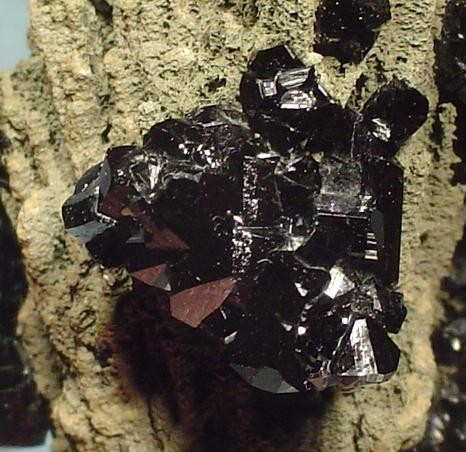
Photo: Wikimedia Commons
Collectors look for several things at once: undamaged terminations, bright glassy to submetallic luster, sharp prism faces, distinct separation of crystals, and a balanced contrast with white or colorless associated minerals. The best specimens are not merely “black crystals”; they are architectural objects, with stout chisel-ended prisms, diverging clusters, or isolated crystals perched on sparkling quartz. Pseudomorphs are a second collecting lane. Siderite, hedenbergite, and pyrite replacements after ilvaite are especially attractive when the original ilvaite habit remains legible.
Search for specimens: View all ilvaite specimens from Nikolaevskiy Mine, Dalnegorsk, Russia
Nikolaevskiy Mine works the Nikolayevskoye deposit, a major skarn-polymetallic ore body in the Dalnegorsk ore district. The deposit is mined underground and is one of the important operations of MMC Dalpolimetall. The ore system is classed with the district’s lead-zinc-silver skarn deposits, rather than the separate borosilicate boron skarn for which Dalnegorsk is also famous. The commercial ore minerals include galena, sphalerite, and pyrrhotite, with chalcopyrite, arsenopyrite, magnetite, silver-bismuth-tellurium minerals, and cassiterite as lesser or trace components. Gangue and skarn minerals include hedenbergite, quartz, calcite, ilvaite, axinite, tourmaline, epidote, fluorite, amphibole, garnet, and wollastonite.
The structural setting is essential to understanding the specimens. The Nikolayevskoye ore body lies in a downthrown block of Upper Triassic limestone beneath volcanic rocks and intruded by gabbro-diorite, diorite, granite, rhyolite, and dolerite bodies related to a local volcanic-plutonic center. The principal ore zone is described as flat-lying to tabular and developed near the upper part of the limestone, below the volcanic cover. Company descriptions place mineralization at depth rather than in surface outcrops, with ore bodies occurring along contacts of limestone plates and taking pod-like, irregular shapes. That deep, concealed, underground character explains why collector material comes from mining, not casual surface collecting.
Dalnegorsk’s modern mining history began in the older Tetyukhe district in the late nineteenth century, when Julius Joseph Bryner claimed silver-lead-zinc ground in 1897. Commercial development at Verkhniy began in the early twentieth century, and the district grew through Russian Imperial, concession, Soviet, and post-Soviet phases. The Nikolayevskoye deposit entered operation in 1982; Dalpolimetall’s own historical summary identifies it as having the deepest shafts in the Russian Far East, more than 800 m. Early construction and development of the Nikolayevskiy mine are specifically associated with 1981 and 1983 company photographs, aligning the mine’s specimen era with the broader late Soviet and early post-Soviet mineral boom that brought Dalnegorsk specimens into Western collections.
Collectors should treat Nikolaevskiy as an active industrial mine, not an open collecting locality. Access is controlled by the operator, underground workings are hazardous, and recent public reports have described regulatory suspensions at Nikolayevsky over industrial safety violations. From a collecting standpoint, the practical source is the specimen market: older stock from 1980s–1990s and early 2000s production, dealer inventories, collection dispersals, and occasional specimens released from Russian or international sources.
Notable finds include classic late 1980s and 1990s ilvaite clusters, ilvaite with quartz and calcite, ilvaite on or with siderite after aragonite, and unusual pseudomorphs such as siderite after ilvaite and pyrite after ilvaite. A documented 2001 ilvaite with quartz and calcite from the Al and Sue Liebetrau collection carried a contemporary handwritten note describing it as one of the best Nikolaevskiy ilvaites seen at that time, a useful reminder that the mine produced collector-grade pieces well beyond the first wave of late Soviet material.
Nikolaevskiy ilvaite is typically black to jet-black, highly lustrous, and prismatic. The classic habit is a stout prism with dominant 110 and 111 forms, commonly giving crystals a blocky, chisel-like appearance. Mindat records crystals to 10 cm for the locality, though most collector specimens on the market are miniatures and small cabinets with individual ilvaite crystals from about 1 to 3 cm. Larger crystals exist but are much less frequently encountered in fine condition.
The best crystals show sharp edges, bright reflective faces, and strong terminations. Some are isolated on matrix with quartz needles, a style that highlights the black-and-clear contrast beautifully. Others occur in clusters, where multiple crystals crowd together in black, glossy groups. On attractive specimens the ilvaite is not lost in dark matrix; it stands out against colorless quartz, white calcite, tan to greenish carbonate, or pale hedenbergite-rich skarn.
Associations are one of the chief pleasures of the locality. Quartz and calcite are the most familiar companions, followed by fluorite, siderite, goethite, aragonite, hedenbergite, and prehnite in photographed specimens. The broader Nikolaevskiy mineral suite includes galena, sphalerite, pyrrhotite, pyrite, chalcopyrite, bournonite, jamesonite, tetrahedrite-group minerals, axinite-(Mn), hedenbergite, fluorite, siderite, and calcite, which gives collectors many legitimate combination possibilities. Quartz may occur as drusy carpets, small needles, or distinct crystals; calcite may appear as rhombs, scalenohedra, nailhead forms, or pale coatings; siderite can occur as rhombs, aggregates, or pseudomorphic material.
Pseudomorphs are especially important at Nikolaevskiy. Siderite after ilvaite preserves the original prismatic habit while replacing the black silicate with tan to brown carbonate. Pyrite after ilvaite is rarer and more unusual, preserving ilvaite form in brassy sulfide. Siderite after aragonite, with ilvaite coating or clustered around the replacement, produces some of the most textural Dalnegorsk pieces: black mirror-bright ilvaite against fibrous or needlelike carbonate forms. Hedenbergite after ilvaite is also represented in the modern market and can be valuable when the pseudomorph is sharp and complete.
Quality is judged by a fairly strict set of factors. First is luster: dull black ilvaite is common enough not to excite advanced collectors, while glassy, mirror-bright crystals are the standard for fine Nikolaevskiy material. Second is termination quality. Because many pieces come from cavities and pocket walls, contacts and breaks are common; a crystal with clean termination and no distracting rear contact is much stronger. Third is isolation and composition. The locality produced clusters, but the most displayable pieces often have individual crystals separated enough for the eye to read their shape. Fourth is association. Quartz and calcite contrast can elevate a specimen dramatically, while rare pseudomorph combinations add mineralogical interest. Finally, condition matters more than size: a smaller, brilliant, complete 2 cm crystal on quartz is usually preferable to a larger, battered black mass.
The chief authenticity issue with Nikolaevskiy ilvaite is not widespread artificial manufacture; it is locality precision and condition disclosure. Dalnegorsk contains several ilvaite-producing localities, including Nikolaevskiy, Bor Pit, 1st Sovetskii, 2nd Sovetskii, and Verkhnii. Older labels sometimes say only “Dalnegorsk,” “Dal’negorsk,” or “Primorskiy Kray,” and such specimens should not be upgraded to Nikolaevskiy without evidence. Genuine Nikolaevskiy material often has plausible associated minerals and styles, but style alone is not proof. A specimen with an old dealer label, collection history, or published photograph carries more weight than a loose locality assignment.
Repairs are a real concern. Ilvaite is brittle, heavy for its size, and commonly protrudes from matrix in exposed positions. Dalnegorsk ilvaites in particular are known in the trade for repaired crystals and reattached groups. This does not automatically disqualify a specimen, but repairs should be priced and described honestly. Inspect bases of crystals, contact points with quartz or carbonate, and any suspiciously clean junctions under magnification and UV. Look also for filled chips on glossy black faces; black minerals can conceal adhesive and restoration better than pale minerals.
Condition problems include bruised terminations, contacted rear faces from pocket walls, cleaved or broken prism ends, edge chipping, and detached quartz needles. Calcite associations may be chipped or etched. Sulfide-rich matrix can be unstable in poorly stored pieces, especially where pyrite or marcasite is present, although this is not the dominant issue for most ilvaite specimens. Carbonate pseudomorphs may have crumbly surfaces or naturally rough faces that should not be mistaken for fresh damage, but sharpness of the original ilvaite form remains important.
Rarity depends strongly on quality. Ordinary Nikolaevskiy ilvaite is available from time to time, and small specimens with partial crystals or modest luster are not rare. Fine, bright, well-composed examples from the late 1980s and 1990s are much scarcer than they once were. Auction records and dealer listings show miniatures and small cabinets still appearing, often from older collections, while high-end pseudomorphs or exceptional old-stock pieces command substantial premiums. A recent listed hedenbergite pseudomorph after ilvaite at 70 x 60 x 40 mm was priced in the low thousands of dollars; small-cabinet ilvaite with quartz and calcite from a named collection sold at auction in 2025 for a few hundred dollars; lesser or damaged miniatures have sold for less. The spread is wide because luster, isolation, repair status, association, and provenance matter more than locality name alone.
For serious collectors, the strongest purchases are specimens that do one clear thing well: a sharp isolated black crystal on quartz; a balanced cluster with bright terminations; a documented late-1990s piece; or a pseudomorph that preserves ilvaite form unmistakably. Avoid vague “Dalnegorsk ilvaite” labels priced as Nikolaevskiy unless the specimen’s documentation supports the more precise attribution.
Dalnegorsk’s mineral story begins not with ilvaite but with ore. On April 2, 1897, Julius Joseph Bryner, a Vladivostok businessman, staked a claim in the Tetyukhe, or Rudnaya, river valley and named the deposit Verkhniy. By 1902 the first 97 tons of ore had been mined, and by 1907 the deposit was in commercial development. The early ore was supergene zinc material, calamine and smithsonite, shipped by sea to England. In 1912 a German company, Gumbolt, began building an enrichment plant in Tetyukhe; in June 1914 that plant produced its first lead concentrate, at a capacity of 8 tons of ore per hour. Long before the mineral-show world knew Dalnegorsk for black ilvaite on quartz, the district was already a hard industrial source of lead and zinc.
The human scale of the district expanded rapidly. From 1911 to 1916, more than 100,000 tons of ore were mined at Verkhniy. During the concession period after 1924, production rose again: in 1928 alone, the district produced 19,925 tons of zinc concentrate and 6,335 tons of lead concentrate, while the workforce grew from 107 to 850 between 1924 and 1930. Those numbers matter to collectors because the great specimen-producing era was built on a century of industrial momentum. Dalnegorsk did not become famous because of occasional prospecting; it became famous because large, deep, technically developed mines repeatedly opened the right cavities.
The Second World War years were another revealing chapter. The company history records that during four war years the workforce produced 80,200 tons of lead and 60,500 tons of zinc. The phrasing is industrial rather than romantic, but the figures are startling: a remote Far Eastern mining district, operating through wartime, feeding metal into the Soviet economy. Decades later, the same district’s cavities would send lustrous galena, sphalerite, calcite, fluorite, and ilvaite into cabinets worldwide.
Nikolaevskiy itself enters the story late but dramatically. Company history marks construction of the Nikolayevskiy mine in 1981 and commencement of the Nikolayevskoye deposit in 1982. A 1983 company caption refers to development of the first stage of the deposit with self-propelled mining machines. The mine was not a shallow collector dig: it was a deep underground operation with shafts reported at more than 800 m. Its ore was hidden, with no surface outcrops, and mineralization was described at about 700 m depth from datum. The great collector specimens therefore came from a place the casual field collector could never simply walk up to and work.
For Western collectors, the shock came in the late 1980s and 1990s, when Dalnegorsk material appeared in quantity and quality that seemed almost implausible: mirrorlike galena, bright sphalerite, fluorite, calcite in many forms, and black ilvaite with a luster that dealers compared favorably to anything then known. Mineral-auction descriptions of older stock repeatedly point back to that moment. One late-1990s Nikolaevskiy ilvaite with quartz, formerly in Herb Obodda’s stock, carried a 20-year-old label and a $900 price tag; the auction description called those pieces some of the finest ilvaites the world had seen “gram per gram,” especially for luster. Whether one accepts the flourish or not, it captures the market memory: Dalnegorsk ilvaite arrived as a modern classic, not a locality footnote.
The pseudomorphs add a second layer of intrigue. One documented Nikolaevskiy specimen from 1990s finds shows mirror-bright black ilvaite covering a diverging cluster of green to brown siderite replacing very elongated aragonite needles. Another auctioned example featured siderite after ilvaite with quartz, preserving a doubly terminated ilvaite form after replacement. A pyrite-after-ilvaite specimen from Nikolaevskiy was described as one or two chisel-point ilvaite crystals transformed into brassy pyrite, set with hexagonal pyrrhotite, quartz scepters, and translucent calcite rhombs. These are not just attractive combinations; they are frozen episodes of chemical overprinting, replacement, and reopening of cavities inside a working ore system.
The Al and Sue Liebetrau specimen gives a quieter, more personal glimpse of how Dalnegorsk ilvaite circulated among serious American collectors. Their small-cabinet ilvaite with quartz and calcite, mined in summer 2001, carried a handwritten note saying that at the time it was one of the best ilvaites from Nikolaevskiy Mine. The piece later appeared at auction from a collection better known for fine crystallized display specimens and fluorescent minerals. That is the kind of provenance that gives a Dalnegorsk specimen life beyond its locality label: mine date, collection history, and a collector’s immediate judgment preserved on paper.
 Amethyst
 Quartz
 Fluorite
 Tourmaline
 Malachite
 Azurite
 Rhodochrosite
