Wessels Mine is one of the essential names for collectors of crystallized hausmannite. The best pieces from this mine show exactly why the locality has become a benchmark: jet-black to brown-black, mirror-bright, pseudo-octahedral and “pagoda-like” tetragonal crystals, often stacked into sharp ridges or rich clusters on dark manganese-oxide matrix. In hand, good Wessels hausmannite has a weighty, metallic seriousness; under light, the crystal faces flash with a lacquered luster that can be startling for a manganese oxide.
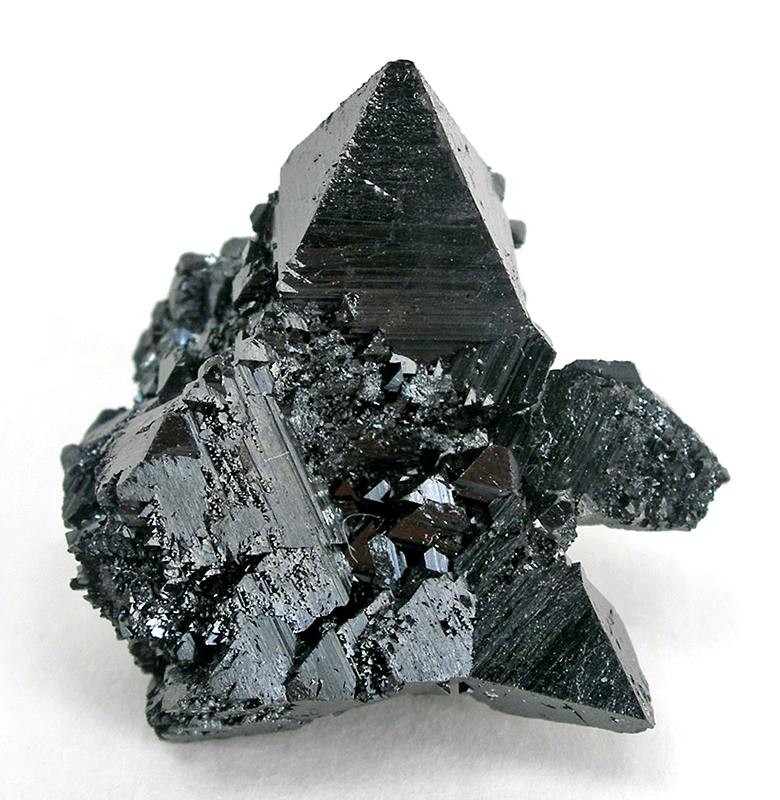
Photo: Wikimedia Commons
The geological reason for that quality is tied to the mine’s place in the Kalahari Manganese Field of the Northern Cape, the great manganese province near Hotazel and Kuruman. Wessels is not merely a specimen locality sitting on an orebody; the mine exposes the high-grade, hydrothermally altered “Wessels-type” manganese ore in which hausmannite is a principal constituent. Normal faults acted as fluid pathways, and hydrothermal alteration transformed lower-grade sedimentary manganese ore into a coarser, oxide-rich assemblage dominated by hausmannite, braunite II, bixbyite and manganite, with vuggy zones and late gangue minerals providing the open space and contrast that make fine cabinet specimens possible.
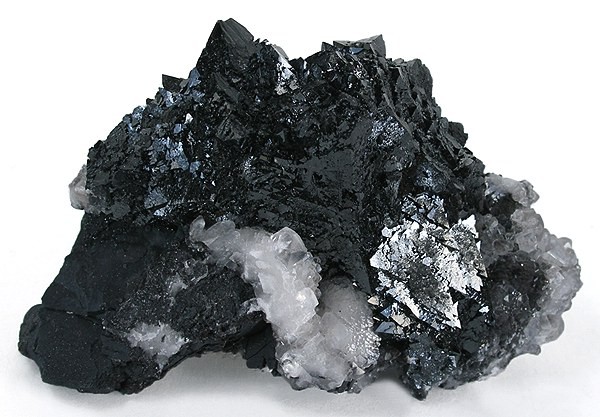
Photo: Wikimedia Commons
For collectors, Wessels hausmannite is desirable in two overlapping ways. First, it is classic species material: sharp, high-luster tetragonal crystals of Mn3O4 in the very form collectors picture when they think of hausmannite. Second, it carries the broader prestige of Wessels Mine, one of the most mineralogically productive localities in the Kalahari Manganese Field, with a record of rare and type-locality minerals that places it among the world’s great systematic-collector mines. Fine hausmannite is therefore not just a black oxide specimen; it is a crystallized expression of the same alteration event that made Wessels famous.
Search for specimens: View all hausmannite specimens from Wessels Mine, South Africa
Wessels Mine is an underground manganese mine near Hotazel in the Joe Morolong Local Municipality, John Taolo Gaetsewe District Municipality, Northern Cape Province, South Africa. It forms part of the Hotazel Manganese Mines operation with Mamatwan Mine; Wessels is the high-grade underground mine, while Mamatwan is the medium-grade open-pit operation. The mine uses vertical and incline shafts and a mechanized bord-and-pillar, or room-and-pillar, mining method. Mindat records the mine as having started in May 1973, and modern operator descriptions still identify Wessels as an active underground operation.
The host setting is the Kalahari Manganese Field, within Paleoproterozoic manganese-bearing strata of the Transvaal Supergroup. In the northwestern part of the field, north-south normal faults localized hydrothermal alteration. Those faults and their adjacent alteration halos are the key to the Wessels story. Primary, lower-grade Mamatwan-type sedimentary ore was upgraded by removal of silica, carbonate components and other material, with manganese-bearing carbonates oxidized to manganese oxides. The result is Wessels-type ore: high-grade, coarse-grained, shiny, massive to vuggy manganese ore in which hausmannite and braunite II are principal minerals.
For specimen collectors, the important feature is the vuggy nature of parts of the altered ore. Hausmannite-rich Wessels-type ore may be porous and cavity-bearing, and those cavities allowed crystals to develop with the sharpness and luster that made the mine famous. Calcite, baryte, clinochlore, andradite and gaudefroyite may occupy or line vugs in the hausmannite-rich ore, while the broader Wessels paragenesis includes an exceptional range of manganese oxides, silicates, borates, sulfates and rare barium-strontium-copper minerals.
Collecting access is not comparable to a public field-collecting locality. Wessels is a working underground manganese mine, and specimen recovery has historically depended on miners, mine access, authorized collecting, and material saved from mining operations rather than casual collecting by visitors. Older specimens in the market often come through established South African and international mineral dealers, from collections formed during productive specimen periods, or from mine-run finds that entered the collector trade years after extraction.
The mine’s specimen reputation is broader than hausmannite alone. Wessels has produced type-locality minerals including effenbergerite, poldervaartite, vonbezingite, wesselsite, scottyite, colinowensite, diegogattaite and others. That rare-mineral context matters for hausmannite because the same ore-forming and alteration history that created the great systematic assemblages also provided the manganese-oxide environment in which first-rate hausmannite crystallized.
Wessels hausmannite is most admired as lustrous, jet-black to brownish-black pseudo-octahedral crystals, typically tetragonal in symmetry but visually close to squat octahedra or stacked pyramids. The classic habit is a pagoda-like growth: individual pyramidal forms stacked or intergrown into stepped clusters, ridges, or compact groups. Many crystals show horizontal striations on the faces; the very finest display crisp edges, bright reflective faces, and little visual interruption from dull coatings or bruising.
Crystal size varies widely. Many good miniature and small-cabinet specimens show crystals in the several-millimeter to roughly centimeter range. Better pieces may carry individual crystals around 1–1.5 cm, and some specimen descriptions record larger crystals near an inch across. In the ore itself, petrographic studies describe fine-grained hausmannite with patches of medium- to coarse-grained crystals; collector specimens represent the more open, aesthetic end of that spectrum, where the crystals had space to grow and survive extraction.
Color is usually black in normal display light, but the luster is what separates good Wessels material from merely correct Wessels material. Top pieces are glossy to mirror-lustrous, sometimes so reflective that photography washes the faces into silver-white highlights. Less desirable material is dull, bruised, granular, or massive, and may be perfectly legitimate ore hausmannite without having much specimen appeal.
Matrix and association are important. Hausmannite from Wessels may occur on dark manganese-oxide matrix, with manganite, braunite II, bixbyite, hematite, calcite, baryte, gaudefroyite, clinochlore and andradite among the relevant associated minerals. Calcite can provide white contrast, and andradite can give a granular orange-brown to brown garnet matrix that sets off the black hausmannite strongly. Some pieces show hausmannite as rich black crystals partly overgrown by calcite; others are nearly pure clusters with little visible matrix.
A particularly interesting scientific aspect of Kalahari and Wessels-related hausmannite is iron substitution. Studies of hydrothermally altered Kalahari manganese ore documented unusually magnetic, Fe-rich hausmannite in high-grade altered ore, with iron present as Fe3+ and with magnetic behavior very different from ordinary hausmannite. This is not a field test for buying ordinary specimens, but it underscores that Wessels hausmannite is not just visually important; it has been part of serious mineralogical work on manganese-oxide crystal chemistry, alteration and magnetism.
The quality factors collectors should weigh are straightforward: sharpness, luster, crystal size, aesthetics, damage, and association. A thumbnail with perfect glossy pseudo-octahedra may be more desirable than a larger but bruised and dull specimen. A specimen with black hausmannite standing proud on contrasting calcite or andradite often has more display value than a solid black mass, but dense, all-hausmannite clusters can be superb if the crystals are sharp and reflective.
The main authenticity concern with Wessels hausmannite is not a well-known treatment, but attribution and visual confusion. The Kalahari Manganese Field contains several mines that produced fine black manganese oxides, including Wessels and the N’Chwaning mines. Hausmannite from N’Chwaning can also be sharp, lustrous and associated with andradite or calcite, so a precise old label, a reliable dealer history, or a collection provenance is valuable. “Kalahari manganese field” is sometimes used loosely in trade; if the mine name matters to your collection, ask whether the Wessels attribution is supported by a label or by the specimen’s chain of custody.
No common enhancement improves hausmannite in the way that heating changes amethyst or dyeing changes porous pale material. Wessels hausmannite is valued for natural crystal form and luster, and any artificial coating would generally be a defect rather than a benefit. The practical risks are more ordinary: repaired contacts, glued crystals, concealed bruising on black reflective faces, and oily handling or surface contamination that temporarily exaggerates luster. Examine high-value pieces under strong side lighting. Mirror-bright faces will reveal chips, cleaves and edge bruises quickly.
Condition matters because hausmannite is brittle and the best Wessels crystals often stand in exposed stepped groups. Tiny edge nicks are common on old mine-run specimens, but large broken tips, abraded ridges, or rehealed-looking glue seams should affect price. Calcite-associated pieces need extra care: the calcite can be more vulnerable to acid cleaning than the oxide assemblage, and attempts to brighten or “clean” a specimen can remove desirable contrast or expose damage.
Rarity depends heavily on quality. Ordinary Wessels hausmannite exists in the market with some regularity, especially as older miniatures and small cabinet pieces. Fine examples with sharp, lustrous, undamaged pseudo-octahedra; crystals exceeding a centimeter; attractive calcite or andradite contrast; or strong old provenance are far scarcer. The best examples are species-level pieces rather than locality fillers, and they compete with top N’Chwaning and classic European hausmannites in serious collections.
Market availability is intermittent. Modern listings show Wessels and broader Kalahari hausmannite appearing through specialist mineral dealers and archive platforms, with prices rising sharply for size, sharpness, luster and provenance. A modest but attractive miniature may be obtainable, while a top Wessels specimen with large, glossy, undamaged pagoda crystals should be treated as a premium manganese-oxide specimen and evaluated accordingly.
 Amethyst
 Quartz
 Fluorite
 Tourmaline
 Malachite
 Azurite
 Rhodochrosite

