Saranovskii is one of the great name localities for green garnet, and for collectors the word almost always means uvarovite: the calcium chromium garnet Ca3Cr2(SiO4)3. The best pieces are immediately recognizable—emerald-green, glassy dodecahedra scattered or packed across black chromitite, sometimes with white calcite or silvery-green chlorite minerals setting off the color. The contrast is the charm: brilliant green crystals on dense, dark chromium ore, looking more like a mossy jewel crust than a conventional garnet specimen.
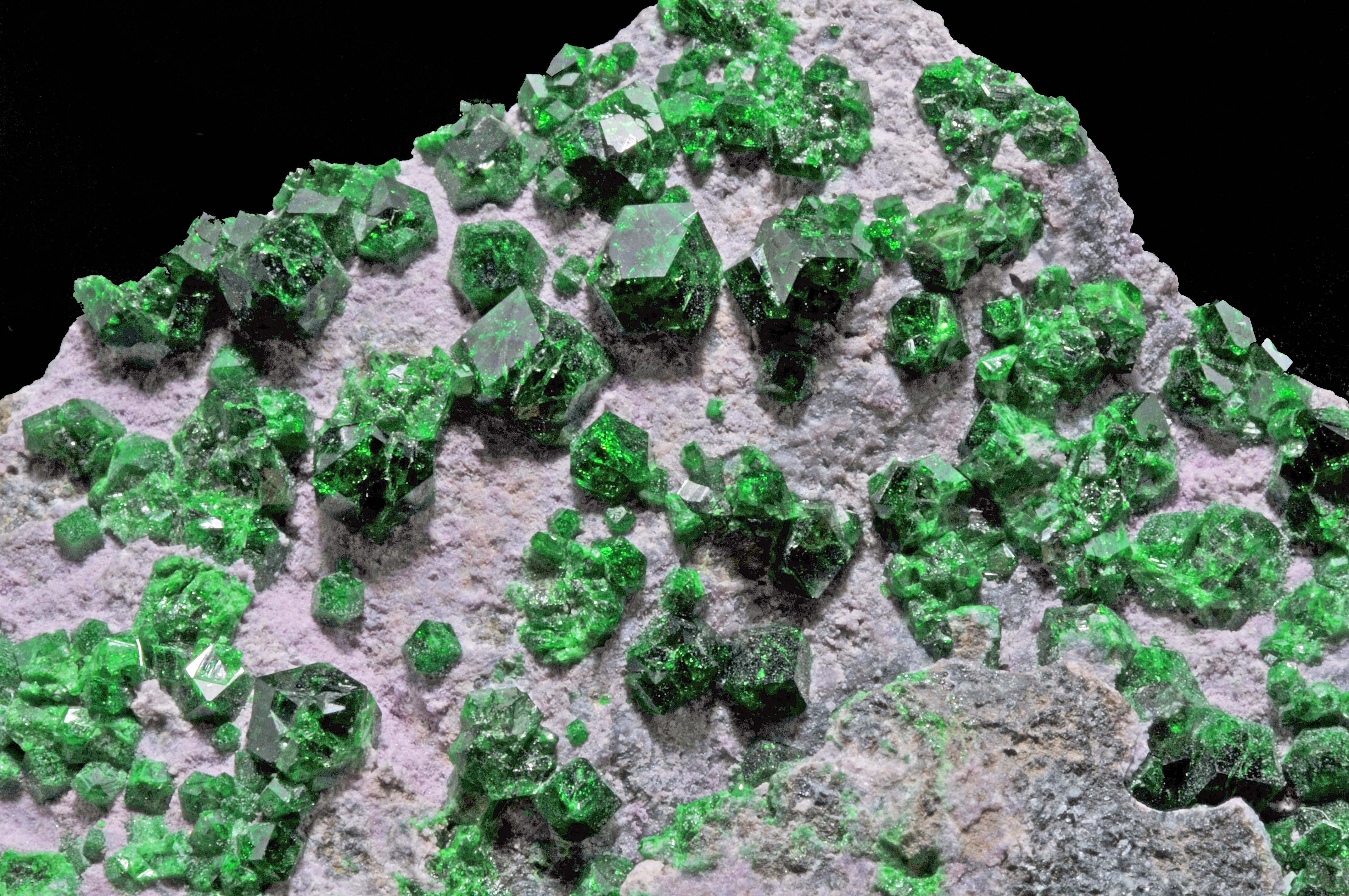
Photo: Géry PARENT / Wikimedia Commons
The locality is important not just because it has yielded attractive specimens, but because it is the type locality of uvarovite itself. Germain Henri Hess described the new chromium garnet in the early nineteenth century and named it for Count Sergey Semenovich Uvarov, then a central figure in Russian scholarly life. That historical status matters in the specimen market: a modest plate from Sarany can carry more locality weight than a larger but less classic chromium garnet from elsewhere.
Geologically, Saranovskii is a chromite deposit in an ultrabasic massif of the western Urals. The garnets belong to a chromium-rich mineral suite developed where fluids and low-grade metamorphism acted on chromitite, dunite, harzburgite, gabbroic bodies, and carbonate veins. In collector terms, that geology expresses itself as drusy green garnet on chromite; in mineralogical terms, it produced uvarovite, Cr-rich grossular, chromian clinochlore, amesite, diaspore, shuiskite-group minerals, chromium-bearing titanite, calcite, and other Cr-bearing species.

Photo: James St. John / Wikimedia Commons
The classic Saranovskii look is a tight, sparkling green crust rather than a few large isolated crystals. Fine pieces have saturated color, lustrous and well-formed faces, and enough relief that the crystals read individually under a hand lens. Exceptional specimens show larger transparent rhombic dodecahedra, crystals perched on pale calcite or chromian chlorite, or the rarer combination of uvarovite with violet-lilac chromian minerals from the same chromium-rich system.
Search for specimens: View all garnet specimens from Saranovskii Mine, Urals, Russia
Saranovskii Mine is at Sarany in the Gornozavodskii District of Perm Krai, on the western side of the Ural Mountains. The locality is also encountered under older or variant spellings such as Saranovskoye, Saranovsky, Sarany, Saranovskaya, and the “Rudnaya” underground chromite mine at the Glavnoe Saranovskoe deposit. The mine is recorded as an active chromite mine; historically it began as open-cast workings, while modern extraction has been mainly underground.
The ore setting is compact but mineralogically rich. Chromitite horizons, reported up to several tens in number, occur in Precambrian dunites and harzburgites of the Saranovsky massif. These ultrabasic rocks are cut by gabbro, gabbro-dolerite, dolerite, and picrite bodies and dikes. Later deformation, fluid movement, and low-grade metamorphism produced the alpine-type carbonate veins and fracture systems that collectors care about most, because that is where uvarovite and associated chromium minerals form attractive specimen surfaces.
The mine’s history is inseparable from uvarovite. Before chromite became the economic driver, the beautiful green garnet itself was an object of attention. Local historical accounts describe the Sarany chromite occurrences as tied to the discovery and recognition of uvarovite; before 1889 the deposits were worked largely for the green garnet, and only later primarily for chromite ore. Early ore was hand-mined and hauled to the Biser station in winter by sled, a detail that gives some sense of the remoteness and seasonality of early work in the Urals.
Production history includes important interruptions and reorganizations. The mine was not operated during the revolutionary and civil-war period from 1917 to 1924; after work resumed, geological exploration, a Laki–Sarany rail branch, and improved mechanization changed the scale of operations. During the Second World War years, local accounts emphasize the strategic role of chromite ore for high-grade steel and armor production.
For modern collectors, Saranovskii is not a casual rockhounding locality. It is an active industrial mine, and specimen material reaches the market through mine production, older collections, local recovery, dealer channels, and estate dispersals rather than normal public collecting. Labels should be treated carefully: “Saranovskii,” “Sarany,” “Saranovskoye,” and “Rudnaya” may all refer to the same general collecting tradition, but a good label should still identify the mine/deposit in Perm Krai rather than simply “Ural Mountains.”
Saranovskii garnet is most prized as uvarovite. The crystals are typically rhombic dodecahedra, often in closely spaced druses and crusts. Most collector specimens show crystals in the sub-millimeter to low-millimeter range; crystals around 1–2 mm can already make a bright, lively miniature if the luster and coverage are strong. Published work on the deposit records transparent green garnets up to 12 mm across in the uvarovite–grossular–andradite compositional range, with uvarovite crystals up to about 7 mm shown in figured material, but such crystals are not the everyday market standard.

The color ranges from bright grass green to deep emerald green, sometimes appearing nearly black-green where crystals are thick or crowded. The finest specimens balance saturation with transparency: too thin a coating can look merely dusty; too dark a crust can lose the internal green flash. Strong vitreous luster, crisp face definition, and even coverage across an undamaged matrix are major quality factors.
Matrix is a large part of the Saranovskii identity. The classic support is dark gray to black chromite or chromitite, and that contrast makes even small crystals visually powerful. Calcite appears as white to translucent vein material and may either enhance a specimen by contrast or obscure the garnet if overgrown. Chromian clinochlore, historically often called kammererite in specimen trade language, can add silvery-green to lilac tones. Amesite, diaspore, titanite, shuiskite-group minerals, quartz, albite, rutile, diopside, magnesiochromite, and other chromium-bearing species form part of the broader mineral environment.
Compositionally, Saranovskii green garnets are not all a single ideal end-member. Detailed analytical work places many of them in the uvarovite–grossular–andradite range, with chromium-rich compositions and fine oscillatory zoning. That is important for serious collectors: a visually “uvarovite” specimen from Sarany can be a chromium-rich garnet whose exact species position depends on analysis. For display purposes the classic trade name remains uvarovite, but for systematic collections a confirmed analysis or a label from a reliable source is especially valuable.
The most desirable specimen styles are:
The main authenticity issue is not treatment but naming. “Uvarovite” has long been applied too loosely to many green chromium-bearing garnets. Some material sold as uvarovite from other countries is actually chromian grossular, chromian andradite, chromian pyrope, or other Cr-bearing garnet. Saranovskii is the type locality and a classic source, but even there the green garnets can occupy solid-solution ranges, so analytical precision matters for high-end systematic specimens.
For ordinary hand specimens, the matrix is one of the best practical checks. Classic Saranovskii material is commonly green garnet on chromite/chromitite, often with calcite or chromium-bearing chlorite minerals. A loose green garnet crystal without matrix, a bright green garnet on an unfamiliar pale skarn matrix, or a piece labeled only “Russia” deserves more scrutiny. Labels that mention Sarany, Saranovskii Mine, Saranovskoye, Rudnaya mine, Glavnoe Saranovskoe deposit, Gornozavodskii District, or Perm Krai are preferable, especially when supported by old collection tags or reputable dealer history.
Condition should be inspected under magnification. The crystals are small, so damage can hide in the sparkle: bruised dodecahedral faces, crushed high points, abraded edges, and broken patches along the rim of a sawn or trimmed matrix are common faults. Calcite can be naturally present, but excessive whitish residues in cavities may mask the garnet. Some specimens have been acid-cleaned to remove carbonate; when well done this can reveal the uvarovite, but aggressive cleaning may leave etched, undercut, or unnaturally stark surfaces.
Saranovskii uvarovite is available on the market, but fine examples are not interchangeable. Small thumbnails and miniatures with dense green sparkle appear regularly; larger plates, rich cabinet specimens, crystals above a few millimeters, and attractive associations with clinochlore, calcite, shuiskite, or chromian minerals are much less common. A premium specimen should be judged by color first, then crystal size and definition, then coverage, matrix aesthetics, association, condition, and label quality.
Long before Sarany became known to the industrial world as a chromite mine, a small green garnet sat in the orbit of Russian mineralogical science without its birthplace being understood. Local historical accounts preserve the odd sequence: the emerald-green mineral was already kept in the cabinet of the Russian Mineralogical Society, but its deposit was not known until the late 1820s. Hess recognized the species and attached to it the name of Count Uvarov, then president of the Academy and an honorary member of the mineralogical society. The future type locality of a garnet species entered mineralogical history not first as an ore body, but as a beautiful puzzle in a cabinet.
The nineteenth-century descriptions read with the excitement of a mineralogist seeing both beauty and rarity. A quoted 1841 remark places uvarovite first among the local minerals for rarity and situates it near the village of Saranovskaya. The same account emphasizes its strong glassy luster and its pictorial druses on hard chromic ironstone. Even then, the difficulty that still defines the species for collectors was clear: the stone could invite comparison with emerald, but the small size of the crystals made it chiefly a mineral-collection treasure rather than a practical jewelry material.
The early workings were physically modest but logistically demanding. Before 1889, the Sarany deposits were worked mainly for uvarovite; afterward, chromite ore became the central product. Ore was mined by hand, and delivery to Biser station was possible only in winter, by sled. That detail is worth lingering over: the famous green garnet and the chromium ore beneath it were part of a Ural mining rhythm governed not by catalog seasons or show tables, but by frozen roads, horses, sledges, and the short interval when heavy loads could move.
The mine also passed through the broader disruptions of Russian history. During the Revolution and Civil War, from 1917 to 1924, the operation ceased. When work resumed, the mine entered a more modern phase, with geological exploration, a rail connection between Laki and Sarany, and increasing mechanization. In the 1941–1945 war years, the chromite was treated as strategic material for high-quality steel and armor, and local accounts connect the miners’ output with more than seventy defense plants. Against that industrial backdrop, the mineral specimens collectors prize today were incidental flashes of green on the walls and broken ore of a working chromium mine.
 Amethyst
 Quartz
 Fluorite
 Tourmaline
 Malachite
 Azurite
 Rhodochrosite
.jpg)
_1.jpg)
