Ala Valley garnet is one of the great European Alpine classics: not a single look, but a family of orange-red hessonite, brown-red grossular-andradite, and small yellow andradite/topazolite crystals formed in the rodingites of the Lanzo Valleys. The finest specimens have an unmistakable association—glossy cinnamon to hyacinth-red garnet spread over pale green diopside, often with clinochlore—so distinctive that old European specimens are commonly recognizable at a glance.
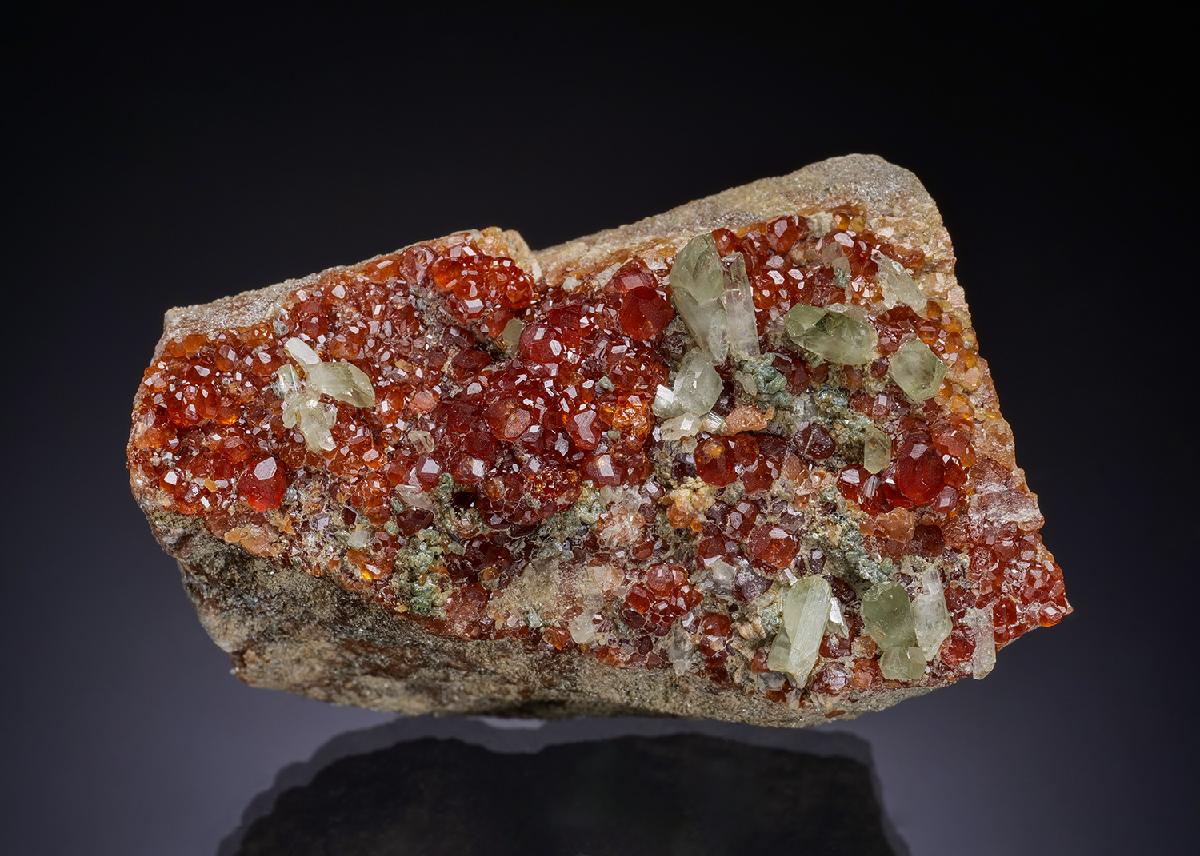
Photo: Crystal Classics
The locality’s mineralogical importance rests on its rodingites: calcium-rich, silica-undersaturated bodies and veins within serpentinite and metaophiolitic rocks of the Piemonte Zone of the Western Alps. These rocks record ocean-floor alteration, Alpine subduction, and later exhumation, and the garnets preserve that overprinted history in their color zoning, chemistry, crystal habit, and fracture textures. In the most studied material, the garnet chemistry ranges from grossular-rich grandite to nearly pure andradite, with irregular zoning that reflects repeated changes in fluid chemistry and metamorphic conditions.
Collectors know Ala Valley above all for hessonite from Testa Ciarva and Roch Neir, where sharp, lustrous, red-orange to brownish-red crystals occur with diopside and clinochlore. The scientific literature also notes yellow to light-yellow andradite of the topazolite variety, especially from Roch Neir, but these crystals are generally small and less important for cutting. Historically, Ala Valley garnet was not merely a scientific curiosity: orange-brown grossular known as hessonite was used in local traditional costume jewelry and as an engagement symbol in the valley.
The best specimens balance three things: saturated orange-red color, sharp modified dodecahedral form, and strong contrast with pale green diopside or greenish clinochlore. Large, clean gem rough is unusual; the locality’s reputation is built less on big faceted stones than on glittering Alpine specimen plates and old, well-provenanced cabinet pieces.
Search for specimens: View all garnet specimens from Ala Valley, Piedmont, Italy
Ala Valley, or Val d’Ala, is the central branch of the Lanzo Valleys in the Metropolitan City of Turin, Piedmont. The classic mineral localities lie around Balme, Pian della Mussa, Testa Ciarva, Roch Neir, and related outcrops and debris areas extending down-valley toward Ala di Stura and Curbassera.
The garnet deposit type is Alpine rodingite hosted by serpentinite. In the valley, antigorite serpentinite is the dominant ultramafic rock, enclosing metric to decametric rodingite lenses, layers, and veins. These rodingites are calcium-rich reaction rocks produced by metasomatic interaction between serpentinite and mafic rocks, later modified by Alpine metamorphism. The relevant assemblage is characteristic: calcium-rich garnet with diopside, epidote, chlorite or clinochlore, vesuvianite, titanite, calcite, magnetite, rutile, and other opaque minerals.
The broader geology belongs to the Piemonte Zone of the Western Alps, between the Gran Paradiso and Dora-Maira Penninic continental nappes. The rocks represent Mesozoic oceanic lithosphere—ultramafites, metagabbros, metabasalts, and calcschists—overprinted by Alpine metamorphism. Studies of the Val d’Ala metaophiolites describe greenschist- and blueschist-facies assemblages, with preserved eclogite-facies relics indicating pressures of at least 1.3 GPa and temperatures around 425–550 °C during subduction.
The best-known grossular localities are Testa Ciarva and Roch Neir near Pian della Mussa, where serpentinite cliffs contain boudinaged rodingite layers locally reaching about 2 m thick. Testa Ciarva is celebrated for the quality and quantity of hessonite-bearing material it produced, particularly specimens of red to orange-brown garnet with diopside. Roch Neir is especially associated with darker red garnet and small, bright yellow andradite/topazolite crystals lining fractures in mussite or diopside-rich rock, commonly with magnetite. Mount Tovo has yielded rounded to globular garnets, and Curbassera is known for grossular concentrations in brown rodingite lenses and in landslide debris.
This is a collecting and specimen locality rather than a garnet ore deposit. The Lanzo Valleys have a separate and much older mining history involving iron, silver, copper, and other metals, with medieval and early modern mining activity documented in the region. The garnet-bearing rodingites, however, entered mineralogical history principally through specimen collecting and study. The minerals of Val d’Ala—garnet, diopside, vesuvianite, epidote, and chlorite—were already well known by the 18th century, and the rodingite dikes were famous to mineralogists by the early 19th century.
Collecting access is not what it once was. Testa Ciarva was heavily worked in the past, including by the use of explosives, and modern sources describe the area as closed or forbidden for mineral collecting. Published geological work also notes that Testa Ciarva, the valley’s most exploited deposit, is now forbidden for sampling. Collectors should treat historical Ala Valley pieces as specimen-market material and should not assume that classic sites are open for field collecting.
Ala Valley garnet is chiefly calcium-rich garnet: grossular, hessonite, andradite, and grossular-andradite solid-solution material. The orange-red to brown-red hessonite variety of grossular, Ca3Al2(SiO4)3, is the collector’s classic. Yellow to light-yellow andradite, traditionally called topazolite, is also characteristic but generally much smaller. Rare andradite varieties described from the valley include melanite and demantoid, though these are not the locality’s dominant specimen style.
The typical specimen habit is a crust or cluster of lustrous crystals lining fractures, seams, and pockets in rodingite. Good hessonite crystals are often sharp dodecahedra with trapezohedral modifications; scientific work on cut and rough samples records combinations of rhombic dodecahedron and trapezohedron, with some reddish crystals also showing more complex faces including cube, trapezohedron, rhombic dodecahedron, and hexoctahedron. Some crystals are elongated, deformed, or irregularly grown, a feature especially prized when the crystal surfaces remain bright and gemmy.
Color is one of the locality’s strengths. Studied samples range from light yellow through jacinth to dark red. Faceted stones examined from Roch Neir II were orange-red, while faceted stones from Testa Ciarva were reddish orange. On specimens, the most attractive material tends to be red-orange, deep cinnamon, hyacinth-red, or orange-brown, with vitreous luster and enough transparency to glow under magnification. Some crystals are slightly polychrome, and uneven color may be caused by inclusions, cracks, or intergrown minerals.
Size varies sharply by type. Published work describes reddish crystals from about 1 to 3 cm, although many specimen crystals seen on matrix are only a few millimeters. Light-yellow andradite/topazolite crystals are typically smaller, up to about 4 mm in studied material, clear, and rhombic-dodecahedral. A Princeton University specimen records deep red grossular crystals to 3 mm on matrix, while commercial and auction examples commonly describe hessonite crystals in the 3–4 mm range on attractive cabinet-sized plates. Exceptional grossular crystals to about 20 mm have appeared in auction descriptions, but these are not the normal run of the locality.
The best associations are highly diagnostic. Pale green to gray-green diopside crystals on orange-red hessonite are the signature combination. Clinochlore provides green to blue-green contrast; calcite, chlorite-group minerals, vesuvianite, epidote, titanite, rutile, tremolite, magnetite, and other opaque minerals may also occur. The scientific thin-section assemblages include garnet with clinopyroxene, Mg-rich chlorite, tremolite, calcite, magnetite, rutile, titanite, and late andradite-rich veins.
Quality depends on scale and purpose. For display specimens, look for saturated orange-red color, undamaged crystal faces, strong luster, visible individual crystals rather than massive crust, and clean contrast against diopside or clinochlore. For systematic or locality collections, small yellow topazolite from Roch Neir and well-labeled hessonite from Testa Ciarva carry special interest. For cutting, Ala Valley garnet is attractive but limited: studied faceted stones showed vivid reddish-orange to orange-red colors and vitreous luster, but translucency, internal fractures, inclusions, and microcracking make gem-grade rough scarce.
Ala Valley garnet is a locality where provenance matters. Old labels naming Testa Ciarva, Roch Neir, Pian della Mussa, or Val d’Ala carry real value, especially when paired with the classic hessonite-diopside association. Broad labels such as “Piedmont, Italy” or “Italian hessonite” should be treated cautiously, because hessonite also occurs in other Italian Alpine rodingite localities, including Val d’Aosta, Val di Susa, Val di Viù, and Ligurian sites.
The most common authenticity issue is not treatment but mislocality. A genuine Italian hessonite specimen from another rodingite locality may resemble Ala Valley material. The strongest visual clues for classic Ala Valley are orange-red to hyacinth grossular on rodingite with pale green diopside and clinochlore, especially in the old European cabinet style. Still, precise locality should come from a credible label chain, dealer history, museum record, or documented collection provenance.
Condition needs careful inspection. Many crystals are small and sit on exposed seams, so edge bruising, rubbed luster, and broken crystal tops are common. Some specimens show old extraction damage on matrix edges or through crystalized surfaces. Scientific microtomography of faceted material documented widespread microcracking, pores, and fractures inside the garnet, so even attractive translucent crystals may have internal weakness. For specimens, this is part of the locality’s character, but for faceting it limits yield and clarity.
Treatment is rarely the main concern for matrix specimens. Faceted hessonite from Ala Valley should be evaluated like other garnet gems: check for natural inclusions, fractures, and locality documentation rather than expecting routine enhancement. The literature emphasizes inclusions such as clinochlore, diopside, calcite veinlets, and fractures; it does not frame Ala Valley garnet as a treatment-driven market.
Rarity is tiered. Small crusts of hessonite on matrix are obtainable. Good miniature and cabinet pieces with bright color, undamaged crystals, and diopside contrast are less common. Old pieces from major European collections, early labels, and closed or restricted collecting areas are significantly more desirable. Large, gemmy crystals, well-formed yellow topazolite, and major museum-quality hessonite-diopside plates are genuinely scarce.
The market is intermittent rather than abundant. Recent documented sales and listings show a wide spread: modest small-cabinet examples can appear in the low hundreds of dollars, while exceptional old or exhibition-quality grossular with clinochlore has reached several thousand euros. The strongest pieces sell on locality identity, aesthetics, association, and provenance, not just crystal size.
Ala Valley garnet has a social history as well as a geological one. In the valley, orange-brown hessonite was more than an attractive mineral: it was used in traditional costume jewelry and as a sign of engagement. That small detail explains why the material has always felt different from many Alpine garnets. It was collected, studied, worn, and remembered locally before it became a specimen-market classic.
One of the most evocative surviving threads is the Spada Collection specimen in Rome. The University Museum of Earth Sciences identifies a garnet from Testa Ciarva, Mussa, Val d’Ala, as one of the important samples from the Spada Collection, which entered the Museum of Mineralogy in 1852. Its description captures the old collector’s ideal of the locality: gem-quality transparency and luster, diopside crystals in association, and a red-hyacinth to deep-red color. Testa Ciarva is also given its local name, “Calva,” a reminder that the locality was not just a label on a drawer but a named rock in the landscape.
Testa Ciarva’s fame came at a cost. The locality became known for both the quality and the quantity of specimens it produced, and it was worked harder than any other garnet site in the valley. Museum and geological sources describe abundant past exploitation, including the use of explosives, and the site is now closed or forbidden for collecting. That history gives old specimens a particular gravity: a bright plate of hessonite and diopside is not merely pretty, but a survivor from a locality whose classic production cannot simply be repeated.
Roch Neir tells the complementary story. If Testa Ciarva is the emblem of red-orange hessonite, Roch Neir is tied to small, bright, yellow andradite/topazolite crystals and to the old diopside-rich “mussite” association. The early name “alalite” for diopside came from this region, and old European collections from the late 18th and early 19th centuries commonly contained the instantly recognizable pairing of orange-red hessonite and pale green diopside. On a good specimen the association has an almost theatrical color contrast: a garnet crust like burnt sugar, interrupted by glassy green prisms.
Modern documented specimens add their own small episodes. A Crystal Classics specimen collected in 1972 and formerly in the Mineralogical Museum at Humboldt University measures 70 x 43 x 40 mm, with hessonite crystals to 4 mm and diopside crystals to 9.5 mm. A closed MineralAuctions example from the Chet Lemanski collection, collected circa 1980, measured 11.1 x 8.6 x 4.7 cm and carried sharp reddish-orange hessonite crystals to about 3 mm on diopside and clinochlore. A Rossini auction lot described orange-brown, gemmy, elongated and curiously deformed grossular crystals to 20 mm on a 9 x 7 x 5 cm matrix, a piece exhibited in the 2015 prestige show at Sainte-Marie-aux-Mines. Such specimens show the range of Ala Valley material: from glittering small crystals that need magnification to appreciate fully, to rare, old, museum-scale examples where the crystals have enough size and eccentric form to command a room.
 Amethyst
 Quartz
 Fluorite
 Tourmaline
 Malachite
 Azurite
 Rhodochrosite