Panasasqueira is one of the great names in European mineral collecting, and fluorapatite is one of the minerals that made it so. The mine’s best crystals have the instantly recognizable Panasqueira look: lustrous hexagonal prisms and thick tabular crystals, commonly green to grey-green, blue-green, colorless, white, lilac, violet, or color-zoned, perched on glittering muscovite, siderite rhombs, arsenopyrite, quartz, pyrite, fluorite, or black bladed ferberite. A good Panasqueira apatite is not merely “green apatite”; it carries the whole visual grammar of the deposit—flat hydrothermal quartz veins, silvery mica selvages, sulfide sparkle, and the clean geometry of slowly grown phosphate crystals.
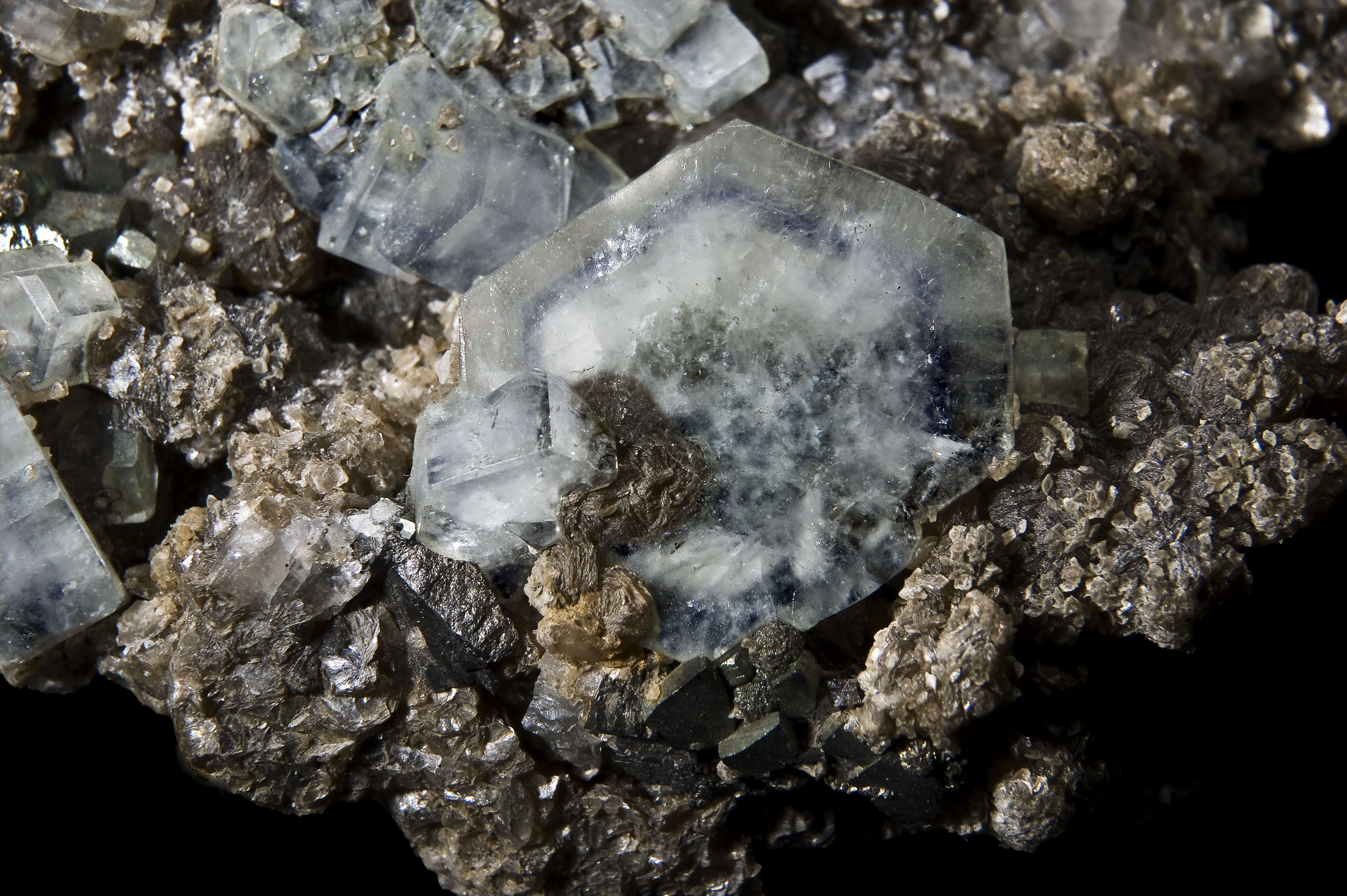
Photo: Wikimedia Commons
The deposit is a world-class W-Sn-Cu lode system in central Portugal, developed as stacked, subhorizontal quartz-wolframite veins in Beira schists above a concealed Variscan granite and greisenized cupola. These veins are thin by mining standards, but the open spaces within them were ideal crystal chambers. Wolframite, cassiterite, arsenopyrite, quartz, muscovite, siderite, and apatite grew in repeated pulses as the system opened, sealed, and reopened. The result is a suite of specimens whose aesthetics are inseparable from the deposit’s structure: crystals often appear as if they were set deliberately on mica-lined vein walls or on blade-like ferberite.

Photo: Wikimedia Commons
Scientifically, Panasqueira fluorapatite has been important for decades because its zoning, trace-element chemistry, and relationships with muscovite, wolframite, topaz, and sulfides record changes in the ore-forming fluids. Larger crystals may show clear growth zones, color zoning, corrosion by later quartz or muscovite, and partial overgrowths by mica rosettes. The mine’s fluorapatite is also significant historically: Panasqueira has operated, with interruptions, for well over a century as a tungsten mine, while collectors have watched successive production levels yield classic mineral specimens.
Collectors prize Panasqueira fluorapatite for sharpness, luster, undamaged terminations and edges, attractive color, and association. Violet and purple color-zoned crystals are especially coveted; green and blue-green crystals with strong transparency are the locality’s workhorse classics. Matrix matters greatly. A single gemmy crystal on clean muscovite can be superb, but the top pieces are true combinations: fluorapatite with siderite, arsenopyrite, quartz, ferberite, pyrite, fluorite, or muscovite in a balanced miniature or small-cabinet arrangement. The very best examples have enough transparency to reveal internal color zoning, enough contrast to separate the crystal from the matrix, and enough locality character that they could hardly be confused with material from anywhere else.

Photo: Wikimedia Commons
Search for specimens: View all fluorapatite specimens from Panasqueira Mines, Portugal
The Panasqueira Mines lie in central Portugal, in Castelo Branco District, in the mountainous country southwest of Covilhã. The modern mining center is at Barroca Grande near Aldeia de São Francisco de Assis, while the historical workings and associated sites include Cabeço do Pião, Rio, Vale das Freiras, Vale da Ermida, Panasqueira, and Barroca Grande. The mining concession is the long-lived Couto Mineiro da Panasqueira, today a tungsten-tin operation rather than a specimen mine.
Geologically, Panasqueira is a granite-related hydrothermal lode deposit. The ore occurs mainly in a dense swarm of subhorizontal quartz veins hosted by metamorphosed Beira schists of the Schist-Greywacke Complex. The mineralized veins are spatially related to a concealed late Variscan granite and a greisenized cupola. Individual quartz veins are commonly thin—around a few tens of centimeters on average—but may persist laterally for considerable distances and locally contain vugs lined with large, well-formed crystals. The tungsten-bearing veins dip gently, in contrast to an older set of subvertical quartz veins known locally as “Seixo Bravo,” which are not the main wolframite-bearing ore.
Mining began as tungsten became an industrial metal of strategic importance. The mining company was founded in 1896, and by the early twentieth century ore was being brought to a treatment plant near Cabeço do Pião on the Zêzere River. In 1912 an aerial ropeway more than five kilometers long carried ore from Panasqueira workings to the Rio plant. The First World War accelerated production, and the Second World War brought the mine to one of its great peaks: thousands of employees worked directly for the operation, while additional independent miners recovered small quantities from surface veins and sold ore back to the company.
The mine has repeatedly expanded and reorganized with the tungsten market. In the twentieth century it passed through the Wolfram Mining and Smelting Company, Beralt Tin & Wolfram, Charter Consolidated, Minorco, Avocet, Primary Metals, Sojitz, and ultimately Almonty Industries, which acquired control in 2016. Mechanization changed the underground method from older longwall-style stoping toward room-and-pillar mining. A deeper Level 2 came into production in the early 1980s, and Level 3 haulage was developed later; current planning has focused on a still deeper Level 4 extension.
For collectors, the crucial point is that Panasqueira is an active industrial mine, not an open collecting locality. Specimens historically entered the market through miners, mine personnel, local channels, dealers, and old collections. Modern access underground is controlled by the operating company, and casual collecting in the active mine should not be assumed. Old collection pieces, dealer-held stock, and specimens recovered during ongoing operations keep the locality visible in the market, but the best pieces are still finite, carefully traded mineral specimens rather than common field-collected material.
Notable finds include the classic green and blue-green fluorapatites on muscovite, sharply zoned purple and colorless crystals, crystals on ferberite blades, and combination specimens with siderite, arsenopyrite, pyrite, quartz, fluorite, and cassiterite. Panasqueira also produced type-locality phosphate species such as panasqueiraite and thadeuite, underscoring how unusual and chemically rich the phosphate assemblage is. For collectors, however, fluorapatite remains the emblematic phosphate of the mine: the mineral that links Panasqueira’s science, mining history, and specimen aesthetics.
Panasqueira fluorapatite is most often seen as short to stout hexagonal prisms, thick tabular crystals, barrel-shaped crystals, and flattened color-zoned crystals with broad basal faces. The prism faces may be strongly lustrous and striated; basal faces may be glassy, frosted, or zoned. Many crystals are not tall prisms in the pegmatite sense, but compact hydrothermal crystals with a strong architectural presence: broad faces, clean edges, and a squat, powerful geometry.
The most familiar colors are green, grey-green, and blue-green. Better pieces can be transparent to translucent, with smoky internal zones, pale rims, or deep green cores. Purple, lilac, violet-edged, and colorless-to-purple zoned crystals are especially desirable. Some of the classic violet material shows a “bull’s-eye” or concentric zoning effect when viewed down the c-axis, with a pale or colorless center and a purple outer zone. Collectors also encounter pale blue, white, nearly colorless, and occasionally more complex bicolored crystals.

Photo: Wikimedia Commons
Typical matrix associations are a major part of identification and value. Silvery muscovite is one of the most characteristic hosts, commonly forming sparkling plates or rosettes around the fluorapatite. Siderite appears as tan to brown rhombs or bladed aggregates. Arsenopyrite provides brilliant silver metallic contrast, often as sharp prismatic crystals. Quartz may be milky or transparent; ferberite occurs as black to dark metallic blades; pyrite can form bright brassy accents; fluorite, calcite, dolomite, chalcopyrite, sphalerite, cassiterite, chlorite, and topaz are also recorded in the broader assemblage.
Crystal size ranges widely. Small but sharp crystals under 1 cm are common on matrix and can be attractive when numerous and undamaged. Miniature specimens with crystals in the 1–2 cm range are highly collectible if the luster and composition are good. Crystals of 2–4 cm, especially if transparent, well-zoned, and aesthetic on matrix, are significant. Larger crystals exist and are famous, but many show natural corrosion, edge wear, repairs, or incomplete attachment simply because large apatite crystals are vulnerable and the mine’s matrix minerals are hard, angular, and unforgiving.
The internal structure of Panasqueira fluorapatite is one of the locality’s signatures. Lagerwey’s trace-element work emphasized the variety of colors and habits, the dominance of green to grey-green short prismatic crystals, the common basal pinacoid, alternating prism faces that can create conspicuous striation, and the importance of color zoning. Many crystals formed in or near early muscovite selvages and may be based on wolframite, quartz-wolframite aggregates, or mica-rich vein borders. Later muscovite and quartz can corrode or overgrow fluorapatite, giving some crystals irregular surfaces or partially obscured outlines.
Quality is judged first by luster and crystal integrity. A top Panasqueira crystal should have a wet, glassy surface rather than a dull, etched skin. Color should be attractive and, ideally, zoned or sufficiently saturated to stand out from the matrix. Transparency is valuable, but not mandatory; some excellent green crystals are more translucent than gemmy. Composition is crucial: a single crystal centered on muscovite may outrank a larger but clumsy cluster, while a balanced combination with siderite, arsenopyrite, ferberite, quartz, or fluorite can be more desirable than an isolated crystal of similar size.
Fluorescence is a useful bonus but not the main market driver. Some Panasqueira fluorapatites fluoresce yellow under ultraviolet light, and collectors of fluorescent minerals may value this, particularly on specimens that already have strong daylight aesthetics. Fluorescence should be treated as an added layer of interest rather than a substitute for form, luster, damage-free edges, and locality character.
Panasqueira fluorapatite is common enough in the market that serious collectors can usually find examples, but fine pieces are not common in the meaningful sense. Small green crystals on muscovite or quartz appear regularly. Attractive miniatures with sharp crystals, good zoning, and balanced matrix command stronger prices. Purple-zoned crystals, large undamaged crystals, ferberite combinations, and highly aesthetic cabinet pieces can be very competitive, especially with old provenance or publication history.
The main authenticity concern is not a broad wave of fake Panasqueira fluorapatite, but the familiar specimen-market issues of undisclosed repair, reattachment, trimming, and overly vague locality data. Apatite has perfect to good cleavage and is less durable than quartz, wolframite, or arsenopyrite; crystals can pop off matrix, chip along basal or prism edges, or be reattached after extraction. Repairs are documented on Panasqueira fluorapatite specimens in public specimen records, and a well-executed repair can be almost invisible. On major pieces, disclosure matters. Ask specifically whether crystals are repaired, reattached, or stabilized.
Condition issues are predictable. Look closely at the six prism edges and the perimeter of the basal face; small corner chips are common. Broad basal faces may show bruising, frosted patches, or contact marks. Green crystals on siderite and muscovite can be partly corroded or overgrown by later minerals, which may be natural rather than damage. Ferberite combinations are dramatic but can be fragile, with apatite attached to sharp, heavy blades. Siderite may cleave; arsenopyrite and pyrite may have sharp points that abrade adjacent crystals during transport.
Color and photography deserve caution. Panasqueira fluorapatite can shift subtly between green, blue-green, grey-green, and violet depending on lighting. Some stones that look vividly blue or purple in photographs are paler in hand, while some color-zoned crystals are difficult to photograph accurately. For high-value purchases, request images under neutral daylight-equivalent lighting, a side view showing attachment, and close-ups of terminations and edges. UV photographs should not be used to judge daylight color.
Older labels may use “apatite,” “apatite-(CaF),” “fluoroapatite,” “fluorapatite,” or even obsolete varietal language. For modern cataloging, fluorapatite is the appropriate species name for the fluorine-dominant apatite-group mineral, formula Ca5(PO4)3F. Historical labels reading simply “apatite, Panasqueira” are normal and should not be dismissed, but the specimen’s actual identity should still be consistent with Panasqueira fluorapatite habit and associations.
Because the mine is still active and has produced specimens over many decades, “old Panasqueira” can mean different things. A 1970s piece, a 1990s Level 2 specimen, a Level 3 specimen, or a recent recovery may all be legitimate. When evaluating provenance, prioritize original labels, published photographs, named collections, and consistent locality detail. A published or ex-collection Panasqueira fluorapatite is often worth a premium when the specimen itself is strong.
At the entrance to Panasqueira, the mine announces itself not with a collector’s cabinet but with a workplace ritual. Beside the board where workers confirm entry into the mine stands a small statue of Santa Bárbara, patron saint of miners. From there the mountain swallows the visitor quickly: more than a hundred meters of rock overhead, darkness broken by the beams of helmet lamps, and the long descent toward Level 2.
A recent report from inside the mine described the approach as a sloping drive more than two kilometers from the entrance at the 560-meter elevation. After that, the route threads through a wet maze of tunnels and galleries down toward about 470 meters above sea level. The writer’s scene is not romanticized; it is industrial and damp, the galleries “profusely flooded” by recent rain, and the work front is reached through the kind of darkness in which every mineral specimen began as ore, wall rock, and risk before it became a cabinet piece.
The numbers give the place its scale. More than a century of mining has left over 5,000 kilometers of tunnels and galleries, cut by five generations of miners. Each day, the mine reportedly advances by more than 100 meters—about two kilometers per month. The present workforce is about 250 people, but during the Second World War Panasqueira reached an entirely different order of intensity: more than 5,700 workers directly employed, plus thousands of independent miners selling wolframite by the kilogram to the company.
The daily routine of discovery is still organized around drilling, blasting, mucking, and following the vein. Manuel Pacheco, technical director of the mine, described more than 100 active work fronts distributed across 12 mining areas. The quartz veins being pursued are narrow by any collector’s fantasy of a crystal cavern: commonly 30 centimeters to one meter thick, set in metamorphosed schist. Explosives are placed in drill holes with compressed-air equipment, the holes are sealed with clay, and blasts occur from one o’clock in the morning—about 60 explosions per night. Dust is drawn away through ventilation raises; the blasted areas are watered; the 7 a.m. shift begins removing broken rock.
The room-and-pillar geometry has its own stark order. Galleries are opened five meters wide in north-south and east-west directions to define pillars of 11 by 11 meters. Those pillars can later be recovered on retreat, ultimately leaving smaller 3 by 3 meter pillars. Ore moves by mechanical loaders and wagons to an underground crusher, then travels by a 1,200-meter conveyor belt to the processing plant. Somewhere in that chain, when luck and care align, a pocket that could have become only mill feed instead yields a fluorapatite on muscovite, a siderite-apatite combination, or a ferberite blade carrying a green hexagonal crystal.
Panasqueira’s modern life is tied to tungsten markets as surely as its specimens are tied to quartz veins. The mine has stopped three times across its long history: after the First World War, after the Second World War by government order, and from 1993 to 1995 during a tungsten price slump. During the 1993 closure, when the operation employed about 700 workers, Beralt Tin & Wolfram helped compensate some employees by transferring houses in the Barroca Grande workers’ neighborhood at symbolic prices. That detail is worth remembering when handling a fine specimen: the locality is not just a name on a label, but a mining community whose fortunes have followed the metal in the black wolframite blades.
The future, too, is being driven downward. António Corrêa de Sá of Beralt has described a project to open a new Level 4, the deepest level at Panasqueira. The company’s public project materials describe a plan to deepen existing infrastructure by about 120 meters, improve drainage and ventilation, and follow the orebody downward. For collectors, that does not guarantee specimens; industrial mines do not operate for mineral cabinets. But every new level in Panasqueira carries the possibility of fresh vein pockets, and every pocket belongs to the same long geological system that has already produced some of Europe’s most recognizable fluorapatites.
 Amethyst
 Quartz
 Fluorite
 Tourmaline
 Malachite
 Azurite
 Rhodochrosite


