Tsumeb dioptase is the collector’s ideal of the species: deep, slightly bluish emerald-green crystals, bright enough to seem lit from within, often set against white calcite or dolomite so that the color reads with maximum force. Fine examples have a combination that is hard to duplicate elsewhere: transparency in the terminations, sharp short-prismatic form, glassy to almost sub-adamantine luster, and a crisp architectural look on pale carbonate matrix.

Photo: Wikimedia Commons / Didier Descouens
The mine’s reputation rests on far more than beauty. Tsumeb was a polymetallic pipe-like copper-lead-zinc-silver deposit hosted in the Otavi Mountainland carbonates of northern Namibia, and its unusual vertical oxidation history produced one of the richest secondary-mineral assemblages known. Dioptase was not simply an attractive accessory there; it became one of the signature minerals of the locality and one of the standards by which world-class dioptase is judged.
The great Tsumeb dioptase era belongs chiefly to the second oxidation zone, especially the deeper workings around the 29th to 33rd levels. Earlier assumptions that the famous near-surface “Green Hill” was rich in dioptase are not well supported by preserved collections. The strongest specimen record comes later, when the mine intersected silicified and ferruginized parts of the ore body at depth. Those zones yielded pockets of gemmy dioptase in quantity and quality sufficient to transform the mineral’s standing in modern collecting.

Photo: Wikimedia Commons / Didier Descouens
Collectors look first for the unmistakable Tsumeb color: saturated green with a cool bluish cast rather than yellowish or olive tones. The most desirable specimens combine individual, well-separated crystals with good terminations, undamaged edges, and strong contrast on calcite or dolomite. Cluster specimens without much matrix can be superb, especially when the crystals form sculptural groups, but the classic “Tsumeb look” is emerald-green dioptase perched on white carbonate.
Search for specimens: View all dioptase specimens from Tsumeb, Namibia
The Tsumeb Mine, also known historically as the Tsumcorp or Ongopolo Mine, is at the town of Tsumeb in Namibia’s Oshikoto Region. Geologically it was an irregular, steep, pipe-like ore body cutting through Neoproterozoic carbonate rocks of the Otavi Group. The pipe contained feldspathic sandstone, sandstone breccias, dolomite breccias, and massive to disseminated sulfides rich in copper, lead, zinc, silver, arsenic, cadmium, gallium, germanium, and other elements. That combination of metals, carbonate host rock, brecciation, open spaces, and repeated oxidation is the reason Tsumeb produced such astonishing mineral diversity.
The deposit is famous for three oxidation zones. The first extended from surface down through the upper mine levels; the second lay much deeper, centered around the North Break Horizon where it intersected the pipe; and a third oxidation zone was later recognized still deeper, beginning around the 42nd level. Tsumeb dioptase is tied most strongly to the second oxidation zone, where silicification and ferruginization created favorable conditions for copper silicate crystallization in cavities, country rock, and carbonate-lined openings.
Mining began in pre-colonial times at the copper-rich outcrop and moved into commercial production under the Otavi Minen und Eisenbahn Gesellschaft after the German colonial period brought organized development. Trial shafts were started in 1900, while full commercial production followed after the railway made large-scale export practical. After World War II, mining resumed under Tsumeb Corporation Limited, and deepening of the workings revealed the second oxidation zone that later supplied many of the great dioptase specimens.
For dioptase collectors, the critical production interval was not the earliest mining period but the late 1960s through the 1980s. The dioptase zone, essentially the 29th to 32nd levels, became one of the great specimen-producing intervals in the history of the mine. The 30th level yielded numerous pockets, including material from the S110 Stope and E19 area. The 32nd level, especially Zero Stope, is remembered for exceptional dioptase on white calcite. The 33rd level produced the rare and highly prized association of dioptase with gemmy cerussite on white calcite in 1975. Deeper, on the 44th level in the third oxidation zone, dioptase appeared with malachite and conichalcite, and in another striking association with chromate-yellow wulfenite.
Large-scale mining ceased in the mid-1990s. The mine workings ultimately flooded after 1996, and later attempts at specimen-oriented working were short-lived. Tsumeb is therefore not a modern collecting locality in the practical field-collecting sense. Material in today’s market comes from old mine production, historical dealer stocks, collections, estate dispersals, and auction circulation. Collectors visiting Namibia should treat mineral acquisition as a regulated activity: Namibia requires permits for collected or purchased mineral material, and commercial export has additional requirements.
Tsumeb dioptase is usually short prismatic rather than long prismatic. The common habit is built from the hexagonal prism and rhombohedral terminations, producing blocky, sharply terminated crystals that often look more compact than material from the Kaokoveld and some other Namibian localities. Rarely, additional bevels or a pinacoid modify the form and can give individual crystals a slightly pseudo-cubic impression.
The best color is a deep emerald green with a faint blue component. Under strong light the crystals can flash a glowing green through the terminations; under poor light or inaccurate photography they may look too blue, too black, or too flat. Tsumeb dioptase is notoriously difficult to photograph because the color is both saturated and internally luminous.
Typical high-quality crystals are small but intense. Flawless gemmy crystals around 5 mm are common enough in Tsumeb material that they do not by themselves make a specimen exceptional. Crystals around 1 cm are well within the classic range and are important when sharp, isolated, and well placed. Crystals reaching several centimeters are far scarcer and move a specimen into the serious trophy category when the condition and aesthetics support the size. Reliable published collector literature records crystals to about 5 cm; larger claims should be treated cautiously unless tied to a specific, documented specimen.
Calcite is the classic matrix partner and provides the most coveted contrast, especially when white or translucent rhombohedrons support discrete green crystals. Dolomite is also important, and quartz-rich or siliceous matrix occurs in some parageneses. Common and notable associates include duftite, plancheite, malachite, conichalcite, cerussite, smithsonite, mottramite, minrecordite, wulfenite, quartz, and dolomite. Azurite with dioptase is a much rarer Tsumeb combination than casual collectors might assume.
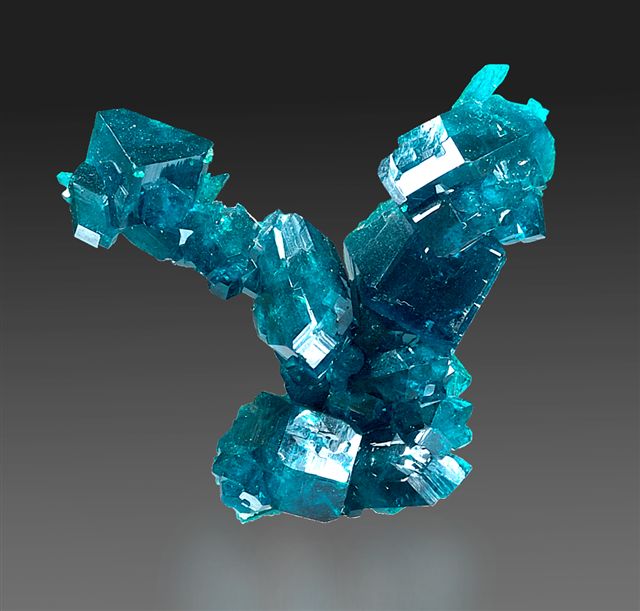
Photo: Wikimedia Commons / Rob Lavinsky, iRocks.com
The most collectible Tsumeb dioptase specimens fall into several recognizable types. The first is the classic cabinet or miniature specimen with sharp, gemmy green crystals on white calcite. The second is the sculptural group of large, intergrown dioptase crystals with little matrix, judged by transparency, crystal size, three-dimensional form, and freedom from chipping. The third is the association piece: dioptase with cerussite, minrecordite, wulfenite, plancheite, malachite, or conichalcite, where rarity of the combination can rival pure dioptase aesthetics.
Minrecordite deserves special attention because it is intimately tied to Tsumeb dioptase collecting. The mineral was first recognized on a Tsumeb dioptase specimen and commonly occurs as tiny colorless to milky-white, saddle-shaped rhombohedral crystals that are easy to confuse with dolomite or calcite. On a specimen label, “minrecordite with dioptase” is meaningful only when supported by analysis or a reliable provenance trail.
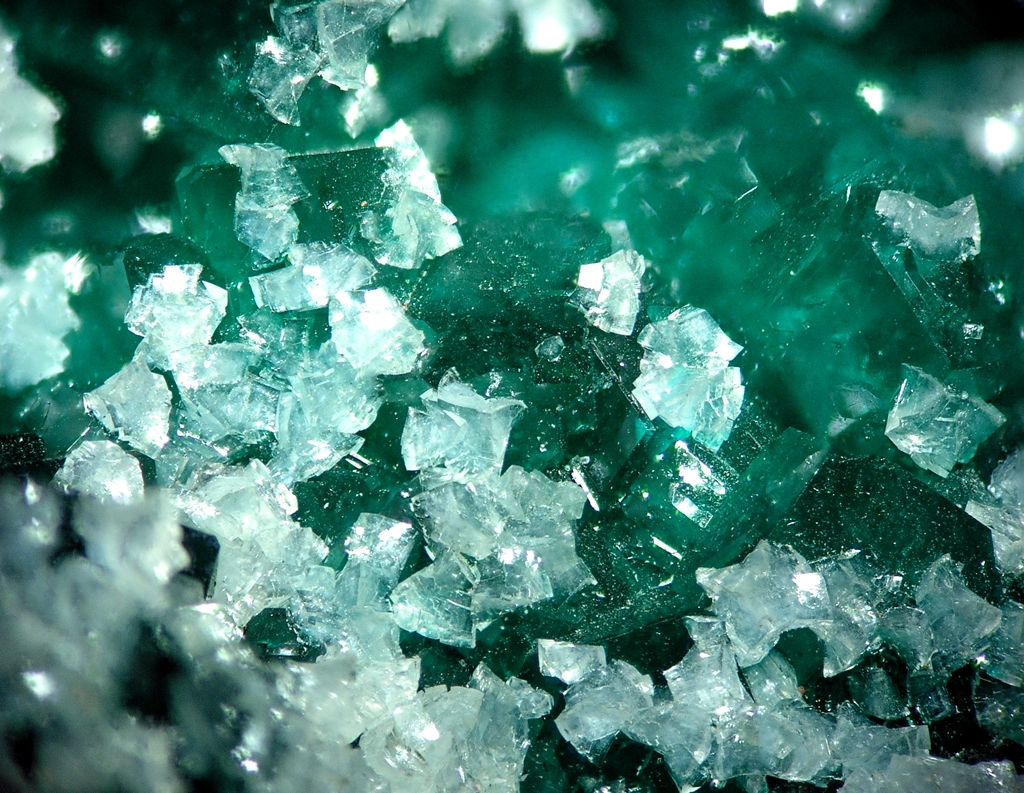
Photo: Wikimedia Commons / Joachim Esche
Quality is controlled by the same factors that matter in other elite secondary copper minerals, but Tsumeb raises the standard. Look for saturated color without blackened, opaque centers; intact terminations; clean crystal edges; strong luster; balanced placement on matrix; and minimal iron staining unless the specimen is a known red-matrix type from a specific stope. White calcite matrix, when undamaged and naturally proportioned, adds value because it frames the green crystals so effectively.
Tsumeb dioptase is not routinely treated in the gemological sense. The color is inherent to the copper-bearing mineral, and convincing dyed or glass imitations are not the normal problem in the serious specimen market. The real issues are attribution, repair, restoration, and condition.
Attribution matters because “Namibia” is not automatically “Tsumeb.” Namibia has other dioptase localities, including Kaokoveld occurrences that may show longer prismatic crystals and different matrix character. Congolese dioptase is also common on the market and may be sold casually as “African dioptase” without precise locality. A convincing Tsumeb attribution should be supported by old labels, dealer provenance, recognizable matrix and habit, or association minerals consistent with the mine.
The most frequent condition issue is edge damage. Dioptase has perfect cleavage and is brittle; even small contacts on terminations can be visually important because the luster and color are so intense. Inspect crystal tips and prism edges under magnification. On matrix pieces, look around the bases of large crystals for glue lines, filled gaps, or unnatural seating. Repairs are not automatically fatal on an important Tsumeb specimen, but they should be disclosed and priced accordingly. A reattached original crystal is different from a transplanted crystal from another specimen.
Cleaning history is worth asking about. Acid cleaning can brighten carbonate-associated specimens but dioptase itself is vulnerable to etching and surface dulling under improper preparation. Over-cleaned examples may lose the crisp glassy face quality that distinguishes fine Tsumeb material. Iron staining, sawn bases, and trimmed matrix are common enough to evaluate case by case; none is inherently disqualifying, but each affects value.
Rarity is strongly tiered. Small Tsumeb dioptase thumbnails and miniatures remain available because the mine produced a great deal of material, and old collections continue to release specimens. Fine large crystals, undamaged calcite-matrix pieces, documented Zero Stope examples, dioptase with cerussite, and confirmed minrecordite combinations are much scarcer. Top pieces are no longer being mined, so the best examples tend to move from one advanced collection to another rather than appearing as fresh commercial supply.
For a locality so deeply associated with dioptase, Tsumeb’s early record is surprisingly quiet. Pre-war cabinets from the mine are rich in azurite, cerussite, smithsonite, and other classics, yet dioptase is largely absent. Wilhelm Klein, who managed at Tsumeb between the World War I era and the late 1930s and carefully recorded mine levels on many specimens, considered dioptase “a great rarity” in the upper workings. That absence matters. It suggests that the mineral now so closely identified with Tsumeb became a collector phenomenon only after the mine reached the deeper oxidation zones.
The story changes underground in the second oxidation zone. On the 30th level, miners broke into pockets that Charles Key later remembered for “dark emerald-green dioptase.” Some pockets were large, and the production ran into thousands of specimens. That is the moment when Tsumeb dioptase ceased being a curiosity and became a defining mineral of the mine.
Clive King, who worked as an underground geologist for Tsumeb Corporation Limited in the early 1980s, left a particularly useful recollection of what was coming out when he arrived. Dioptase was being recovered from 30 level, especially S110 Stope and E19. Much of it was not the white-calcite trophy material collectors now chase most aggressively; he remembered many crystals as “small and sugary,” sitting on red earthy matrix. That detail is valuable because it explains why not all genuine Tsumeb dioptase looks like the textbook green-on-white cabinet specimen.
Then Zero Stope on the 32nd level came back into production in the early 1980s. King regarded that stope as the source of some of the best Tsumeb dioptase, especially specimens on white calcite. It was also the last stope before the crown pillar; after it was mined out, the area was abandoned for years. For collectors, a credible Zero Stope provenance gives a specimen more than an address. It places the piece in one of the remembered high points of Tsumeb dioptase production.
One of the strangest later episodes belongs far deeper, in the third oxidation zone. On the 44th level, about 30 specimens were found with dioptase crystals up to 1 cm, associated with malachite and conichalcite. A separate third-zone discovery produced one of Tsumeb’s great color shocks: chromate-yellow wulfenite crystals sprinkled over emerald-green dioptase. The combination is almost theatrical, and it could only have come from a mine whose chemistry was as varied as its mineral record.
Minrecordite entered mineralogy in a quieter but very Tsumeb way: as a puzzle on a dioptase specimen. Italian collector Gian Carlo Fioravanti received a Tsumeb dioptase in an exchange, and small white microcrystals on it were first thought to be willemite. Closer scrutiny showed that the habit did not fit, and analysis revealed a zinc-rich carbonate member of the dolomite group. The new species was named minrecordite in honor of The Mineralogical Record, acknowledging the magazine’s role in connecting professional mineralogists and serious collectors. The holotype went to the museum of the Università di Bari. For the collector, that story turns tiny white crystals on green dioptase into one of the most satisfying labels a Tsumeb specimen can carry.
 Amethyst
 Quartz
 Fluorite
 Tourmaline
 Malachite
 Azurite
 Rhodochrosite


