Jegdalek is the classic Afghan ruby locality: a marble-hosted corundum deposit east of Kabul that has supplied bright red ruby, pink sapphire, and subordinate blue or bicolored sapphire to the gem and mineral trade for centuries. For collectors, the most desirable specimens show sharp, lustrous ruby crystals rising from pale calcite-marble matrix, often with the glowing raspberry-to-pigeon’s-blood color and strong red fluorescence expected of low-iron, chromium-colored marble-type ruby. The visual contrast is the locality’s signature: red corundum on white marble, sometimes accented by phlogopite, pyrite, graphite, or other dark inclusions.
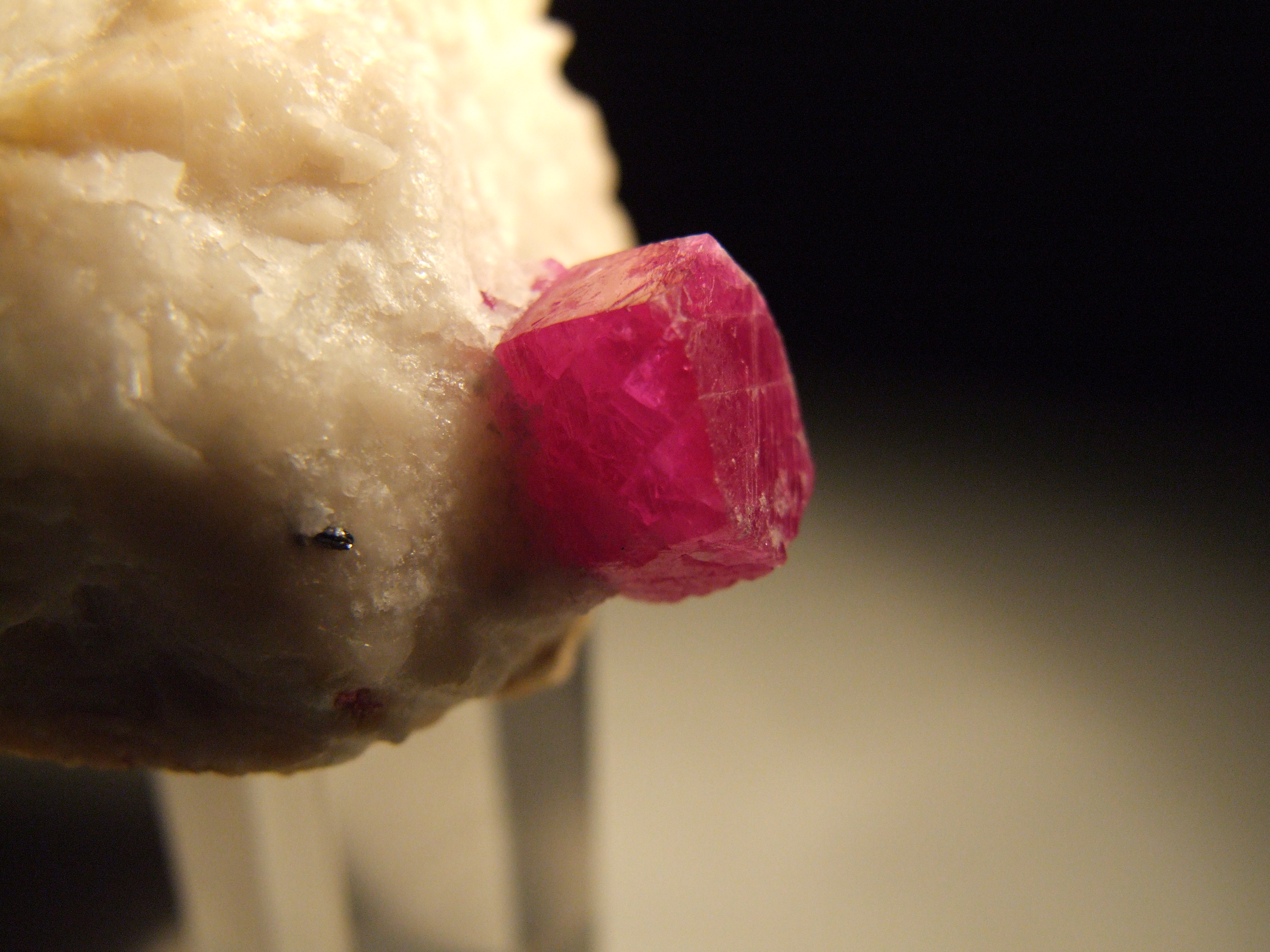
Photo: Wikimedia Commons
Geologically, Jegdalek belongs to the great belt of Central and South Asian marble-hosted ruby deposits linked to the India–Asia collision. The corundum occurs in calcite to calcite-dolomite marble within a metamorphic sequence of marbles and gneisses, intruded locally by granitic and pegmatitic rocks. This is the same broad genetic family as Mogok in Myanmar, Hunza and Nangimali in Pakistan, Nepalese ruby localities, and northern Vietnamese ruby deposits: silica-poor carbonate rocks, chromium-bearing impurities, regional metamorphism, and local fluid activity combined to create red Al2O3 in a marble host.
The locality is also important historically. Jegdalek, under spellings such as Jagdalek, Jagdalak, and Jagdalik, has appeared in gem literature for well over a century, and the mines are commonly described as having been worked for more than 700 years. Nineteenth-century observers reported local extraction with hand tools; a century later, gemologists still found miners breaking marble with hammers, picks, prybars, occasional pneumatic drills, and dynamite. That continuity gives Jegdalek an unusual place in mineral collecting: it is both a living artisanal mining district and a classic specimen source.

Photo: Wikimedia Commons
The finest mineral specimens are not simply chunks of ruby-bearing marble. Collectors look for terminated or partly terminated crystals with recognizable corundum morphology, saturated red color in daylight, strong fluorescence, clean presentation on matrix, and minimal bruising to the crystal edges. Most Jegdalek corundum is fractured, translucent, semitransparent, or cabochon quality; truly gemmy, well-formed, matrix specimens are much scarcer and command a premium.
Search for specimens: View all corundum specimens from Jegdalek Ruby Deposit, Afghanistan
The Jegdalek ruby deposit lies in Surobi District, Kabul Province, Afghanistan, roughly east to east-southeast of Kabul in the southern part of the Surobi region. Published locality coordinates cluster near 34°26′N, 69°49′E, and Mindat places the deposit at 34.43333, 69.81667. The broader mine field includes named workings such as Chak, Chongay, Karoon-Sapara, Lal-Poor, Loy-Khan, Mirkalwat, Njoni-Ghala-Spai, Pahra-Dar-Khana, Taghar, and Warmankai, along with many smaller unnamed diggings.
The deposit is hosted by calcite to calcite-dolomite marble, with marble horizons reported from narrow beds to hundreds of meters thick. Mindat summarizes the deposit as corundum hosted in calcite-dolomite marble up to about 2,000 m thick, with the mine field worked by about 20 mines from more than 2,000 open pits and trenches. The ore field also includes skarns and muscovite-bearing pegmatites and lies in the western part of the Surkh-Rod pegmatite field. GIA’s detailed study describes interstratified Proterozoic gneisses and marbles of the Nuristan series, striking roughly east-west, with marble horizons extending hundreds of meters to several kilometers.
The local geology is especially important for understanding the specimens. Ruby and sapphire occur in two principal mineralized marble zones, north and south, separated by several hundred meters and joined toward the west. The vertical extent of mineralization is reported at more than 400 m. Within the marble, corundum is concentrated in irregular lenses and thin zones, rather than as broad, continuous ore. Older descriptions and later gemological work agree that the ruby-bearing marble is coarse grained and that corundum is irregularly distributed, commonly in small pocket-like concentrations.
Mining has remained artisanal for much of the deposit’s recorded history. In the 1880s, C. L. Griesbach wrote of hundreds of men extracting ruby with hammer and chisel. In the 1990s, Gary Bowersox observed strikingly similar methods: marble broken by hand tools, occasional drills and explosives, rock lifted from pits by simple pulley systems, and miners sorting corundum in shelters built from the excavated marble. The GIA study reported around 400 miners active at the time, usually working in small groups, with larger mines operated by groups of 15 to 20.
Jegdalek’s production is heavily weighted toward non-ruby corundum. GIA estimated approximately 75% pink sapphire, 15% ruby, 5% mixed blue and red-to-pink corundum, and 5% blue sapphire. Because much of the material is semitransparent, most is suitable for cabochons, carving, or specimen use rather than faceting. Only a small fraction is facet grade, though exceptional stones have been cut; GIA noted fine faceted rubies up to 32 ct, while top-quality material rarely exceeds 5 ct. The largest crystal seen by the senior author of the GIA study weighed 174 ct, and typical semitransparent rough was reported up to about 1.5–3.0 cm.
Access for collectors should be understood as market access, not casual field collecting. Jegdalek is an active mining area in a politically sensitive and historically dangerous region. Permission, security, land and mineral rights, and local conditions are serious matters; published field accounts repeatedly describe military escorts, unstable control of mining areas, and illegal or informal distribution channels. For most collectors, legitimate purchase from established dealers, with careful attention to provenance and ethics, is the realistic path to acquiring Jegdalek material.
Jegdalek corundum is Al2O3, with ruby color produced by chromium and sapphire colors reflecting different trace-element and color-zoning relationships. The rubies range from red to purplish red, often with a vivid raspberry or “pure” red appearance in the best stones. Fancy-color sapphires from the same deposit may range from bluish violet through violet and purple to reddish purple, and some stones show both blue and red or pink zones in a single crystal. Pure blue sapphire is much less common than pink sapphire or ruby.
Crystal morphology is one of the delights of Jegdalek specimens. GIA described the corundum as typically subhedral, though attractive euhedral crystals occur. Smaller crystals tend to be sharper, with distinct faces and crisp edges; larger crystals are usually more modified and more likely to show damage, rounding, or irregular development. The dominant crystal habits are dipyramidal, with hexagonal dipyramidal faces, subordinate basal pinacoid faces, and positive rhombohedral faces. Collectors often describe the best display crystals as pseudo-hexagonal or pseudo-octahedral because of their modified, equant ruby form.
Specimen crystals commonly sit in white to grayish marble or calcite matrix. Phlogopite is a classic companion and may form tan to brownish micaceous bands or books. Pyrite appears as metallic brassy accents in some specimens, and graphite may occur as dark inclusions or flakes. Mindat’s species list for the deposit includes calcite, chlorite-group minerals, corundum including ruby and sapphire, garnet-group minerals, graphite, margarite, muscovite, orthoclase, phlogopite, plagioclase, pyrite, spinel, titanite, and tourmaline. Gemological studies of polished stones also identify calcite, apatite, zircon, mica, iron sulfides, graphite, rutile, and aluminum hydroxide phases as inclusions.
The most characteristic internal features are not subtle. Jegdalek rubies commonly show dense healed and unhealed fractures, lamellar twin planes, and color zoning. These features reduce transparency in much of the production and explain why the deposit yields far more cabochon and specimen material than clean faceting rough. Under magnification, many stones show partially healed fracture planes with a frosted texture, nonhealed fractures, twin planes parallel to rhombohedral directions, and narrow blue zones cutting through red or pink corundum. Some blue zones form bands; others create geometric patterns controlled by the crystal’s growth planes.
Fluorescence is a major part of the locality’s appeal. The rubies typically fluoresce medium to strong red under long-wave ultraviolet light and weaker red under short-wave ultraviolet. Pink and fancy-color sapphires may show faint to medium red or orange-red fluorescence, sometimes unevenly distributed. In specimens that retain marble, whitish or chalky fluorescence from matrix minerals may appear alongside the ruby glow. A strong red reaction is not proof of origin by itself, but in a well-provenanced Jegdalek specimen it reinforces the classic marble-hosted ruby character.
Size expectations matter. Many attractive matrix specimens have ruby crystals in the millimeter to low-centimeter range. A 1 cm sharp, lustrous crystal on contrasting marble is already a desirable thumbnail to miniature specimen if the color is rich and the form is complete. Crystals around 2 cm are much less common in fine condition, and larger crystals with good color, termination, and intact matrix are exceptional. Published specimen descriptions and GIA figures repeatedly emphasize that well-crystallized matrix pieces occur, but only occasionally compared with the volume of fractured rough.
Quality in Jegdalek specimens is judged differently from quality in loose gems. For mineral collectors, the finest examples combine saturated red color, visible crystal form, and natural matrix aesthetics. Translucency and fluorescence are highly prized, but perfect gem transparency is not required. A crystal that is slightly included but sharp, lustrous, and well placed on white marble can be more collectible as a mineral specimen than a cleaner but loose or broken fragment. Conversely, dull, fractured lumps of red corundum in marble are common and should not be confused with top-level display pieces.
The first authenticity issue is locality attribution. Afghan ruby is often traded through Pakistan, especially Peshawar, and older labels may say “Afghanistan,” “Jagdalak,” “Jegdalek,” “Kabul,” or simply “Afghan ruby.” A specimen label is strongest when it is consistent across the chain of ownership and when the specimen’s mineralogy fits the locality: ruby or pink sapphire in white to gray calcite-marble matrix, commonly with phlogopite, pyrite, graphite, or other marble-hosted associations. Unlabeled loose red corundum should not be assumed to be Jegdalek merely because it is Afghan or came through a Pakistani dealer.
The second issue is species and variety. Jegdalek produces a great deal of pink sapphire and lesser ruby, and the boundary between ruby and pink sapphire is not universally applied in the same way by miners, traders, gemologists, and collectors. Some material marketed as ruby may be better described as pink sapphire, especially if the color is pale, strongly pink rather than red, or uneven. For mineral specimens, the variety name should follow the actual color of the displayed crystal rather than the romance of the locality.
Spinel confusion is also historically and practically relevant. Spinel occurs in marble-hosted gem settings in the broader region and is known from Jegdalek locality records. Nineteenth-century reports even misidentified some Afghan “ruby” material as spinel before later analysis corrected particular specimens to ruby. On a specimen, corundum’s striated crystal faces, hardness, hexagonal crystal system, and fluorescence can help, but professional testing is the safe route for valuable pieces. A good ruby specimen should not be bought solely on color and matrix.
Treatments are more of a concern for cut stones than for intact mineral specimens, but they are still relevant. Heat treatment, dyeing, fracture filling, and other ruby enhancements exist in the market, and Hughes specifically noted that Jegdalek rubies may be dyed or heat treated. GIA’s study examined material collected directly from miners and confirmed that its study samples were not heat treated. For collector specimens, beware of unusually vivid red color concentrated in fractures, surface-reaching cracks with suspicious residue, or matrix pieces that seem artificially stained. UV fluorescence alone cannot prove that a specimen is natural, untreated, or from Jegdalek.
There is one particularly important diagnostic trap: natural aluminum hydroxide alteration products and low-luster veins in Jegdalek corundum can resemble glassy fracture fillings in reflected light. GIA described veins and alteration products related to boehmite or diaspore-like AlO(OH) phases, and FTIR absorption related to these phases can actually help demonstrate that a stone has not been heat treated. This is a reminder that treatment calls should be made carefully, preferably by a qualified gemological laboratory for high-value cut stones.
Condition issues are common. Corundum is hard, but it is not immune to cleavage-like parting, fractures, edge bruising, or repairs. Jegdalek crystals are often naturally fractured and twinned; many are partly embedded in marble; and mining by hand tools and explosives can break or bruise terminations. Check the crystal edges, the contact between ruby and matrix, and any white calcite-rich areas for glue, reconstruction, or acid etching. Calcite matrix is much softer than corundum and may show scratches, bruises, or cleaning damage.
Market availability is steady but selective. Small to modest Jegdalek ruby-on-marble specimens appear regularly through dealers, auctions, and online marketplaces. Good color is not rare, but good color plus sharp crystal form plus undamaged matrix presentation is much scarcer. Premium examples are usually older, well-trimmed specimens with a single strong crystal or a balanced cluster on white marble; these can compete visually with classic Burmese ruby specimens, though the overall texture and matrix style are distinct. The best purchases are made with the eye of a mineral collector, not merely a gem buyer: composition, locality character, and condition matter as much as color.
In 1886, Griesbach recorded about 300 men extracting ruby in the Jegdalek region with hammer and chisel. More than a century later, Gary Bowersox saw much the same scene. The tools had changed only slightly: hammers, picks, prybars, a few pneumatic drills, and dynamite. Broken marble was pulled from pits by simple pulley systems. The waste rock did not go far; miners stacked it into rough shelters, and inside those shelters the red and pink corundum was separated from the white marble. The continuity is striking. Many famous mineral localities have been transformed by machinery, but Jegdalek’s ruby-bearing marble was still being opened with methods that would have been recognizable to nineteenth-century observers.
The 2000 GIA article carries one of the starkest field details in modern gemological literature: during a 1992 visit to the ruby mining area, Bowersox experienced nightly rocket attacks. Later visits in 1996 and 1998 still found small-scale mining and local control. The article’s acknowledgments read like a political map of wartime Afghanistan, thanking commanders and officials for permission, transportation, and security. In most locality descriptions, “access” means a road, a trail, or a locked gate. At Jegdalek, access has often meant armed permission and safe passage.
A BBC field report from 2012 begins before sunrise, with a road journey out of Kabul toward Jegdalek. The reporter described a mountainous area in Surobi district with rugged beauty, poor roads, mud houses, ruins, and local displays of newly mined gems despite an official mining ban. The hills were marked by hundreds of white trenches leading toward the mines. Wasil Khan, a local resident near the mines, described unskilled miners digging large holes, filling them with gunpowder, and setting them off, a crude method he said damaged both the mines and the gem wealth within them.
That same journey turned abruptly from reporting to retreat. A police officer led the reporter into a narrow mine trench surrounded by thick marble walls, but as they looked deeper into the workings, a policeman ran up with a warning. “We will have to wind up,” the officer said; suspicious people had been spotted on nearby hills. As the party prepared to leave, nearly a dozen Taliban fighters armed with rocket-propelled grenades and heavy machine guns took positions less than a kilometer away. It is a vivid reminder that a small ruby crystal in a collector’s drawer may have passed through a landscape where geology, poverty, insurgency, and international gem demand all meet.
Al Jazeera’s 2013 documentary “Crystal Dreams” followed the same larger drama: miners pursuing red crystals in the mountains, rough stones moving across borders, and competing forces trying to control a resource valuable enough to be carried in a pocket. The film framed Jegdalek not as a romantic gem field but as a place where generations of miners have worked deep into barren ground with dynamite and pick axes while the stones move onward to Peshawar and beyond. For collectors, the human context is uncomfortable but essential. Jegdalek ruby is beautiful because of its mineralogy; it is complicated because of its history.
The older literature has its own detective story. In 1879, Major Stewart of the Guides visited the so-called ruby mines near the village of Jagdalak in Kabul, and two stones called yakut by local people were forwarded for examination. Valentine Ball reported them as spinel in 1881, reinforcing the old confusion between ruby and red spinel that runs through much of Central Asian gem history. Later, F. R. Mallet’s analysis showed that the two specimens were in fact ruby. That small correction matters: it is the sort of nineteenth-century mineralogical sorting that gradually separated legend, trade name, and species.
Bowersox, G. W., Foord, E. E., Laurs, B. M., Shigley, J. E., and Smith, C. P. (2000). “Ruby and Sapphire from Jegdalek, Afghanistan.” Gems & Gemology, Vol. 36, No. 2, pp. 110–126. The key modern gemological study of Jegdalek, covering geology, mining, production, morphology, inclusions, chemistry, and origin determination.
USGS Publications Warehouse record for “Ruby and sapphire from Jegdalek, Afghanistan.” A stable bibliographic record for the GIA article, with abstract and suggested citation.
Orris, G. J., and Bliss, J. D. (2002). “Mine and mineral occurrences of Afghanistan.” U.S. Geological Survey Open-File Report 2002-110. A national inventory of Afghan mineral occurrences that includes Jegdalek and related mine records.
Garnier, V., Giuliani, G., Ohnenstetter, D., Fallick, A. E., Dubessy, J., Banks, D., Vinh, H. Q., Lhomme, T., Maluski, H., Pêcher, A., Bakhsh, K. A., Long, P. V., Trinh, P. T., and Schwarz, D. (2008). “Marble-hosted ruby deposits from Central and Southeast Asia: Towards a new genetic model.” Ore Geology Reviews, Vol. 34, Nos. 1–2, pp. 169–191. Places Jegdalek within the wider belt of Asian marble-hosted ruby deposits and the genetic model involving high-grade metamorphism, carbonate platforms, and evaporitic components.
Giuliani, G., Groat, L. A., Marshall, D., Fallick, A. E., and Branquet, Y. (2020). “Ruby Deposits: A Review and Geological Classification.” Minerals, Vol. 10, No. 7, Article 597. A broad review of ruby deposit types that classifies Jegdalek among marble-hosted ruby deposits and summarizes associated mineral assemblages.
Hughes, R. W. (1994). “The rubies and spinels of Afghanistan: A brief history.” Journal of Gemmology, Vol. 24, No. 4, pp. 256–267. Historical and gemological discussion of Afghan ruby and spinel, including Jegdalek occurrence, color range, inclusions, fluorescence, and older literature.
Mindat locality page: Jegdalek ruby deposit, Surobi District, Kabul, Afghanistan. The most useful mineral-collector locality record, with coordinates, alternate spellings, mineral list, photographs, and sublocality links.
Wikimedia Commons category: Jegdalek Ruby Mine. Openly licensed photographs of ruby and related specimens from the Jegdalek locality, many derived from Mindat photo records.
“Crystal Dreams” — Al Jazeera 101 East — A 25-minute documentary on Afghanistan’s ruby miners, the Jegdalek/Sappar mining region, smuggling routes, and the struggle for control of the ruby trade.
“KCC8208 Ruby, Jegdalek Ruby Deposit, Afghanistan” — Crystal Classics on Vimeo — A dealer video showing a specific Jegdalek ruby specimen for visual reference.
“Ruby from Jegdalek, Afghanistan” — Fluorescent Mineral Society FMDB — A media record documenting a Jegdalek ruby specimen in normal light, long-wave UV fluorescence, and emission spectrum.
Mindat: Jegdalek ruby deposit — Essential collector locality page with mineral list, photos, coordinates, alternate spellings, and sublocalities.
Gemdat: Jegdalek ruby deposit — Gem-focused locality summary with geology, occurrence description, and gemstone list.
GIA PDF: Ruby and Sapphire from Jegdalek, Afghanistan — The primary modern reference for Jegdalek gemology and specimen characteristics.
USGS Publications Warehouse: Ruby and sapphire from Jegdalek, Afghanistan — Stable citation page for the GIA article.
USGS Open-File Report 2002-110: Mine and mineral occurrences of Afghanistan — Countrywide mineral occurrence inventory useful for Afghan locality context.
Ruby & Spinel of Afghanistan — Richard W. Hughes — Historical essay with early accounts, gemological notes, and discussion of ruby/spinel confusion.
Ore Geology Reviews: Marble-hosted ruby deposits from Central and Southeast Asia — Geological framework for Jegdalek and related Asian marble-hosted ruby deposits.
Minerals: Ruby Deposits, a Review and Geological Classification — Open-access review placing Jegdalek in the global classification of ruby deposits.
Wikimedia Commons: Jegdalek Ruby Mine category — Open image repository for visual comparison of Jegdalek ruby specimens.
Fluorescent Mineral Society FMDB: Ruby from Jegdalek, Afghanistan — Useful fluorescence documentation for a Jegdalek ruby in marble.
Al Jazeera 101 East: Crystal Dreams — Documentary context for the human and political side of Afghan ruby mining.
 Amethyst
 Quartz
 Fluorite
 Tourmaline
 Malachite
 Azurite
 Rhodochrosite
