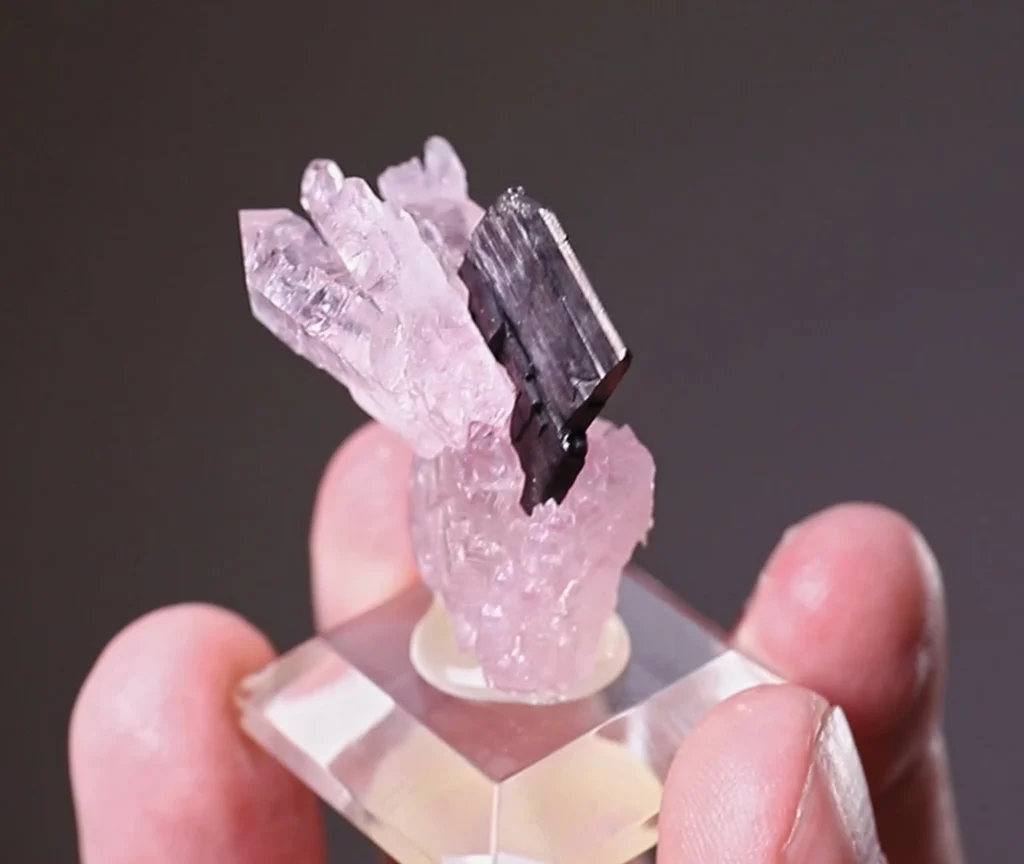
Rose Quartz, the pink variety of Quartz is rarely known to form distinct well-formed crystals and on the rare occasions when it does, their form is very different to most other types of Quartz crystal, tending to form smaller complex aggregates of more 'ragged' terminations with prism faces often missing or distorted. Brazil is the undisputed king of countries for producing crystallized Rose Quartz from its vast swathes of pegmatite-bearing rocks. This very unusual combination specimen of Rose Quartz with Columbite (an iron or manganese niobium oxide) comes from the well-known historic pegmatites at Sapucaia do Norte. The best crystallized Rose Quartz specimens were found at Sapucaia do Norte during the 1960s. This specimen features a very 3-dimensional cluster of gemmy pink Rose Quartz crystals exhibiting great translucency, but the star is the rare combination with a prominent dark red-brown, bladed Columbite crystal with very sharp straight edges reaching 1.5 cm. A very unusual Rose Quartz miniature. Ex Jesse Fisher and Joan Kureczka Collection.
Comments