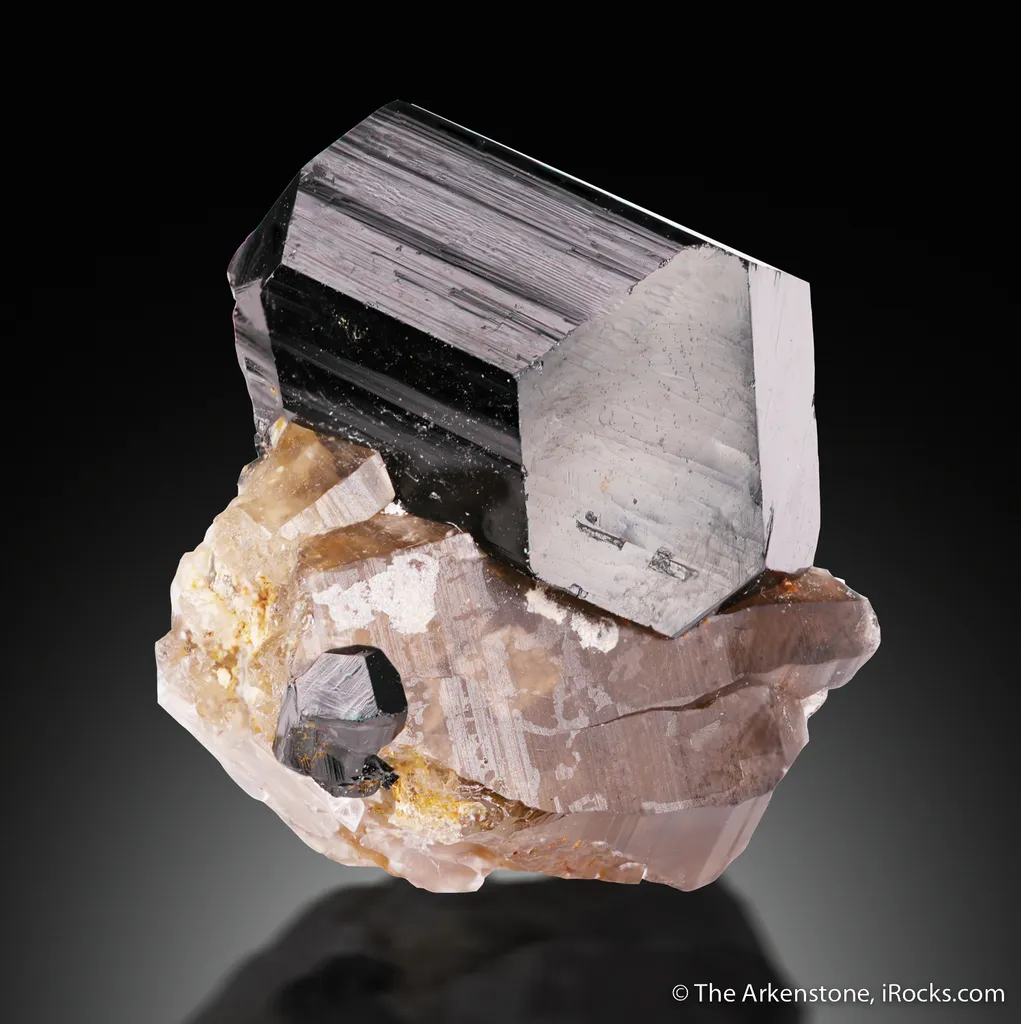
Tourmaline on Smoky Quartz
Unknown Owner
Help improve this recordNo owner is registered for this specimen yet. If it's yours or you know more about it, you can add the owner, provenance, publications and other details.
Tourmaline from New York has set a standard for the old crystallography books and was famous by the 1800s already. Today, finer specimens of quality from the famous old Powers Farm locality are simply rare on the market, although larger and more damaged pieces are around. They often have damage or lack luster. This is as close to a gem and jewel as they can be obtained! The floating crystal atop, perfectly perched atop a natural pedestal of smoky quartz, is 1.7 cm across. It is so sharp that it looks carved, so metallic that it looks like a hematite at first glance. It has a metallic luster you almost never seen on tourmaline. Lastly, the shape is so dramatic, that at first glance it looks like a garnet, because this crystal is not elongated on the c axis as are most tourmalines. This was purchased by Kyle Kevorkian from father/son collecting team Mike and Jay Walter. Mike's label says the following: May 11 2017 - this is the finest TN sized specimen I have seen in my 45 plus years of collecting and evaluating Powers Farm tourmalines. It was collected by my father and me from the hilltop dig site (the classic locale) sometime in the late 1990s. Sold to Kevorkian in 2017. This is a phenomenal, rare, competitive-level thumbnail specimen. These have been reclassified a few times during our time as a dealer, and are currently considered to be dravite tourmaline.
Product details
SpeciesTourmaline, Quartz, Smoky quartz
SizeThumbnail
Dimensions2.0 x 1.9 x 1.8 cm
Added on10/23/2024
LocalityUSA, New York, Power's Farm
Known provenance
| Date | Collector | Acquisition price |
|---|---|---|
| 08/2024 | Unknown Owner | Not disclosed |
| — | The Arkenstone | Not disclosed |
Learn more
Mineral guide
Learn about Tourmaline
color range and crystal variety define a diverse group; top localities, value factors, quality assessment, and care tips for collectors.Regional guide
Comments