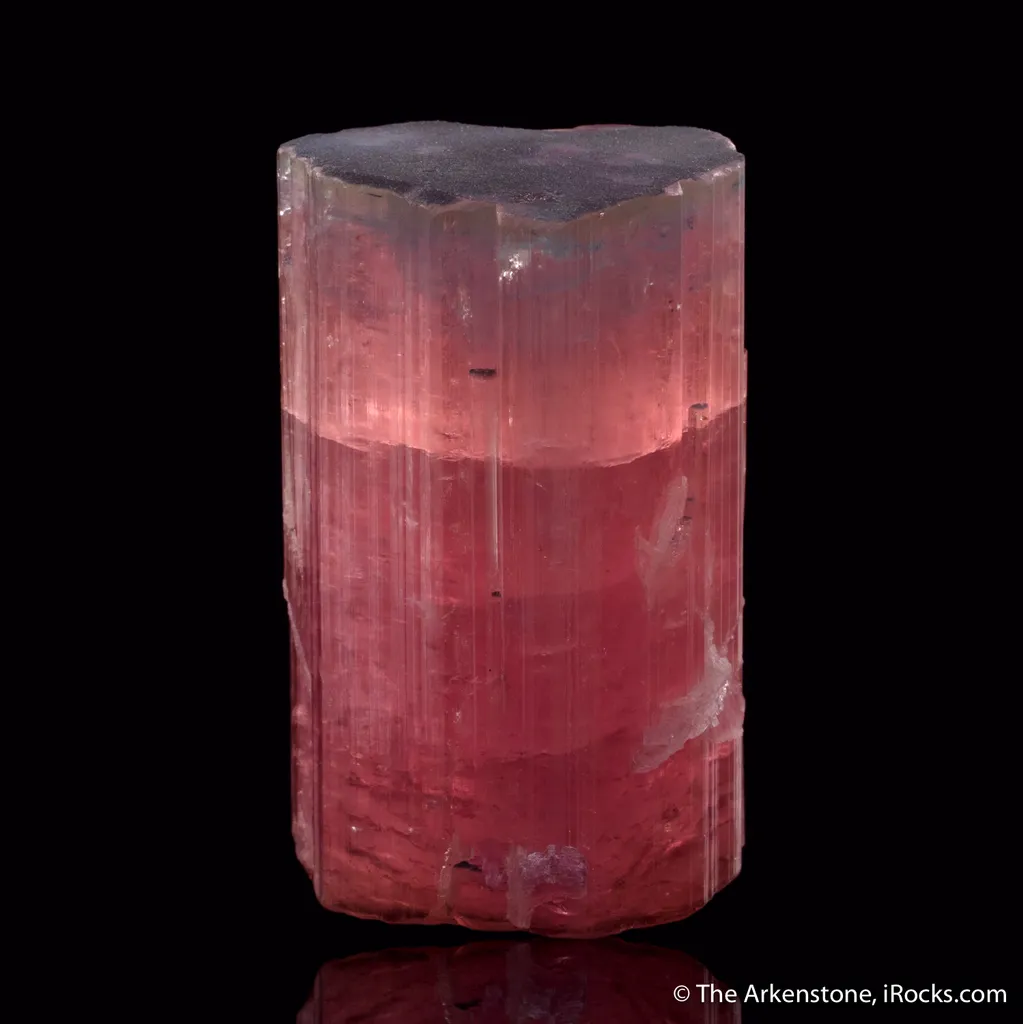
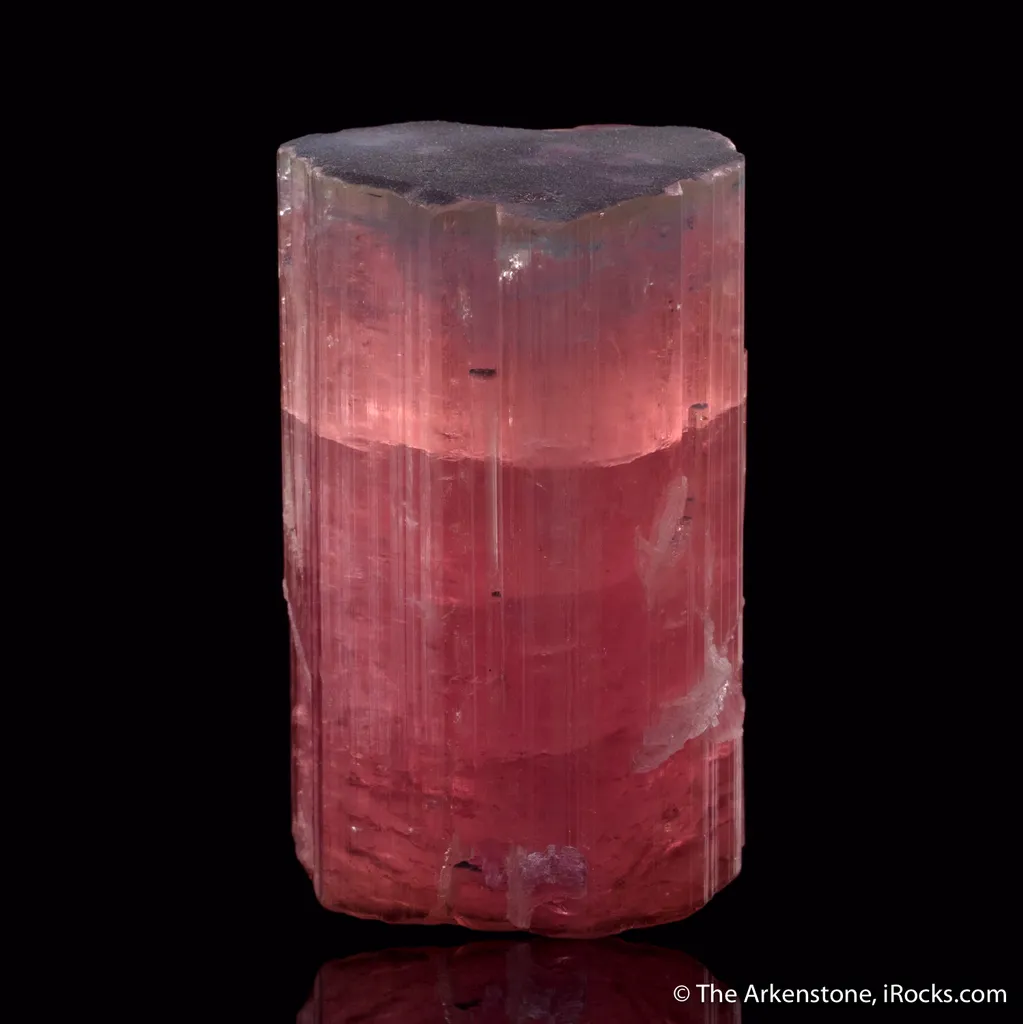
Elbaite Tourmaline "Blue Cap"
Unknown Owner
Help improve this recordNo owner is registered for this specimen yet. If it's yours or you know more about it, you can add the owner, provenance, publications and other details.
This is an extremely rare example of a blue-capped Tourmaline from the Himalaya Mine and NOT from the famous Queen Mine in San Diego County. The crystal has a rich pink color throughout with a distinctly blue termination. The body of this robust crystal is translucent to transparent with a saturated pastel pink color. The prism faces have good luster and are striated. The bottom two-thirds of the crystal is a richer pink and the top third is lighter, but distinctly more transparent and the transition to the 2 mm thick blue cap is abrupt and the side view reveals the cap is gemmy. Although the flat termination has a satin luster, it shows the blue color very well. Out of the tons of tourmaline produced at this mine, this is one of only a handful of blue-caps which were ever found. It should be highly regarded and is actually more rare than the famous 1972 blue caps form the nearby Tourmaline Queen Mine which number in the many dozens all told, although these are admittedly not as lustrous or saturated blue, nor glassy on the termination. Still, it is a rarity from the Himalaya and a beautiful County specimen. It has a few nicks at either end, but otherwise in great condition for this Himalaya rarity. This stout Tourmaline has a mass of 142.4 grams. Bill Larson mined these in the early 1980s. This one was sold to Chet Lemanski through dealer Ken Roberts, in 1984.
Product details
SpeciesTourmaline, Elbaite
SizeSmall Cabinet
Dimensions5.8 x 3.3 x 3.2 cm
Added on10/23/2024
LocalityUSA, California, Himalaya Mine
Known provenance
| Date | Collector | Acquisition price |
|---|---|---|
| 08/2024 | Unknown Owner | Not disclosed |
| — | The Arkenstone | Not disclosed |
Learn more
Mineral guide
Learn about Tourmaline
color range and crystal variety define a diverse group; top localities, value factors, quality assessment, and care tips for collectors.Regional guide
Comments