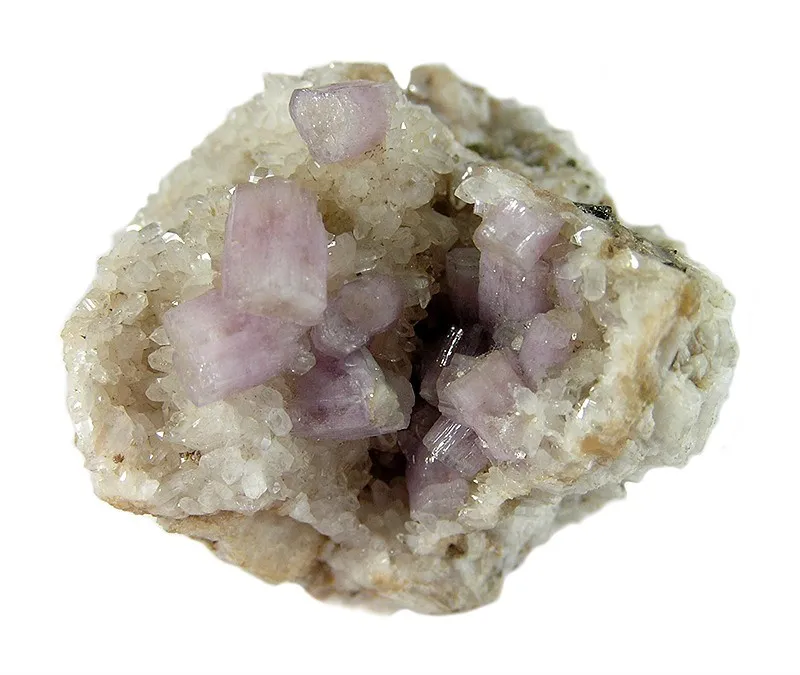
Apatite-(Caf), Quartz
Unknown Owner
Help improve this recordNo owner is registered for this specimen yet. If it's yours or you know more about it, you can add the owner, provenance, publications and other details.
From a classic locale, this is a lovely example of purple apatite. The crystals are aesthetically nestled in a vug of colorless, sparkling quartz crystals, to 2 mm in length. The apatite crystals exhibit glassy luster along with a pastel lilac color. Several of the translucent crystals, to .8 cm in length, are also doubly terminated. It is unusual to find specimens from here so nicely contrasted on matrix, and isolated form one another instead of the usual jumble.INTERESTING NOTE courtesy of WENDELL WILSON:I'm pleased that you are posting old labels with specimens. Your Hauck specimen # RH1-11 carries a label for H. W. Arndt. If you check the Label Archive you will find some background on him as follows: "Harold W. Arndt was President of the Delaware County, Pennsylvania Institute of Science, and was Curator of Minerals at Bryn Mawr College in Bryn Mawr, Pennsylvania from 1958 to 1989. He selected many of the finest minerals from the Vaux Collection for display in hall cases along the first and second floors of the Physics and Math wings of the Park Science Center. He also maintained a personal collection of minerals, as the labels shown here attest." That's all I know about him. I had two blank Arndt labels posted there, but didn't have one filled out in Arndt's handwriting. I hope you don't mind that I lifted your image and added it to Arndt's page. http://mineralogicalrecord.com... 5.2 x 4.2 x 4.0 cm
Product details
SizeSmall Cabinet
Dimensions5.2 x 4.2 x 4.0 cm
Added on10/23/2024
LocalityUSA, Vermont, Belvidere Mountain Quarries
Known provenance
| Date | Collector | Acquisition price |
|---|---|---|
| 08/2024 | Unknown Owner | Not disclosed |
| — | The Arkenstone | Not disclosed |
Learn more
Mineral guide
Learn about Quartz
a versatile mineral with clear, milky, and colored varieties; crystal forms, formation clues, and tips for identifying amethyst and citrine.Regional guide
Comments