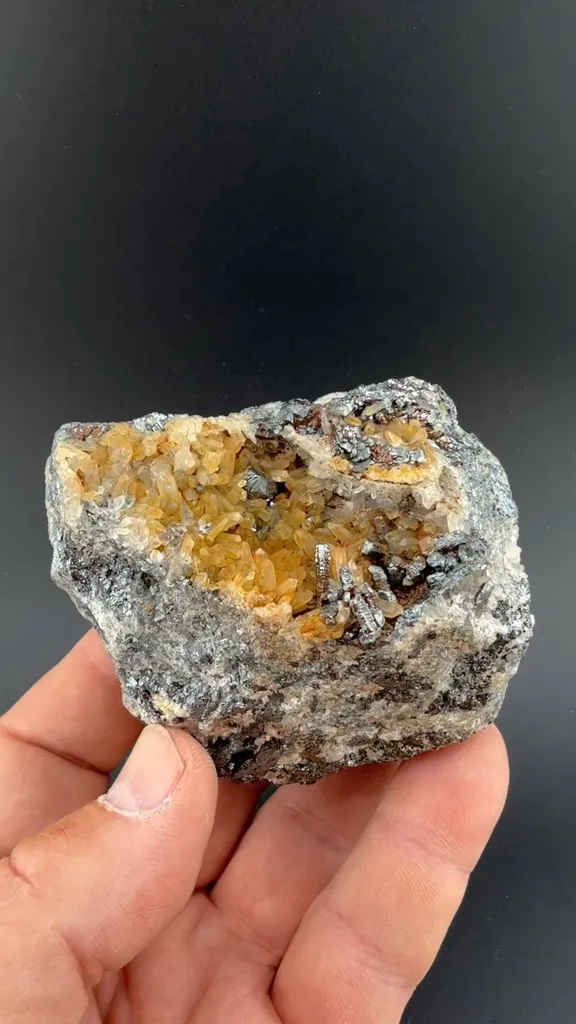

Hematite with Quartz
Unknown Owner
Help improve this recordNo owner is registered for this specimen yet. If it's yours or you know more about it, you can add the owner, provenance, publications and other details.
Interesting freestanding metallic crystals of hematite measuring to 0.8 cm in size coming off of matrix with quartz. The specimen comes with an antique label that notes the specimen previously was in the collection of Georgetown University. This is shown at the end of the video.The Marquette Iron Range, located in the Upper Peninsula of Michigan, is a prominent region of Precambrian rock centered within Marquette County. Geologically, the range consists of the Negaunee Iron Formation, a middle Precambrian sequence of folded and metamorphosed sedimentary rocks—primarily rich deposits of hematite and magnetite chert interbedded with slates and quartzites. Mineralogically, it is celebrated for its massive bodies of high-grade iron oxides, which later transitioned into extensive commercial production of beneficiated taconite ores. Historically, the range was discovered in September 1844 by government surveyor William A. Burt, whose party noticed erratic magnetic compass readings caused by local iron outcroppings. Commercial mining operations officially commenced with the opening of the Jackson Mine in 1847. While the historic underground and early open-pit operations eventually phased out—such as the closure of the Empire Mine in 2016—the Marquette Range remains active today through operations like the Tilden Mine, marking a continuous history of iron mining spanning over 175 years.
Product details
Known provenance
| Date | Collector | Acquisition price |
|---|---|---|
| 08/2026 | Unknown Owner | $135.00 |
| — | Weinrich Minerals | Not disclosed |
Comments