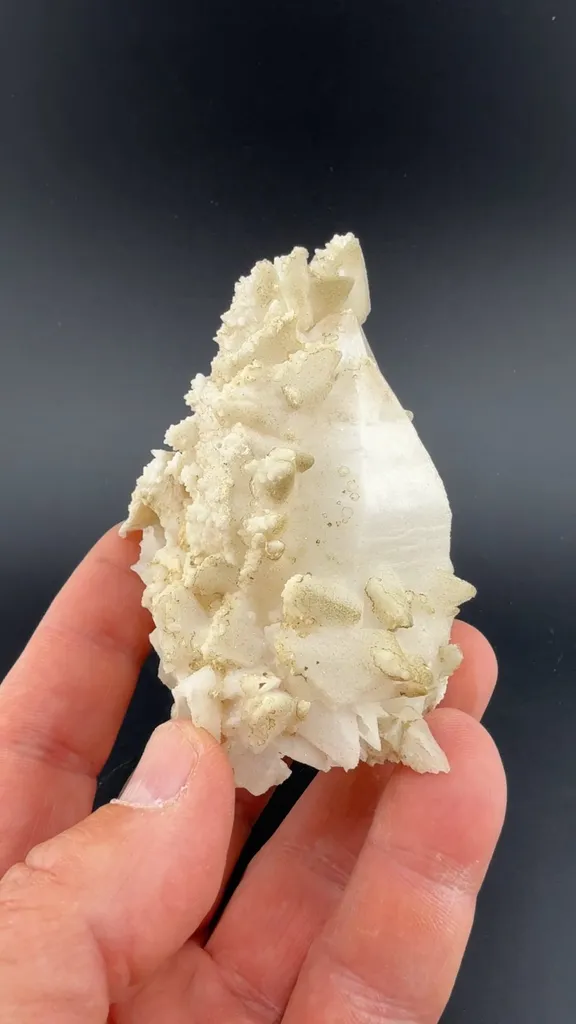

Quartz after Calcite with Quartz
Unknown Owner
Help improve this recordNo owner is registered for this specimen yet. If it's yours or you know more about it, you can add the owner, provenance, publications and other details.
Scalenohedral crystals of what were once calcite to 2.0 cm in size, these now replaced by sugary crystallized quartz. These are scattered nicely across the top of a grouping of much larger white milky quartz crystals. In good condition all around.The Droujba Mine, situated within the prominent Laki ore district of the Plovdiv Province in southern Bulgaria, is part of a historic mining region with roots stretching back to ancient Thracian and Roman times. Modern industrial scale operations in the area developed primarily during the 20th century as part of Bulgaria's organized state-led mining sector for lead and zinc extraction. Geologically, the deposit is set within the complex metamorphic and igneous terrain of the Rhodope Massif. It is characterized by hydrothermal vein systems formed through Tertiary magmatic activity, producing rich polymetallic mineralizations consisting chiefly of galena, sphalerite, and pyrite, alongside well-crystallized gangue minerals like calcite and quartz.Pseudomorphs occur when one mineral replaces another while preserving the original crystal form of the parent mineral. A classic example is quartz after calcite, where silica-rich fluids gradually dissolve the original calcium carbonate crystal and replace it with quartz. During this replacement process, the external crystal geometry of the calcite is perfectly maintained, resulting in a hollow or solid quartz replica with an exterior shape it never could have formed on its own.
Product details
SizeSmall Cabinet
Dimensions9.0 x 7.0 x 5.5 cm
Added on08/04/2026
LocalityBulgaria, Plovdiv Province, Droujba mine
Known provenance
| Date | Collector | Acquisition price |
|---|---|---|
| 08/2026 | Unknown Owner | $150.00 |
| — | Weinrich Minerals | Not disclosed |
Learn more
Mineral guide
Learn about Quartz
a versatile mineral with clear, milky, and colored varieties; crystal forms, formation clues, and tips for identifying amethyst and citrine.Regional guide
Comments