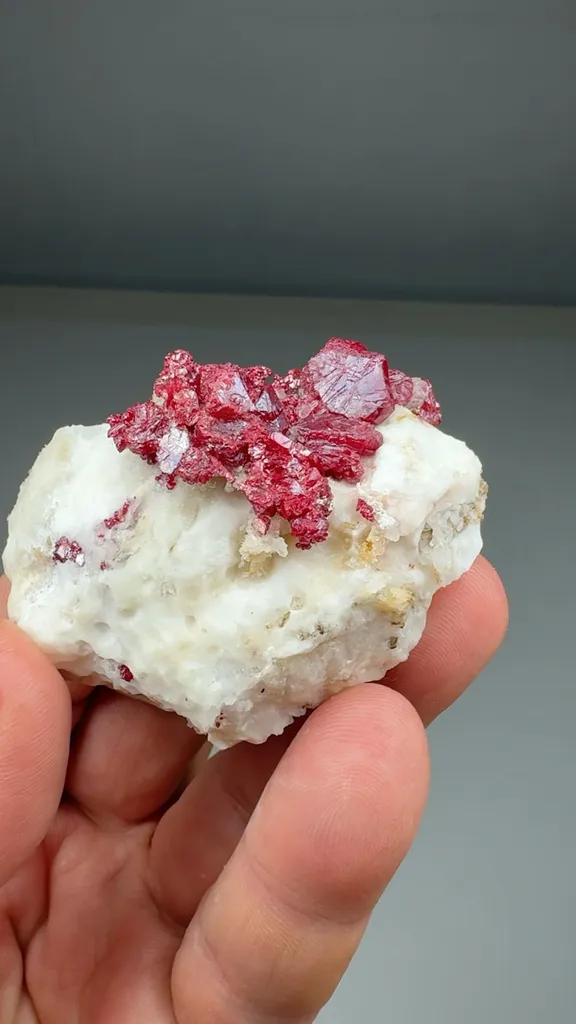

Cinnabar with Quartz (O-0027)


- Free shipping
- Seller offers an extended return window of up to 14 days
 Ships from USA
WM
Weinrich MineralsFeatured
A wonderful example for the species from this mining district. Brilliant red sharply formed crystals of cinnabar to 1.0 cm side is in excellent condition.
The Charcas mining district, situated in the northern part of the state of San Luis Potosi, Mexico, is recognized as the oldest active mining area in the region and a premier producer of zinc, lead, silver, and copper. Geologically, the Charcas deposit is classified as an epigenetic skarn and hydrothermal vein system. The mineralization is genetically associated with Tertiary-aged magmatic pulses, including monzogranite and granodiorite dikes spanning from 157 to 30 million years ago, which intruded Mesozoic sedimentary formations to form massive polymetallic replacements. The historical timeline of the district began in 1572 when Spanish conquistadors initially established a frontier settlement, with systematic extraction officially launching in 1583 to 1584 after local Chichimeca resistance subsided. Throughout the 17th and 18th centuries, prominent individual underground works like the Santa Ana, San Juan, and La Purisima mines focused heavily on high-grade silver, utilizing historic colonial processing techniques. Following a cyclical decline after the Mexican War of Independence, the district underwent extensive modernization in the late 19th and 20th centuries through industrial infrastructure investments. Today, the unified Charcas mining complex is owned and operated by Industrial Minera Mexico (IMMSA), a subsidiary of Grupo Mexico, which continues large-scale, deep-shaft mechanized exploitation and milling activities well into the 21st century.
In mineralogy, a pseudomorph occurs when a mineral chemically replaces or encrusts a pre-existing mineral, perfectly preserving the original crystal habit, shape, and structure of the initial specimen while changing its internal composition. In the specific case of quartz after danburite, the process begins with an initial crystal of danburite, a calcium borosilicate mineral that typically forms distinct, sharp, wedge-like or prismatic crystal structures. Over time, changes in the local geochemical environment introduce silica-rich hydrothermal fluids that either dissolve the danburite while simultaneously depositing quartz in the resulting void, or completely encrust the danburite shell before the interior dissolves away. The resulting specimen displays the classic orthorhombic crystal form of the original danburite, but is composed entirely of microcrystalline or macrocrystalline quartz, creating a fascinating geologic artifact where the external geometry tells the story of one mineral while the chemical makeup reflects another.
Product details
SizeSmall Cabinet
Dimensions6.5 x 4.5 x 3.0 cm
Listed on07/16/2026
LocalityMexico, San Luis Potosí, San Bartolo mine, Charcas
SKU9273133
Learn more
Mineral guide
Learn about Quartz
a versatile mineral with clear, milky, and colored varieties; crystal forms, formation clues, and tips for identifying amethyst and citrine.Regional guide
Comments