
Fluorite


- Free shipping
- Seller offers an extended return window of up to 14 days
 Ships from USA
WM
Weinrich MineralsFeatured
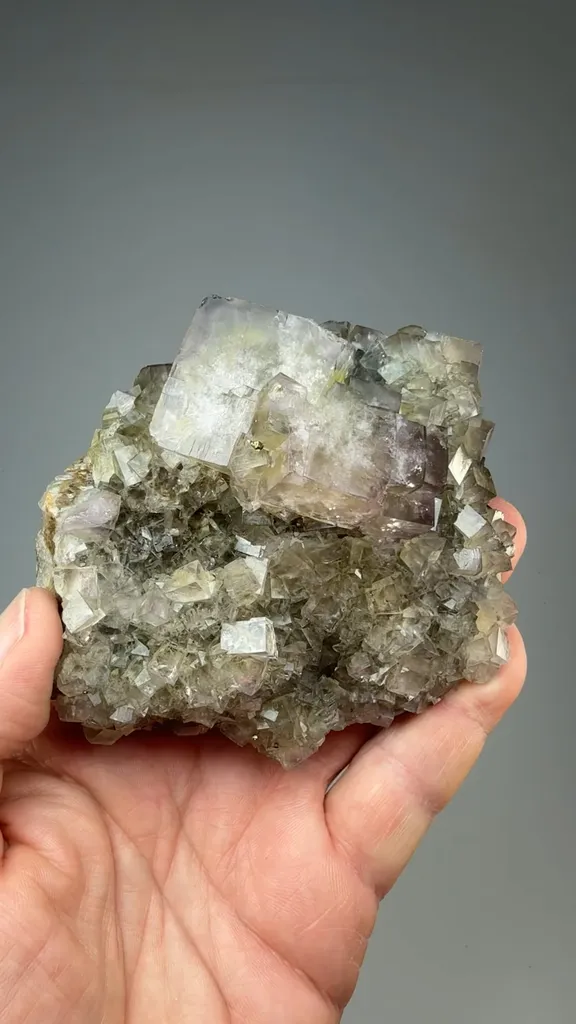
Lustrous translucent cubic crystals of fluorite measuring to 3.0 cm on edge across the top of matrix. Minor chalcopyrite present. Slight damage present as seen. The specimen comes with an antique label as shown at the end of the video. The acquisition date for this piece was originally 1910. Incredibly fluorescent under longwave ultraviolet light.
The Weardale mineral district, situated within the North Pennines Orefield in County Durham, England, is a historic lead and fluorite mining region worked through an extensive network of underground mines, adits, and surface quarries. Geologically, the district is located on the Alston Block, where a thick sequence of Carboniferous-age limestones, sandstones, and shales was intruded by the underlying Devonian-age Weardale Granite, which acted as a thermal engine to drive mineralizing fluids. These hydrothermal fluids deposited mineral veins along regional fault lines, forming classic Mississippi Valley-Type (MVT) deposits rich in galena, iron carbonates, and large cavities lined with intergrown, fluorite crystals that frequently exhibit intense natural fluorescence. Historically, lead mining in the valley dates back to the Roman occupation and was heavily exploited by the Bishops of Durham during the medieval period, reaching its industrial peak in the eighteenth and nineteenth centuries under operations like the London Lead Company and the W.B. Lead Company. As lead reserves diminished toward the end of the nineteenth century, the district transitioned to mining fluorite for use as a metallurgical flux in the steel industry, with major operations at the Boltsburn, Beaumont, and Blackdene mines sustaining production through the mid-to-late twentieth century until changing economic conditions forced the closure of the last major industrial mines in 1999. Following this commercial shutdown, independent mining ventures and specialized syndicates successfully reopened specific underground adits, such as the Rogerley and Diana Marie mines, which have operated continuously through 2026 to systematically extract minerals for the international trade.
Ernst August Boettcher (often spelled Boettcher or Boettcher in historical records), operating from Berlin, Germany, during the late nineteenth and early twentieth centuries, was a highly successful natural history dealer and commercial merchant who distributed premier geological, mineralogical, and zoological materials to prominent museums and private collectors worldwide. Inheriting the established firm in 1900 following the death of his father, August Boettcher, he systematically expanded the business under the commercial title Naturalien- und Lehrmittel-Anstalt Ernst A. Boettcher, building a vast trading network headquartered at Bruederstrasse 15 in Berlin. While Boettcher achieved considerable scientific renown in entomology as a specialized collector and describer of lepidoptera, his dealership simultaneously functioned as a major European hub for educational supply suites, offering highly curated collections of minerals, rocks, and paleontological specimens structured specifically for academic instruction in mineralogy and economic geology. His exceptional organizational skill and high-quality educational displays earned the firm a prestigious Gold Medal at the St. Louis World Fair in 1904, solidifying his international reputation. His commercial operations remained highly influential through the 1910s and 1920s, continuing to supply verified European mineral specimens to institutions like the Berlin Natural History Museum, with the enterprise maintaining a registered commercial presence in the Berlin business directories well into the 1940s.
Product details
SpeciesFluorite
SizeCabinet
Dimensions11.0 x 8.5 x 7.0 cm
Listed on07/16/2026
LocalityAustralia, New South Wales, Durham Co.
SKU1052736
Learn more
Mineral guide
Learn about Fluorite
calcium fluoride with a dazzling color range, cubic and octahedral crystals, and UV fluorescence; prized by collectors for Blue John banding.Regional guide
Comments