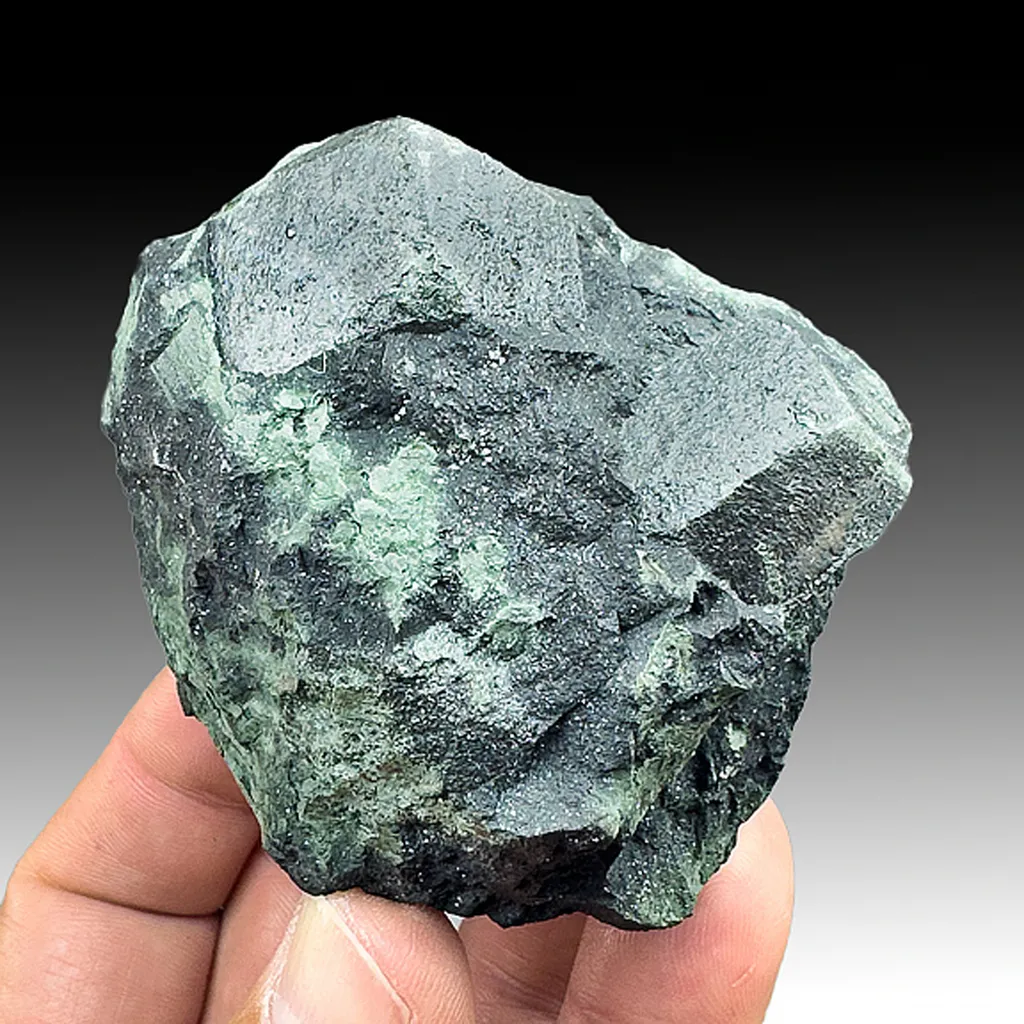
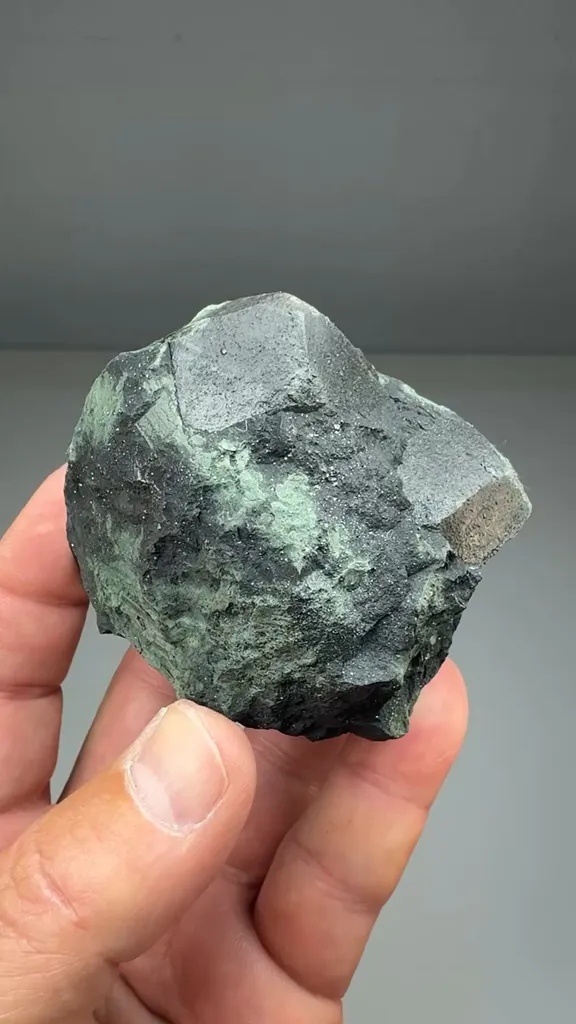

Chamosite after Almandine
Unknown Owner
Sharp crystals of what were almandine to 3.5 cm in size, these now replaced by micaceous micro chamosite crystals and embedded nicely up on matrix. Classic pseudomorph specimen for this area.The Michigamme area of Marquette County, Michigan, is situated within the Marquette Iron Range and is geologically characterized by the Paleoproterozoic Michigamme Formation, which consists of metamorphosed shales, siltstones, and sandstones. During the Penokean Orogeny, high-grade regional metamorphism transformed these sediments into schists containing large almandine garnets, which were later subjected to retrograde metamorphism and hydrothermal alteration. This process resulted in the formation of famous pseudomorphs where dark green, fine-grained chamosite (a member of the chlorite group) completely replaced the original dodecahedral almandine crystals while perfectly preserving their sharp geometric forms. Historically, the town of Michigamme was established in 1872 following the discovery of iron ore, leading to the development of the Michigamme Mine and several nearby quarrying operations. The Michigamme Mine itself operated as an underground and open-pit producer of magnetite iron ore from 1872 until approximately 1905, with various smaller prospects in the district continuing sporadically into the early 20th century. Today, the area is widely celebrated by the mineralogical community for these distinctive "chlorite after garnet" pseudomorphs, which are commonly found in the localized schist outcrops and historical mine rock piles of the region.
Product details
Species
SizeSmall Cabinet
Dimensions7.5 x 6.5 x 6.0 cm
Added on05/26/2026
Locality
Michigamme, Marquette Co., Michigan, USA
Known provenance
| Date | Collector | Acquisition price |
|---|---|---|
| 05/2026 | Unknown Owner | $115.00 |
| — | Weinrich Minerals | Not disclosed |
Comments