
Cerussite
Unknown Owner
Help improve this recordNo owner is registered for this specimen yet. If it's yours or you know more about it, you can add the owner, provenance, publications and other details.
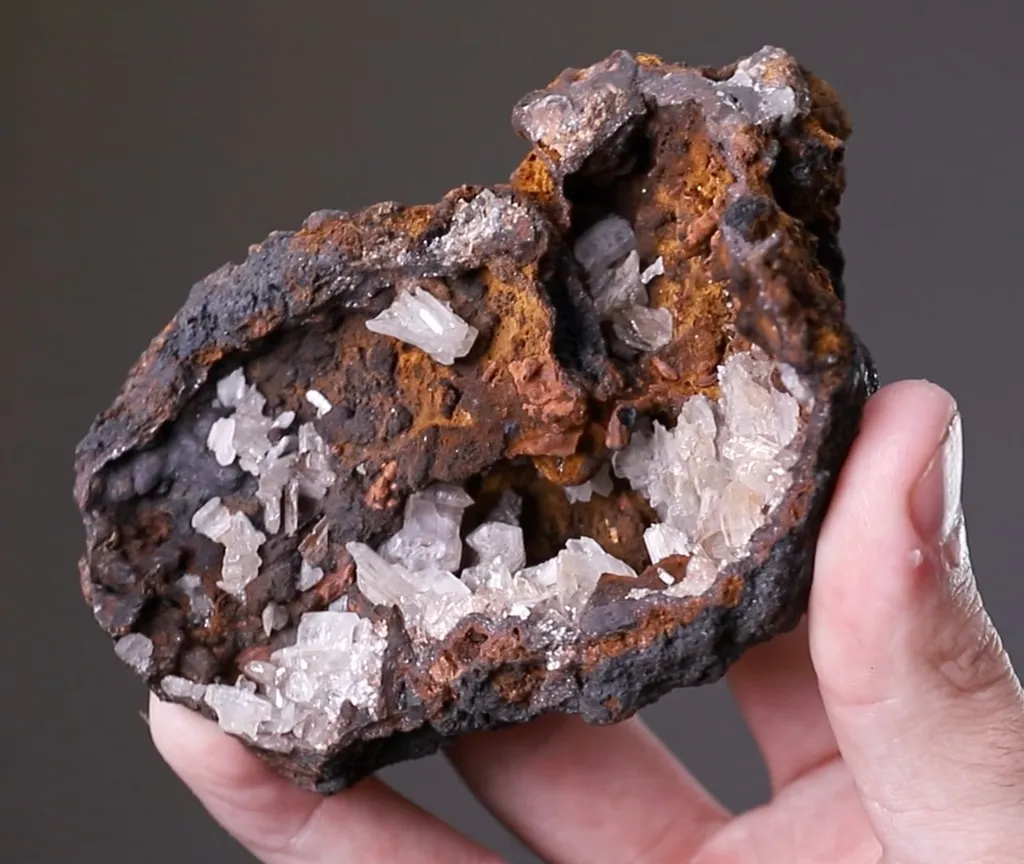
Prior to the discovery of Tsumeb mine in the early 20th century, Germany played host to one of the world's most important sources of well-crystallized Cerussite, at Friedrichssegen mine in the Bad Ems District, Rhineland-Palatinate, Germany. Incredibly rich specimens were available during the second half of the 19th century and made their way through famous European mineral dealers to the greatest collections at that time. This wonderful cabinet-sized specimen displays not only quite large and well-formed Cerussite crystals, but they are contextualized by their presence within the inside of a gossanous, iron-oxide rich nodule, showing their typical formation within oxidized vein material. Many of the crystals are platy in form, and repeatedly twinned, the largest reaching about 1 cm in size, but with much larger areas of aggregated crystals. This lovely historic piece is further enhanced by its accompanying labels including Alexandre Stuer (c.1860-1920) in Paris, Julius Bohm (c.1850-1925) in Vienna and an unidentified collector/institutional label. Ex Professor Werner Paar Collection.
Product details
SizeSmall Cabinet
Dimensions8.5 x 6.7 x 5.4 cm
Added on04/22/2026
LocalityGermany, Rhineland-Palatinate, Friedrichssegen Mine
Known provenance
| Date | Collector | Acquisition price |
|---|---|---|
| 07/2026 | Unknown Owner | $5,000.00 |
| — | Crystal Classics | Not disclosed |
Learn more
Mineral guide
Learn about Cerussite
lead carbonate famed for adamantine luster, dramatic V-twins and snowflake reticulations; prized from Tsumeb, Mibladen and Ojuela.Regional guide
Comments