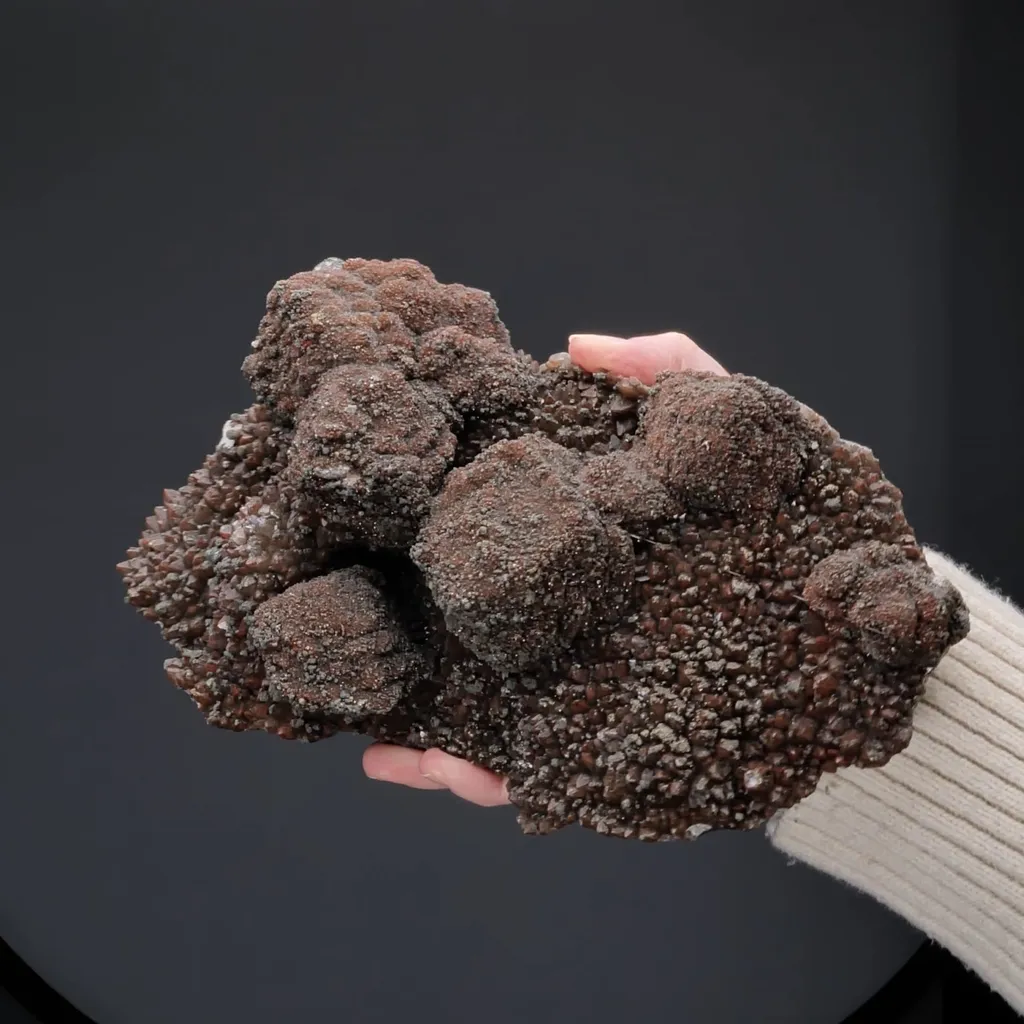

Quartz var. Eisenkiesel with Pyrite Calcite and Baryte
Unknown Owner
Help improve this recordNo owner is registered for this specimen yet. If it's yours or you know more about it, you can add the owner, provenance, publications and other details.
The famous historic mining district at Príbram in Bohemia, Czechia has furnished collections around the world with a wide range of species, but larger cabinet-sized specimens are uncommon, except in museums. This very large plate of predominantly Quartz was actually acquired by Hans Engelbrecht (collection no. 1722) from Príbram Museum. Although the date is not recorded, his accession number suggests that it was probably during the 1980s. There are several generations of Quartz all of which consistently contain red inclusions of iron oxides (probably Hematite), giving them the varietal name Eisenkiesel. The first generation, which forms the main plate, or bed, are the coarsest crystals with pyramidal faces reaching 6 mm in length. These are, in some scattered areas, dappled with a coating of golden Pyrite. However, of greater significance are five large (and several smaller) freestanding rhombic crystals (to over 4 cm on edge) of presumed Calcite, but they are totally encased in a layer of Eisenkiesel Quartz crystals, topped with a partial dusting of Pyrite. These Quartz crystals are much smaller than the main bed, but identical in colour. On the back of the specimen areas of grey-white bladed Baryte can be seen but are bruised from how the specimen sits. There is one area of contact on the top of one of the large Calcite rhombs, but otherwise this is a really impressive and unusual large display specimen from Príbram.
Product details
SizeLarge Cabinet
Dimensions26.7 x 14.4 x 6.3 cm
Added on03/21/2026
LocalityCzech Republic, Karlovy Vary Region, Háje
Known provenance
| Date | Collector | Acquisition price |
|---|---|---|
| 07/2026 | Unknown Owner | $1,500.00 |
| — | Crystal Classics | Not disclosed |
Learn more
Mineral guide
Learn about Quartz
a versatile mineral with clear, milky, and colored varieties; crystal forms, formation clues, and tips for identifying amethyst and citrine.Regional guide
Comments