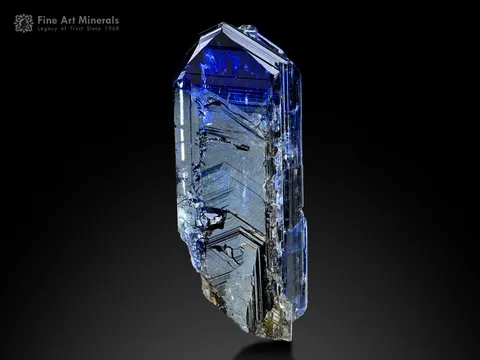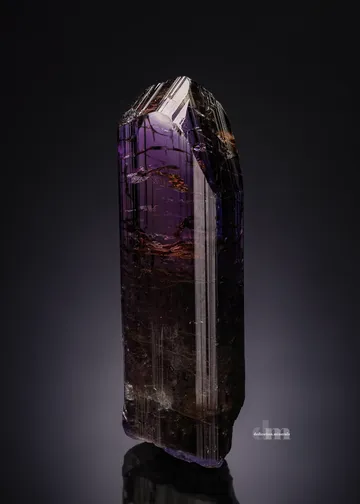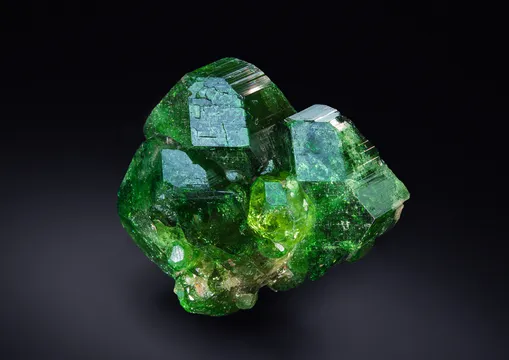
Zoisite from the Merelani Hills is one of the great modern mineral stories: a once modest species transformed almost overnight by vivid blue-violet crystals from a narrow belt of metamorphic rock in northern Tanzania. To the gem trade the blue-to-violet variety is tanzanite, but to mineral collectors it remains, importantly, zoisite — an orthorhombic sorosilicate whose Merelani crystals can combine sharp form, glassy luster, gem transparency, and strong pleochroism in a way no other zoisite locality has matched.

Photo: Rob Lavinsky, iRocks.com via Wikimedia Commons
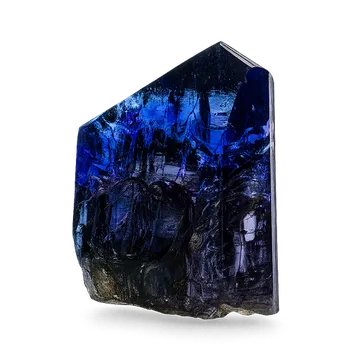
The appeal is not only color. A fine Merelani zoisite crystal can show a saturated indigo body, violet flashes, and bronze, greenish, or reddish directions depending on orientation and heating history. In specimens, the best crystals are typically prismatic to blocky, with chisel-like terminations, striated faces, and enough internal clarity to glow when backlit. The most desirable matrix examples retain their geological context: graphite-black rock, white to buff calcite, brassy pyrite, and sometimes diopside, prehnite, or other calc-silicate companions from the same extraordinary mineralized system.

Photo: Rob Lavinsky, iRocks.com via Wikimedia Commons
Geologically, the Merelani occurrence belongs to the Mozambique Belt, a deeply reworked Precambrian metamorphic terrain. The gem-bearing zone is developed in a structurally complex package of graphitic gneisses, metacarbonate rocks, and calc-silicate rocks that were folded, boudinaged, fractured, and locally overprinted by later fluid activity. The key collector point is that Merelani zoisite is not a casual pocket mineral in a granite pegmatite; it is a metamorphic gem formed in a very specific chemical and structural environment. Vanadium-rich conditions, graphite-bearing host rocks, calc-silicate assemblages, tight folding, and boudinaged vein systems all contributed to the narrow, unusually productive tanzanite-bearing horizon.
Historically, the locality is equally significant. Violet-blue zoisite entered the gem world in 1967, and Tiffany & Co. introduced the name “tanzanite” in 1968. That branding changed zoisite’s public identity, but among collectors the locality’s mineralogical importance goes well beyond faceted gems. Merelani has produced museum-quality crystals, unusual fancy-color zoisites in green, pink, yellow, orange, brown, and mixed hues, rare matrix pieces, and a suite of associated species that has made the area one of the most studied and collected gem-mineral localities in Africa.
For the serious specimen collector, Merelani zoisite is judged by a different set of priorities than cut tanzanite. Saturation matters, but so do natural crystal form, termination quality, transparency, pleochroic liveliness, absence of bruising, matrix association, and whether the specimen remains unheated. Strongly trichroic, naturally colored crystals with blue, violet, and bronze-to-greenish axes are especially prized. Matrix examples with bright pyrite, graphite, calcite, or diopside are much rarer than loose crystals and are valued as locality specimens rather than mere gem rough.
Search for specimens: View all zoisite specimens from Merelani Hills, Tanzania
The Merelani Hills, also spelled Mererani in Tanzanian usage, lie in the Lelatema Mountains of northern Tanzania, in the Simanjiro District of Manyara Region, south to southeast of Arusha and not far from Mount Kilimanjaro. In specimen labels, older material may appear as “Arusha Region,” “Merelani Hills, Lelatema Mts.,” “Mererani,” or simply “Tanzania,” but the modern locality is best given as Merelani Hills, Lelatema Mountains, Simanjiro District, Manyara Region, Tanzania.
The deposit is a narrow gem-mineralized belt, famous for yielding the only major commercial source of tanzanite. The productive ground has been described as a slender strip divided administratively into Blocks A, B, C, and D. These blocks are mining and licensing divisions rather than separate mineral species localities; the gem-bearing system continues through the broader structural zone, though different blocks have had different mining histories, depths, operators, and reputations in the trade.
The host environment is graphitic gneiss and associated metacarbonate and calc-silicate rock within the Mozambique Belt. In the Merelani system, gem zoisite occurs in and around boudinaged, fractured, and mineralized zones, commonly with calcite, graphite, pyrite, diopside, quartz, and other calc-silicate minerals. The geological style explains several features collectors see in hand specimens: graphite smears and black inclusions, calcite-rich matrix, brassy pyrite dustings, and crystals that may be gemmy but stress-fractured or cleaved.
Mining began as surface collecting and shallow digging after the 1967 discovery of blue-violet zoisite. The rush quickly intensified. By the early 1970s the mines were nationalized, and production became irregular under difficult and often chaotic conditions. In 1990 the Tanzanian government divided the tanzanite field into Blocks A, B, C, and D. Block C became the main large-scale mechanized operation, while Blocks B and D remained strongly associated with small-scale and artisanal mining. The contrast between organized mechanized mining and dangerous narrow-shaft artisanal work has shaped both production and specimen recovery.
Collector-quality crystals have come from more than one part of the field, but Block D is especially legendary in the mineral trade for matrix specimens, unusual associations, and stories of miners following pyrite- and graphite-rich seams through very tight underground workings. Block C is important historically for larger-scale production and for notable large rough crystals, including heavily included but enormous zoisite masses. Fine free-standing crystals, however, are still scarce because the economic pull of the faceting market means many gemmy crystals are broken, trimmed, heated, or cut rather than preserved as specimens.
Access is not casual. The Merelani mining area is an active, controlled gemstone district with licensed mining rights, security, and hazards that are not compatible with recreational collecting. Permission from claim holders and authorities is essential, and underground access is inherently dangerous. The 2018 construction of a long perimeter wall around the Mirerani tanzanite mining area further formalized access and trading controls. For collectors, ethical acquisition is through established dealers, documented miners, reputable Tanzanian sources, and specimens with credible labels or provenance.
Production has not been uniform through time. Early surface pieces and shallow-mine crystals are now historic. Later mechanized mining and deeper artisanal workings produced both large volumes of gem rough and occasional spectacular specimens. Modern material remains available, but the best old-time crystals, unheated strongly pleochroic specimens, and undamaged matrix pieces are increasingly difficult to replace.
Notable finds include kilogram-scale rough tanzanites from the modern mining era. In 2020, small-scale miner Saniniu Laizer became internationally known after his team recovered enormous rough tanzanite stones, including pieces reported at 9.27 kg and 5.103 kg, later sold to the Tanzanian government. Such finds belong more to the gem and national-heritage story than to the cabinet-specimen market, but they underline the continuing productivity and occasional drama of the Merelani field.
Merelani zoisite most often appears to collectors as prismatic to blocky crystals, commonly elongated, vertically striated, and terminated by wedge- or chisel-like faces. Many crystals are complete enough to be appreciated as thumbnails or miniatures, but fine cabinet-size crystals are far rarer, especially when gemmy and undamaged. The best crystals show sharp morphology rather than waterworn pebble-like rough, and the most collectible pieces preserve multiple faces with good luster and recognizable orthorhombic geometry.
Color is the locality’s signature. Blue-violet tanzanite is the classic form, but Merelani zoisite also occurs in brown, yellow, orange, pink, green, blue-green, purple-pink, and mixed “fancy” colors. Unheated crystals may show strong trichroism: blue in one direction, violet or purple in another, and bronze, brownish, greenish, or yellowish tones along the third direction. Heating commonly reduces the brownish or yellowish component and shifts the apparent color toward stable blue to violet. For specimen collectors, unheated material with obvious pleochroic variation is often more interesting than uniformly enhanced gem color.
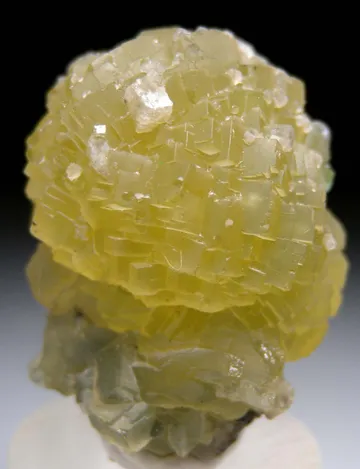
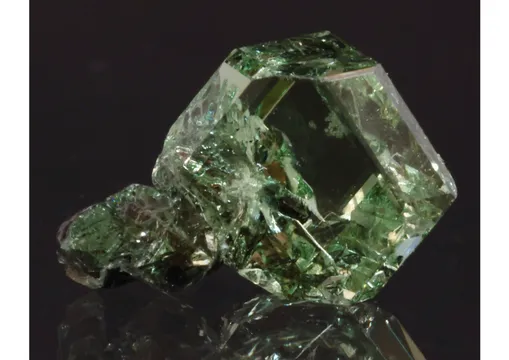
Transparent blue-violet crystals are the most familiar, but the collector market increasingly appreciates nonstandard colors. Green zoisite from Merelani, including blue-green and yellowish green stones, is highly sought after when transparent. Pink to purple-pink zoisite is particularly rare in attractive facetable size, and crystals or rough showing these tones are specialty collector material. Yellow, orange, champagne, and brown crystals are less mainstream but important for a complete Merelani suite, especially when they retain natural color and sharp form.
Matrix pieces are among the most desirable. Graphite is the visual anchor of many Merelani specimens, occurring as black matrix, smears, coatings, or inclusions. Calcite may form white to creamy masses or pocket fillings. Pyrite is a classic association, sometimes dusting zoisite faces with brassy microcrystals. Diopside, tremolite, prehnite, fluorapatite, quartz, tsavorite grossular, kyanite, phlogopite, vanadian phlogopite, and rare sulfides are all part of the broader mineralogical environment. The locality is also the source of merelaniite, a remarkable molybdenum-lead-vanadium-antimony sulfide known as dark metallic whiskers and, very rarely, as inclusions in tanzanite.
Typical specimen sizes vary widely. Small loose crystals of about 1–3 cm are the most frequently encountered collector pieces. Fine miniatures in the 3–6 cm range are much less common when transparent and undamaged. Larger single crystals exist and have long attracted attention, but many are cleaved, contacted, etched, included, or commercially too valuable as cutting rough to survive intact. Exceptional large gemmy crystals, especially those approaching or exceeding several inches, are high-end mineral specimens.
Quality factors differ depending on whether the piece is a gem crystal, a matrix specimen, or a fancy-color example. For loose crystals, collectors look for strong luster, transparency, saturated natural color, intact terminations, minimal edge chipping, and striking pleochroism. For matrix pieces, the placement and contrast matter: a blue-violet crystal emerging from graphite and calcite, or a tanzanite accented by pyrite, is far more desirable than a loose crystal of equivalent size if the composition is natural and undamaged. For fancy-color zoisite, rarity of hue, natural color, clarity, and unheated status become central.
Condition is critical. Zoisite has perfect cleavage in one direction and imperfect cleavage in another, so Merelani crystals commonly show internal stress, cleaved faces, bruised terminations, edge nicks, and repaired or stabilized breaks. A crystal that looks large and impressive in poor light may reveal cleavage flashes, incipient cracks, or rehealed fractures under a fiber-optic lamp. This is not unusual for the locality, but condition should be priced honestly.
Merelani zoisite sits at the intersection of the mineral-specimen and gemstone markets, so terminology matters. Blue-to-violet gem zoisite from Merelani is properly called tanzanite. Non-blue Merelani zoisite may be sold as “fancy-color tanzanite” in the gem trade, but mineral collectors are better served by precise labeling: zoisite, with color noted, from Merelani Hills. A green, yellow, pink, or brown zoisite crystal is not less genuine because it is not blue; it is often more interesting mineralogically.
Heating is the most important treatment issue. Much commercial tanzanite is heated to improve blue-to-violet color from brownish or greenish-brown starting material. The treatment is stable and widely accepted in the gem trade, but for mineral specimens, unheated status can add value when credible. Strong trichroism including a bronze, brownish, yellowish, or greenish direction may support an unheated interpretation, but visual inspection alone is not proof. Conversely, a beautiful blue crystal should not be assumed unheated merely because it is still a crystal rather than a cut stone. Provenance, old labels, and reputable dealer disclosure matter.
Coating and fracture filling are less common but important concerns. Coated tanzanite has been documented in the gem trade, generally to intensify apparent color; coatings are not durable and should be disclosed. Fracture filling is uncommon but possible in transparent stones. For mineral specimens, additional concerns include oiling, resin stabilization, glued repairs, concealed cleavages, and composite matrix specimens assembled to look more dramatic than they are. A loupe, short-wave and long-wave lighting, careful side lighting, and inspection of contact points are useful before purchasing expensive examples.
Imitations also exist. Synthetic forsterite has been sold as a tanzanite imitation in the gem market and can look deceptively similar in color, though its optical properties differ from zoisite. Glass, synthetic corundum, synthetic spinel, cubic zirconia, and coated stones may also appear in inexpensive jewelry or tourist material. In specimen form, the commonest risk is not a laboratory-grown “synthetic tanzanite” crystal but misrepresented rough, dyed or coated material, repaired crystals, or non-Merelani zoisite sold under the tanzanite name. Serious purchases deserve a reputable source and, for faceted gems, laboratory documentation.
Condition issues are almost unavoidable in Merelani zoisite. Cleavage is the collector’s enemy. The species has enough hardness for jewelry with care, but it is not tough like corundum; sharp blows, ultrasonic cleaning, steam cleaning, thermal shock, and pressure on cleavage planes can damage it. Specimens should be handled over a padded surface. Avoid aggressive cleaning. Graphite-rich matrix can be friable and messy, calcite matrix can be acid-sensitive, and pyrite coatings may be delicate.
Rarity should be understood by category. Small heated or undetermined blue loose crystals are available, though good ones still command attention. Fine unheated, strongly pleochroic crystals are much scarcer. Matrix tanzanites with good aesthetics are genuinely rare because of mining damage, trimming for gem rough, and the fragility of the host. Pink, saturated green, and attractive multicolor zoisites are specialty rarities. Large, gemmy, fully terminated crystals with no significant damage are among the classic high-end African gem-mineral specimens.
Current market availability is uneven. Commercial faceted tanzanite remains widely traded, but first-rate mineral specimens are not abundant. Many pieces offered as “collector grade” are simply gem rough with a termination or a cleavage face. The best buys are specimens that satisfy mineralogical criteria: natural form, honest condition, credible locality, interesting color behavior, and if possible, matrix or association that ties the crystal unmistakably to Merelani’s graphite-calcite-pyrite environment.
The discovery story begins, as so many great gemstone stories do, with competing memories. The broad outline is fixed: in 1967, blue-violet zoisite appeared at Merelani, near the foothills of Kilimanjaro, and within a year the gem world had a new commercial name. The details remain disputed. Manuel de Souza, a Goan tailor and part-time prospector in Arusha, has long been central to the story; Tanzanian accounts have also credited Jumanne Ngoma, and other names appear in early narratives. What matters for the collector is that the first crystals were not recognized as zoisite immediately. They were beautiful, transparent, and blue, but they arrived as a mineralogical mystery before laboratory identification gave them their scientific place.
One of the vivid early accounts has Ndugu Jumanne Ngoma seeing blue crystals on the ground while traveling through the bush near Kiteto at the beginning of January 1967. In his retelling, he gathered roughly 5 kg in only a few hours. That number is astonishing to modern collectors, because today even a sharp, undamaged 2 cm crystal with natural color can be a serious purchase. The first Merelani collectors were not choosing among carefully prepared thumbnails in a case; they were picking up a new blue mineral from the earth before the world understood what it was.
Then came the name. “Blue zoisite” is accurate mineralogically, but Tiffany & Co. saw the need for a marketable identity and introduced “tanzanite” in 1968, tying the gem directly to Tanzania. That act changed the fate of the mineral. Zoisite, long known to mineralogists from European localities and as massive pink thulite elsewhere, suddenly became a luxury gemstone. For collectors, the irony is delicious: the commercial name made the gem famous, while the best crystals still reward those who think like mineralogists rather than jewelers.
The most visceral modern field account is from Block D, where Vincent Pardieu, Richard W. Hughes, and companions entered the artisanal workings documented in “Working the Blueseam.” Their visit began not with romance but with permissions, fencing, and hard boundaries between mining worlds. The Kikuyu Mine compound held sixty miners working underground in two thirty-man teams on six-hour shifts. The mine manager, Nixon Monga, was only 24 years old and had been managing the operation since his father’s death nine years earlier.
The descent was sobering. The main shaft dropped about 100 meters by wooden ladder, then led into 200–300 meters of cramped tunnels before the working face. Some passages were no more than a meter high, too tight even for normal crawling. The visitors described moving on their bellies through graphite-dust passages, masks becoming useless, breathing hot carbon-laden air, and meeting miners coming the other way in spaces too narrow for dignity. At the working face, the miners followed veins marked by pyrite and graphite — the same mineral clues that, on a specimen, make a Merelani matrix piece so compelling.
The return to daylight gave the account its unforgettable image. Miners emerged coated head to foot in graphite, collapsing and gasping, then sparkling when the sun hit their dust-covered skin. The writers called them “black ghosts,” and the phrase is hard to forget. In a collector’s cabinet, graphite is an aesthetic contrast to blue zoisite; underground, it is dust in the lungs, grit on the skin, and the atmosphere through which men pursue one pocket at a time.
Months after that visit, heavy rains flooded some Merelani workings and miners died underground. The tragedy is part of the locality’s history, not an ornament to it. Serious collectors should hold both truths together: Merelani has produced some of the most beautiful gem crystals of the modern era, and many of those crystals came from hard, dangerous work in narrow graphite seams.
A later episode brought Merelani onto the world news pages. In June 2020, small-scale miner Saniniu Laizer’s team recovered two enormous rough tanzanite stones, reported at 9.27 kg and 5.103 kg. The stones were sold to the Tanzanian government for billions of Tanzanian shillings, and Laizer was suddenly famous. In August 2020, another large stone from his operation was reported, around 6 kg to 6.3 kg depending on the source. These were not delicate cabinet crystals; they were national-scale gem rough. But their fame reminded the public that Merelani is still alive, still capable of producing astonishing zoisite, and still tied to the lives of small-scale miners chasing rare pockets in a finite geological strip.