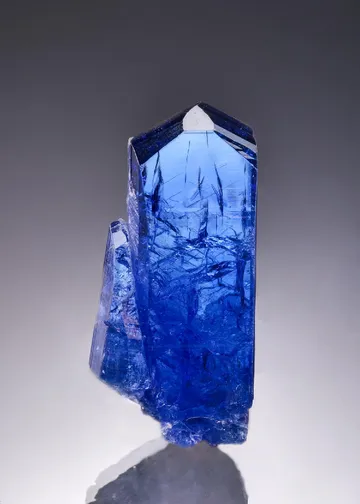
Zoisite Collectors Guide
Zoisite is an orthorhombic silicate in the epidote supergroup, best known to collectors for its celebrated gem varieties: blue-violet tanzanite, pink thulite, and green “anyolite” (ruby-in-zoisite rock). Well-formed crystals are typically prismatic to blocky with fine striations, vitreous luster, and prominent cleavage on 010. Colors range from green, grayish to brown, and honey tones in “classic” zoisite, to vivid violet-blue tanzanite (often heated to bring out the blue), and manganese-colored pink thulite (generally massive, rarely as discrete crystals).
Eye-catching contrast defines many of the most desirable specimens: sapphire-blue tanzanite prisms on graphite schist or calcite from Merelani Hills, ruby corundum embedded in green zoisite from Mundarara, or Alpine cleft crystals with titanite and epidote from Austria. Prices vary widely—massive thulite and ruby-in-zoisite carvings are accessible, while fine, undamaged tanzanite crystals of strong color can command premium prices comparable to other top-tier pegmatite and Alpine classics.
Zoisite’s collector appeal surged after the 1967 discovery of tanzanite at Merelani Hills, Tanzania. In addition to its importance in the gem trade, tanzanite quickly proved to be an exceptional crystal species for mineral collections: sharply formed prisms, strong pleochroism (violet/blue to burgundy/brown depending on orientation), and dramatic associations with graphite, calcite, diopside, and prehnite. Heated tanzanite with saturated blue-violet tones draws the most attention, but unheated crystals with natural color zoning and trichroism are increasingly prized by specimen purists.
Thulite, the pink Mn-rich variety, has long been favored in lapidary arts, particularly from Norway’s Telemark, while anyolite (ruby-in-zoisite) from northern Tanzania is a classic ornamental rock whose best examples display striking red-green-black patterns. “Classic” green-to-brown zoisite from Alpine clefts also has a following, especially when combined with titans such as titanite and epidote on elegant matrix pieces.
Merelani Hills is the unrivaled source of tanzanite, producing prismatic to blocky zoisite crystals with vivid violet-blue hues after heating (and a wide range of natural colors before). Crystals can be gem-clear, often with pronounced pleochroism and glassy luster. Associations include graphite, calcite, diopside, prehnite, pyrite, and dravite. Matrix specimens on graphite schist or calcite are especially attractive but scarcer than loose crystals. Larger crystals (>5–10 cm) with strong color and undamaged terminations are trophy pieces.
Collectors value Merelani specimens for:
- Strong color and pleochroism (often requiring thoughtful display orientation)
- High clarity and luster
- Attractive matrix contrasts (graphite schist, calcite) when found in situ
- Increasing rarity of top, unrepaired, unreheated examples
- Color
- Tanzanite: Saturated violet-blue commands the highest prices, especially when color shows well in ambient light (not just under strong backlight). Unheated crystals can show brownish, greenish, or burgundy tones with strong pleochroism; these are increasingly coveted by purists.
- Classic Zoisite: Attractive greens to honey-browns with even, appealing hue win out; overly dull brown lowers impact unless compensated by form and luster.
- Thulite (Telemark): Look for vivid, uniform pink; splotchy or pale material is less desirable.
- Anyolite (Mundarara): The best pieces have saturated green zoisite with bright red ruby distributed in eye-catching patterns.
- Clarity and Luster
- Tanzanite values rise sharply with clarity; “window-clean” zones and glassy faces impart brilliant life. Slight internal veils are common; avoid heavily cracked crystals lacking transparency.
- Alpine zoisite/clinozoisite: Bright, glassy luster with minimal pitting stands out; clarity varies and is less critical if overall aesthetics and associations are strong.
- Massive thulite/anyolite: Clarity is secondary; focus on color, coherence, and polish response.
- Crystal Form
- Merelani tanzanite: Desirable forms include sharply terminated prismatic/blocky crystals with clean pinacoids or pyramidal terminations. Crystals with distinct, symmetric shape display best.
- Alpine zoisite: Well-developed prisms or intergrown clusters on attractive matrix elevate desirability.
- Thulite/anyolite: Typically massive; form is about the overall shape and suitability for display or cutting.
- Condition
- Termination integrity is critical for crystals. Even small nicks can be distracting on deep-colored tanzanite; strive for undamaged or minimally dinged tips.
- Matrix integrity matters: intact, natural contacts and solid attachments enhance value. Avoid crumbling or overly stabilized matrix unless the specimen is exceptional.
- Aesthetics
- Composition, contrast, and balance rule. Tanzanite on graphite or calcite with complementary species can be spectacular. Alpine combinations with titanite and quartz add visual complexity.
- For massive varieties, seek striking color distribution and pleasing shapes that present well from multiple angles.
- Repairs/Assembly
- Merelani crystals may be reattached to matrix or repaired along natural fractures. Inspect closely under a 10x loupe for straight glue lines, small misalignments in striations, or epoxy residues at crystal/matrix interfaces. Some epoxies fluoresce under LW-UV.
- Matrix salting: Be cautious of crystals mounted onto non-native matrix. Know the matrix and associations typical of each locality (e.g., graphite/calcite at Merelani; amphibolite/gneiss in Alpine clefts).
- Heat Treatment (especially tanzanite)
- Most vivid blue-violet tanzanite has been heated (commonly accepted in the gem trade). In specimens, heating can intensify blue and reduce brown/green components.
- Visual clues can be subtle; uneven color concentration or “sleepy” brown remnants may suggest incomplete heating, but definitive identification may require lab analysis. Natural-color Merelani crystals (often with mixed brown/green/violet pleochroism) are sought after and should be documented.
- Avoid ultrasonic cleaners and high heat—heating after collection risks damage.
- Surface Coatings/Polish
- Polished repair to terminations is uncommon but possible. Natural faces typically show minute growth features; a mirror-like, featureless “termination” may be a polished surface and should be disclosed.
- Handling
- Support crystals at their base with two hands; avoid pressure on terminations and do not twist crystals across the cleavage plane.
- Transport in well-padded containers; isolate from harder minerals that could scratch it.
- Light and Temperature
- Normal display lighting is fine; LED case lights are ideal. Prolonged high heat or sudden temperature changes can cause fracturing or color alteration—keep away from hot case lights, windows with direct sun, or radiators.
- Do not use ultrasonic or steam cleaners.
- Cleaning
- Dust gently with a soft brush or air bulb. For grime, use lukewarm water with a drop of mild dish soap and a very soft brush; rinse and air-dry.
- Avoid strong chemicals or acids—zoisite may survive, but common matrix species (calcite, amphiboles) may not.
- Never boil or heat to “clean.” Heated tanzanite color is generally stable, but additional heat can risk cracking.
- Storage
- Store on padded surfaces, with adequate separation from other specimens to prevent scratches and knocks.
- In seismic or vibration-prone areas, secure specimens with museum putty or custom mounts.
- Label thoroughly—documented provenance (e.g., “Merelani Hills, Block D, natural color”) significantly enhances value.
By focusing on color, clarity, termination quality, and aesthetic associations—while staying mindful of repairs and common heat treatment—collectors can assemble a compelling suite of zoisite specimens spanning its iconic expressions: Merelani tanzanite, Telemark thulite, Tanzanian anyolite, and classic Alpine crystals.