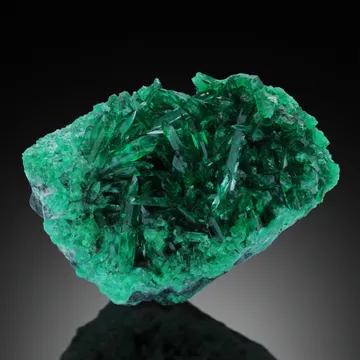
Zincolivenite Collectors Guide
Zincolivenite is a relatively recent, zinc-rich member of the olivenite group with approximate formula CuZn(AsO4)(OH). It typically forms as vivid to dark emerald-green crystals and crusts in the oxidized zones of polymetallic ore deposits rich in copper, zinc, and arsenic. Crystals are most often slender prisms to bladed needles in radiating sprays or micro-draperies on limonitic matrix, though thicker prismatic crystals and sparkly druses also occur. Luster ranges from vitreous to adamantine on fresh faces, and many specimens show attractive contrast against white quartz, calcite, dolomite, or rusty gossan.
For collectors, zincolivenite bridges two worlds: it satisfies strict species collectors (newer arsenate species with a well-defined structure and chemistry) and aesthetics-driven collectors who appreciate its saturated greens, radiating sprays, and fine associations. Most pieces are small—thumbnails and micromounts dominate—but select localities have produced cabinet-sized plates with rich coverage and attractive associations.
Since its formal recognition in the mid-2000s, zincolivenite has quickly earned a following. Early and ongoing finds from Morocco (Bou Azzer), Namibia (Tsumeb), Mexico (Ojuela), and Greece (Laurion) put fine examples into major collections and the micromount community. Its popularity is driven by:
- Color and luster: a deep, glassy green with crisp micro-crystallization.
- Locality prestige: “blue-chip” districts like Tsumeb and Bou Azzer add provenance value.
- Species appeal: a well-characterized member of the olivenite group, often collected alongside olivenite, conichalcite, duftite, austinite, and adamite.
Prices vary with locality, crystal size, sharpness, and association. Choice micromounts are affordable, while richly covered matrix plates from elite localities, especially with contrasting calcite or quartz, command strong premiums. Distinctive or unusually large crystals are genuinely scarce and sought after.
Below are reliable, well-documented sources of zincolivenite that have produced specimens appreciated by collectors. Each entry includes a map and a gallery filtered to the species and locality.
Tsumeb is legendary for complex arsenate suites and outstanding crystallization. Zincolivenite from Tsumeb tends to form lustrous, dark green microcrystals in sprays or drusy coatings, sometimes on dolomite or quartz, and occasionally accompanied by duftite, conichalcite, or smithsonite. While most crystals are small, the sharpness and provenance elevate even modest specimens.
These pieces are prized for their “Tsumeb look”—intense luster, crisp crystal forms, and refined matrix compositions. Scarcity of larger, undamaged coverage ensures strong demand among locality and species collectors alike.
-
Color and saturation
- Best pieces show saturated deep green to emerald tones that hold color in ambient light. Pale or muddy greens are less desirable.
- Even coloration across the display face is preferred; zoning is uncommon but acceptable if not visually distracting.
-
Crystal size and habit
- Most zincolivenite crystals are micro to a few millimeters. Needles and prismatic blades in radiating sprays or sparkling druses are typical.
- Thicker, freestanding prisms or dense, uniform druses on contrasting matrix are premium; isolated sharp crystals >3–5 mm are scarce and sought after.
-
Luster and sharpness
- High vitreous luster makes sprays “pop” under light. Look for crisp terminations on individual prisms; dull, powdery coatings are less exciting.
- Under magnification, well-formed faces with minimal pitting or corrosion add value.
-
Matrix and associations
- Strong contrast elevates aesthetics: green on white quartz/calcite/dolomite, or bright green against rusty gossan.
- Desirable associations include duftite, conichalcite, adamite/austinite (Ojuela), smithsonite (Tsumeb), or other Bou Azzer arsenates. Associations should complement rather than obscure the zincolivenite.
-
Coverage and composition
- Even, richly covered plates with an elegant composition display best. Avoid overly jumbled pieces where crystals are crushed or smeared.
- For locality collectors, well-documented provenance (e.g., Aït Ahmane, Tsumeb) adds value.
-
Condition
- Zincolivenite is brittle; look for intact sprays with minimal bruising or contact marks. On druses, watch for areas where crystals were scuffed during extraction.
- For mounted micromounts, ensure the main cluster is undamaged and sits strongly in the chosen display angle.
-
Repairs and stabilization
- Because matrices (especially gossans) can be friable, you may encounter discreet stabilization of the back or edges with thin adhesives. This is generally acceptable when disclosed and not visible.
- Reattached fragments are uncommon on pure micro-sprays but can occur on larger plates. Inspect for straight glue lines, misaligned growth textures, or glossy seams under a loupe. Some epoxies fluoresce under LW-UV.
-
Cleaning and surface alteration
- Acid cleaning can etch or dull associated carbonates and may subtly affect the surface sheen of zincolivenite; avoid pieces showing unnaturally matte, “melted” textures next to pristine zones.
- Dyeing or oiling is not typical for this species; overly uniform, unnatural color should prompt closer examination, but true fakes are rare.
-
Assemblages
- Beware of artificially assembled “combo” specimens where unrelated crystals are glued together. Cross-check associations against known paragenesis for the locality.
-
Safety
- Zincolivenite is an arsenate. The intact crystal poses negligible risk, but do not ingest dust or fragments. Avoid licking specimens; wash hands after handling, especially if matrix is crumbly.
-
Handling
- Crystals are brittle and commonly form delicate sprays. Handle matrix pieces by the base, not the crystal areas. Use two hands for larger specimens; micromounts should be well-secured in their boxes.
-
Light and temperature
- Colors are generally stable in normal display lighting. Avoid prolonged direct sun and high heat, which can stress brittle matrices and adhesives.
-
Cleaning
- Best: soft air bulb or gentle brush (camel hair) to remove dust. If needed, briefly rinse with distilled water and a drop of mild soap, then air-dry thoroughly.
- Avoid acids (even weak acids like vinegar) and aggressive chemical cleaners; these can damage both zincolivenite and associated carbonates/sulfates.
- Do not use ultrasonic or steam cleaners—risk of crystal detachment and matrix failure.
-
Storage and display
- Keep in padded boxes or on stable stands. Prevent contact with harder minerals to avoid abrasion; conversely, zincolivenite can scratch softer species—store separately.
- In humid climates, ensure good airflow and fully dry specimens after any rinse to prevent mold on organic bases or labels. Light stabilization of crumbly backs with reversible conservation adhesives is acceptable.
With careful selection and gentle care, zincolivenite adds vibrant color, locality depth, and species interest to any collection—particularly when chosen from its classic sources and mounted to highlight its sparkling, deep-green crystallization.