






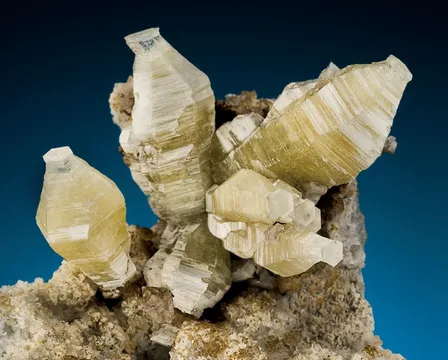
Weloganite - rare sodium-strontium-zirconium carbonate prized for lemon to honey-yellow crystals; scarce type-locality material drives premiums for collectors.
Key facts
Weloganite is a rare sodium–strontium–zirconium carbonate first discovered in Montréal, Canada, and famed for its distinctive lemon to honey‑yellow crystals. Typically forming sharply faceted, pseudo-hexagonal prisms with steep terminations, crystals range from millimeters to a few centimeters, with occasional larger cabinet examples. Luster is vitreous to slightly resinous, and many specimens show subtle internal zoning. The species is a connoisseur favorite because fine crystals are both visually striking and geochemically unusual—weloganite is one of the few known natural zirconium carbonates. Most collectible material comes from a single historic source, making provenance central to its appeal and value.
Weloganite’s reputation rests on scarcity and type-locality prestige. The Francon Quarry (St‑Michel, Montréal), where the species was discovered in the late 1960s, produced a relatively small number of pockets over a limited time; the site has long been inactive. As a result, the supply is finite, and quality pieces have steadily migrated into long-term collections and museums. Prices reflect this: attractive thumbnails and small miniatures are attainable, but well-formed, vivid yellow crystals on aesthetic matrix are uncommon and command strong premiums. Collectors who focus on carbonatites, alkaline environments, or type-locality classics consider weloganite an essential anchor species.
While weloganite has been reported at very few sites, by far the most important and defining source is its type locality in Montréal.
The type and benchmark locality for weloganite, the Francon Quarry (St‑Michel district, Montréal) yielded the classic sharply faceted prisms in shades from pale straw to warm honey yellow. Crystals occur in vugs within carbonate-rich, alkaline-influenced assemblages and are frequently associated with calcite, dolomite, strontianite, and other rare carbonates. The best specimens show glassy luster, crisp edges, and contrasting white to tan matrix that sets off the color. Aesthetic pieces often feature multiple intergrown crystals or isolated, perfectly terminated singles perched in open cavities.
Collectors prize Francon material for:
Production is long past, and surviving fine specimens are limited, making Francon examples the gold standard.
Color and Saturation:
Clarity and Luster:
Crystal Form:
Size:
Condition:
Provenance:
Repairs/Reattachments:
Over-cleaning and Etching:
Polishing:
Weloganite is a carbonate with modest hardness and should be treated gently.
Handling:
Cleaning:
Environment:
Display:
Transport:
With careful selection and sensible care, weloganite will retain its vivid color, sharp form, and historical allure for decades—standing out as a quintessential, single-locality classic in any advanced suite of carbonates or Canadian rarities.