






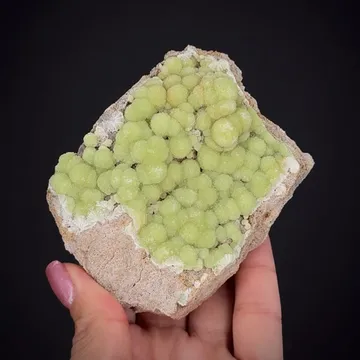
Wavellite — radiating starburst crystals in apple- to emerald-green; prized in Arkansas, Devon, Pennsylvania, and Turkey for color, form, and matrix displays.
Key facts
Wavellite is a hydrated aluminum phosphate celebrated for its radiant, starburst crystal habit. It most often forms hemispherical to spherical aggregates of tightly packed, acicular crystals that radiate from a central point, yielding “firework” cross-sections and velvety-sparkling surfaces. Classic colors range from fresh apple- to emerald-green, with variations spanning yellow, blue-green, colorless/white, and rarely darker greens or browns. Luster shifts from silky (on fibrous hemispheres) to glassy (on open, radiating sprays), and translucency can be superb—top pieces glow with backlighting.
Its preferred settings are aluminous rocks altered by phosphate-bearing fluids: bauxite and laterite pockets, aluminous shales, or limestone/quartz veins that acted as host to secondary phosphates. Associations commonly include variscite, crandallite-group minerals, strengite, turquoise-group phosphates, kaolinite, quartz, and limonite.
Collecting appeal lies in the near-unique aesthetics: perfect, undamaged hemispheres displaying sharp radial spokes, zesty color, and strong contrast on matrix (e.g., on tan sandstone, white quartz, or dark shale) make for striking cabinet displays. Prices remain approachable for modest pieces, while deeply colored, gemmy, and undamaged Arkansas and Pennsylvania specimens on attractive matrix can command four- and even low five-figure prices at the top end.
Wavellite has been a connoisseur favorite for generations. The Arkansas bauxite belt brought worldwide attention with vivid green, lustrous hemispheres—many now considered classics. In the UK, the type locality at High Down Quarry (Devon) secured its historical significance. Pennsylvania’s Mount Pleasant Mills quarries revitalized interest with lemon-yellow to bright green sprays, while Turkey’s Hisarcik Mine impressed with unusually rich greens and large hemispheres.
Because wavellite forms in dramatic, radiating clusters that are unmistakable in a display case, collectors often add at least one standout example to a suite of secondary phosphates or to a “textures and habits” case. Abundant thumbnails and hand specimens keep the species accessible, yet fine, unmarred hemispheres with strong color remain surprisingly scarce—supply is patchy as key localities wax and wane. The balance of affordability for smaller pieces and rarity of truly top-tier, undamaged matrix specimens underpins wavellite’s steady desirability.
While wavellite occurs widely, a handful of districts are recognized for producing benchmark pieces prized by collectors.
Mount Pleasant Mills is renowned for lemon-yellow to bright green wavellite in open, radiating sprays as well as compact hemispheres. The limestone-hosted occurrences yield vivid contrast—green or yellow radial stars scattered over pale matrix or lining pockets with additional phosphate species. Individual “firework” sprays can be remarkably sharp and translucent, often showing glassy tips and fine radial definition.
Collectors seek clean, isolated sprays with intact terminations, attractive composition, and strong color. Pieces with multiple colors (yellow transitioning to green) or with complementary species can be especially appealing. Availability has been episodic and typically in smaller sizes, but fine minis and small cabinets from this quarry are modern American classics.
Color and translucency:
Habit and form:
Luster and surface quality:
Matrix and composition:
Condition:
Repairs and reattachments:
Cleaning and coatings:
Fakes:
Wavellite is a hydrated phosphate with delicate, fibrous surfaces; treat it gently to preserve luster and fiber integrity.
Handling:
Light and temperature:
Cleaning:
Storage and display:
By focusing on vibrant color, unblemished hemispheres or sprays, and strong composition on contrasting matrix, collectors can secure wavellite specimens that punch far above their price class in display impact—beautiful, unmistakable, and quintessentially “radiant.”