






Nevada turquoise — diverse appearances from Royston to Lone Mountain, supergene deposits, and coveted by serious collectors.
Key facts
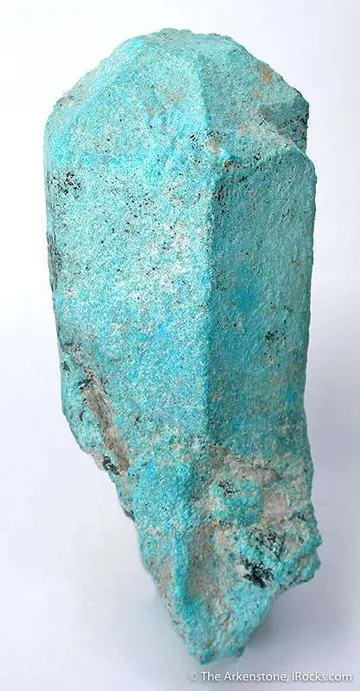
Nevada turquoise is not a single “look” so much as a family of looks: hard, clean blues from Lone Mountain; golden- to black-webbed blue from Number 8; blue-green and brown-matrix material from Royston; chocolate-matrix and dark-blue stones from old Nye County workings; and black-chert matrix pieces from several central Nevada deposits. That breadth is exactly what makes Nevada indispensable to serious turquoise collectors. A drawer labeled simply “Nevada” can hold more visual variety than some entire national suites.

Photo: Wikimedia Commons
Mineralogically, Nevada turquoise is the familiar hydrated copper aluminum phosphate CuAl6(PO4)4(OH)8·4H2O, but the collecting interest lies in how that phosphate mineral was emplaced. Nevada deposits are generally supergene products in oxidized, fractured, and altered host rocks where copper-bearing solutions met aluminous rocks and phosphate sources in an arid environment. Instead of dramatic crystals, turquoise here occurs as dense cryptocrystalline seams, veinlets, nodules, slabs, coatings, and breccia fillings. The state’s best deposits are structurally controlled: shear zones, faults, bedding planes, fractures, intrusive contacts, and argillized or silicified host rocks all play a role.
The classic Nevada turquoise belt trends north-northeast across central Nevada, from Mineral and Esmeralda Counties toward Elko County. The great named camps—Royston, Lone Mountain, Number 8, Blue Gem, Fox/Cortez, Pilot Mountain, Carico Lake, Godber-Burnham, Easter Blue, Blue Matrix, Super-X, and others—owe their individuality to different host rocks and alteration histories. At Royston, turquoise occurs in altered porphyry and quartzite around the Nye–Esmeralda county line. At Lone Mountain it is in calcareous shale along a sheared zone near Paymaster Canyon. At Number 8, near the Tuscarora Range north of Dunphy, turquoise formed in intensely altered quartz monzonite, shale, and thinly bedded black chert.

Photo: Wikimedia Commons
Historically, Nevada is one of the great American turquoise regions. Frank R. Morrissey’s 1968 Nevada Bureau of Mines report described 68 separate turquoise mines or districts, noted prehistoric working at some sites, and recorded Nevada as the major United States producer of turquoise up to that time. The same report preserved information that might otherwise have disappeared with the early miners, cutters, and claim owners who knew the old workings firsthand. Nevada turquoise also became the state’s official semiprecious gemstone in 1987.
Collectors look for different virtues depending on the mine. The finest Lone Mountain material is judged for hard, unfading blue and classic spiderweb in selected pieces. Number 8 is sought for light to dark blue nodules laced by black, brown, red, or golden webbing. Royston is prized for bold natural matrix, blue-to-green color zoning, and cabochons that retain a rugged “boulder turquoise” character. Across the state, the most desirable specimens combine hardness, saturated color, tight natural matrix, provenance, and honest disclosure of any stabilization or backing.
Search for specimens: View all turquoise specimens from Nevada, USA
Nevada turquoise is best understood as a suite of small, structurally controlled, near-surface phosphate deposits rather than a few large industrial ore bodies. The common pattern is turquoise in oxidized rock above or near copper-bearing mineralization, most often as veinlets, nodules, seams, and slabs along fractures, bedding planes, faults, and shear zones. Host rocks reported from Nevada include limestone, shale, chert, quartzite, altered intrusive rocks, and metamorphosed volcanic and sedimentary rocks. In the Tonopah quadrangle, USGS authors described turquoise deposits as shallow, supergene, oxidized occurrences rarely exceeding 50 meters in depth.
The most productive historic areas were the Copper Basin and Bullion districts of Lander County, the Royston district straddling the Nye–Esmeralda county line northwest of Tonopah, and the Crescent Peak area of Clark County. Lander County was especially important in the early literature, with production scattered through Copper Basin, Bullion, Tenabo, Gold Acres, and related districts. In several Nevada districts, turquoise was a companion to broader mining activity: old copper prospects led to turquoise finds, and later copper or gold open-pit operations consumed or obscured earlier turquoise workings.
Royston is one of the best-known collector names. The district lies roughly 24 miles northwest of Tonopah, where mines are scattered along a shallow canyon for nearly a mile. Morrissey described altered quartz monzonite intruding fine-grained quartzite, with the Royal Blue, Bunker Hill, and Oscar Wehrend among the key mines. At Royal Blue, turquoise occurs mostly as veinlets and seams, with lesser lenses and nodules; masses filling brecciated matrix have been recorded more than 5 inches thick. The Royal Blue produced dark sky-blue to pale light-blue material, some with a greenish cast, and the better pure-blue stones were judged among the finest American turquoise.
Lone Mountain, historically also called Blue Jay, is near Paymaster Canyon in Esmeralda County. Its turquoise occurs as nodules in thinly bedded calcareous shale within a sheared, folded, faulted zone about 40 feet wide. The mine is famous for pale to dark blue material without green tones, including both clear blue stones and spiderweb stones. The early underground workings were substantial for a turquoise mine: a 60-degree inclined shaft, multiple levels, and more than 1,500 feet of workings were recorded in the 1968 report.
Number 8, in the Lynn mining district of northern Eureka County, is one of the iconic spiderweb turquoise sources. Its host rocks are intensely altered quartz monzonite, shale, and thinly bedded black chert, with turquoise concentrated along quartz veins in intrusive rock and faults in sedimentary rock. The 1950 discovery of a high-grade spiderweb pocket transformed the mine’s reputation; more than 1,600 pounds of very high-grade turquoise came from that pocket before it was exhausted.
Collecting access in Nevada must be treated conservatively. Most turquoise mines and prospects are private claims, patented ground, active mine sites, or otherwise controlled. The old observation that Nevada turquoise is not “free for the taking” remains the practical rule. Abandoned-looking workings may still be claimed, unsafe, or within restricted mining or military areas. Modern public collecting opportunities are limited and should be arranged directly with current operators. The Otteson Brothers turquoise mine tours around Tonopah have been one of the few well-publicized fee-dig/tour opportunities in recent years, centered on tailings and turquoise-bearing rock from the Royston-area operations.
Modern production is small compared with the mid-20th-century romance of the great pockets, but turquoise is still an active Nevada commodity. The Nevada Division of Minerals’ 2023 active mines directory listed turquoise operations including Lone Mountain Turquoise, Blue Widow, Candelaria Blue, Turkey Track, Montezuma, Thunderbird, and the Side Winder Mine/Royston Claims. These are not large mines by Nevada hard-rock standards, but their presence underscores that Nevada turquoise is not merely an antique-market story.
Nevada turquoise almost never presents as crystals. Collector-grade material is cryptocrystalline and massive, found as nodules, seams, veinlets, slabs, fracture fillings, coatings, and breccia-cementing material. In hand specimen, the most attractive pieces often show turquoise against a contrasting host: limonite-stained porphyry at Royston, black chert in several central Nevada occurrences, calcareous shale at Lone Mountain, and mixed altered intrusive or sedimentary matrices in the Lynn and Bullion districts.
Color is exceptionally broad. Classic Nevada blues range from pale sky blue through deep blue and nearly pure blue. Greens and blue-greens occur in many deposits, especially where iron-rich compositions, related phosphate species, or altered host-rock chemistry influence the color. Royston material commonly spans blue, blue-green, and green, often in the same stone or boulder. Number 8 is famous for light to dark blue set off by black, brown, red, or golden spiderweb. Lone Mountain is distinguished by pale to dark blue without green tints in the best-described historic material. Smith Black Matrix material was noted for blue turquoise against black chert, sometimes with brown stains or gray quartz seams.
Typical usable pieces are small. Morrissey observed that much turquoise occurs in pieces capable of cutting gems around half an inch in diameter, and that even match-head-sized material was sometimes marketable. The exception is what gives Nevada its legend: certain mines produced unusually large nodules and slabs. Number 8 yielded a spiderweb nodule exceeding nine pounds and, in 1954, a turquoise-and-matrix nodule weighing about 150 pounds after cleaning and polishing. Blue Matrix in the Bullion district produced a clear-blue slab nearly a foot square and three-quarters of an inch thick. Royston produced masses more than 5 inches thick in brecciated matrix and lens-shaped pieces weighing an ounce or two, with one piece nearly a pound and a half.
Associated minerals and lookalikes are important. Variscite-group minerals are commonly associated in Nevada turquoise districts, and chalcosiderite may overlap visually with greenish turquoise. Chrysocolla can be mistaken for turquoise in copper districts. Malachite staining, limonite, quartz, chert, shale, and altered intrusive rock are common matrix or association clues. At Lone Mountain, minor silicification and argillization accompany the turquoise. At Blue Silver, minor secondary copper minerals and galena were reported with turquoise. In Royston, a nearby malachite-stained breccia outcrop reflects the copper-rich alteration environment.
Quality factors are both gemological and locality-specific. Hardness and density are critical: the best natural Nevada turquoise takes a clean polish without stabilization and resists darkening or crumbling during cutting. Color saturation matters, but not every collector prefers pure blue; a dramatic Royston boulder stone or tight Number 8 golden web may be more desirable than a plain blue cabochon. Matrix should be natural, well-integrated, and aesthetically balanced. Tight spiderweb, especially in Number 8 and Lone Mountain material, carries a premium when the stone is hard and well documented. Provenance matters enormously: a stone sold merely as “Nevada turquoise” is far less meaningful than one tied credibly to Royston, Number 8, Lone Mountain, Blue Gem, Pilot Mountain, Fox, Carico Lake, or another specific mine.
The first collector rule is to demand disclosure. Nevada turquoise appears on the market as natural, stabilized, backed, dyed, reconstituted, composite, and imitation material. Stabilization is common in softer turquoise and is not inherently fraudulent when disclosed; it becomes a problem when treated material is sold as natural gem-grade stone. Backing is also common on thin cabochons and can be legitimate when stated. Dye, reconstitution, and block material are more serious authenticity concerns when passed off as natural Nevada turquoise.
Specific Nevada names are often misused. “Number 8,” “Lone Mountain,” “Lander Blue,” “Royston,” and “Blue Gem” all carry market weight, so unattributed old-stock material, stabilized commercial turquoise, or even non-Nevada stones may be assigned those labels in weakly documented sales. For serious buying, the strongest provenance is a chain from miner, old lapidary stock, historic collection, or reputable dealer who handles named American turquoise and clearly distinguishes mine from district. Photographs of rough before cutting, old parcel labels, invoices, or estate documentation can add confidence, but none substitutes for mineralogical testing where high value is involved.
Greenish material deserves care. Some Nevada deposits include turquoise, variscite, faustite, chalcosiderite-like material, and other green to blue-green phosphates in close association. In hand specimen or cabochon form, these may be difficult to distinguish by eye. If the commercial value depends on the label “turquoise” rather than “variscite” or “turquoise-family phosphate,” laboratory identification may be warranted. This is especially relevant for bright green Nevada stones and for mixed blue-green seams.
Condition issues are typical of a porous phosphate mineral. Softer turquoise can be chalky, friable, or prone to taking oil and skin darkening. Some stones fade or shift color after light exposure, heat, or chemical contact, though certain Nevada mines—most famously Lone Mountain in the early reports—were praised for stable color. Thin seams in matrix may undercut during polishing. Spiderweb material can fracture along matrix lines. Cabochons should be checked for resin fill, backing, open cracks, repaired breaks, and excessive undercutting along webbing.
Market availability varies dramatically by mine. Royston and some modern Nevada production appear with regularity, including new cabochons, rough, and boulder-style pieces. Number 8, high-grade Lone Mountain, Lander Blue, old Blue Gem, and certain Bullion district classics are largely old-stock and collection material; the best pieces command strong prices and should be approached like historic gem localities rather than routine lapidary goods. Small unattributed “Nevada turquoise” parcels remain common, but top-quality, well-provenanced specimens are genuinely scarce.
At Crescent Peak, the story begins after rain, under a Joshua tree. George Simmons camped near the deposit in 1889 or 1890 while prospecting for copper. In the morning he found bright blue fragments scattered near camp. They did not give him the copper indications he wanted, so he threw them away. About two years later, in New Mexico, he visited a turquoise mine and realized what he had discarded in Nevada. He returned, found the old campsite and the Joshua tree, then followed the blue “float” uphill to its source.
What Simmons found was not a new mine in the usual sense. It was the abandoned remains of an older working. Larger turquoise fragments lay scattered with stone chisels, wedges, and hammers. Below the workings was a leveled terrace with what appeared to be workshops and miners’ quarters. There were rude dugouts with collapsed roofs of logs and brush, a kitchen midden of broken pottery at one end, and at the other a lapidary area with rubbing and polishing stones and quantities of tiny turquoise fragments. From growth rings in the fallen roof logs and from the implements, archaeologists estimated the mine had been worked and abandoned 200 years before Columbus reached America. The absence of rock carvings or pictographs, unlike some California aboriginal mining sites, led Morrissey’s sources to suggest a different people may have worked the mine.
Simmons cleared the old pits and found the turquoise vein. It had been followed until the roof became dangerous. The old mining method, as Morrissey described it, was fire-setting: build a fire against the rock face, throw water on the heated stone to crack it, then drive wedges into the cracks until the mass broke free. Simmons took turquoise to London for appraisal, returned with confidence in the stone, and expanded operations. He hired the German lapidary William Petry and set up a fully equipped shop at the mine. After that, the mine no longer sold rough turquoise; finished gems went to Woods & Lamont, wholesale gem dealers in New York City. In 1896 Simmons sold the mine to J. R. Woods, who patented the claims under the Toltec Gem Mining Co.
The Simmons mine also produced a jewel with a domestic flourish: the largest and most perfect cut stone from the mine weighed a little more than 200 carats, and Simmons had it set in a diamond-surrounded brooch for his wife. The mine’s total production could not be reliably fixed, but the old estimate exceeded $1 million at a time when finished stones from peak production sold for $20 per carat.
At Lone Mountain, Lee Hand’s discovery story begins with a debt. A man who owed Hand for goods offered to show him a turquoise vein if Hand forgave what he owed. Hand agreed, and the two searched for days without finding it. Weeks later Hand returned alone and found the vein several miles from the earlier search area. Someone had already scratched a shallow trench into the outcrop looking for copper, then abandoned it. In the trench debris, Hand found high-grade turquoise the unknown prospector had apparently failed to recognize. He filed the discovery as the Blue Jay Mining Lode, and the mine eventually became known simply as Lone Mountain.
The first spiderweb turquoise at Lone Mountain came not from a broad open pit but from underground work. In 1927, Bert Kopenhaver sank a shaft on the 60-degree inclined vein. At about 40 feet depth, he found the spiderweb material that made the mine famous. The operation later developed into a serious underground turquoise mine with hoist, skip, compressor, jackhammers, stopers, chutes, tramming, screening, and hand sorting. Even match-head-sized pieces were saved and used. The largest recorded clear-blue nugget from the mine measured 4 inches long, 3 inches wide, and three-quarters of an inch thick.
Number 8’s great moment came when the owners were nearly ready to think about copper. By 1950 most of the visible turquoise had been removed from the workings. The Edgar brothers hired a bulldozer contractor to strip overburden elsewhere on the claim, partly because a copper deposit had been found and they thought copper might be the fallback if turquoise failed. After digging a pit about 8 feet deep and 80 feet long, the bulldozer exposed a pocket of spiderweb turquoise that Morrissey called some of the finest ever found in Nevada. The pocket was mostly nodules, some huge. One nodule weighed more than nine pounds and sold to C. F. Wallace of Zuni, New Mexico, for $1,600. Before the pocket was exhausted, it produced more than 1,600 pounds of very high-grade turquoise.
Four years later, on June 23, 1954, T. G. Edgar, J. M. Edgar, and Marvin Symes uncovered one of the largest turquoise nodules on record at Number 8. Cleaned and polished, it weighed about 150 pounds. The measurements recorded in Morrissey’s figure caption were about 31 inches long, 17 inches wide, and 7 inches thick; elsewhere in the report the dimensions are given as 33 by 18.5 by 7 inches. Either way, it was a desert boulder of turquoise and matrix, not a cabochon-maker’s pebble.
The Otteson family’s Royston-era history adds a later, human-scale Nevada story. Lynn Otteson’s first Nevada mine was a Royston claim leased from Lee F. Hand in 1944. Family accounts describe Lynn and his wife traveling from Colorado with baby David, catching a ride to Ely, then hitchhiking all the way to Tonopah. In another episode, Lynn partnered with a man who had the only vehicle. When they had mined a big enough load of turquoise, the partner offered to take it to the Gallup and Albuquerque markets, sell it, and split the proceeds. He never came back. Lynn, his wife, and their baby were left stranded at the Royston mine without a vehicle, and Lynn had to walk 25 miles into town for help. In 1960 he moved the family to Tonopah, and the Otteson name has been tied to Nevada turquoise mining ever since.
_-_50968157587.jpg)
_3.jpg)