Turquoise Collectors Guide
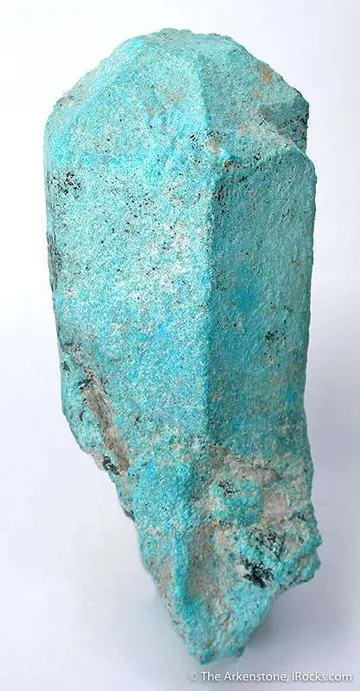
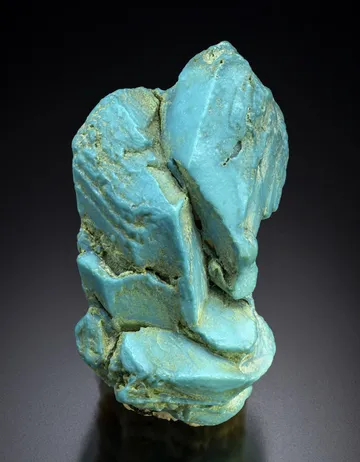
Turquoise is a hydrous copper aluminum phosphate best known for its serene sky-blue to blue‑green color and ancient cultural significance. It typically forms by low-temperature alteration in arid, copper-rich environments, occurring as vein fillings, seams, botryoidal crusts, and nodules, rather than as visible crystals. The finest “robin’s-egg” blues are colored by copper; greener tones usually reflect greater Fe-content and/or dehydration. Attractive host-rock patterns (“matrix”)—from delicate tan to bold black webbing—can create striking spiderweb effects that collectors covet. While often cut as cabochons, natural mineral specimens showing veins, nodules, and vugs in situ are increasingly appreciated. Collectors prize pieces that combine saturated color, tight spiderwebbing, and sound, compact texture with minimal porosity or chalkiness, ideally on an aesthetic matrix.
Few gem-minerals rival turquoise for breadth of cultural allure. From ancient Egypt and Persia to the American Southwest and Tibetan Plateau, it has symbolized protection, prosperity, and sky-water. Museum collections hold historic Persian (Nishapur) nodules of luminous blue, while American collectors celebrate legendary “Bisbee Blue” and the pyrite-speckled “Morenci Blue” from Arizona, along with spiderweb classics from Nevada’s storied Number 8, Lander Blue, and Blue Gem mines. In the last few decades, outstanding production from China’s Hubei province has supplied vivid blues and tight webbing at scale, and Tibetan material—with charismatic green-to-teal hues and bold matrix—has become a stylistic favorite.
Because turquoise is porous and variable in density, much lapidary material is stabilized or dyed; however, natural, untreated, high-grade turquoise commands strong premiums. Specimen collectors are increasingly selective, favoring well-documented pieces from classic localities, aesthetic vein sections on host rock, and nodules or seams exhibiting saturated natural color and crisp matrix patterns. The best turquoise remains scarce relative to demand, and competition for top historic and locality-labeled pieces is keen.
While turquoise is widespread, a handful of regions set benchmarks for color, pattern, and historical importance. Below are notable, ID-confirmed localities.
Nevada is the spiritual home of spiderweb turquoise. Historic districts produced classics like Number 8 (tan-to-black tight webs over powder-blue), Lander Blue (exceedingly rare, inky black web on saturated blue), Blue Gem (varied blues), Royston (blue-to-green bicolors), Carico Lake (minty to apple greens), and Pilot Mountain (bold color zoning). Because many mines are small and long-closed, locality-labeled specimen veins and nodules are prized. Collectors seek natural, high-contrast webs and saturated blues/greens in crisp vein sections on host, often with dramatic, lace-like patterning.
Sonora has produced modern favorites like “Campitos” and “Sonoran Gold,” known for vibrant blue-to-green shades and occasional pyrite highlights. Specimens may occur as veinlets and cavity fillings in copper deposits; colors can transition from vivid blue to fresh apple green within the same piece. Collectors appreciate bright, clean color, occasional metallic accents, and graceful vein geometry on contrasting matrix.
-
Color and Saturation:
- Top turquoise shows a vivid, even “robin’s‑egg” blue or a rich teal/blue‑green, depending on taste and locality. Saturation is key—chalky, pale areas are less desirable unless compensated by exceptional spiderwebbing or historic provenance.
- Greener hues can be highly collectible when intense and well-balanced (e.g., classic Royston/Carico Lake look).
- Uniformity matters for nodules; for veins, attractive zoning or halos along fractures can add interest.
-
Matrix Pattern and Aesthetics:
- Spiderwebbing (tight, consistent black/brown matrix networks) is highly prized, especially when contrasted by saturated blue. Broken, blotchy, or muddy matrix is less appealing.
- Evaluate overall composition: an elegant, well-positioned vein in host rock with pleasing curves and contrast will display better than a random fragment.
- For nodules, natural skin and subtle matrix islands can be visually engaging; cut or polished faces are typically lapidary (less preferred for mineral display unless strategically applied on a teaching piece).
-
Texture, Hardness, and Integrity:
- Natural compactness (lower porosity) is desirable—“hard” turquoise resists crumbling, takes a natural sheen when gently cleaned, and often needs no stabilization.
- Avoid soft, chalky masses that shed grains or require heavy impregnation to hold together as “specimens.”
-
Size and Form:
- Both thumbnails (tight web nodules) and cabinet-sized vein cross-sections are collectible. Rarity climbs with large, intact, high-grade sections showing rich color and crisp patterns.
- On-matrix pieces that clearly show geologic context (vein trajectories, breccia fillings) are especially educational and aesthetic.
-
Condition:
- Look for clean, undamaged surfaces. Fresh breaks through turquoise or matrix are distracting.
- Check for hidden fractures; stable, hairline fractures can be acceptable if non-distracting, but extensive cracks undermine desirability.
- Old labels and solid provenance (mine/district, date) significantly boost value, especially for classic Nevada, Bisbee, or Persian material.
Because turquoise is porous and variable in hardness, treatment is common in the gem trade. Specimen collectors should evaluate:
-
Stabilization/Impregnation:
- Polymer-stabilized pieces feel slightly plastic or “waxy-glassy” on cut surfaces; under magnification, micro-pores may appear filled. Light tapping with a loupe tip can sometimes reveal a subtly “muted” feel vs. natural.
- Edges of stabilized veins may show a thin, clear film where resin wicked into micro-fractures. UV can occasionally reveal fluorescing resins.
- Stabilization is widespread for lapidary; for mineral specimens, many collectors prefer natural, unimpregnated material. If stabilized, it should be disclosed and priced accordingly.
-
Dye:
- Overly uniform, neon-blue with dyed-looking matrix is a red flag. A cotton swab with acetone lightly applied on a tucked-away spot may lift dye (do not overdo—this is a diagnostic touch, not a cleaning method).
- Dyed matrix lines can “bleed” into host rock or appear too consistent in thickness.
-
Reconstituted/Composite (“block”) turquoise:
- Made from powdered turquoise and resin; under magnification, granules and bubbles may be visible. Patterns appear too uniform and the feel is plasticky. These are not mineral specimens.
-
Assembly/Repairs:
- Veins reattached to matrix with epoxy may show a thin glue line at the interface or faint misalignment across striations/fractures. Some epoxies fluoresce under UV.
- Repairs can be acceptable if expertly done and fully disclosed, but unrepaired, intact pieces command premiums.
-
Heat and Surface Coatings:
- Heat can alter color; surface waxes/oils may enhance luster temporarily but attract dust and yellow over time. Coatings should be disclosed.
In short: buy from reputable sources, ask about treatments, and use a loupe and (optionally) longwave UV to inspect. Natural, untreated, locality-labeled specimens are most sought after.
Turquoise is relatively soft and porous (Mohs ~5–6; variable porosity), so treat gently.
-
Handling:
- Support matrix pieces with two hands. Avoid rubbing or frequent handling—skin oils can darken or spot natural turquoise over time.
- Use nitrile gloves if you must handle frequently; otherwise touch matrix rather than turquoise.
-
Light and Temperature:
- Normal display lighting is fine. Avoid prolonged direct sun and high heat, which can dehydrate or shift color and may exacerbate cracks or adhesives.
- Do not subject specimens to sudden temperature swings.
-
Cleaning:
- Best: dust with a soft brush or air bulb. For grime, use a slightly damp microfiber cloth with distilled water only; pat dry. Do not soak.
- Avoid detergents, household cleaners, acids, ultrasonic/steam cleaners—these can stain, etch, or destabilize turquoise and matrix.
- If iron staining on matrix must be addressed, consult a professional preperator; many chemical methods that are safe for quartz/feldspar are risky around porous turquoise.
-
Storage and Display:
- Keep in a stable, moderate environment away from direct sun and heat sources. Maintain gentle humidity; overly dry conditions may encourage micro-cracking in porous pieces.
- Separate from harder minerals to prevent scratches; turquoise can be abraded easily. Use padded stands and a tiny bit of inert mineral tack on matrix—not directly on turquoise—if needed for stability.
- Avoid oiling or waxing specimens; these alter appearance and can reduce value.
-
Long-Term Considerations:
- Track provenance and any known treatments on labels. Stabilized or dyed pieces should be segregated and clearly marked to preserve collection integrity.
- Inspect annually for signs of color change, new fissures, or adhesive aging, especially on older or repaired pieces.
By prioritizing natural color, compelling matrix patterns, sound integrity, and solid provenance—and by caring for specimens gently—you can build a turquoise suite that captures both the mineral’s quiet beauty and its extraordinary cultural legacy.