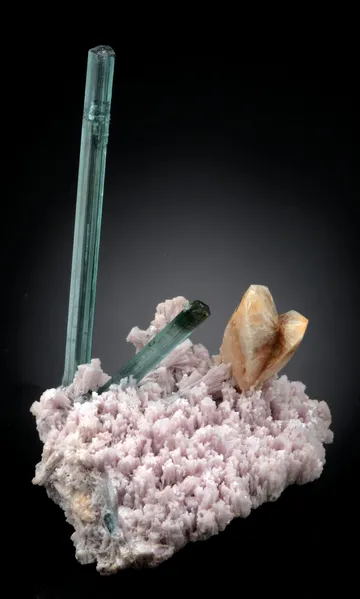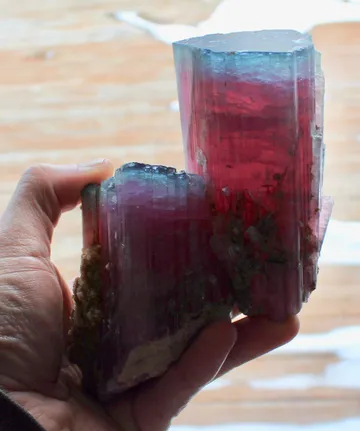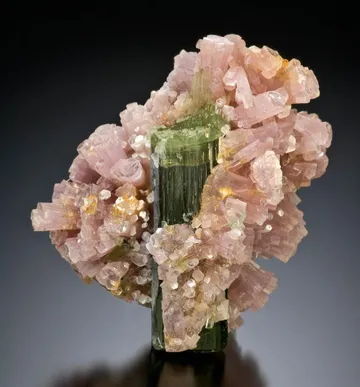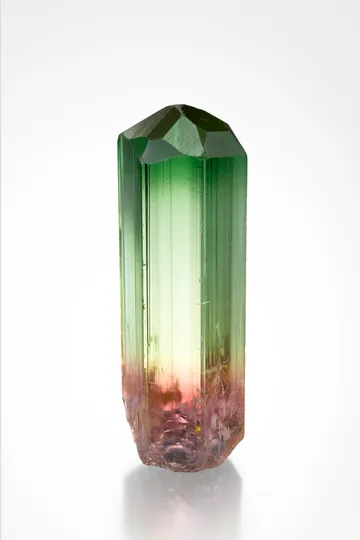
Pederneira Mine, Brazil — landmark locality for collector-grade elbaite tourmaline; saturated colors, high transparency, and iconic pocket assortments.
Key facts
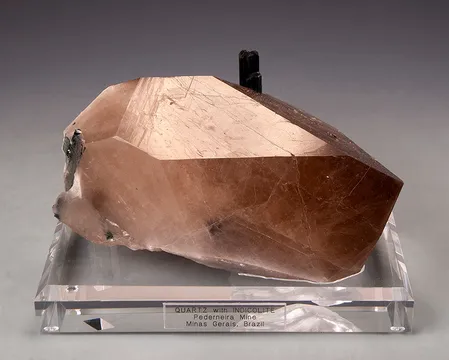
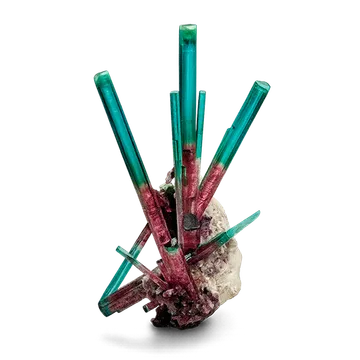
Pederneira is one of the modern landmark localities for collector-grade elbaite tourmaline. The mine’s reputation rests not on a single color or one celebrated specimen, but on a succession of pockets whose crystals seem to have distinct personalities: sharp green-blue prisms, cranberry-red cores wrapped in green, watermelon crystals, blue indicolites, scepters, “rocket” forms, jackstraw clusters, and dramatic matrix pieces on white cleavelandite, lavender lepidolite, quartz, feldspar, and occasional accessory species. The best examples have the combination that serious tourmaline collectors prize most: saturated color, high transparency, clean terminations, architectural composition, and enough matrix to make the crystal look natural rather than merely gemmy.

Photo: Rob Lavinsky, iRocks.com / Wikimedia Commons
Mineralogically, Pederneira is a lithium-rich granitic pegmatite locality in the São José da Safira district of Minas Gerais, within the Eastern Brazilian Pegmatite Province. Its show-quality tourmalines are chiefly elbaite, the lithium-aluminum member of the tourmaline group, with schorl also recorded from the locality. The pocket suite is classic for a highly evolved pegmatite: albite var. cleavelandite, quartz, lepidolite-group mica, microcline, muscovite, spessartine, fluorapatite, hydroxylherderite, beryl including morganite, and rarer species. What makes Pederneira exceptional is not simply that these minerals occur together, but that the pocket environment repeatedly produced them in well-crystallized, aesthetically compatible combinations.

Photo: Rob Lavinsky, iRocks.com / Wikimedia Commons
Historically, Pederneira has a two-part identity. It began in the 1940s as a wartime mica prospect, after a farmer found muscovite exposed by a storm. Decades later, beginning in the late 1990s, it emerged as one of the world’s great specimen mines. The modern production was important because it treated intact mineral specimens as the primary objective, not as accidental by-products of gem rough mining. That collector-first approach is one reason so many Pederneira pieces survived as crystals on matrix rather than vanishing into parcels of cutting rough.
For collectors, the name “Pederneira” carries a specific visual expectation: long, glassy prisms with strong vertical striations; flat pedions or pyramidal terminations depending on polarity and pocket; bicolor and tricolor zoning; transparent green and blue sections; cranberry, raspberry, or pink cores; and the white-lavender contrast of cleavelandite and lepidolite at the base. The finest pocket pieces are not just colorful tourmalines. They are locality documents: specimens whose color sequence, termination style, matrix, and repair history may point to a named pocket such as Keké’s, Rocket, Afghan, Porcupine, 18%, Grandon, Azul Bien Grande, Bi-Color Steel, Violet, Blue Gem, or Blue-Green.

Search for specimens: View all tourmaline specimens from Pederneira Mine, Brazil
Pederneira Mine is in the municipality of São José da Safira, Minas Gerais, Brazil, in a district famous for gem pegmatites and close enough in collector memory to be discussed alongside Cruzeiro, Aricanga, and other eastern Brazilian tourmaline localities. The mine is also known in older references as the Pederneira claim or Lavra da Pederneira. Its name comes from a small river at the base of the mountain where the workings lie.
The deposit consists of two principal pegmatite bodies, known through the modern workings as Dilo and Dada, developed in biotite-quartz-garnet mica schist. Geological work described the bodies as subparallel tabular pegmatites, broadly concordant with the host-rock schistosity and separated by a mica-schist septum. In ordinary tabular sections, the pegmatite may be only tens of centimeters to a few meters thick and comparatively simple: quartz and feldspar with biotite, muscovite, sparse black tourmaline, and garnet. The collector-grade pockets, however, came from thicker, inclined columnar sectors where the pegmatite swelled dramatically and its mineralogy changed. In those enriched zones, tourmaline became a major component together with garnet and muscovite, and open cavities allowed the growth of the euhedral elbaites that made the mine famous.
The early story belongs to mica. During World War II, demand for muscovite was high, and the original discovery reportedly followed a storm that exposed a muscovite-rich outcrop. Local material was carried by mule to São José da Safira and sold to Americans working nearby. The mica operation did not become a major long-lived industrial enterprise, but it opened the locality’s mining history.
The modern specimen era began much later. Work in the productive upper area started around the fall of 1999, after a local miner named Dada found a new pegmatite outcrop roughly 100 meters above older workings. That discovery led to the Dada tunnel, a new partnership, and the late-1999 pocket later called Keké’s Pocket. The material was good enough to announce Pederneira as a serious world locality almost immediately. From that point through the mid-2000s, named pockets came in rapid succession and supplied the international mineral market with some of the most recognizable Brazilian tourmalines of the period.
Access is not comparable to a public collecting site. Pederneira is a commercial underground mine, and the modern specimen operation depended on organized crews, security, equipment, preparation, reconstruction, and marketing. The mine workings included Dada’s Tunnel and Dilo’s Tunnel, with a camp, storage, generators, compressors, ventilation, diamond chain saws, hydraulic splitters, and trained miners. The same infrastructure that made specimen recovery possible also makes casual collecting inappropriate. Fine pieces on the market should therefore be treated as commercial or collection specimens, not as products of casual field collecting.
The production history is best understood pocket by pocket. Keké’s Pocket in 1999 yielded only a small amount of material but combined chrome-green gem tourmaline with vivid pink lepidolite. The Rocket Pocket in 2001, though only about half a cubic meter or a little more, yielded more than 350 crystals ranging from about 2 cm to 12 cm and introduced some of the locality’s most famous “rocket” and scepter forms. The 18% Pocket in 2002 produced blue crystals to about 20 cm long and over 2.5 cm across, with unusually large flawless gem sections. The Grandon Pocket in 2004 was over 2 cubic meters and produced the largest intact Pederneira specimen, “Grandon,” now associated with the Houston Museum of Natural Science. The Azul Bien Grande Pocket, discovered in the last days of May 2004, was nearly 5 cubic meters and required three rooms in a house in Governador Valadares just to lay out the recovered contents.
The classic Pederneira tourmaline crystal is a long, striated elbaite prism with a glassy to strongly vitreous luster, pronounced color zoning, and either a flat or peaked termination depending on polarity and pocket conditions. Many crystals are slender, but the mine also produced thick, cabinet-scale examples and large matrix pieces. The most collectible specimens preserve the crystal’s full geometry: sharp vertical prism faces, intact termination, visible color architecture, and a natural base or matrix association rather than an isolated broken rod.
Color is the locality’s strongest signature. Green is common in the celebrated material, but it is rarely dull “ordinary” green. It may be leaf-green, yellow-green, blue-green, teal, or strongly indicolite-blue in sections. Pink and cranberry-red zones may form cores, caps, lower bodies, or narrow bands. Some crystals show the classic watermelon arrangement of a pink-red interior sheathed in green. Others carry a blue body with a raspberry or cranberry termination, or a green body with dark purple to nearly black terminal zones. The color transitions can be gradual, but many Pederneira pieces show remarkably crisp zoning that gives the crystals a constructed, almost engineered look.
The mine is also notable for hemimorphic and pocket-specific termination habits. Some crystals show flat pedion terminations; others have three-faced trigonal pyramids modified by small vicinal faces. In the Rocket Pocket, many crystals had antilogous terminations and a red rubellite core that changed upward into gemmy green-blue and then green with yellowish tones. The famous rocket and scepter shapes relate to selective dissolution and differential preservation of color zones: parts of the outer zone dissolved or broke away, leaving narrow stems beneath broader surviving terminations. These natural forms are among the locality’s most distinctive and most copied-looking, yet well-documented examples were recovered as natural pocket crystals.
Matrix is a major value factor. Snowy cleavelandite blades form the best visual support for green and blue tourmaline, especially where the albite grows as rosettes or fanlike sprays. Lavender to purple lepidolite adds color contrast, while quartz—sometimes pale citrine—provides mass and sparkle. K-feldspar and muscovite are typical pegmatite companions. Less common but important associations include morganite, fluorapatite, hydroxylherderite, spessartine, and other recorded pegmatite minerals. A fine Pederneira matrix piece should look balanced rather than merely “attached”: the base should frame and stabilize the tourmaline, not overwhelm it.
Size ranges are broad. Thumbnails of 2–3 cm can be highly collectible when pristine and intensely zoned. Miniatures and small cabinets in the 4–10 cm range are the most familiar market size. Rocket Pocket crystals reached about 12 cm, while the 18% Pocket produced crystals to roughly 20 cm. Grandon Pocket crystals exceeded 30 cm, and major Azul Bien Grande specimens carried crystals averaging 20–25 cm, with the largest reported around 40 cm. Very large intact matrix pieces are rare, expensive, and often heavily documented because the mine’s big pocket specimens required exceptional recovery and preparation.
Quality is judged by the usual tourmaline standards—color, transparency, luster, termination, proportions, and condition—but Pederneira adds two special considerations. First, named-pocket attribution matters when it is credible and documented, because each pocket has recognizable color and habit traits. Second, repair status must be evaluated realistically. Many important Pederneira specimens were broken in the pocket or during extraction and were later reassembled along original lock-fit contacts. A clean, disclosed repair at the base of a major crystal may be acceptable; undisclosed repairs, polished terminations, or mismatched reconstruction are serious value issues.
The first question to ask about any significant Pederneira tourmaline is not “Is it repaired?” but “What exactly has been repaired, and how well is it documented?” Many matrix pieces and larger crystals have repairs. This is not unusual for the locality, especially for specimens from fractured pocket systems where crystals detached from matrix before or during collection. The highest-value examples are unrepaired, but many museum-level Pederneira pieces include professionally executed repairs or reattachments. The difference is disclosure, quality of work, and whether the repaired crystal returns to an original lock-fit contact.
Condition issues commonly include repaired bases, reattached crystals, chipped terminations, abraded prism edges, pocket bruising, and cleavelandite or lepidolite damage on the matrix. Long slender crystals are especially vulnerable. On blue and green prisms, small chips may be visually subtle in low light but obvious under magnification or backlighting. On flat terminations, inspect for unnatural gloss, perfectly planar polishing, or a surface that lacks natural growth texture. Natural flat pedions do occur at Pederneira, so the issue is not flatness by itself but whether the face shows believable growth features.
Authenticity concerns for Pederneira are less about outright fake tourmaline crystals and more about modification, reconstruction, and attribution. Scepter and rocket forms from the mine are natural and well documented, but because they look so sculptural, they deserve careful examination. Look for consistent growth striations, natural color zoning that continues through the crystal, believable corrosion or regrowth textures, and a repair history that makes sense. For matrix pieces, inspect attachment points with magnification and, where appropriate, UV light to look for adhesive. A clean repair should be disclosed; a hidden or disguised repair should affect price.
Pocket attribution is valuable but should be treated carefully. Names such as Rocket Pocket, Afghan Pocket, 18% Pocket, Grandon Pocket, Azul Bien Grande Pocket, Violet Pocket, and Blue-Green Pocket are meaningful when backed by older labels, dealer documentation, publication photos, or credible provenance. A loose crystal merely described as “Rocket style” is not the same as a documented Rocket Pocket crystal. Some pocket identities are visually plausible because of distinctive color and termination traits, but the strongest attributions are those tied to original mining records, published photographs, or long-standing collection history.
Rarity varies sharply by type. Loose single crystals from the broad Pederneira production are available with some regularity, especially in miniature and small-cabinet sizes. Fine, unrepaired, strongly colored crystals are much scarcer. Matrix specimens with good composition are scarcer still, and large named-pocket pieces of exhibition quality are elite objects. The top tier—major Rocket, Porcupine, Grandon, Azul Bien Grande, Bi-Color Steel, or comparable named-pocket specimens—belongs in the same conversation as the best modern tourmalines from any locality.
Market availability is healthy in the sense that Pederneira is famous and widely collected, so specimens continue to surface from old dealer inventories and private collections. It is not healthy in the sense of abundant fresh production. Much of what collectors encounter today comes from earlier finds, later releases of prepared material, or secondary-market turnover. Prices reflect that history: attractive small crystals remain attainable, while high-grade gemmy matrix pieces and documented named-pocket specimens command strong premiums.
The story of Pederneira begins with a storm and a farmer. In the 1940s, a man named Pacheco walked the area after heavy weather and found an outcrop full of muscovite. World War II had made mica valuable, and Americans were working nearby at the Cruzeiro mine. Pacheco gathered several barrels of muscovite and moved them by mule to São José da Safira, where he sold the mica. That mule-load of mica was the beginning of the mine, even though the first chapter did not yet hint at the extraordinary tourmalines that would later come from the mountain.
The modern specimen era began with Dada, a local miner who had worked in the old lower adit. Prospecting about 100 meters above the earlier workings, he found a new pegmatite outcrop. Dada and his sons made a road up the hillside and began with hand tools, digging into the mountain. The work grew beyond what hand tools could manage, and Dada brought in partners with equipment and mining rights. That adit became Dada’s Tunnel, and by the end of 1999 it had produced the material later known as Keké’s Pocket.
Keké’s Pocket had a strange, almost cinematic market debut. The pocket contents appear to have left the mine without the original partners’ knowledge and ended up with a local dealer named Domingo in Governador Valadares. Domingo offered the lot to Saint-Clair Fonseca Jr., known as Keké, who recognized that the crystals were probably worth more as specimens than as cutting rough. He contacted Pierre Laville, a French dealer living in Brazil, who had connections to the American dealer Wayne Thompson. The specimens changed hands at Sky Harbor Airport in Phoenix, while the Tucson show season was underway. From that airport transaction, the Pederneira name began moving into major American collections.
Wilson Tomich then set out to find the source of the material. He spent about two weeks touring Brazilian mining towns and localities, even as the 2000 Tucson Show was taking place. A clue finally came from a Governador Valadares dealer named Lezito, who had acquired a small piece of the same material and said it was from Pederneira. Tomich went to the mine, met Dada, and learned enough to enter the partnership structure. In a short span, the mine went from a local pegmatite working to a new force in the world specimen trade.
The Rocket Pocket in 2001 has become one of the great Pederneira episodes. The call to Brazil was urgent: the partners told Daniel Trinchillo he needed to come back immediately. In Governador Valadares he found himself at a table with gem-green crystals from about 2 cm to 12 cm long, so glassy and clean that he later recalled never having seen crystals quite like them. The pocket was only about half a cubic meter, perhaps a little larger, yet it yielded more than 350 crystals. Each crystal was numbered with a small sticker and logged by size and weight. The pocket’s three best “rocket” forms gave the find its name, and the “Missile,” “Space Shuttle,” “Takeoff,” and “Ignition” became part of Pederneira lore.
The Rocket crystals carried a complicated color story inside their forms. Many began with a red rubellite core, shifted upward into pure gemmy green-blue, and then blended into green with yellowish tones. Between the red core and outer green-blue zone, some crystals showed a fibrous or corroded layer. In certain examples, the outer zone had been dissolved or broken away, leaving a narrow stem beneath a broader termination—a natural scepter form. The remarkable thing is that these shapes, which can look almost too dramatic to be believed, were documented from the pocket as natural products of corrosion, breakage, regrowth, and hemimorphic tourmaline behavior.
The Proud Pocket supplied a different kind of story: the specimen that turned a buyer into a partner. One piece was nearly a meter across and almost 40 cm tall, with a tourmaline crystal approaching 14 cm long and 7 cm in diameter projecting from quartz with albite and lepidolite. The price was so high that buying it outright made little business sense, but the opportunity was too important to lose. After several meals of picanha and plenty of draft beer, a different arrangement was made: a half-interest in that specimen and a 50% stake in future finds. In a week, a buyer became a partner in the mine’s future production.
Pederneira’s largest intact specimen emerged from the Grandon Pocket in 2004. The pocket measured over 2 cubic meters, and its great specimen was nicknamed “Grandon,” loosely “the Big Boss.” It lay on its side inside the pocket, so that a person looking horizontally into the opening was effectively looking down at the tops of three giant citrine quartz crystals that formed the specimen’s foundation. José Menezes was central to saving it. He and mine owner Deca looked into the breached pocket, and the extraction took more than two weeks.
Getting Grandon out of the mine was only the beginning. The specimen had to be moved to Governador Valadares, where the cleaning and reconstruction began. It took nearly six months to find the tourmaline crystals and correctly return them to their original positions. Small stickers marked the places where loose tourmalines had lock-fit contacts to the spots where they had grown. Then the specimen was disassembled again, packed, and sent to the United States for careful trimming, cleaning, repair, and restoration. It was finally shown publicly at the 2007 Tucson Gem and Mineral Show and later went to the Houston Museum of Natural Science.
Then came Azul Bien Grande, discovered in the last days of May 2004. The name translates roughly as “Blue, Good ’n’ Big,” and the pocket lived up to it: nearly 5 cubic meters. The tourmalines seemed to multiply as they were removed. More than three rooms in the Pederneira house in Governador Valadares were needed just to lay out the contents, and it took more than a year of reconstruction work to understand what had actually been collected. One major specimen carried crystals averaging 20 to 25 cm long shooting in all directions from cleavelandite and lepidolite, with a three-crystal group rising more than 40 cm. Another, “the Smokestacks,” was 30 cm tall and featured massive blue tourmaline “stacks” about 10 cm tall and 9 cm across.
The day-to-day mine life behind these finds was disciplined rather than romantic. A workday ran from 7 a.m. to 4:30 p.m., with lunch at 11 a.m. and a coffee break at 3 p.m. The staff ranged from about 15 to 20 people, with around ten miners underground on a given day. Drillers worked jackleg drills; assistants relieved them when fatigue set in; others hauled blasted schist and pegmatite to the dump, managed water, pumps, dynamite, tools, compressors, generators, fans, diamond chain saws, and hydraulic splitters. The tunnels were relatively hospitable when blasting was not underway, generally dry and cool year-round. Above ground, the camp had a cook, Neuza, whose meals became part of the mine’s internal legend, along with gardens, chickens, and the everyday machinery of keeping a remote specimen mine alive.