






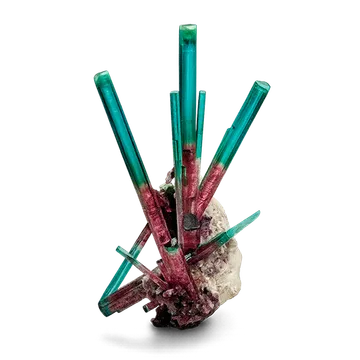
Paprok, Afghanistan - tourmaline from a famed elbaite locality, color-zoned, prismatic crystals, prized by collectors for form and locality.
Key facts
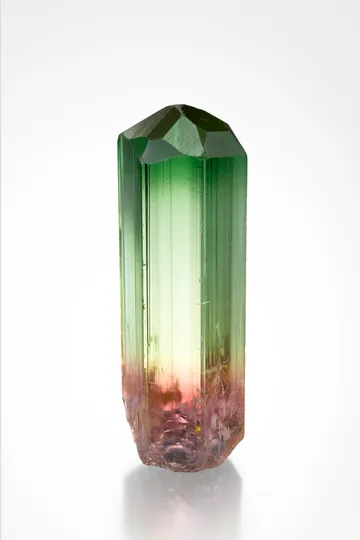
Paprok is one of the great Afghan names for gem elbaite: a mountain pegmatite locality whose best crystals combine the delicacy of cut-gem color with the architecture demanded by specimen collectors. The classic Paprok look is a sharply prismatic tourmaline, vertically striated, glassy to gemmy, and color-zoned in pink, green, pale colorless, brownish olive, or dark “Moor’s head” caps. The finest examples are not merely bright; they are readable as growth histories, with colors changing along the length of the prism or concentrically through the crystal in watermelon sections.

Photo: Wikimedia Commons
Mineralogically, Paprok belongs to the rare-element pegmatite province of northeastern Afghanistan, in the Hindu Kush. These are LCT-type granitic pegmatites — lithium-, cesium-, tantalum-family systems — spatially associated with Oligocene two-mica granites of the Laghman intrusive complex and emplaced into older metamorphic rocks. At Paprok, the productive pegmatites are recorded as gem-bearing bodies hosted in Late Triassic slate, a setting that helps explain the familiar suite: elbaite and fluor-elbaite with albite var. cleavelandite, quartz and smoky quartz, lepidolite, microcline, beryl, pollucite, spodumene, hydroxylherderite, topaz, phosphates, and tantalum-bearing species.

Photo: Wikimedia Commons
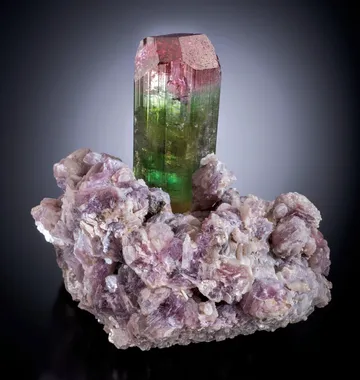
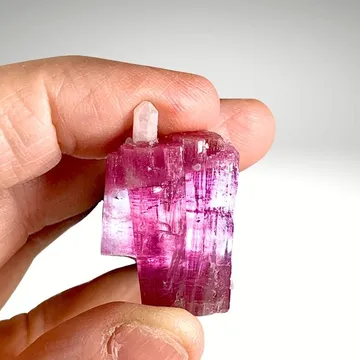
For collectors, Paprok’s special appeal lies in its balance of color, form, and matrix. Loose single crystals can be jewel-like, but the best cabinet specimens show tourmaline rising from snowy cleavelandite, smoky quartz, quartz, or lilac lepidolite, often with the color zoning oriented in a way that makes the specimen instantly recognizable across a room. A Paprok tourmaline can be refined rather than massive: a slim green prism with a pink termination, a raspberry rubellite with a dark cap, or a thick, flat-topped watermelon crystal whose cross-section reveals a pale pink core wrapped by colorless and green zones.
The locality has also attracted serious laboratory attention. Paprok watermelon tourmaline has been studied for its chemical zoning, fluor-elbaite component, Fe-Li variation, mineral inclusions, and Raman response across its colored zones. That research has elevated Paprok beyond a dealer’s locality name: it is a documented pegmatite system whose tourmaline records late-stage changes in fluid chemistry and element availability during crystallization.
Search for specimens: View all tourmaline specimens from Paprok, Afghanistan
Paprok is in Kamdesh District, Nuristan Province, northeastern Afghanistan, with the Mindat locality coordinates recorded at 35°30′20″ N, 71°04′50″ E. The locality has also appeared under variant spellings including Papruk Mine and Paprowk Mine, a common complication in Afghan pegmatite labels.
The “Paprok mine” is best understood not as a single tidy mine portal but as a pegmatite field or group of workings. The main workings are recorded on the right side of the Kéhi Dara Valley, south of Paprok village, with named workings including Me Tunnel Madan, KAL Tunnel Madan, GUL Tunnel Madan, and Al Madan. “Madan” means mine or working, and the surviving labels on older specimens may preserve one of these names, a broader Paprok attribution, or simply “Nuristan, Afghanistan.”
Geologically, Paprok sits within the Nuristan rare-metal pegmatite area, part of a much larger northeastern Afghan pegmatite belt. Regional USGS summaries describe numerous rare-metal pegmatites in the mountainous Hindu Kush, enriched in lithium, tantalum, niobium, beryllium, tin, cesium, boron, phosphorus, and fluorine. The pegmatites are largely LCT-family bodies genetically and spatially related to fertile Oligocene two-mica granites. In the Paron pegmatite field, the Paprok zone is one of the spodumene-bearing groups; at Paprok itself, tourmaline occurs in the gem pockets of complex pegmatites with albite, quartz, lepidolite, beryl, pollucite, spodumene, and rare phosphates.
Production has been irregular and highly dependent on access, security, pocket discovery, and the specimen trade route through Afghanistan and Pakistan. Soviet geologists documented the broader pegmatite region in the 1960s and 1970s, while Afghan pegmatite minerals entered Western collections more visibly in the late twentieth century. Paprok became especially familiar to collectors through the 1990s and 2000s, when high-quality elbaite, beryl, spodumene, and rare minerals from Nuristan and Kunar began appearing more regularly at international mineral shows.
Collecting access is not casual. This is remote, mountainous country, with difficult trails, damaged or limited road networks, and political and security realities that have changed repeatedly over the life of the locality. Modern collectors should regard Paprok material as a market-acquired locality, not a field-collecting destination. The responsible route is through reputable dealers with credible locality history, not independent travel to workings.
Notable finds from Paprok extend beyond tourmaline. The locality list includes elbaite, fluor-elbaite, achroite, indicolite, rubellite and verdelite varieties, as well as beryllonite, väyrynenite, viitaniemiite, pollucite, petalite, hydroxylherderite, hambergite, fluorapatite, topaz, tantalum minerals, and gem spodumene var. kunzite. That breadth is typical of a highly fractionated rare-element pegmatite system and is one reason Paprok is treated as a serious mineral locality rather than merely a gem-crystal source.
Paprok tourmalines are usually elbaite-group crystals, with documented fluor-elbaite in studied watermelon material. “Tourmaline” on labels should be read as a group name unless the specimen has been analyzed or is confidently tied to published species determinations. In the collector market, Paprok pieces are commonly sold as elbaite or elbaite tourmaline, and that is appropriate for much of the classic pink-green material.
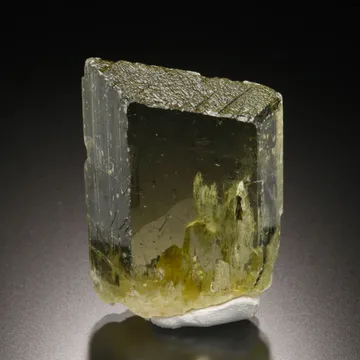
Crystal habit is typically prismatic and vertically striated. Slender pencils occur, but Paprok also produces thicker, columnar crystals with rounded triangular cross-sections and flat pinacoidal terminations. Some crystals show steep pyramidal terminations; others are flat-topped and display the layered color zones especially well. Doubly terminated crystals are known and prized, particularly when the crystal is gemmy and undamaged.
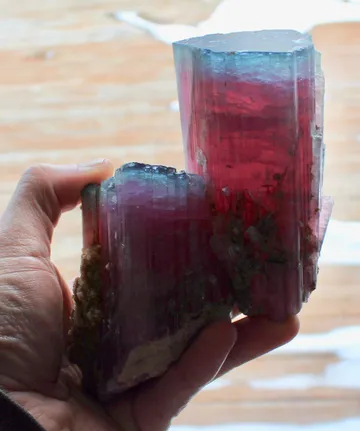
The locality’s color range is broad, but the signature palette is pink to red, green to yellowish green, colorless to pale pink, and darker brownish to black caps. Watermelon structure is important at Paprok: studied material shows a pale pink inner zone, a thin colorless zone, and a green outer zone. Other specimens show axial zoning, with a green shaft changing to pink at the tip, a pink base passing into green, or a dark cap over a pink or green body. Fine examples can be transparent enough to glow under backlighting, but many attractive specimens are translucent rather than fully gem.
Matrix specimens are a central part of Paprok’s appeal. The most desirable combinations place tourmaline on white cleavelandite, smoky quartz, colorless quartz, or lepidolite. Smoky quartz provides strong contrast, while cleavelandite gives the classic Afghan “snow” setting around the base of the crystal. Lepidolite can add lilac to purple tones that complement pink and green tourmaline. Less common but mineralogically interesting associations include beryllonite, hydroxylherderite, fluorapatite, beryl, pollucite, and rare phosphate or tantalum minerals.
Typical collector sizes range from thumbnails of a few centimeters to small cabinet and cabinet specimens. Single crystals in the 2–5 cm range are common in the market; 8–12 cm crystals or matrix pieces are more consequential; large, aesthetic cabinet specimens become expensive quickly. Published and market examples show Paprok tourmaline-bearing matrix specimens in the 10–17 cm class, and high-end cabinet pieces may carry strong five-figure asking prices when color, transparency, termination, matrix, and condition align.
Quality is judged by the same standards used for elite pegmatite tourmaline, but with a Paprok accent. The ideal specimen has crisp prism faces, lively luster, visible but harmonious color zoning, a natural termination, good transparency, and a believable, undisturbed attachment to matrix. For watermelon pieces, a clean cross-section or visible internal zoning is a major advantage. For matrix specimens, the best compositions look natural rather than crowded: the tourmaline stands clearly, the matrix supports rather than hides it, and associated minerals add context without overwhelming the main crystal.
The first authenticity issue with Paprok tourmaline is locality confidence. Afghanistan and Pakistan share a broader Himalayan-Hindu Kush pegmatite trade network, and specimens may pass through Peshawar or other trading centers before reaching Western dealers. A vague “Afghanistan/Pakistan” attribution should not be upgraded to Paprok without supporting evidence. Conversely, genuine Paprok pieces are common enough that a Paprok label is plausible, but serious purchases should be supported by old labels, dealer history, publication history, or a chain of ownership.
Repairs are a major point of inspection. Tourmaline crystals are brittle, vertically striated, and prone to breakage across the prism; Paprok matrix pieces often combine a valuable crystal with cleavelandite or quartz, creating obvious incentives for reattachment. A cleanly repaired tourmaline is not necessarily unacceptable, especially in large cabinet specimens, but it must be disclosed and priced accordingly. Inspect the base of the crystal with magnification and long-wave UV light; glue can collect along the contact line between tourmaline, albite, and quartz.
Composite specimens are the main fraud concern. A loose tourmaline crystal can be glued into a drilled or natural-looking pocket on quartz or albite, creating a false matrix specimen. Warning signs include an oddly smooth socket, glue sheen, crumbs of crushed albite around the base, a matrix association that does not match the growth direction, or a crystal that appears to “sit on” rather than grow from the matrix. Paprok tourmaline really does occur with quartz, smoky quartz, cleavelandite, and lepidolite, so the association alone is not suspicious; the contact is what matters.
Treatments are less central for display crystals than for faceted gems, but collectors should still be cautious. Reports in the mineral trade have long noted heating and irradiation concerns for Afghan and Pakistani minerals, including tourmaline. For Paprok specimens, the more practical concerns are repaired crystals, polished or recut terminations, acid-cleaned matrix, and misleading color presentation through strong backlighting. A natural flat termination should show subtle growth texture, not the perfectly uniform mirror gloss of a polished break.
Condition is crucial. Many Paprok crystals are lustrous and gemmy enough that even small bruises are visible. Check termination edges, prism corners, and the base contact. Dark caps can conceal chips; pale green and pink zones can reveal internal fractures. Cleavelandite matrix is fragile and commonly sheds blades. Smoky quartz on Paprok pieces may have edge bruising or repaired tips, so the entire specimen should be inspected rather than only the tourmaline.
Market availability is moderate but uneven. Small single crystals, watermelon slices, and modest bicolor crystals appear regularly. Strong thumbnails and miniatures are accessible. Fine matrix pieces, large gemmy crystals, undamaged doubly terminated examples, and dramatic green-pink crystals on cleavelandite or smoky quartz are much scarcer and priced accordingly. The very best Paprok tourmalines compete not because they are the largest tourmalines in the world, but because they combine color zoning, gem clarity, and sculptural Afghan pegmatite matrix in a way few localities can match.
The romance of Paprok is inseparable from movement: crystals leaving high mountain workings, then moving by hand, mule, truck, and trader through one of the world’s hardest mineral routes. The USGS summary of the Nuristan pegmatites describes access in plain, sobering terms: mountainous terrain, poor road and trail networks, and routes that may require travel on foot for tens of kilometers after the last usable jeep road. For collectors used to show cases and velvet pads, it is worth remembering that a clean Paprok elbaite may have begun its market life in a tunnel above the Kéhi Dara Valley, packed out through country where weather, politics, and broken roads are as important as geology.
One of the most memorable Paprok specimen notes attached to a published Wikimedia image concerns a 10.5 cm bi-colored cabinet elbaite with lepidolite. The specimen was described as having been acquired through a “satellite phone email” while it was still coming down from the mines toward Peshawar, “yet uncleaned.” That tiny detail captures a particular moment in the Afghan mineral trade: high-value pocket material being negotiated almost in real time, before preparation, before show labels, before the specimen had even fully entered the international market. In that stage, the buyer was not just judging a crystal; he was judging a possibility wrapped in clay, feldspar, mica, and uncertainty.
Paprok also has a second, quieter story: the way a collector specimen became a research object. A 53 mm, 62.82 g watermelon tourmaline crystal from the Paprok mine was cut and studied zone by zone. What collectors see as a beautiful pink-and-green effect became, under the microscope and spectrometer, a record of changing Fe and Li availability, fluor-elbaite composition, inclusions of stannite and calcium carbonates, and Raman bands that shift across the crystal. The specimen’s pale pink core, thin colorless zone, and green rim were not merely color; they were a preserved chemical sequence from the late life of a pegmatite pocket.


.jpg)