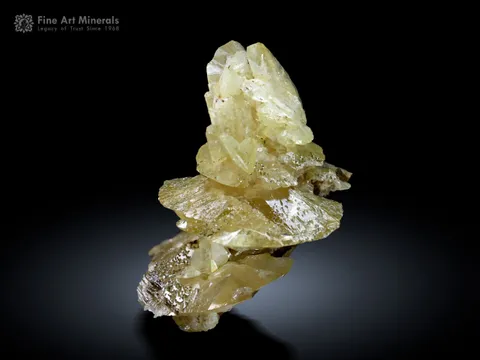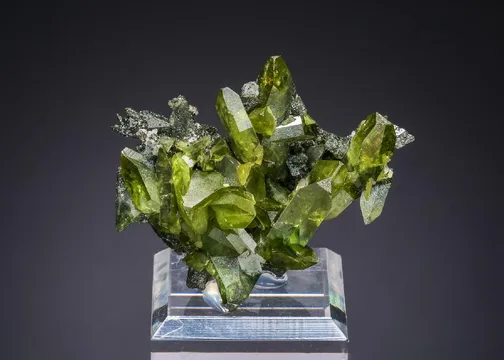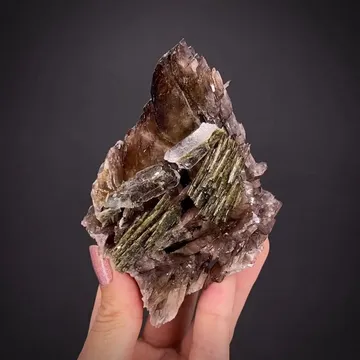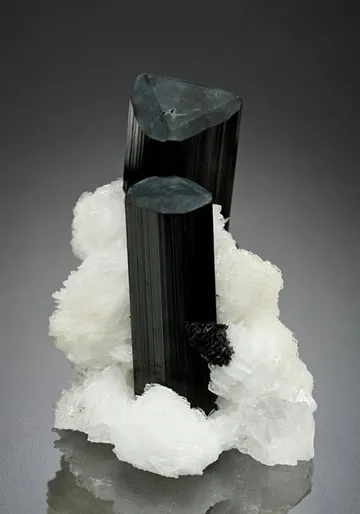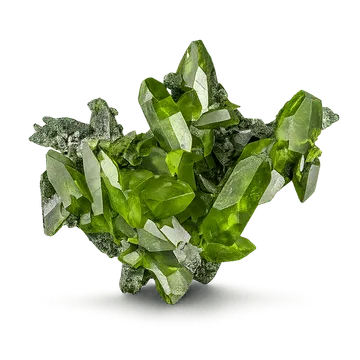
Tormiq Titanite, Pakistan: Alpine-style, cleft-grown green twin crystals on adularia; a modern classic prized by collectors for color, form, and locality.
Key facts
Tormiq Valley titanite is one of the great modern “Alpine-type” surprises of the Karakoram: sharply crystallized, lustrous, green to honey-green titanite from Pakistan that can look uncannily like a European Alpine classic until the locality label gives it away. The finest pieces have the collector’s ideal combination of form and contrast—bright grass-green or yellow-green twinned crystals, often glassy and partly gemmy, standing on white adularia or albite with dark chlorite or clinochlore tucked around the base.

Photo: Wikimedia Commons
The locality belongs to the Haramosh Mountains of Gilgit-Baltistan, in a tectonically battered part of northern Pakistan where granitic, amphibolitic, ultramafic, metasedimentary, and metavolcanic rocks are cut by abundant fractures. Those fractures and clefts are the key: Tormiq is not famous because titanite is rare as a species, but because its cleft-grown crystals developed with the clean geometry, luster, and contrasting matrices that collectors associate with the best Alpine fissure specimens.
The look is distinctive. Tormiq has produced several habits—disc-like or tabular crystals, pinkish tabular material, steep honey-colored wedges, flattened doubly terminated floaters, and the prized blocky green twins—but the green twinned crystals are the material that made the locality a modern classic. They may be isolated on feldspar, seated in chlorite-rich cleft matrix, or arranged with albite, calcite, quartz, clinochlore, ilmenite, or axinite-(Fe). In top examples the twin plane is crisp, the prism faces are wet-looking, and the color shifts from olive to yellow-green or golden green as the specimen is turned.

Photo: Wikimedia Commons
For serious collectors, Tormiq titanite occupies a useful middle ground between European Alpine classics and broader Pakistani gem pegmatite material. It has the Alpine cleft aesthetic, but with Pakistani color and associations; it also carries the market history of the 1990s and 2000s, when northern Pakistan began delivering mineral specimens that forced collectors to take its cleft deposits as seriously as its aquamarine and tourmaline pegmatites.
Search for specimens: View all titanite specimens from Tormiq Valley, Pakistan
Tormiq Valley, also recorded under spellings such as Turmik, Tormic, Tormik, Tormig, and Turmiq, is a tributary valley of the Indus River between Shengus and Skardu in the Haramosh Mountains of present-day Roundu District, Gilgit-Baltistan. The commonly cited coordinates for the locality are about 35° 38′ 26″ N, 75° 18′ 14″ E.
The collecting area is best understood as an Alpine cleft-type metamorphic environment rather than a single conventional mine. The lower valley near the Indus includes granite, amphibolite, and ultramafic rocks, while the central and upper parts include metasedimentary and metavolcanic rocks. Regional deformation associated with the Main Karakoram Thrust opened fractures and clefts in which titanite and associated minerals crystallized. That setting explains the “European Alpine” visual vocabulary of the specimens: feldspar, quartz, chlorite-group minerals, calcite, and sharply formed accessory species growing in open spaces rather than as massive ore.
The broader Haramosh region is also known for complex granitic pegmatite fields and gem-bearing systems, but Tormiq titanite is most admired as cleft material. In specimen terms, the important pocket assemblage is typically titanite with chlorite/clinochlore, adularia or albite, calcite, quartz, and locally ilmenite, magnetite, hematite, epidote, axinite-(Fe), fluorapatite, rutile, anatase, or other accessories. Tormiq’s ilmenite “roses” and sharp metallic blades are notable in their own right, and their presence reinforces the titanium-rich character of the cleft assemblages.
Specimens began appearing as a recognizable collector phenomenon in the 1990s. By the 2000s, fine Tormiq titanites had been absorbed into major Pakistani-mineral collections and into European-Alpine-style suites. The best older pieces now often trade by provenance: Herb Obodda, Jack Halpern, Gene Meieran, Kurt Hefendehl, Kay Robertson, and other named collections appear in specimen records and auction archives. Dealer notes from recent auctions describe fresh supply as scarce, with the near-surface or easily worked pockets largely exhausted and new production uncertain without more demanding collecting.
Access should be treated as remote, permission-dependent, and potentially hazardous. This is high Karakoram terrain, not a casual fee-collecting locality. The valley has local communities and mineral rights, and collecting should only be considered through legitimate local channels with attention to safety, season, terrain, and legal permission.
The signature Tormiq titanite is a sharp, green, twinned crystal—often described by dealers as grass-green, bright green, chrome-green, olive-green, or yellow-green—on white feldspar or dark chloritic matrix. The word “chrome-green” in specimen descriptions is usually a color descriptor, not a chemical analysis; it should not be taken as proof that chromium is the coloring agent unless analytical data accompanies the specimen.
Crystal size varies widely. Fine thumbnails may carry 1.0–2.0 cm twins that are visually powerful because of their sharpness and color. Miniatures and small cabinets can show crystals in the 2–4 cm range, and documented auction pieces include individual or main crystals around 4.0–4.1 cm. Such larger, sharp, lustrous, well-displayed twins are the premium tier for the locality. More typical examples are smaller, partly embedded, included with chlorite, or associated with multiple smaller blades.
Habit is one of the joys of the locality. Tormiq has produced steep wedge-shaped titanites, flattened doubly terminated floaters, tabular and disc-like crystals, pinkish tabular pieces, and blockier twinned forms. Some crystals show a clean, spearhead-like profile; others are thick and architectural, with a strong twin plane and offset crystal halves. The best twins have enough thickness to show body color, enough transparency to glow when backlit, and enough surface luster to flash even under ordinary display lighting.
Color is commonly green to yellow-green, but honey-yellow, golden-amber, olive, gray-green, and pinkish tones occur. Some crystals are distinctly bicolored, with green and amber zones separated sharply enough to be visible without magnification. Chlorite inclusions are common and can either enhance the locality character or lower value, depending on placement. A little chlorite near the base can give excellent contrast; heavy internal chlorite that dulls the crystal can reduce the gemmy effect.
The classic matrix is white feldspar—often labeled adularia or albite—with dark green to black chlorite or clinochlore. Albite may be twinned, and adularia can form blocky or pearly white crystals that make the green titanite stand out dramatically. Calcite is an important association on some pieces and may be fluorescent; quartz, clinochlore, ilmenite, magnetite, hematite, axinite-(Fe), and fluorapatite are also documented companions. Unusual combinations, such as titanite on axinite-(Fe), are much rarer and command attention even when the titanite itself is not the textbook green twin.
Quality factors are straightforward but strict. The first requirement is a complete, sharp titanite crystal with no distracting edge chips or broken terminations. The second is luster: Tormiq titanite should look glassy to adamantine, not matte. The third is color, with saturated green and yellow-green crystals most sought after. The fourth is composition: a crystal well perched on feldspar or clinochlore is far more desirable than a loose or visually buried crystal. The fifth is locality character—chlorite inclusions, Alpine-style matrix, and a clear twin plane all help an experienced collector recognize the material.
Tormiq titanite is scarce enough that provenance matters. Fine pieces are not impossible to find, but the best twins—large, gemmy, sharply terminated, and well placed on matrix—are now much less common than ordinary Pakistani titanite labels might suggest. Recent auction records show strong competition for top small-cabinet pieces, especially those with named collection history or exceptional green color.
Condition requires close inspection. Titanite has moderate hardness and distinct cleavage/parting, and the wedge edges can chip easily. On Tormiq pieces, check the exposed perimeter of the twin, the termination, and any point where the crystal rests against feldspar. Small edge contacts are common; a major repaired break through the crystal or a missing termination should be priced very differently from a pristine example. Dark chlorite, pocket clay, or included material can be mistaken for damage, so use magnification and side lighting before judging.
Matrix authenticity is worth attention. No well-documented, Tormiq-specific titanite fraud category dominates the market, but broader Pakistani specimen commerce has documented problems with glued, reconstructed, or enhanced mineral specimens. For Tormiq titanite, the most important checks are the contact between titanite and matrix, whether chlorite or feldspar continues naturally across the join, whether adhesive fluoresces or gathers dust in a suspicious seam, and whether the crystal orientation makes geological sense. A sharp green titanite improbably perched on an unrelated-looking matrix deserves scrutiny.
Repairs should not be automatically disqualifying if disclosed, but they change value. A repaired large twin may still be desirable as a display specimen; an undisclosed glued crystal on feldspar is a different matter. Examine with a loupe, long-wave UV, and raking light. Be especially cautious with inexpensive “Skardu sphene” lots sold without a precise locality, and with pieces labeled only “Pakistan” that borrow Tormiq’s reputation without showing its characteristic associations.
Faceted titanite from Pakistan appears in the gem trade under both titanite and sphene. That is a separate market from cleft specimens. Faceted stones may be attractive, but they do not by themselves document Tormiq origin unless supported by reliable provenance. Heat treatment and color claims are more relevant to cut stones than to natural crystal specimens; for mineral specimens, the greater concern is assembly, repair, and locality accuracy.
The arrival of Tormiq material changed the way collectors talked about Pakistan. For years, the international imagination of Pakistani minerals was dominated by pegmatite royalty—aquamarine, topaz, tourmaline, morganite, and fluorapatite from the great valleys of Gilgit-Baltistan. Then the Alpine-type clefts of northern Pakistan began producing titanite, epidote, quartz, fluorapatite, rutile, and ilmenite that did not look like pegmatite cabinet specimens at all. They looked like the Alps had been lifted, folded into the Karakoram, and dusted with chlorite.
Collectors noticed the resemblance immediately. The comparison was not casual; it affected prices. Mineralogical Record commentary on Alpine iron-rose and cleft specimens noted that when magnificent Pakistani cleft specimens reached European markets, their prices were “instantly” pushed above normal levels because they so strongly resembled cherished European classics, especially Austrian material from the Pinzgau region. That was the moment Tormiq stopped being merely a new Pakistani source and became a locality that Alpine collectors had to reckon with.
A thumbnail photographed by Rob Lavinsky captures another side of the locality’s appeal: its almost suspicious perfection when the crystals line up just right. The specimen is only 2.1 x 2.0 x 1.5 cm, but it carries gemmy yellow-green titanite with a twinned, doubly terminated 2.0 cm main crystal and a small white feldspar crystal balancing the composition. The original description is memorable because it says what many collectors have thought while handling a too-perfect Tormiq piece: “I thought it was glued together...its not.” That is Tormiq at its best—natural architecture so balanced it makes a cautious collector reach for a loupe.
Named provenances now add their own stories. A Jack Halpern specimen sold at auction in 2024 carried a 4.1 cm strong green twinned titanite on blocky white adularia, a small-cabinet piece from collection number 2624. The auction record framed Halpern’s collecting taste around color, quality, and style, which is exactly why such a Tormiq piece fit his cabinet: not a huge specimen, but one with a large, sharp, vivid crystal and the kind of clean matrix contrast that makes a mineral look inevitable.
Other pieces tell quieter stories about how varied the pockets were. A Herb Obodda specimen was a flattened, doubly terminated, wedge-shaped titanite only 0.2 cm thick, with olive-green, gray, and honey-yellow color depending on the light. A Gene Meieran example placed titanite on axinite-(Fe), the titanite perched like a floater on a natural pedestal. A Kurt Hefendehl cabinet specimen combined twin titanite, twinned albite, chlorite, and fluorescent calcite in a long, ship-like composition. None of these is the standard postcard view of Tormiq, yet together they show why the locality rewards specialists: the best pieces are not just green crystals, but small records of different clefts, fluids, and pocket geometries.