






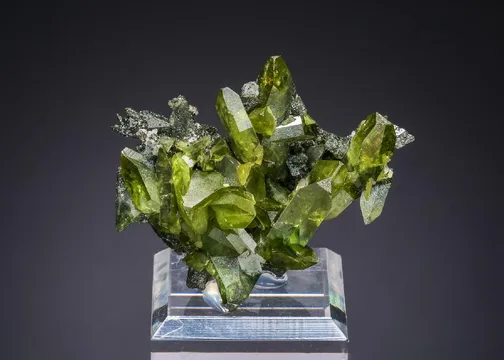
Titanite — spearhead crystals with fiery dispersion in honey-brown to golden hues; Alpine twins on adularia give striking contrast, prized for form, luster, an…
Key facts
Titanite (historically called sphene) is a calcium titanium silicate best known to collectors for its striking “wedge” or spearhead crystal habit and fiery dispersion. Fine crystals often glow honey-brown, olive-green, or golden-yellow, with an adamantine to resinous luster that can look almost gem-like. Classic contact twins produce dramatic arrowhead shapes, and Alpine pieces frequently sit on white adularia or snowy quartz with green chlorite for eye-popping contrast. Though titanite occurs in many rock types—skarns, greenschists, and Alpine clefts—it is most coveted when crystals are sharp, glassy, and balanced on clean matrix.
While titanite is used as a gemstone, superb cutting rough is scarce; most material is collected as natural crystals. Prices vary widely: attractive thumbnails from Canada or Russia remain affordable, while pristine Alpine or Pakistani showpieces with perfect twins and superb luster can be intensely competitive. Top specimens combine strong color, high luster, sharp symmetry, and a display-friendly matrix, and they often become “forever pieces” in advanced collections.
Titanite holds a special niche among collectors who appreciate form and optical properties. Its high dispersion—higher than diamond—gives transparent crystals a fiery “sparkle” uncommon among silicates. Historic European Alpine finds cemented titanite’s stature in the late 19th and early 20th centuries; more recently, Pakistan’s Northern Areas have delivered modern classics with razor-sharp twins. Because excellent crystals are seldom large and condition-sensitive, truly top pieces remain scarce. Enthusiasts value titanite for its unmistakable habit, distinctive colors, rich associations (adularia, epidote, quartz, diopside, calcite), and the way even modest crystals can command attention in a cabinet.
While titanite occurs worldwide, several districts are renowned for producing particularly aesthetic and collectible specimens.
A modern titanite stronghold, Tormiq Valley has produced razor-sharp contact twins in rich olive to brownish-green tones, with bright, glassy luster. Crystals commonly sit on feldspar and quartz with chlorite or epidote accents. Typical sizes run 1–4 cm, occasionally larger; top twins have crisp re-entrant angles and excellent terminations. Tormiq material set a new standard for symmetry and lustrous faces in the 2000s and remains highly sought after.
Nearby to Tormiq, the Haramosh Mountains also deliver fine titanites—often slightly stouter crystals with deep olive hues. Associations include quartz, feldspar, and epidote, and twinning is common. The best pieces show bright luster and excellent display composition, with crystals perched rather than embedded, making them easy to position in a case.
Color and Transparency:
Luster and Surface Quality:
Crystal Form and Twinning:
Size and Composition:
Condition:
Repairs and Reattachments:
Polishing and Enhancement:
Titanite is visually robust but mechanically delicate. With proper care, it will retain its color and luster for generations.
Handling:
Cleaning:
Light and Temperature:
Storage:
By focusing on crisp twins, vivid but not overly dark color, bright luster, and clean matrix composition, collectors can assemble a titanite suite that shines—literally and figuratively—among the classics of the mineral world.