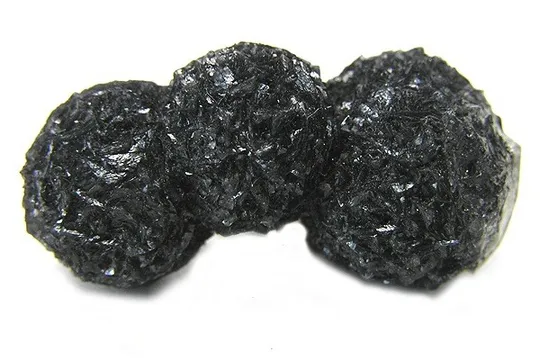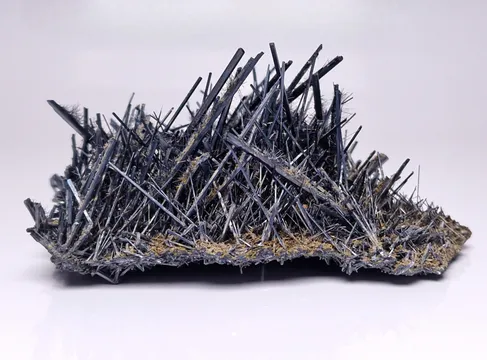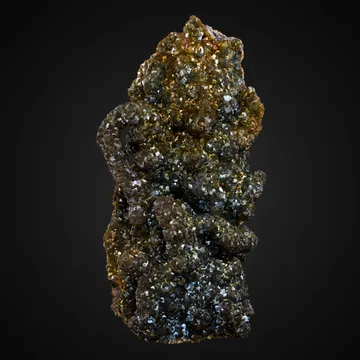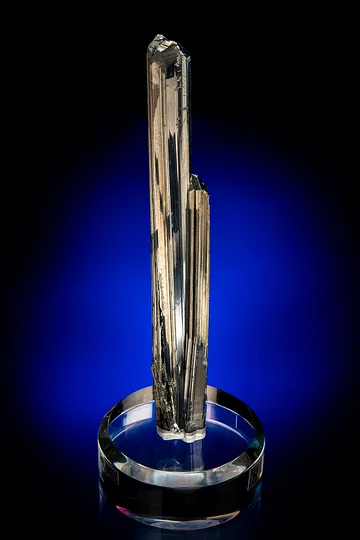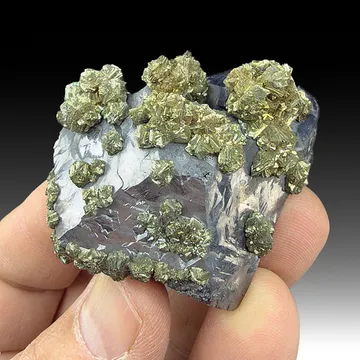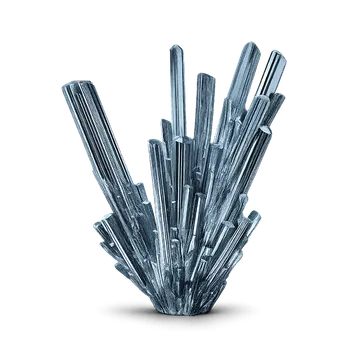
Mine Herja, Roumanie - une localité classique européenne de stibnite réputée pour ses gerbes rayonnantes, sa brillance gris/bleu métallisé et ses cristaux sculpturaux prisés par les collectionneurs.
Key facts
Herja est l'une des localités européennes classiques pour la stibnite: non pas parce que ses cristaux sont les plus longs jamais enregistrés, mais parce qu’ils présentent un aspect immédiatement reconnaissable pour les collectionneurs ayant manipulé suffisamment de matériel roumain. Les meilleures échantillons sont des gerbes tridimensionnelles hérissées et des “boules” arrondies de cristaux gris-noir métalliques, généralement mesurant seulement quelques centimètres de long, disposés en éventails radiaux denses ou en grappes en hedgehog compactes. Leur éclat est souvent d’un noir acier profond plutôt que le brillant miroir, effilé comme une lame, associé à la stibnite moderne chinoise, et cette différence est précisément ce qui confère à Herja son caractère d’ancienne époque.

Photo : Didier Descouens via Wikimedia Commons
Géologiquement, Herja se situe dans le district minier de Baia Mare des monts Gutâi, au nord-ouest de la Roumanie, un district célèbre pour les veines hydrothermales polymétalliques liées au volcanisme du Néogène. Le gisement d’Herja est un système Pb-Zn-Ag-Sb avec du Au en faible quantité, développé comme un vaste réseau de veines conjugées. La stibnite fait partie de l’étape tardive et riche en antimoine de la minéralisation, suivant le développement principal de sphalérite-galène et accompagnée en calcites vugales par une riche gamme de sulfosels Pb-Sb, quartz, calcite, sidérite, baryte, marcasite, pyrite, sphalérite, galène, jamesonite, berthierite, boulangerite, et le matériau fibreux historiquement appelé « plumosite ».
L’attrait des collectionneurs pour Herja est inséparable de cette minéralogie des vugs. Une stibnite d’Herja n’est rarement qu’une seule lame; les pièces convoitées sont des objets sculpturaux. Les collectionneurs recherchent des gerbes radiantes qui se détachent clairement de la matrice, des terminaisons en forme de burin, des extrémités minimales écrasées, et un contraste avec la calcite pâle, le quartz, la baryte ou la sidérite. Certains échantillons montrent la stibnite glissée dans la Calcite blanche et cavernicole, tandis que d’autres sont de véritables forêts de prismes métalliques émergeant d’une base sulfureuse sombre. Les plus beaux exemples sont de petite cabinet ou de taille cabinet, équilibrés dans toutes les directions, et indiscutablement roumains.

*Photo : Rob Lavinsky, iRocks.com, via Wikimedia Commons*Herja a également une importance historique. La mine était une source importante de minerai non ferreux pour la région de Baia Mare, avec du plomb, du zinc, de l’argent, de l’antimoine, du soufre et de petites quantités d’or signalées dans le gisement. L’antimoine était particulièrement important avant 1928, et la mine resta une présence industrielle majeure pendant l’ère minière socialiste d’après-guerre. La production et l’emploi ont diminué fortement après les années 1990, et à la mi-2000 la mine était fermée. Cette fermeture compte pour les collectionneurs: presque tout le stibnite de haute qualité de Herja sur le marché provient aujourd’hui de l’exploitation ancienne, de collections roumaines anciennes, de stocks de marchands européens ou de collections déclassées plutôt que de la collecte active.## Spécimens en vedette## Informations sur la localité
Rechercher des spécimens : Afficher tous les spécimens de stibnite provenant de la mine Herja, Roumanie
La mine Herja se situe dans le district minier de Baia Mare, dans le județ de Maramureș, au nord-ouest de la Roumanie, dans les montagnes Gutâi des Carpates orientales. Les étiquettes plus anciennes indiquent souvent Chiuzbaia ou Kisbánya, et les noms de localité historiques hongrois et germanisés peuvent apparaître sur les étiquettes anciennes, mais la mine est généralement traitée sur le plan minéralogique comme Mine Herja, Baia Mare, județ de Maramureș.
Le gisement est un système de Veine polymétallique à bas sulfate d’épithermal lié à une activité volcanique et subvolcanique du Néogène. Il est associé à un complexe stock intrusif d’âge panglobal et à une alteration hydrothermale qui comprend des styles propylitique, argillic, phyllitique et potassique. Le système veineux a généralement une orientation ENE-WSW et est étendu : les synthèses modernes décrivent plus de 250 structures veineuses, dont 67 sont considérées comme les veines principales. Des travaux antérieurs détaillés décrivaient deux grands groupes de veines, dont un groupe méridional hébergé par du quartz microdiorite porphyrique et un groupe septentrional dans des roches sédimentaires altérées d’âge panglobal, sarmatien et éocène. Certaines veines principales ont été exploitées sur près d’un kilomètre le long de la strike et à plus de 500 mètres en profondeur.
L’assemblage d’oxydes est dominé par des sulfures de métaux de base et des sulfosels. La principale série économique comprend la sphalérite et la galène avec la chalcopyrite, la pyrite, la pyrrhotine, la marcasite, les minéraux du groupe tétraédrite, la stibnite, et une population remarquable de sulfosels Pb-Sb. L’or était présent mais secondaire ; l’argent pouvait être localement élevé dans les parties supérieures des veines, avec des rapports historiques d’un minerai d’argent très riche dans certaines zones. Le gisement était connu pour son minerai de galène massif, son minerai riche en sphalénite et ses assemblages de vugs à l’étage supérieur porteurs d’antimoine. La cavité de stibnite et de sulfosels était particulièrement abondante dans les niveaux supérieurs de la mine, dont beaucoup avaient été largement exploités au moment où les collectionneurs modernes ont commencé à documenter les spécimens.
L’histoire minière à Herja est longue et stratifiée. L’exploitation régionale dans la zone de Baia Mare remonte au Moyen Âge, et les récits locaux décrivent souvent Herja comme l’une des anciennes mines entourant Baia Mare. À l’époque industrielle moderne, Herja est devenue partie intégrante du système organisé d’exploitation minière non ferreuse et de métallurgie de la région. Après la nationalisation des grandes entreprises en 1948, le complexe métallurgique non ferreux de Baia Mare a intégré Herja parmi les mines alimentant les installations de traitement régionales, aux côtés de localités maramureș mieux connues telles que Baia Sprie, Cavnic, Băiuț, Săsar et Nistru.L’histoire tardive de la mine est liée à l’effondrement de l’industrie minière non ferreuse roumaine après 1990. Un important processus de réduction de la main-d’œuvre a commencé en 1997 et, en janvier 2007, seul un petit reliquat de personnel aurait été resté. Des sources locales décrivent une fermeture finale au début de 2007, tandis que des publications minéralogiques parlent d’une mine fermée depuis 2006. Dans tous les cas, Herja devrait être considérée comme une mine souterraine fermée. L’accès à la collecte n’est pas une affaire pratique de chasse au terrain moderne; la localité est représentée dans les collections par le matériel récupéré au cours des opérations d’extraction, notamment au XXe siècle et durant les dernières décennies d’activité.
Les découvertes notables ne se limitaient pas à la stibnite. Herja a produit des spécimens de classe mondiale ou hautement significatifs de plusieurs minéraux et sulfosels, dont la sémseyite, la berthierite, la fizélyite, la jamesonite, la boulangerite et le matériau fibreux de type « plumosite ». La mine est également célèbre pour des formes carbonatées inhabituelles : calcite noire, sphères de calcite bi-color noir et blanc, sphérites de sidérite et calcite associée à des sulfosels en forme d’aiguilles. Ces curiosités comptent pour les collectionneurs de stibnite car elles reflètent le même environnement hydrothermal tardif, en espace libre, riche en antimoine qui a produit les meilleures gerbes de stibnite.## Caractéristiques de la stibnite de la mine Herja, Roumanie
La stibnite de Herja est généralement gris-noir à gris acier foncé, avec une lustre métallique à submétallique jaunâtre. Les habitudes les plus diagnostiques sont des boules radiantes de gros cristaux prismatiques à terminaisons en ciseau et des épanouissements denses de fines aiguilles. De nombreux spécimens présentent des prismes courts et massifs plutôt que de longues lames similaires à des lances. D’autres forment des nids radiaux compacts, des éventails aérés ou des amas hérissés où les cristaux individuels sont courts mais nets et nombreux.
Les cristaux ne sont en général pas de grande taille selon les standards mondiaux de la stibnite. Les notes d’occurrence de Mindat pour Herja insistent sur le fait que les cristaux individuels mesurent couramment seulement plusieurs centimètres de longueur, mais que les boules radiantes font partie des plus esthétiques au monde. Les fiches de marchands et les enregistrements de ventes aux enchères appuient ce schéma : les spécimens d’Herja varient couramment de miniatures d’environ 4–7 cm de diamètre à des pièces petites ou cabinet autour de 10–16 cm, avec des épanouissements individuels signalés autour de 1,6–3 cm sur de nombreuses pièces spectaculaires. Un spécimen « forêt » de 10,5 cm et un amas aciculaire de 16 × 14 × 5 cm illustrent l’extrémité cabinetale du marché, tandis que les miniatures les plus équilibrées affichent souvent le coup visuel le plus fort.
Les associations constituent une part majeure du caractère localité. La calcite est la matrice la plus familière pour bon nombre de stibnites de Herja, allant de la calcite blanche cavernelle à des formes sculpturales à lames ou stalactitiques. Le quartz est également courant, et certaines pièces présentent des cristaux de quartz dispersés à travers la stibnite. La barytine est moins courante mais attrayante lorsqu’elle est présente sous forme de cristaux tabulaires incolores sur ou parmi les épanouissements métalliques. La sidérite donne à certains spécimens une matrice plus chaude brunâtre et est particulièrement prisée lorsqu’elle soutient des épanouissements isolés. D’autres espèces associées comprennent le plumose, la jamesonite, la berthierite, la boulangerite, la dolomite, la marcasite, la pyrite, la sphalérite, la chalcopyrite, la galène, la pyrrhotite, la zinkenite et de rares realgar ou oxydes d’antimoine secondaires tels que la stibiconite.
Les plus belles stibnites de Herja présentent simultanément trois qualités: architecture, surface et durabilité. L’architecture signifie une épanouissement radial ou une boule tout autour qui se montre bien sans avoir besoin de cacher un côté endommagé. La surface signifie un lustre métallique avec des stries nettes et des terminaisons reconnaissables en ciseau ou en lame. La durabilité signifie que les pointes n’ont pas été écrasées. Ce dernier point est crucial. La stibnite de Herja est cassante, tendre et facilement meurtrissable; un spécimen dont les pointes restent réellement intactes et les espaces entre les épanouissements ouverts est nettement meilleur que celui qui n’a que des cristaux en abondance.Le contraste de couleur influence également la valeur. La stibnite sombre sur de la calcite neigeuse constitue l’association d’exposition classique, surtout lorsque la calcite forme une matrice creuse ou sculpturale plutôt qu’une base plane. Les associations baryte-stibnite sont plus rares et particulièrement prisées lorsque la baryte est transparente et ne paraît pas visiblement boueuse. Les « forêts » de stibnite pures, en revanche, reposent sur la densité et le rythme : les collectionneurs recherchent un champ uniforme de cristaux droits et terminés plutôt qu’une masse aplatie.## Notes du collectionneur
Herja stibnite should be bought first with the eyes and then with a loupe. The species is soft, brittle, and strongly cleavable, so broken crystal tips, bruised edges, rubbed terminations, and collapsed sprays are common. Damage can be visually disguised in dense clusters, especially where the original form is a chaotic thicket of blades. Inspect the highest and outermost crystals, not just the front face. If the piece has calcite or baryte, check whether those associated minerals have cleaved or lost corners as well.
Old Herja labels are desirable but not infallible. Romanian stibnite from Maramureș has been repeatedly misattributed among Herja, Cizma, Băiuț-area mines, Baia Sprie, and broader “Baia Mare” labels. Herja’s most typical look is the radiating ball or dense spray of short, grey-black prisms, but other Romanian localities can produce superficially similar material. Be cautious with isolated stout sprays without matrix, especially if the label is vague or modern. A good Herja specimen should ideally have a precise old label, a known dealer history, or a morphology and association consistent with the locality.
Documented fakes specific to the Herja mineral scene are better known among the carbonate spheres than among the stibnite itself. Researchers reported fake centimeter-sized black or grey “calcite spheres” shown at a mineral fair in Cluj-Napoca in 2016; X-ray diffraction identified them as synthetic aluminum oxide with subordinate spinel balls, coated with glued jamesonite debris and needles. That does not mean Herja stibnite sprays are commonly fabricated, but it is a useful warning: Romanian antimony-rich curiosities from this district have attracted fakery, and any improbable Herja association should be judged carefully.
Treatments are not commonly documented for Herja stibnite in the way they are for some colorful secondary minerals, but cleaning and stabilization issues matter. Stibnite should not be aggressively cleaned, oiled, acid-treated, or ultrasonically cleaned. Avoid soaking specimens with sulphosalts, pyrite, marcasite, or delicate calcite. If a specimen has a dull brownish or yellowish coating, it may be natural alteration, a secondary antimony oxide such as stibiconite, iron staining, or mine dirt; do not assume it can be safely removed.
Health handling is straightforward but worth stating. Stibnite is antimony sulfide, Sb2S3. It is not a specimen to grind, lick, carry loose in a pocket, or allow children to handle unsupervised. For normal display and occasional handling it is manageable: wash hands afterward, avoid dust, and keep it away from food surfaces.La disponibilité sur le marché est meilleure que pour bon nombre de classiques européens fermés, car Herja a produit un grand nombre d’échantillons sur des décennies, et l’ancien stock continue de circuler. Cependant, de bons exemplaires ne sont pas courants. Des miniatures ordinaires de stibnite de Herja avec quelques dommages apparaissent régulièrement; des gerbes nettes, équilibrées et non endommagées sur une matrice séduisante de calcite, sidérite, quartz ou barytine sont beaucoup plus rares. Les plus beaux morceaux commandent des prix premium car ils allient l’histoire du locality, le statut de mine fermée et une esthétique distincte non inchangée par la production moderne chinoise.## Stories & Field Notes
Dans la mémoire locale de Baia Mare, Herja n’était pas un petit trou dans les collines mais « mina mare » — la grande mine. Les anciens travailleurs se souvenaient d’une époque où l’exploitation employait plus de 2 000 personnes de la ville et des villages voisins. Des visiteurs allemands venaient apparemment année après année voir le travail et les ressources, et les anciens employés parlaient avec fierté de l’uranium de Herja comme étant exceptionnellement pur. La mine était non seulement une source de minerai ; c’était un monde social avec des bureaux, des ateliers, des équipes, des syndicats, des mariages et l’au revoir rituel du mineur, « Noroc bun ! »
La fin est venue lentement puis soudainement. Le déclin décisif a commencé en 1997, lorsque la politique gouvernementale a commencé à réduire l’exploitation non ferreuse à travers le Maramureș. Les travailleurs ont été licenciés par vagues, avec des indemnités de licenciement, une aide au chômage et une reconversion. D’anciens mineurs protestèrent devant la préfecture, et les syndicats tentèrent de résister aux fermetures, mais le processus s’est poursuivi. En janvier 2007, il restait moins de 150 employés. Des reportages locaux décrivent le dernier moment comme un dernier « Noroc bun ! » puis le cadenas sur la porte. Certains mineurs se sont rendus dans la vallée du Jiu, d’autres ont quitté pour la Hongrie, et un ingénieur respecté, Florin Pop, aurait poursuivi sa carrière jusqu’au Chili.
Herja a aussi produit l’une des histoires de collectionneurs les plus étranges en mineralogie roumaine : les « boules minérales d’Herja ». Les premières sphères d’halite hydrothermale en noir et blanc ont été découvertes en 1958 dans les parties inférieures des géodes dans des veines telles que Șălan, Clementina et Ignațiu. Alexandru Dunca, qui travaillait comme standardisateur à la mine, se souvient plus tard que « dans certaines géodes, des boules de différentes tailles pouvaient être remarquées. Certaines étaient noires, certaines noires et blanches », et que les mineurs en étaient tellement surpris qu’« ils jouaient avec elles ». Pour les géologues de la mine, elles furent au départ des curiosités, non des objets d’intérêt sérieux.
L’une de ces sphères d’Herja est devenue un spécimen minéralogique du patrimoine national roumain : une sphère d’halite calcite environ semi-noire, semi-blanche, au musée départemental de minéralogie « Victor Gorduza » à Baia Mare. Elle a été volée de son lieu sûr durant la nuit du 25 au 26 janvier 2014, et était toujours manquante lorsque l’étude de 2019 sur les sphères a été publiée. La même étude préservait des détails d’autres spécimens de musée : une sphère blanche-dominante de 4,5 × 4,5 × 5 cm qui émettait un bruit lorsqu’elle était mise en mouvement, suggérant un intérieur creux avec des inclusions solides ; et une sphère noire de calcite de 6 × 6 × 6 cm constituée de rhomboèdres jusqu’à 10 mm de arête, saupoudrée de petites sphères de sidérite et apparemment de marcasite.
Ces histoires de carbonate peuvent sembler bien loin de la stibnite, mais elles font partie de la même personnalité d’Herja. Les meilleurs spécimens minéraux de la mine sont nés dans des espaces ouverts — cavités, géodes, paleochannels de fluide hydrothermal — où des aiguilles de sulfures, stibnite, calcite, sidérite, quartz et baryte avaient de la place pour s’organiser en formes que les mineurs se souvenaient et que les collectionneurs reconnaissent encore.## Archives et Publications Minéralogiques
Nigel J. Cook et Gheorghe S. Damian, “New data on ‘plumosite’ and other sulphosalt minerals from the Herja hydrothermal vein deposit, Baia Mare district, Rumania,” Geologica Carpathica 48, 387–399 (1997) — Article essentiel sur le système veineux hydrothermal de Herja, sulfosels Pb-Sb, plumosite, cavités portant de la stibnite, géologie des veines et paragenèse.
Gheorghe Damian, “The genesis of the base metal ore deposit from Herja,” Studia UBB Geologia 48(1), 85–100 (2003) — Article clé sur l’ORIGINE des gisements métalliques de haute teneur identifiant Herja comme un système épithermal à faible sulfidation lié à des intrusions magmatiques successives et à l’évolution des fluides hydrothermaux.
Ioan Mârza, Călin Gabriel Tămaș, Romulus Tetean, Alina Andreica, Ioan Denuț, et Réka Kovács, “Epithermal Bicolor Black and White Calcite Spheres from Herja Ore Deposit, Baia Mare Neogene Ore District, Romania—Genetic Considerations,” Minerals 9(6), 352 (2019) — Étude détaillée des sphères de calcite noires, blanches et bicolores de Herja, avec des notes historiques importantes issues du personnel d’ancienne mine et des archives du musée.
G. Brănoiu, “Rietveld Structure Refinement of the Stibnite Crystals” — Affinement par diffraction sur poudre X des cristaux de stibnite de la Mine de Herja, utile pour les collectionneurs intéressés par la confirmation analytique de l’espèce.
Mindat: Stibnite from Herja Mine, Baia Mare, Maramureș County, Romania — Fiche d’occurrence résumant l’habitus, la couleur, la qualité et les minéraux associés à la stibnite de Herja.
Mindat: Herja Mine, Baia Mare, Maramureș County, Romania — Page principale de locality avec la liste des minéraux, des débouchés, notes historiques sur le nom de la localité et références.
[Musée Countyal de Minéralogie “Victor Gorduza,” Baia Mare — Collection de minerais] (https://www.muzeuminbm.ro/colectiaminereuri/) — Page du musée documentant les spécimens miniéraux régionaux, y compris le matériel de Herja au sein de la collection du patrimoine minier de Baia Mare.
Wikimedia Commons: File: StibineRoumanie.jpg — Photographie librement sous licence d’un spécimen de stibnite Herja mesurant 7 × 5,8 cm par Didier Descouens.
Wikimedia Commons: File: Stibnite-Calcite-139573.jpg — Photographie librement sous licence de Rob Lavinsky montrant de la stibnite dans la calcite de Herja, documentant une association matrice classique.## Vidéos & Médias
“QPJ2378 STIBNITE, Herja, Roumanie” — Crystal Classics, Vimeo — Vidéo de spécimen de dealer montrant une stibnite de Herja en format d’exposition tournant.
“Stibine, Herja, Roumanie” — Minerals and Crystals spécimen vidéo — Page du dealer avec vidéo d’un grand cluster d’herja stibnite aciculaire sur gangue siliceuse.
“Imagini rare: Mina Herja și începuturile barajului Firiza (VIDEO)” — ZiarMaramureș — Média roumain décrivant des séquences d’archive de la Mine d’Herja pendant sa période active et les débuts des travaux du barrage Firiza.