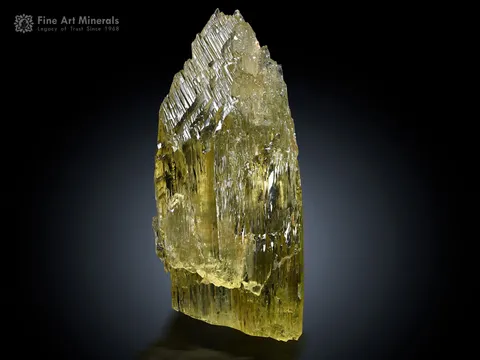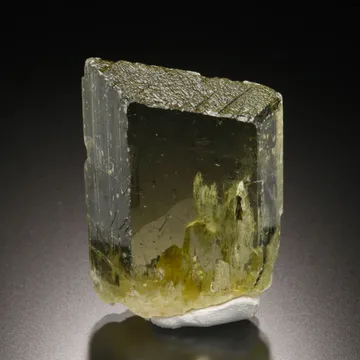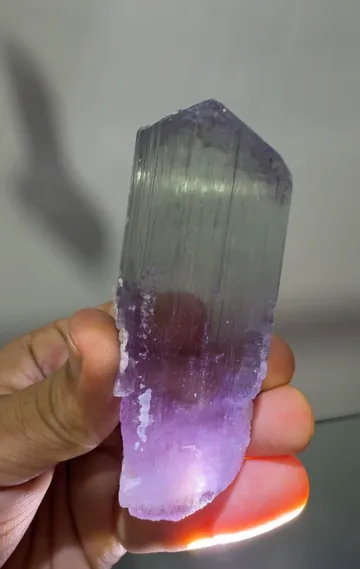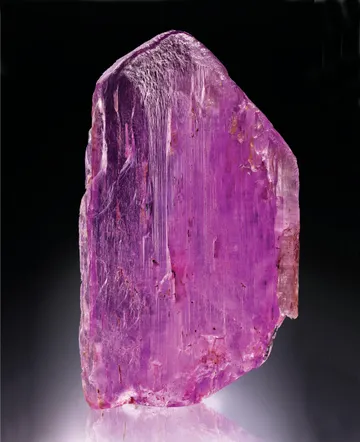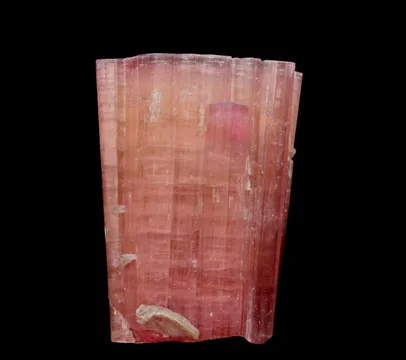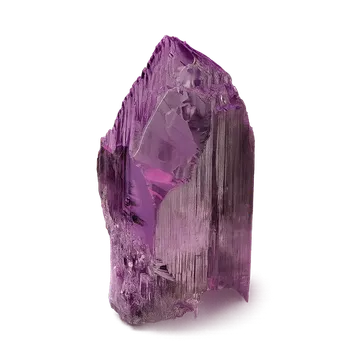
Spodumène de Mawi, Afghanistan: kunzite rose à lilas plus vert, bleu, jaune et incolore, prisé pour ses prismes nets et son fort pleochroisme.
Key facts
Mawi est l’un des noms de référence pour la spodumène afghane : une pegmatite de haute montagne en terrain escarpé dont les meilleurs cristaux allient taille, limpide, couleur fortement pleochroïque et une forme prismatique nette et tranchante que les collectionneurs sérieux reconnaissent immédiatement. La localité est surtout connue pour la kunzite, variété rose à lilas de spodumène, mais la littérature classique sur Mawi enregistre également de la spodumène verte, bleue, jaune et incolore. Cette variété de couleur — surtout lorsqu’elle est montrée dans un cristal zoné ou pleochroïque unique — fait partie de l’attrait de la localité.

Photo : Pala International
Le pegmatite de Mawi appartient au champ de pegmatites Nilaw-Kolum, au nord-est de l’Afghanistan, un district de pegmatites évoluées porteuses de gemmes riches en lithium, béryllium, tantalite-niobium, césium et rubidium. Dans la littérature minérale plus ancienne, la localité est couramment étiquetée comme Mawi, Laghman ou Lagman, Afghanistan ; les bases de données de localités modernes la placent dans la province de Nuristan, au sein du champ Nilaw-Kolum. Les collectionneurs devraient considérer les deux étiquettes comme faisant partie de l’histoire documentaire de la localité plutôt que comme preuve de deux dépôts différents.
Ce qui sépare la spodumène de Mawi de la spodumène ordinaire de pegmatite n’est pas seulement sa grande taille. Beaucoup de localités produisent de la spodumène lourde et terne. Mawi a produit des cristaux aux faces plates et bien développées, arêtes nettes, stries longitudinales marquées et suffisamment transparents pour révéler l’effet de couleur « axe c » qui rend la kunzite afghane si spectaculaire lorsqu’elle est rétroéclairée. Les pièces les plus fines sont des lames élégantes ou des prismes blocky, parfois doublement terminés, parfois perchés sur de la cleavelandite blanche ou du quartz, et parfois portant ce type de zoning de couleur — rose, lilas, vert pâle, jaune miel, ou proche de l’incolore — qui donne au cristal une profondeur visuelle plutôt qu’une simple masse.

Photo : Wikimedia Commons
Historiquement, Mawi est entré dans la conscience occidentale des collectionneurs à travers la vague de minéraux de pegmatite afghans qui a commencé à atteindre les négociants et les collectionneurs dans les années 1970. L’article classique de 1978 dans Mineralogical Record par J. F. Poullen et Pierre Bariand a donné à Mawi une place permanente dans la littérature des spécimens, décrivant l’excédente spodumène du dépôt, la morganite, l’aquamarine et la tourmaline tricolore. Des comptes rendus et des fiches de spécimens ultérieurs ont continué à présenter Mawi comme l’une des grandes sources afghanes de cristaux gemmes, avec des spécimens remarquables dans des collections institutionnelles et privées majeures.Pour les collectionneurs, la spodumène Mawi idéale n’est pas simplement le plus gros cristal. Les meilleures pièces présentent une terminaison complète, un éclat vif, des faces prismatiques striées lisibles, une couleur naturelle qui résiste aux conditions d’exposition courantes et peu de coups d’angle. Les spécimens en matrice sont particulièrement recherchés car les premiers observateurs sur les tas ont vu de nombreuses bases de spodumène laissées sur des plaques de quartz, de microcline et de cleavelandite après que les chasseurs de gemmes aient détaché les cristaux; les pièces intactes en matrice sont donc moins courantes que les cristaux simples détachés.## Specimens en vedette
Search for specimens: View all spodumene specimens from Mawi Pegmatite, Afghanistan
Mawi is a gem pegmatite in the Mawi valley, a small western branch of the Kolum valley in the Nilaw-Kolum pegmatite field. Mindat places the pegmatite at roughly 35.202° N, 70.336° E and treats it as a pegmatite locality within Nuristan Province, Afghanistan. Older geological and collecting literature often used Laghman or Lagman for the same area, reflecting earlier administrative and collecting usage.
The deposit is part of the northeastern Afghan pegmatite belt, where lithium- and beryllium-rich pegmatites occur in and around crystalline metamorphic and intrusive rocks. Regional descriptions of the Nilaw-Kolum field emphasize Be-Ta-Nb-Li-Cs-Rb-rich pegmatite veins hosted by schist, diorite, gneiss, or granite. In the older Nilaw-Mawi geological model, pegmatites were injected into the Nilaw intrusion, with dioritic to gabbroic rocks, migmatites, mica schists, quartzites, marble, and granitic rocks all part of the broader geological picture. The gem pockets at Mawi represent the highly evolved, volatile-rich end of this system.
The principal Mawi pegmatite was described by Rossovskij and coauthors, as cited by Poullen and Bariand, as about 40 meters thick and 1,200 meters long. Later satellite-based reporting described the Mawi pegmatite as about 1.5 kilometers long, broadly consistent with the older scale. These figures matter to collectors because Mawi is not a single small pocket mine; it is a large pegmatite system capable of repeated pocket production over decades.
The classic paragenesis at Mawi begins with quartz-muscovite border aggregates against the wall rock, followed by biotite, microcline, quartz, aquamarine, and black tourmaline in parts of the deposit. A giant-crystal zone of quartz and microcline developed later, with beryl in apophyses of the main vein. The spodumene-bearing stage formed as local quartz-spodumene segregations several meters thick, also carrying columbite-tantalite. Later albite-muscovite-quartz assemblages include lepidolite, multicolored tourmaline, and additional spodumene. This sequence explains why the best collector pieces may show spodumene with white albite-cleavelandite, quartz, lepidolite, tourmaline, or beryl rather than occurring in a single uniform rock type.
Mining history at Mawi begins in modern mineral literature with Soviet-era geological work in the 1970s. Afghan pegmatite minerals were discovered and developed in that period for strategic elements as well as gems, and local men were employed to search for lithium, cesium, and related mineralization. By the mid-1970s, Mawi was already producing enough spodumene to be measured in hundreds of kilograms during individual production intervals: 420 kg in July 1973 and 176 kg during October-November of the same year were recorded in the classic account.L’accès a toujours été difficile. Poullen et Bariand décrivaient l’approche de 1977 vers les pegmatites de Laghman comme un voyage exigeant à pied après la fin de la route praticable en jeep. À Nilaw, le chemin vers Mawi pouvait être parcouru en une demi-journée de marche en traversant la chaîne Koh-e-Sagoli à environ 3 000 mètres, puis en descendant par la courte vallée de Mawi jusqu’à ce que les dépôts et les travaux apparaissent. Les collectionneurs modernes devraient considérer Mawi comme une localité minière afghane active ou intermittente, et non comme un site de collecte récréatif. L’autorisation, les droits miniers, la sécurité et le contrôle local sont décisifs ; la localité n’est pas un endroit pour une collecte de terrain occasionnelle.
Mawi est restée une localité active ou connue pour sa production après la première vague de publication. L’USGS a inscrit Mawi comme mine de gemmes active en 1995, avec de la morganite, de l’aquamarine, de la spessartine, de la spodumène et de la tourmaline. Une analyse par satellite publiée en 2022 a noté une activité renouvelée ou accrue après 2021, comprenant de nouveaux bâtiments, des toitures restaurées, des véhicules et de nouveaux tailings à Mawi et à proximité de Kolum. Cette activité moderne explique en partie l’apparition continue de spodumène, de kunzite, de morganite et de tourmaline de Mawi sur le marché des collectionneurs.## Caractéristiques de la spodumène de la pegmatite Mawi, Afghanistan
Le spodumène de Mawi est surtout admiré sous forme de prismes monoclinique allongés, généralement aplatis et fortement striés le long de la longueur du cristal. L’habitus classique est le clinoprism aplati avec des faces largement striées, mais Mawi a également produit des cristaux avec une section transversale plus bloc ou presque carrée où les formes principales du prisme se développent plus uniformément. Le jumelage est documenté, y compris des jumeaux sur 100 avec un angle réentrant visible.
La plage de couleurs est exceptionnellement large. Le kunzite rose à lilas est la variété la plus collectée, mais les descriptions plus anciennes de Mawi enregistrent aussi du spodumène vert, bleu, jaune et incolore. De nombreux cristaux présentent une couleur plus intense lorsqu’ils sont regardés ou éclairés le long de la longueur du cristal, conséquence directe de la pleochroïsme du spodumène. Un cristal qui paraît pâle de face peut révéler des éclats bien plus riches en lilas, violet ou rose le long de l’axe c. C’est pourquoi les collectionneurs expérimentés demandent souvent à voir à la fois l’éclairage de face ordinaire et une vue en rétroéclairage axiale avant d’évaluer une pièce de Mawi.
Les cristaux de Mawi peuvent être volumineux sur n’importe quelle échelle de spécimen raisonnable. Les cristaux de spodumène dans les sédiments quartz-spodumène ont été décrits comme atteignant jusqu’à 2 mètres de long, bien que une grande partie de ce matériau fût incrusté ou de qualité non idéale pour un bel échantillon. Le district plus large de Laghman-Nuristan a produit des cristaux gemmes de spodumène jusqu’à environ un mètre de long, et les célèbres photographies historiques de Mawi incluent un cristal vert décrit comme mesurant 60 cm de haut et un cristal kunzite mesurant 20 cm de haut dans la collection Sorbonne. Les échantillons de collection contemporains varient couramment de miniatures à de grandes pièces de cabinet, avec des cristaux d’exposition fins dans la plage 5-15 cm et des cristaux exceptionnels s’étendant bien au-delà.
Les surfaces constituent un plaisir diagnostic majeur. Les cristaux de Mawi peuvent présenter des faces prismatiques plates, vitreuses à cireuses avec une striation longitudinale nette; des zones gravées ou dissoutes; des bases ré-guéritées; et des terminaisons nettement développées. Bariand et Poullen ont souligné que le spodumène de Laghman diffère de nombreux grands cristaux de Californie et du Minas Gerais par des faces plus plates et mieux développées et des arêtes relativement nettes plutôt que arrondies. Certaines faces latérales peuvent être confondues avec des cassures de clivage, en particulier lorsque 110 est développé; une inspection minutieuse des figures de croissance ou de corrosion est donc importante avant de rejeter une face comme endommagée.Les associations sont au cœur de l’identité de Mawi. Les minéraux associés courants et importants incluent quartz, microcline, albite comprenant cleavelandite, muscovite, lépidolite, elbaïte ou autres tourmalines, tourmaline noire, béryl comprenant morganite et aventuremanite aquamarine? Wait: "aventuremin..." No. Correct: aquamarine, et spessartine. Des accessoires moins visibles mais importants sur le plan minéralogique enregistrés du système Mawi/Nilaw-Kolum incluent columbite-tantalite, tantalite-(Mn), minéraux du groupe microlite, cassitérite, pollucite, fluorapatite, topaze, et minéraux d’altération argileuse tels que la montmorillonite. Les combinaisons esthétiques les plus convoitées sont la spodumène rose ou lilas sur cleavelandite blanche, spodumène avec quartz, et des spodumènes plus rares associés à la lépidolite, à la tourmaline ou à la morganite.
La qualité est jugée selon plusieurs axes. Une couleur saturée mais crédible est importante, surtout dans le kunzite; toutefois, la forme et l’état comptent souvent plus que la couleur seule. Un cristal modérément coloré avec une terminaison complète, des arêtes nettes, une brillance prononcée et sans réparations peut être plus collectible qu’un cristal plus lumineux mais endommagé. La matrice élève la barre : un kunzite Mawi bien équilibré sur cleavelandite ou quartz est nettement plus rare qu’un cristal détaché, car de nombreux cristaux ont été retirés des plaques de poche pour l’usage gemme ou la vente facile.## Notes du Collecteur
La question d’authenticité la plus importante pour la spodumène de Mawi n’est généralement pas de savoir si le minéral est de la spodumène; les cristaux afghans bien formés se distinguent par leur dureté, leur cassure, leur habitudes, leurs stries et leur pleochroïsme. Les questions plus sérieuses portent sur le traitement, la stabilité des couleurs, la réparation et la précision de la localité.
Le traitement de la couleur est une préoccupation réelle pour la kunzite et d’autres spodumènes colorés. La kunzite peut être irradiée et chauffée pour intensifier la couleur, et la couleur traitée peut s’estomper. Même la kunzite naturelle est sensible à la lumière à des degrés variables et ne doit pas être exposée à la lumière directe du soleil ou sous un éclairage chaud et intense. Le spodumène bleu, bleu-vert et vert particulièrement vif issu d’Afghanistan mérite une attention particulière : certaines couleurs peuvent être liées à une irradiation naturelle, d’autres peuvent être artificielles, et d’autres encore peuvent être instables. Un vendeur responsable devrait indiquer si le traitement est connu, suspecté ou non testé.
La terminologie est également importante. Dans le commerce, « kunzite » est parfois utilisé de manière approximative pour presque n’importe quel cristal attrayant de spodumène afghan, y compris le matériel jaune, verdâtre, bleu ou incolore. Strictement, la kunzite est du spodumène rose à lilas. Le matériel jaune à jaune-vert est mieux décrit comme triphan ou simplement spodumène; le matériel vert ne doit pas être automatiquement appelé hiddenite à moins que l’origine de la couleur et la chimie ne soutiennent ce nom. Des publications plus anciennes sur Mawi admiraient spécifiquement le spodumène vert mais ne le traitaient pas comme_hiddenite_ véritable confirmée.
L’état est le principal champ de bataille de valeur. Le spodumène présente une cassure parfaite et peut se fendre proprement; il se fissure également facilement le long des arêtes exposées et des terminaisons. Les éraflures sur les arêtes apparaissent souvent pâles ou blanches sur un matériau transparent coloré. Examinez attentivement la terminaison, les arêtes inférieures, la base ré-accidentée et tout point de contact avec la matrice. Sur les spécimens en matrice, inspectez si le cristal est naturellement attaché, réparé à sa matrice ou stabilisé. Les réparations ne sont pas rares sur le spodumène de grande taille, mais elles doivent être divulguées.
L’estampage n’est pas automatiquement synonyme de dommage. De nombreuses cristaux de Mawi présentent des textures de dissolution naturelle, des zones ré-accidentées ou des irrégularités de croissance. Le défi est de distinguer les surfaces naturellement émées des surfaces clivées ou cassées. L’estampage naturel respecte généralement les motifs de croissance et peut avoir une texture soyeuse, pommée ou corrodée; le clivage frais est plus plat, plus brillant et plus plan, coupant souvent brusquement à travers la forme de croissance du cristal.
Il n’existe pas de scandales largement cités, spécifiques à Mawi, de faux spécimens comparables aux problèmes bien connus de matrices fabriquées dans certaines autres espèces minérales. Pourtant, la valeur d’une fine kunzite de Mawi rend la prudence nécessaire. Méfiez-vous des étiquettes vagues telles que « kunzite afghan » lorsque le vendeur demande un prix au niveau de Mawi. La provenience vers Mawi, Nilaw-Kolum, Laghman/Nuristan, ou une collection nommée renforce la confiance. Un spécimen portant une vieille étiquette, une histoire de publication, un archive de revendeur ou une photographie assortie commande une prime.La rareté est hiérarchisée. Des cristaux de kunzite afghane individuels et libres se trouvent sur le marché dans de nombreuses tailles et qualités. Des exemples attribués à Mawi apparaissent régulièrement, en particulier par le biais de canaux afghans et pakistanais et de marchands de spécimens en ligne. Les pièces fines attribuées à Mawi — couleur riche, termination complète, pas de dommages significatifs, forte transparence, proportions attractives — sont bien moins courantes. Les pièces de matrice supérieures et les grands cristaux historiquement importants sont véritablement rares et appartiennent à l’extrémité supérieure de la collection de pegmatites afghanes.
Pour l’exhibition, gardez la spodumène de Mawi à l’écart du soleil direct, des éclairages riches en UV, de la chaleur et des changements de température rapides. Manipulez-la comme un cristal gemme sensible à la clivage, et non comme un spécimen de quartz. Soutenez les longs cristaux par le dessous, évitez toute pression sur les terminaisons et ne serrez jamais un cristal de spodumène dans un support. Pour les pièces de grande valeur, conservez les photographies du vendeur et toutes les informations sur les traitements ou réparations avec l’étiquette; les collectionneurs futurs accorderont autant d’importance à cette documentation qu’au spécimen lui-même.## Stories & Field Notes
Le voyage classique vers Mawi se lit comme un rappel que ces délicates cristaux roses proviennent d’un pays rude. En 1977, la route en jeep quittait l’itinéraire Kaboul-Jalalabad, remontait vers le nord jusqu’à Mehtar Lam, puis se terminait à 70 km après le bifurcation près d’un petit pont à Gandalabouk sur le fleuve Alingar. De là, les minéralogistes poursuivaient à pied. Une journée entière était nécessaire pour parcourir 25 km de gorges étroites afin d’atteindre les maisons les plus proches près de Dahaneh-Pyar, à la confluence des rivières Kolum et Alingar. Une autre journée entière sur plus de 15 km d’un sentier rocheux défavorable mènerait à Nilaw. Mawi lui-même se situait à l’est de Nilaw : une demi-journée de marche à travers la chaîne Koh-e-Sagoli, d’environ 3 000 mètres d’altitude, puis une descente dans la courte vallée de Mawi, où les dépôts révélaient les travaux.
La situation juridique dans les années 1970 était déjà compliquée. La législation afghane interdisait l’exploitation par quiconque, sauf les employés du Ministère des Mines, et la règle s’appliquait même aux villageois locaux. Pourtant, les dépôts étaient trop tentants. Le récit classique décrit des contrebandiers venant de Kaboul et d’ailleurs, prêts à gagner de l’argent en vendant des pierres à Kaboul, Peshawar, Gilgit et même Tucson. Les minéraux circulaient déjà le long des mêmes corridors commerciaux qui allaient façonner le commerce des échantillons afghan pendant des décennies.
À Mawi, la spodumène n’était pas un accessoire mineur. Les chiffres de production enregistrés sont stupéfiants : 420 kg de spodumène en juillet 1973, et 176 kg supplémentaires pendant octobre-novembre de la même année. Ces chiffres se cachent derrière la célébrité de la localité. Ils impliquent non pas une poche chanceuse unique, mais un gisement avec une production répétée et significative et des poches suffisamment grandes pour alimenter à la fois les tailleurs de pierres et les marchands de spécimens.
Les dépôts racontaient la tragédie d’un collectionneur. Poullen et Bariand virent d’importantes plaques de quartz, de microcline et d’albite-cleavelinătă, avec seulement les bases des cristaux de spodumène encore attachées. Les cristaux eux-mêmes avaient été retirés par des chasseurs de pierres précieuses. Cette observation unique explique pourquoi les pièces de spodumène sur matrice intactes aujourd’hui à Mawi sont si recherchées : de nombreux échantillons potentiels sur matrice ont été réduits, à la mine, à des bases et des cicatrices.
La même visite produisit de petites merveilles et une frustration presque comique. Les observateurs trouvèrent des échantillons recouverts de petits tourmalines tricolores et même de tourmaline incolore, achroite. Ils remarquèrent des grenats spessartine attractifs incrustés dans le pegmatite. Ils trouvèrent aussi deux énormes boules de muscovite botryoïdales, chacune jusqu’à 30 cm de diamètre, mais les pièces étaient trop grandes et impraticables à retirer. Le compte rendu original les qualifie de « malheureusement transportables ».
Un échantillon admiré ne devint jamais le leur : un cristal de microcline de 20 kg portant un cristal de spodumène rose transparent de 15 cm de long. Les auteurs ne pouvaient que l’admirer. Cette image — un bloc de feldspath lourd avec un spodumène rose en émergeant — résume le genre d’échantillon que Mawi pouvait produire lorsqu’une poche n’était pas dépouillée de ses cristaux lâches.Les photographies historiques de la collection de la Sorbonne ont fixé Mawi dans l’imagination des collectionneurs. L’une montre un cristal de kunzite de 20 cm provenant de Mawi. Une autre montre un cristal de spodumène vert, doubles terminaison et érigé, de 60 cm de hauteur, décrit dans l’article classique comme probablement le plus beau cristal jamais retrouvé à l’époque. Une troisième montre une kunzite à doubles termination de 15 cm de hauteur. Ce ne furent pas des pierres de marché anonymes; elles furent des premiers témoins d’une localité qui venait de placer l’Afghanistan parmi les grandes régions de spécimens pegmatitiques du monde.## Registres et Publications minéralogiques- J. F. Poullen et Pierre Bariand, “Famous Mineral Localities: The Pegmatites of Laghman, Nuristan, Afghanistan,” The Mineralogical Record, Vol. 9, No. 5, 1978, pp. 301-308 — Le compte-rendu anglophone fondateur pour Nilaw, Mawi et Korgal, avec la paragenèse classique, notes d’accès, chiffres de production et premières photographies de spécimens.
Réimpression Pala International de “The Pegmatites of Laghman, Nuristan, Afghanistan” par Poullen et Bariand — Version en ligne lisible de l’article classique, incluant des photographies historiques de spodumène et kunzite de Mawi provenant de la collection de la Sorbonne.
Peter Lyckberg, “Gem pegmatites of northeastern Afghanistan,” The Mineralogical Record, Vol. 48, No. 5, 2017, pp. 610-675 — Revue moderne majeure des pegmatites gemmes du nord-est de l’Afghanistan, avec une section dédiée à Mawi et des références d’imagerie satellite/de terrain.
Greta J. Orris et James D. Bliss, “Mines and Mineral Occurrences of Afghanistan,” USGS Open-File Report 02-110, 2002 — Compilation USGS listant Mawi comme mine de gemmes active en 1995 et enregistrant ses principaux minéraux gemmes.
Stephen G. Peters et al., “Preliminary Non-Fuel Mineral Resource Assessment of Afghanistan: Deposits related to felsic phanerocrystalline intrusive rocks,” USGS Open-File Report 2007-1214 — Cadre régional pour les champs pegmatitiques porteurs de lithium, beryllium, métaux rares et gemmes d’Afghanistan, y compris le champ Nilaw-Kolum.
Aleksandr N. Evdokimov et co-auteurs, “Geochemistry of spodumene from pegmatites of the Laghman granitoid complex, Afghanistan,” Journal of Mining Institute — Étude scientifique régionale des types de spodumène et de la géochimie dans les pegmatites est-afghanes.
Habib Ur Rehman et co-auteurs, “An X-ray Absorption Near-Edge Structure Study on the Oxidation State of Chromophores in Natural Kunzite Samples from Nuristan, Afghanistan,” Minerals, 2020 — Étude analytique des chromophores de kunzite afghane, utile pour comprendre la couleur dans le spodumene de Nuristan.
Terra mineralia specimen: kunzite with quartz from Mawi, photographed on Wikimedia Commons — Exemple d’affichage muséal d’une grande kunzite de Mawi associée au quartz.
Wikimedia Commons category: Minerals of Mawi pegmatite — Archive d’images libre des spécimens de Mawi, incluant spodumène, kunzite, albite, quartzz, apatite, béryl, et tourmaline.## Vidéos & Médias
“BFH3628 KUNZITE avec QUARTZ, Mawi pegmatite, AFGHANISTAN” — Crystal Classics — Vidéo du vendeur montrant une spécimen de kunzite avec quartz en vue tournante.
“Spodumène d'Afghanistan, Nuristan, pegmatite de Mawi” — Médias de spécimens EarthWonders — Page de spécimen sur le marketplace avec images fixes et liens vidéo pour un grand cristal de spodumène/kunzite de Mawi.