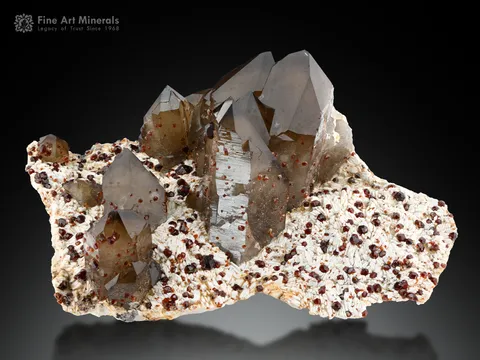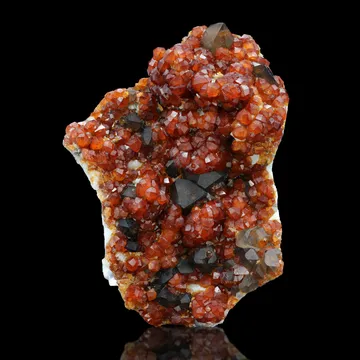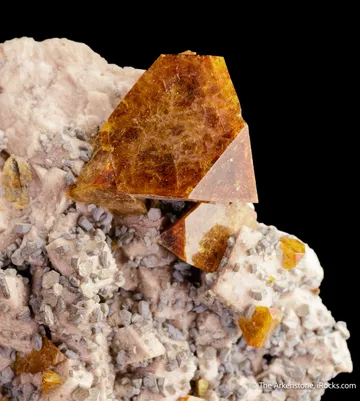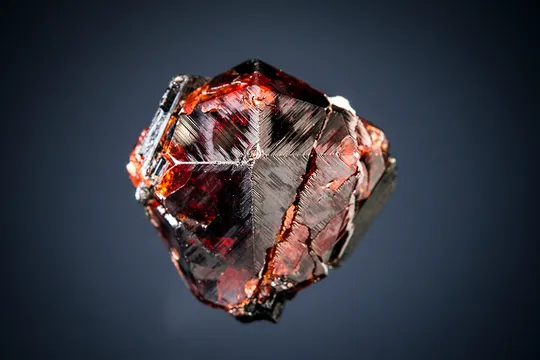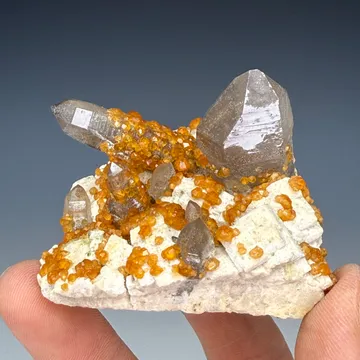
Wushan Spessartine Mine, Tongbei Yunxiao, Fujian - famed for saturated orange spessartine with smoky quartz, a landmark locality prized by collectors.
Key facts
The classic Wushan–Tongbei spessartine is one of the defining Chinese mineral combinations of the modern collecting era: bright orange to reddish-orange garnet crystals sparkling across smoky quartz and pale feldspar. The best pieces have the immediacy of fire on ice—mandarin garnet points scattered over brown-black quartz prisms and cream-white microcline, with enough contrast that even modest miniatures can read across a room.

Photo: Wikimedia Commons
The locality name needs careful handling. “Wushan Spessartine Mine” is the entrenched market and database name, but the material is better understood as a suite of small workings, granite quarries, and pocket zones around Tongbei village and Wushan hill in Yunxiao County, Zhangzhou, Fujian. The garnets occur in miarolitic cavities in Late Cretaceous aluminous A-type granite, part of the mineral-rich coastal granite belt of southeastern China. Those cavities produced the now-famous association of spessartine with smoky quartz, microcline, muscovite, opal-AN, helvine, and, more rarely, fluorite and topaz.

Photo: Wikimedia Commons
Historically, the locality mattered because it put Chinese spessartine on the world specimen market in force. The first Chinese garnet-and-smoky-quartz pieces appeared under Guangdong labels in the late 1990s; by the end of 2001 the trade had recognized Fujian, especially the Tongbei–Yunxiao area, as the true source of the familiar red-orange garnets on smoky quartz and feldspar. Since then, Wushan/Tongbei has become the reference locality collectors picture when they hear “Chinese spessartine.”
What collectors look for is not merely orange garnet. The finest Wushan pieces combine saturated color, glassy luster, small but sharp garnet crystals, sculptural smoky quartz, and a clean pale feldspar base. Spessartine crystals are usually small, so the aesthetic is often about density, sparkle, contrast, and placement rather than a single oversized crystal. A few pieces have garnets perched on or partially included in smoky quartz; others show garnet crusts draped over microcline like orange sugar.
Search for specimens: View all spessartine specimens from Wushan Spessartine Mine, China
The accepted collecting locality is Wushan Spessartine Mine, Tongbei, Yunxiao County, Zhangzhou, Fujian Province, China, at approximately 23° 54′ 21″ N, 117° 11′ 53″ E. In practice, serious labels should be read with some latitude: “Wushan,” “Tongbei,” “Yunxiao,” and older “Fujian” labels can refer to material from the same broader miarolitic granite system rather than a single formal mine opening.
The deposit is a miarolitic-granite specimen locality, not an ore mine in the usual sense. The pockets formed in aluminous A-type granites of the southeastern China coastal belt, where late-stage fluids and volatile-rich residual melts created cavities lined with quartz, feldspar, muscovite, and accessory minerals. Wushan belongs to the aluminous subgroup of these A-type granites; the relevant cavity assemblage is quartz, K-feldspar, muscovite, spessartine, and locally fluorite. This explains the visual grammar of the specimens: smoky quartz prisms, pale feldspar, muscovite flakes or coatings, and small garnets crystallized late enough to decorate open surfaces.
The mining history is tangled because the specimens came through the building-stone and dealer trade rather than from a long-established collector mine with formal bench names. Early Chinese spessartine specimens with smoky quartz and feldspar appeared on the world market in 1998 and were initially attributed to Lechang in Guangdong Province. Around late 2001, dealers began giving Fujian—especially Yunxiao and Tongbei—as the correct source. Berthold Ottens later treated the Tongbei spessartine localities in The Mineralogical Record, and the name “Wushan Spessartine Mine” became the convenient collector shorthand.
The most important correction for labels is feldspar identification. Much early material was described as spessartine on orthoclase, and that wording still appears on older dealer cards and photo captions. Current locality notes state that the feldspar associated with the spessartine is microcline rather than orthoclase as originally reported. Old labels should not be discarded for that reason alone, but a modern label can read “spessartine on smoky quartz and microcline.”
Collecting access is not open. The Wushan area is now described as protected, and collecting minerals from exposed granite there is prohibited. In addition, systematic specimen collecting around Tongbei was never simply a free-for-all legal collecting site; locality notes from Nanjing University describe specimen extraction as tied to granite mining, with specimen mining itself illegal unless connected to quarrying for building material. For collectors, this means old-stock provenance matters, and fresh field collecting should not be assumed possible or permissible.
Production was strongest from the late 1990s through the 2000s, with many market specimens described as early-2000s or mid-2000s material. A later published Fujian mineral-diversity account reports that Tongbei production had ceased by 2016, while dealer listings in the 2020s repeatedly describe the locality as no longer producing or dramatically reduced in availability. Nevertheless, specimens remain visible on the market because the original output was large and because older collections are now being dispersed.
Notable finds include large cabinet pieces with smoky quartz crystals rising from feldspar and carrying dense spessartine coatings; a documented Chinese mineral-treasures exhibition piece measured 18 cm, and major commercial examples have been described at 20 cm and larger. Less common but highly desirable accessory-mineral combinations include spessartine with fluorite, spessartine with helvine, and pieces with opal-AN that may fluoresce green.
Wushan spessartine is typically seen as small, sharp, equant crystals—commonly trapezohedra modified by dodecahedra—rather than as isolated large garnets. Individual crystals are usually in the 1–5 mm range. Fine examples under about 5 mm can be bright, transparent, and highly lustrous; larger crystals are less common and more often darker, cloudier, or less brilliant. Dealer and auction descriptions document crystals around 6–8 mm, and broader Tongbei material includes occasional larger garnets, but the locality’s signature remains the glittering field of many small orange crystals.
Color is the great attraction. The palette runs from pale orange and cinnamon-orange through saturated tangerine to reddish orange and orange-brown. The best crystals are lively and gemmy, with enough manganese-rich orange to glow against smoky quartz. Darker red-orange examples can be dramatic, especially on white microcline, but if the garnets become too opaque or brown they lose the sparkle that makes the locality famous.
Most specimens are matrix combinations. The spessartine may form a crust on microcline, pepper smoky quartz faces, nestle around quartz bases, or coat feldspar ridges between quartz prisms. Some pieces show garnets sitting directly on smoky quartz; others have small garnets partly included in or engulfed by quartz growth. The contrast between bright garnet and dark smoky quartz is the classic Wushan look, but pure spessartine-on-feldspar plates can also be attractive when the garnets are sharp, evenly distributed, and richly colored.
Associated minerals are part of the locality’s appeal. The common matrix minerals are smoky quartz, quartz, microcline, muscovite, and feldspar-group material. Opal-AN, sometimes described in the trade as hyalite opal, is a recognized associate and may appear as glassy, colorless to pale coatings or small masses. Helvine is a notable associate from Tongbei/Wushan and can make very collectible secondary specimens. Fluorite is much less common than the garnet-smoky-quartz association; when present, purple octahedral fluorite on spessartine-bearing matrix is a premium association. Other recorded minerals include albite, pyrite, hematite, beryl, topaz, milarite, molybdenite, manganite, goethite, and mica-group species.
From a gemological standpoint, Tongbei spessartine is exceptionally manganese-rich. Published testing of faceted Tongbei stones reported refractive indices of 1.805–1.810, hydrostatic specific gravity of 4.04–4.13, inert reaction to long- and short-wave ultraviolet radiation, and internal fluid inclusions with rhombic growth structures. Raman spectroscopy confirmed spessartine, and UV-Vis-NIR spectra showed manganese-related absorptions near 445, 460, 480, and 520 nm. Electron-microprobe work cited for Tongbei material gave an approximate composition of Sps94 Alm5 Grs1, among the most spessartine-rich garnet compositions encountered in the gem trade.
Quality is judged by a balance of mineralogy and display. The strongest pieces have saturated orange crystals, high luster, sharp crystal form, clean contrast against pale microcline or smoky quartz, and a sculptural matrix rather than a flat sawn slab. Smoky quartz quality matters greatly: glassy, transparent to translucent crystals with intact tips raise the specimen’s desirability. Damage to quartz terminations is common enough that it must be checked carefully. Saw cuts, heavy trimming, glue, and repairs are also important considerations, especially on cabinet specimens prepared from granite blocks.
The most important authenticity issue is locality naming, not a documented wave of artificial Wushan garnets. “Wushan Spessartine Mine” is a market name for a broader Tongbei/Wushan collecting area, and some pieces are impossible to assign to one small working. Older labels may say Lechang, Guangdong; Tongbei, Fujian; Yunxiao; Wushan; or simply China. A Lechang label on a classic garnet-smoky-quartz-feldspar specimen should be treated cautiously, because early market material was misattributed before Fujian became accepted as the true source. A Wushan label is useful as a collector convention, but “Tongbei–Wushan area, Yunxiao County, Fujian” is often the more geologically honest wording.
Treatments are not usually the central concern with this material. Garnet color is natural, and the smoky quartz association is a primary growth feature of the miarolitic pockets. The more realistic problems are repairs, trimming, saw cuts, and composite-looking preparation. Large granite-pocket specimens are often extracted from hard matrix and may have sawn backs or edges. Saw cuts are not automatically fatal if disclosed and out of sight, but they matter on value. One published dealer description specifically praised a Tongbei specimen for showing no saw cuts from preparation, which is a useful reminder that many do.
Condition issues are predictable. Quartz tips are the first place to look for bruises, rehealed-looking breaks, and small chips. Smoky quartz crystals may be lightly dinged on rear terminations or along edges, and those defects are sometimes hidden when the piece is displayed. Spessartine crystals are small but exposed; tiny contact marks, missing faces, or dulled high points can reduce the sparkle of a plate. Dense garnet crusts can trap iron-oxide films, clay, or pocket residue, and overly aggressive cleaning may leave micro-chipping or a washed, unnatural look. Specimens with opal-AN should be handled gently and not subjected to harsh cleaning.
Rarity is tiered. Small spessartine-on-feldspar and spessartine-on-smoky-quartz specimens remain obtainable, especially as old stock and collection pieces. Balanced miniatures and small cabinets with vivid orange garnets and undamaged smoky quartz are scarcer. Large, sculptural cabinet specimens with multiple intact smoky quartz crystals and dense, bright spessartine are genuinely difficult and command serious prices. Accessory combinations—especially fluorite with spessartine, helvine on microcline, or rich opal-AN associations—are much less common than the standard garnet-smoky-quartz matrix pieces.
Market availability has declined but not disappeared. In 2026, active dealer and aggregator listings still showed Wushan/Tongbei spessartine specimens from a few hundred dollars for smaller or simpler pieces to low five figures for large, dramatic cabinet examples. A small-cabinet auction specimen measuring 6.6 x 4.2 x 3.7 cm closed at $324 in early January 2026, while retail listings for high-quality smoky-quartz combinations commonly sat around $1,000–$2,500 and exceptional large pieces much higher. The best advice is to buy on aesthetics and condition first, then insist on a clear label history and full disclosure of preparation.
The story of Wushan spessartine begins with a label problem. The earliest Chinese garnet-and-smoky-quartz specimens reached the market in 1998 under a Guangdong identity, with Lechang given as the locality. Collectors saw the same striking formula again and again—orange garnet, smoky quartz, pale feldspar—but the map point was wrong. By late 2001 the story shifted: Fujian, not Guangdong, was the true source, with Yunxiao as the nearest large city and Tongbei as the village name that would become familiar on labels.
Then came the “mine” that was not quite a mine. Wushan Spessartine Mine sounds precise, but Berthold Ottens argued that the name was a dealer’s invention, a way to give sharper geographic authority to specimens that actually came from numerous small workings and quarries. Later locality notes refined the point further: Tongbei is the village, Wushan means Wu mountain, and “Tongbei–Wushan hill” is a reasonable label. For collectors, this is a rare case where the less tidy label is the more truthful one.
The granite itself was part of daily life. A Fujian mineral-diversity account notes that houses in Tongbei were built of granite cut from the same miarolitic terrain. That detail explains why a great specimen locality could emerge from construction stone rather than from a romantic underground mine. Granite blocks opened cavities; cavities revealed quartz, feldspar, muscovite, and orange garnet; and the village became attached to a global specimen trade.
The collecting boom also had a legal shadow. Nanjing University locality notes describe Tongbei as the first place in the area where people systematically mined specimens, but add that such work was illegal unless tied to mining granite for building material. Wushan is now described as a protected national park, with mineral collecting from exposed granite prohibited. The result is a modern classic whose best pieces increasingly carry the atmosphere of an old find: abundant enough to be recognized by every serious collector, but no longer a locality one can casually replace from new production.