Batopilas, Chihuahua, Mexico — iconic native-silver district famed for wires, herringbone dendrites, and stark calcite, a sought locality for collectors.
Key facts
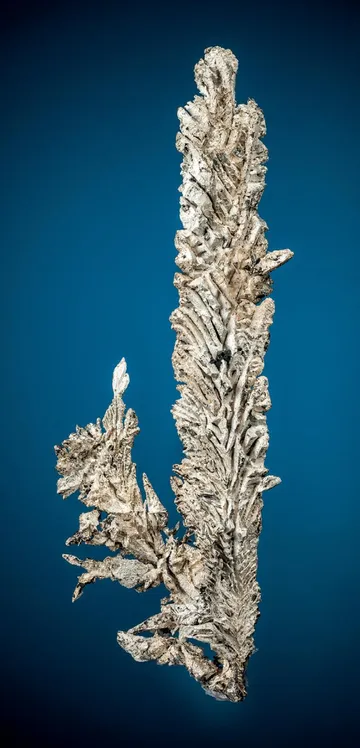
Batopilas is one of the great native-silver names in mineral collecting: a canyon district where the metal did not merely occur as microscopic inclusions in sulfides, but as visible silver itself—wires, herringbone leaves, nails, crystalline dendrites, plates, ropes, and heavy masses locked in white to cream calcite. The best specimens are instantly recognizable: darkly patinated, spinel-twinned silver “feathers” standing from calcite like bronze-black fern fronds, or dense networks of metallic wires threading through etched carbonate matrix.

Photo: Wikimedia Commons / Rob Lavinsky, iRocks.com
The district lies in the deeply incised Barranca country of the Sierra Madre Occidental, along the Río Batopilas in southwestern Chihuahua. Its silver is hosted principally in calcite-native silver veins, a deposit style very different from the more familiar quartz-rich epithermal silver veins of Mexico. In the collecting world, Batopilas belongs with Kongsberg, Cobalt, Silver Islet, Port Radium, and the Erzgebirge among the classic five-element-style native-silver districts—places where metallic silver, arsenic minerals, cobalt-nickel arsenides, and carbonate gangue can define the character of the ore. Batopilas differs visually from many of those northern districts by the prominence of stark white calcite and flattened, herringbone, dendritic silver growths.
Historically, Batopilas was not a marginal curiosity but a bonanza district. Production estimates vary because early records are incomplete, but serious geological and historical treatments commonly place total silver output in the hundreds of millions of ounces. The most important ore was native silver, and the old mines followed thin calcite seams until they opened into astonishing pockets. For collectors, that history matters because most of the native silver that made Batopilas famous was mined for bullion, not preserved. Fine specimens are surviving witnesses of a district whose natural silver was usually destined for the furnace, the stamp mill, the patio, or the mule train.
Collectors look for three things above all: unmistakable Batopilas morphology, original calcite association, and credible provenance. The most desirable examples show sharp, spinel-twinned “herringbone” or feather-like silver crystals with a natural brown, gray, or black tarnish; aesthetic contrast against calcite; and minimal breakage to the projecting wires. Matrix pieces with silver emerging from calcite are especially prized, as are New Nevada Mine specimens from the late 1970s and early 1980s, when a renewed pocket production placed many of the modern classics into collections.
Search for specimens: View all silver specimens from Batopilas, Chihuahua, Mexico
Batopilas is the principal town of the Andrés del Río mining district in Batopilas Municipality, Chihuahua. It sits low in the canyon, beside the Río Batopilas, below the volcanic highlands of the Sierra Madre Occidental. The modern locality name used by collectors usually covers the broader Batopilas district, including important mine groups such as New Nevada or Nevada Valenciana, San Miguel-Santo Domingo, Todos Santos-Roncesvalles, Pastrana, San Antonio, Carmen, and related workings on both sides of the river.
The geological setting is unusually specific. The district is in the Sierra Madre Occidental magmatic province, where Tertiary volcanic rocks and intrusions cut older Mesozoic metasedimentary and metavolcanic rocks. The native-silver veins are not ordinary quartz-adularia epithermal veins. They are calcite-dominant veins and veinlets carrying crystalline native silver, with relatively sparse quartz and only small volumes of associated sulfides and sulfosalts. Modern summaries describe the ore shoots as pods of crystalline native silver irregularly distributed along persistent structures over a vertical interval exceeding 700 meters. The gangue is overwhelmingly calcite, and the ore is famous for its shortage of other metals relative to the amount of silver present.
Several geological models have been proposed. Gregg Wilkerson’s doctoral work and later Economic Geology paper linked the calcite-native silver veins to district-scale hydrothermal circulation related to a porphyry copper system, with low sulfur activity helping stabilize native silver rather than silver sulfide. Later work has emphasized the district’s structural complexity: calcite-native silver veins commonly follow the walls of dikes, and the productive shoots are discontinuous, poddy, and difficult to predict. In practical mining terms, old Batopilas was a district of long stretches of lean structure punctuated by spectacular “clavos,” or bonanza shoots.
Mining history began early. Native silver was found along the Río Batopilas in the 17th century, and production records are said to begin in 1632. The town was formally founded in the early 18th century, and three major periods of production are commonly recognized: the early Spanish period from the 1630s into the 18th century, a late colonial revival around 1790–1819, and the American-led industrial period from the 1860s to the Mexican Revolution. The Spanish and Mexican periods were famous for extraordinarily rich pockets, while the late 19th-century operations brought systematic tunnels, mills, aqueducts, hydroelectric power, and corporate consolidation.
The best-known modern chapter begins with Alexander Robey Shepherd, the former governor of Washington, D.C., who acquired major Batopilas interests in 1880 and built the Consolidated Batopilas Silver Mining Company into the dominant operator. His era produced major engineering works including the Porfirio Díaz Tunnel, an aqueduct, mills, a hydroelectric plant, and an aerial tram. Batopilas became famous for early electrification and for the sheer audacity of moving silver out of a remote canyon by mule train. Operations declined after the Mexican Revolution, when equipment was destroyed, foreign operators were driven away, and the flooded deeper workings could not be maintained as before. Minor production continued into the 1920s; later revivals were limited.
For collectors, the key late-20th-century event was the reopening and working of the New Nevada Mine area in the late 1970s and early 1980s. Local miners encountered rich native-silver pockets that produced many fine crystallized specimens—spiky, herringbone, and dendritic silver commonly released from calcite. These pieces, distributed through dealers and collectors, form the backbone of today’s classic Batopilas specimen market. Earlier antique material exists from 19th-century collections, but those specimens are scarcer, often less precisely localized, and usually carry their value through provenance as much as form.
Batopilas is not a casual public collecting locality. It is a historic mining district with old workings, private or concession-controlled ground, difficult terrain, and real underground hazards. Much collector material now comes from old collections, dealer inventories, and occasional local recovery from dumps, accessible workings, and river gravels by local gambusinos. Serious collectors should treat Batopilas as a specimen-acquisition locality, not a do-it-yourself field destination.
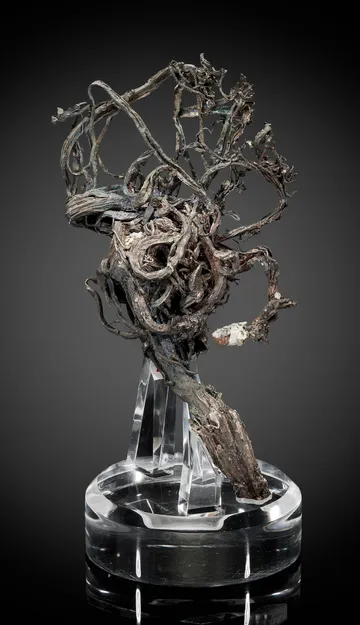
Batopilas silver is native silver, Ag, and its most characteristic collector forms are crystalline rather than merely massive. The district is especially known for flattened herringbone growths produced by spinel twinning, dendritic and arborescent branches, elongated wires, feather-like plates, “nails,” hackly masses, and silver enclosed in or protruding from calcite. The finest pieces show an elegant tension between delicacy and strength: individual silver ribs may be only millimeters across, yet they assemble into miniature fans, combs, and fern-like sprays.
Color depends strongly on surface condition. Fresh silver would be bright metallic white, but Batopilas specimens are usually valued with their natural tarnish intact: dark gray, black, brown, bronze, or iridescent tones along crystal edges. On older pieces the patina is part of the identity. Aggressively cleaned silver can look too bright, too raw, and less convincing as an old Batopilas specimen.
Calcite is the essential matrix. It may be white, cream, grayish, or iron-stained, massive to cleavable, and commonly etched or partially dissolved to reveal silver that was originally embedded. Some Batopilas calcite fluoresces, and work on silver-bearing hydrothermal calcites from the district has shown photoluminescent colors ranging from red-violet and pink to orange; red-violet and pink samples were associated with metallic minerals such as galena, sphalerite, and native silver, whereas orange samples were barren. This does not make every Batopilas specimen a display fluorescent, but it gives collectors another locality-specific clue: the calcite is not decorative accident, it is part of the ore system.
Associated minerals include acanthite, galena, sphalerite, arsenopyrite, pyrite, chalcopyrite, polybasite, proustite, pyrargyrite, stephanite, bromargyrite, chlorargyrite, iodargyrite, native arsenic, native bismuth, native copper, native gold, quartz, barite, dolomite, malachite, azurite, and several cobalt-nickel arsenide-related species reported from the district. In high-quality collector pieces, however, the visual association is usually simpler: silver and calcite, sometimes with minor dark sulfide or gray matrix.
Typical collector sizes range from thumbnails of 1–3 cm to miniatures and small cabinet pieces in the 3–8 cm range. Larger matrix specimens exist, including old museum-scale pieces, but well-balanced large examples with intact projecting silver are rare. Many fine Batopilas silvers are small because the crystals are delicate and because high-grade native-silver ore was historically broken, sorted, treated, or melted rather than saved.
Quality is judged by crystallization, aesthetics, intactness, and provenance. The strongest pieces show sharp, repeated herringbone twins or three-dimensional arborescent sprays, with silver rising above contrasting calcite rather than being merely smeared through it. A matrix piece with natural architecture is usually more desirable than a loose tangled mass unless the mass is fully crystallized and sculptural. Damage is common at tips and along thin wires, so collectors should examine the specimen from multiple angles under magnification. Old labels, mine attribution—especially New Nevada Mine when credible—and collection history add substantial value.
Batopilas silver is available, but fine Batopilas silver is not common. Small thumbnails and modest miniatures appear regularly enough that a collector can still acquire the locality, but the best herringbone sprays, sharp spinel-twinned leaves, and airy calcite-matrix compositions are increasingly old-collection pieces. New Nevada Mine specimens from the late 1970s and early 1980s are particularly sought after because their morphology, history, and specimen-producing episode are well established.
The main authenticity issue is misrepresentation rather than a famous, named Batopilas fake. Native silver is heavy, soft, sectile, non-magnetic, and tarnishes naturally; convincing specimens should show metallic continuity, natural branching or twinning, and credible integration with calcite or matrix. Be cautious with overly bright, freshly polished pieces sold as old Batopilas material, wires that appear glued into calcite, silver-colored solder or metal shavings presented as native wire silver, and specimens with no locality history but an ambitious label. Batopilas morphology is distinctive, but not every silver wire on white matrix is Batopilas.
Treatments to watch for include acid etching of calcite, mechanical trimming, and cleaning of tarnish. Etching is not automatically fraudulent; many New Nevada-style specimens owe their display to the removal of enclosing calcite, and the practice is part of how embedded native silver is revealed. The issue is disclosure and taste. Over-etched pieces can look skeletal or unnatural, while harsh cleaning can remove the old patina that collectors prize. A good Batopilas specimen should not need to shine like jewelry.
Condition is a major value factor. Silver is malleable, and the best herringbone and wire forms bend or snap more easily than their metallic look suggests. Tips may be bruised, flattened, or broken; calcite cleavages may be chipped; and loose wires may have been pushed into a better display position. Old repairs are possible on cabinet pieces. Examine the contact between silver and calcite carefully: natural emergence is irregular and mineralogical, not a neat glue joint.
For storage, keep Batopilas silver dry, stable, and away from sulfur sources such as rubber, wool, poor-quality cardboard, some foams, and polluted display environments. Do not dip or polish. A natural black or brown patina is usually preferable to a bright cleaned surface, and on antique specimens it can be part of the provenance story.
Batopilas is a locality where the stories sound exaggerated until the geological facts catch up with them. The district’s first legend begins at the river. Native silver was found by the Río Batopilas in the 17th century, described as pale, polished, and snow-white enough to inspire the name La Nevada. In a canyon where later miners would chase millimeter-wide calcite seams into vast ore pockets, the first impression was not of gray ore but of silver itself, already visible to the eye.
Rafael Alonzo de Pastrana became one of the great early names of the district after opening the Nuestra Señora del Pilar mine in 1730. The story that survived is not merely that he grew rich, but how he displayed it. Local tradition says that for his daughter’s wedding he invited the Bishop of Durango and paved the route from the hotel to the church with silver ingots. The bishop, in the telling, was appalled by the pride of the gesture, then accepted the metal as a “generous donation to the church.” Whether one reads it as piety, vanity, or canyon theater, it captures the kind of wealth Batopilas represented in the 18th century: silver not as a number in a ledger, but as pavement under a bishop’s feet.
Another vivid figure is Doña Natividad Ortiz, remembered as a woman of “strong character.” By 1842, after political turmoil and dormant mines had weakened the district, she began acquiring and reopening properties with the help of a Tarahumara associate named Avila. In less than a decade she had gathered a remarkable list of mines back into activity: Santo Domingo, San Nestor, Animas, Todos Santos, San Pedro, and La Aurora. Batopilas history is often told through men with companies, titles, and tunnels, but Ortiz belongs in the same canyon narrative: practical, aggressive, and successful in a district that had already swallowed fortunes.
The Le-Brun tunnel story has the feel of unfinished business. In 1859 George Le-Brun acquired the Pastrana and Cata mines and began a lower tunnel beneath the old Pastrana workings around 1861. By 1866, reports described the lower tunnel in ore on a structure 17 feet wide while Le-Brun negotiated the sale of a half interest for $300,000. Then the mine was abandoned in ore because of flooding. Much later, excavation showed the tunnel crosscutting about 90 meters to the vein and drifting roughly 400 meters along it, with stopes above and a flooded winze whose depth could not be determined. For a collector holding a Pastrana-label silver, that is the romance of the place: not just what was mined, but what was left behind the water.
Alexander Robey Shepherd’s arrival in 1880 gave Batopilas its most theatrical industrial chapter. He came after leaving Washington, D.C., bankrupt and disgraced, paid John Robinson $600,000 for San Miguel interests, and then used capital, politics, and engineering to consolidate much of the district. His company drove tunnels, built mills, installed hydroelectric power, constructed an aqueduct nearly 6 kilometers long, erected a foundry capable of castings up to 2,500 pounds, and ran an aerial tram about 800 meters from the San Miguel mine to the San Antonio Hacienda. During his era, Batopilas grew from a few hundred inhabitants to several thousand and became famous as one of the earliest electrified cities in Mexico.
Shepherd also understood symbolism. In 1887 he commissioned the Gorham Silver Company to make fifteen “Batopilas flasks” embossed with views of the valley and mines. Five went to Mexican government officials and ten to Americans. One later sold for $11,000. These were not ore specimens in the mineralogical sense, but they are among the most evocative Batopilas objects: refined silver from a canyon bonanza, turned into portable political theater.
The district’s mining language is equally memorable. Old descriptions divided the ore by what miners actually saw and handled: Plata Maciza, massive silver that had to be hammered or chiseled out because it would not break; Plata Alambrada, wire silver; Plata de Clavos, silver shaped like nails; Plata de Hoja, leaves or sheets; Bolas de Plata, lumps that might look unpromising outside but prove nearly solid within. “Brosa” could mean material so rich that it was described as one-third calcite and two-thirds native silver. “Chispedo” was poorer only by Batopilas standards: two-thirds calcite and one-third silver. These are not abstract grade categories; they are the vocabulary of miners sorting metal with their eyes and hands.
The old workings were a lesson in both abundance and unpredictability. One San Miguel pocket was described as measuring 1 meter by 8 meters by 12 meters and yielding 2 million ounces of silver. Another Santo Domingo pocket reportedly ran about 100 meters long and up to 3 meters wide. Yet the veins between such bonanzas could be barren for long distances. Alexander Shepherd Jr. later summarized the problem plainly: “at Batopilas veins are largely barren except where major pockets occur, and the only way to find these is to mine along the veins.” An even sharper remark is attributed to Shepherd Sr. When a mining engineer tried to calculate ore “in sight,” Shepherd replied, “We have no ore in sight. Just as soon as it gets in sight, we take it out of sight.” Few sentences better describe Batopilas mineralization.
Specimen history has its own lost treasure. At the 1893 Columbian Exposition in Chicago, the Batopilas Mining Company displayed a 380-pound silver specimen along with a primitive voltmeter demonstrating complete electrical connectivity across the piece. No detailed description survives, and the specimen vanished after the fair. It may have come from the Porfirio Díaz Tunnel area or the San Miguel mine. For collectors, the disappearance is painful: a 380-pound native-silver mass from Batopilas would be one of the great surviving mineral objects of the Americas, had it survived in recognizable form.
The modern collector era belongs largely to New Nevada. After the road reached Batopilas from La Bufa in 1977, specimen production increased. In the early 1970s Manuel Limones had discovered an orebody at Nevada Valenciana, the New Nevada Mine. Later, a consortium of four local miners worked the mine under a striking arrangement: each had his own day to work and keep what he found without splitting it with the others. Three pockets were found, reportedly ranging from 200 to 450 kilograms each. The resulting specimens—spiky crystals, herringbone growths, dendritic forms, and silver released from calcite—became the Batopilas pieces that many collectors now recognize instantly in dealer cases and old collection drawers.