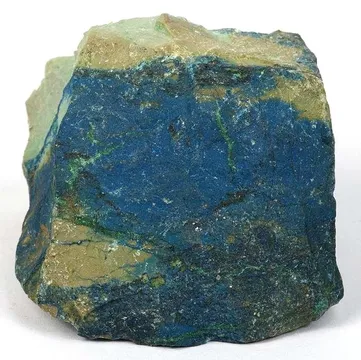
Shattuckite Collectors Guide
Shattuckite is a vibrant copper silicate prized for its saturated royal-to-sky-blue color and silky, velvety textures. Typically forming as radial fibrous aggregates, botryoidal crusts, or delicate sprays lining cavities in the oxidized zones of copper deposits, it often occurs with malachite, dioptase, plancheite, chrysocolla, and quartz. The species can also form sought-after pseudomorphs—where shattuckite replaces earlier minerals such as dioptase or azurite—preserving sharp crystal forms in a rich blue hue. Aesthetic contrasts are a hallmark: shattuckite’s intense blue against snow-white quartz or bright green malachite makes for exceptionally displayable pieces.
Crystallized shattuckite in distinct, free-standing crystals is rare; most prized specimens are fibrous radial sprays, velvety botryoids, or pseudomorphs with sharp outlines. The mineral is relatively soft and brittle (about Mohs 3.5), so pristine surfaces and undamaged sprays are uncommon and valuable. While attractive lapidary material exists, collectors focus on natural crystal textures, well-composed matrix pieces, and dramatic associations—especially with dioptase or quartz druses. Classic localities, including the type locality at the Shattuck Mine in Bisbee (Arizona), Namibia’s Kaokoveld region, and the copper-cobalt deposits of the DR Congo (notably Kakanda and Kipushi), set the standard for quality and variety.
Shattuckite captivates collectors with a blue that rivals the best azurites—but with a completely different, silky aesthetic. Historically, it earned recognition through specimens from Bisbee and Tsumeb, often as fine, velvety crusts in association with other copper minerals. A surge of interest came with modern finds from Namibia’s Kaokoveld (Omaue Mine) and from the DR Congo, supplying dramatic spray-lined vugs and pseudomorphs that quickly became contemporary classics. Even micro-collectors are drawn to shattuckite’s radially fibrous sprays, which can be superb under magnification.
The market spans from affordable botryoidal coverage to high-end showpieces: sharp pseudomorphs after dioptase on quartz or sculptural clusters with malachite command strong prices. Production is sporadic and pocket-driven, so truly top-tier pieces are always in limited supply. As a species that combines strong color, varied habits, and charismatic associations, shattuckite continues to grow in esteem among both new and advanced collectors.
The type locality that gave the species its name, the Shattuck Mine in Bisbee is historically significant. Though fewer specimens circulate compared to Namibia or the DRC, Bisbee shattuckite appears as blue coatings or micro-sprays in classic associations with the district’s rich suite of secondary copper minerals. Any aesthetic, well-provenanced Bisbee piece—especially larger or on contrasting matrix—is coveted for its rarity and heritage.
-
Color and Saturation:
- The premier attribute is color: vivid royal or electric sky-blue is most desirable.
- Even, saturated color that reads well in ambient light is preferred over patchy or dull areas.
- Attractive zoning can add interest, especially when layered with plancheite or chrysocolla, but uneven color that looks “muddy” detracts.
-
Habit and Form:
- Radial sprays and velvety botryoidal crusts are typical; crisp, undamaged sprays are uncommon and valuable.
- Pseudomorphs (e.g., after dioptase or azurite) with sharp outlines and intact faces are highly sought-after and often command premiums.
- Matrix and composition matter: shattuckite on white quartz or with bright malachite or dioptase creates dramatic contrast and stronger display impact.
-
Luster and Surface:
- A silky, velvety sheen is ideal for botryoidal surfaces. For sprays and acicular aggregates, a fine satin to silky luster shows best under case lighting.
- Chalky or heavily weathered surfaces can appear dull; minor surface frosting is common, but extensive dullness reduces appeal.
-
Completeness and Damage:
- Fibrous textures are fragile; assess for crushed sprays, rubbed surfaces, or bald spots on botryoids.
- Edge chips on spray terminations or bruises along high points are common—prefer pieces where any wear is minimal and non-distracting.
- On pseudomorphs, look for crisp edges and unbroken faces; rounding or chipping lowers desirability unless the specimen is exceptional in other respects.
-
Associations and Aesthetics:
- White quartz druses, bright malachite, or emerald-green dioptase with blue shattuckite create classic, high-contrast specimens.
- Balanced composition matters: a well-framed vug or a piece that displays strongly from at least one primary angle is preferable.
- Size isn’t everything—smaller specimens with vivid color and clean surfaces can outshine bigger, worn pieces.
-
Locality and Provenance:
-
Repairs and Reattachments:
- Because shattuckite is delicate, reattached fragments or stabilized vug sections occur. Inspect under a loupe for straight seams, glossy glue lines, or slight misalignments along fibrous textures.
- Check where crystals meet matrix; excess epoxy may fluoresce under longwave UV.
-
Stabilization and Impregnation:
- Lapidary material is often resin-stabilized; less common but possible on specimens to firm delicate surfaces. A subtle “plastic” sheen in low areas or a uniform darkening can hint at impregnation.
- If sprayed or soaked consolidants were used, luster can look atypically uniform. Ask for disclosure when buying delicate pieces.
-
Dyeing and Substitution:
- True shattuckite seldom requires dyeing, but dyed chrysocolla or other copper silicates may be misrepresented. Suspiciously uniform, overly vivid blue with no natural texture variation should be examined carefully.
- When in doubt, rely on reputable dealers or analytical confirmation (Raman/XRD) for high-value purchases.
-
Handling:
- Mohs ~3.5 and fibrous; handle gently and support from beneath. Avoid touching or wiping delicate sprays and drusy surfaces.
- For transport, use soft foam/tissue and immobilize the piece to prevent abrasion on high points.
-
Light and Temperature:
- Natural color is generally stable in normal display lighting. Avoid prolonged direct sun and high heat, which can desiccate or stress fragile matrices and adhesives in repaired pieces.
- Keep temperature changes gradual to reduce risk of micro-fracturing.
-
Cleaning:
- Best is dry cleaning: use a soft blower or a very soft brush (makeup brush) to lift dust. Avoid brushing delicate sprays directly.
- If necessary, use distilled water with a drop of mild soap, applied with a soft artist’s brush only to sturdy surfaces (e.g., quartz matrix). Rinse gently and air-dry thoroughly.
- Do not use ultrasonic cleaners, steamers, or harsh acids. Shattuckite itself can be sensitive, and associated matrices (carbonates) can be damaged by acids.
-
Storage:
- Display in a stable, dust-controlled cabinet; consider a small stand or discrete mineral tack to prevent rolling.
- Keep pieces apart so harder minerals don’t abrade shattuckite; likewise, shattuckite’s fibrous surfaces can shed or matt if rubbed.
- In seismic or vibration-prone areas, secure specimens to prevent falls.
-
Long-Term Care:
- Periodically inspect for any changes, especially on stabilized or repaired pieces. Replace aging putties or unstable supports.
- Maintain labels and provenance; locality and history contribute significantly to the value of shattuckite specimens.