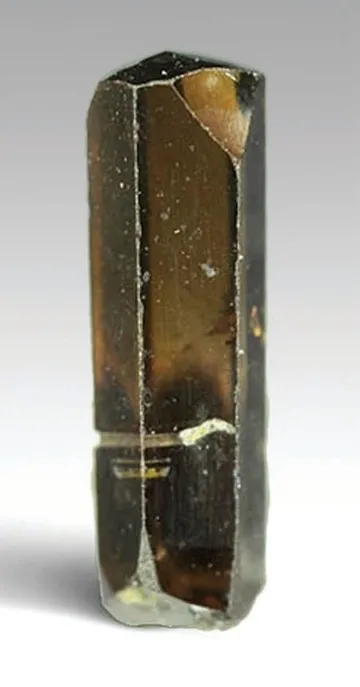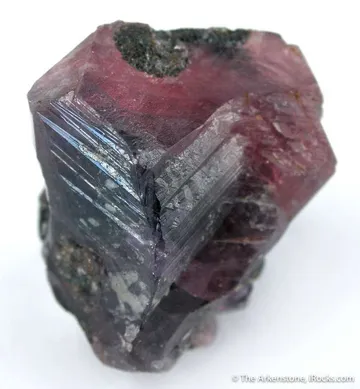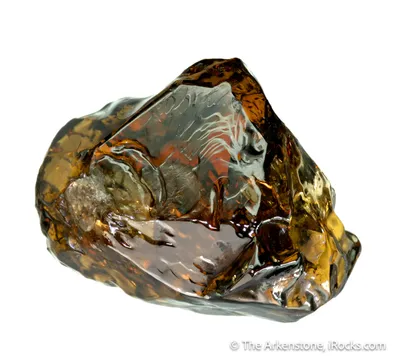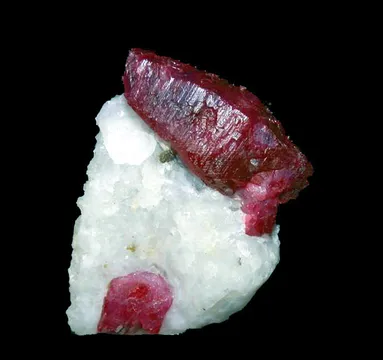
Rubis de Mogok — corindon hébergé par le marbre, célèbre pour ses cristaux rouge pigeon, ses gemmes intactes et un district minier légendaire chéri par les collectionneurs.
Key facts
Le rubis de Mogok est le rubis du collectionneur dont la référence sert encore à mesurer presque toutes les autres localités rubis. Les meilleurs morceaux présentent une couleur corporelle rouge saturé à légèrement rouge violacé, une fluorescence rouge lumineuse et une douceur interne veloutée causée par une soie de rutile fine. Dans les pierres les plus fines, cette combinaison donne l’apparence célèbre « sang de pigeon » : non pas simplement rouge foncé, mais un rouge vivant qui semble retenir la lumière plutôt que de la refléter simplement.

Photo : Wikimedia Commons
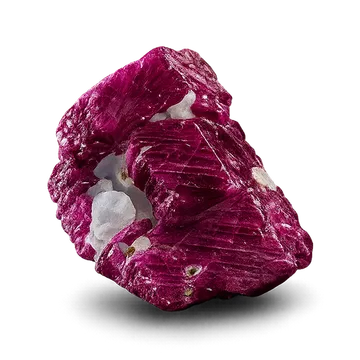
Pour les collectionneurs de spécimens, l’attrait de Mogok diffère du marché des pierres taillées, bien que les deux soient inséparables. Un cristal de rubis de Mogok pouvant être taillé a toujours été menacé d’être taillé, de sorte que les cristaux intacts avec une bonne forme, une bonne translucidité et une matrice marbreuse sont naturellement rares. Les spécimens les plus désirables conservent le drame géologique du dépôt : rubis enchâssé dans du marbre calcite pâle, souvent avec de la spinelle, de la scapolite, du graphite, de la mica, de l’apatite, de la titanite ou d’autres minéraux de Mogok à proximité. Le contraste du corindon cramoisi contre une matrice carbonatée blanche constitue l’un des signatures visuelles classiques de la localité.

Photo : Wikimedia Commons
Le cadre géologique est tout aussi important. Le rubis de Mogok est un rubis métamorphique hébergé dans le marbre : corindon, Al2O3, coloré en rouge par le chrome, formé dans des roches carbonatées qui ont été recristallisées en marbre au cours de la longue histoire tectonique et métamorphique de la Ceinture métamorphique de Mogok. L’environnement hôte est pauvre en fer par rapport à de nombreuses provinces rubis liées au basalte, ce qui permet au fluore chromique de contribuer fortement à l’impact visuel de la gemme. La région n’est pas une seule mine mais un district rocheux — un ancien district gemme complexe centré sur Mogok et les villages voisins, avec des dépôts primaires de marbre, des concentrations résiduelles altérées et des gravels gemmes alluviaux contribuant tous à la production.
Historiquement, Mogok est moins une localité qu’une légende. Ses rubis entrèrent dans des systèmes de tributs, des trésors royaux, des concessions coloniales, des échanges clandestins à la frontière, des collections de musées et les marchés de bijoux les plus élevés du monde. Le même district qui a produit des cristaux délicats de petite taille dans le marbre a aussi donné naissance à des cristaux bruts extraordinaires et à des pierres taillées, y compris des rubis birmans de musée de plus de 20 carats — des pierres si rares qu’elles occupent une catégorie séparée dans le monde des gemmes.Les collectionneurs recherchent plusieurs types différents de rubis Mogok. Le spécimen minéral le plus classique est un cristal bien formé ou un groupe en marbre blanc, de préférence avec une couleur rouge intense, transparence, lustre et abrasion minimale. Une autre forme désirable est un cristal isolé net avec un aspect hexagonal ou pseudo-octaédrique, une bonne terminaison et des caractéristiques de croissance visibles. La roche de rubis étoilé et les pièces de qualité cabochon avec un filé de rutile intact sont également collectionnables, surtout lorsqu'elles sont accompagnées d'une provenance ancienne crédible. Pour les pierres taillées, le prestige repose sur la couleur, la transparence, la taille, l'absence de traitement thermique et un rapport de laboratoire réputé confirmant l'origine et le traitement en Myanmar.## Specimens en vedette
Rechercher des spécimens : Voir tous les spécimens de rubis de la vallée de Mogok, Myanmar
La vallée de Mogok se situe dans la région de Mandalay, en Birmanie, au sein du célèbre Mogok Stone Tract. La vallée elle-même est l’un des éléments d’un district de gemmes plus vaste qui inclut Mogok, Kyatpyin, Dattaw, Kyauk Saung, Lin Yaung Chi, Shwe Pyi Aye, Le-U-le-taw, Ohn-bin-ywe-htwet, et nombre d’exploitations plus petites. Le relief est montagneux, la ville étant perchée au-dessus des basses terres et l’exploitation s’étendant sur les fonds de vallées, les versants, les contacts de marbre, les zones de faults weathered, et les gravels de rivières anciennes.
Les dépôts primaires de rubis sont portés par le marbre. Dans l’expression de terrain la plus simple, le rubis se présente dans des marbres blancs à pâles à gros grains, parfois dans des zones riches en rubis le long de contacts, fractures, brèches, grottes et roches carbonatées faultées. Les minéraux associés dépendent de la mine spécifique et du microenvironnement, mais la calcite, la dolomite, le graphite, la spinelle, l’apatite, le mica, la pyrite ou la pyrrhotine, la titanite, la scapolite et d’autres minéraux calc-silicates ou métamorphiques reviennent dans la littérature et dans le matériel des spécimens.
Les dépôts secondaires de Mogok sont tout aussi importants. À mesure que le marbre se weatherise et se dissout, des minéraux lourds résistants — dont le rubis et la spinelle — sont libérés et concentrés dans des poches résiduelles, des fissures, des remplissages de grottes, des gravels de pente et des alluvions paron. C’est pourquoi le district a historiquement été exploité à la fois par des méthodes de roche dure et par des méthodes de lavage des gravats. Un paysage minier unique pouvait comprendre des tunnels dans le marbre, des coupes ouvertes dans les dépôts de pente, des puits verticaux vers des gravels enfouis, et des femmes retravaillant des résidus abandonnés à la recherche de pierres oubliées.
Les méthodes minières traditionnelles de Mogok portent des noms distinctifs. Les puits twin-lon étaient de petites galeries rondes creusées dans les gravels riches en gemmes. Les puits Lebin étaient des versions carrées, constituées de bois, utilisées dans des terrains moins cohérents. Les travaux Hmyaw-dwin consistaient en des tranchées de pente ou des coupes ouvertes où l’eau aidait à laver le matériel porteur de pierres. Les travaux Lu-dwin suivaient le matériel rubellifère dans des grottes de marbre, des fissures et des cavités naturelles. Les opérations modernes et semi-modernes ont ajouté des puits ouverts mécanisés, des galeries de drainage, des usines de lavage, des pompes et des galeries souterraines avec explosifs.
La phase de minière coloniale britannique a commencé après la Troisième Guerre anglo-birmane. En 1887, une concession fut accordée à Charles Streeter, menant à Burma Ruby Mines, Ltd., qui tenta une production mécanisée sur une grande partie de la zone rocheuse. La société apporta l’énergie hydroélectrique, des pompes, des unités de lavage et des travaux de drainage, mais les méthodes minières européennes se révélèrent coûteuses et mal adaptées à la géologie difficile de Mogok. L’arrivée du rubis synthétique sur les marchés européens, la Première Guerre mondiale et l’évolution économique ont contribué au déclin de l’entreprise; Burma Ruby Mines a fini par remettre ses baux au gouvernement en 1931.Pendant la fin du XXe siècle, les opérations gouvernementales et les coentreprises exploitaient à la fois les gisements primaires et secondaires. Shwe Pyi Aye, Lin Yaung Chi, Dattaw, Than Ta Yar, Kyauk Saung et d’autres mines sont devenues des noms familiers dans les rapports de terrain gemmologique. Dattaw est particulièrement notable pour la production de cristaux de rubis exceptionnellement grands, y compris le rubis Nawata/SLORC du début des années 1990 et d’autres gros cristaux enregistrés par des visiteurs et des catalogues gouvernementaux.
L’accès à la collecte a longtemps été complexe. Mogok a été à maintes reprises restreinte aux étrangers, et la collecte moderne est régie non seulement par la propriété des mines et les autorisations locales, mais aussi par l’instabilité politique de la Birmanie, les règles d’exportation, l’exposition aux sanctions et la réalité pratique selon laquelle le rubis gemme est normalement orienté vers le commerce des gemmes plutôt que vendu occasionnellement comme spécimens minéraux. Le matériel de collection ancien avec une provenance fiable est donc particulièrement précieux pour les collectionneurs de spécimens.
Les récents événements soulignent à la fois le potentiel minéral continu et la difficulté du district. En mai 2026, des reportages internationaux ont décrit un rubis brut de 11 000 carats trouvé près de Mogok à la mi-avril 2026, pesant environ 2,2 kilogrammes. Ce rapport situe la découverte dans le contexte du conflit en cours en Birmanie et de la volatilité du contrôle des régions minières de gemmes. Pour les collectionneurs, de tels rapports rappellent que Mogok n’est pas épuisé, mais que l’offre moderne est mêlée à de graves préoccupations juridiques, éthiques et de sécurité.## Caractéristiques du rubis de la vallée de Mogok, Myanmar
Le rubis de Mogok varie du rose pâle au rouge vif jusqu’au rouge violacé ou grenat. Les pierres les plus convoitées se situent dans la plage rouge à rouge légèrement violacé, avec un ton moyen à moyen-sombre, une saturation élevée et une fluorescence forte. Dans les beaux échantillons, la fluorescence et la couleur du corps se combinent with une soie fine pour produire la lueur intérieure douce pour laquelle le rubis birman est célèbre.
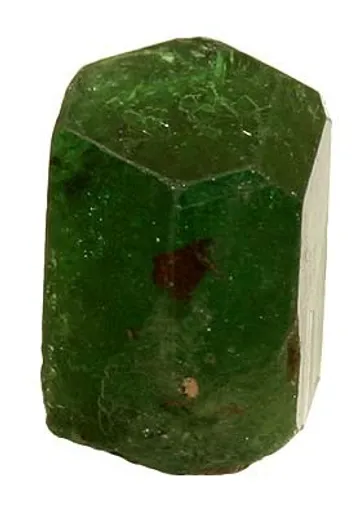
Les cristaux sont de la corindone, Al2O3, et peuvent apparaître sous forme de prismes hexagonaux, de cristaux en forme de baril, de cristaux tabulaires, et de cristaux avec des formes en gradins ou pseudo-octaédriques créées par l’interaction des faces de la corindone. Les descriptions de spécimens de Mogok notent souvent des cristaux nets, brillants, translucides dans le marbre; d’autres sont plus arrondis, usés par l’eau, gravés ou bosselés par l’altération et le transport. Les gros cristaux gemmes de qualité exceptionnelle, et les cristaux intacts avec une matrice sont encore plus rares en raison de la pression financière qui pousse à tailler tout ce qui est transparent et richement coloré.
Les spécimens avec matrice montrent le rubis le plus souvent dans du marbre calcétoïde. Les pièces de contraste les plus fines présentent des cristaux rouge vif perchés dans le calcite blanc, parfois associés à la scapolite, au graphite, à la muscovite, à la spinelle ou à d’autres minéraux de Mogok. La spinelle est une association particulièrement importante car Mogok produit aussi certains des plus beaux spinelles rouges et roses du monde; dans les collections anciennes, et même dans les inventaires royaux historiques, la spinelle rouge et le rubis n’étaient pas toujours distingués clairement.
Au microscope, les rubis de Mogok sont connus pour leur soie de rutile fine, souvent en concentrations imbriquées. Ces aiguilles de rutile peuvent être courtes, réfléchissantes, aplaties, ou en forme de pointe de flèche; dans d’autres pierres elles sont plus longues et plus évidentes. Lorsqu’ils sont préservés plutôt que détruits par le chauffage, la soie peut améliorer le caractère visuel d’un rubis en dispersant la lumière et en adoucissant l’extinction. Dans les rubis étoile, le rutile orienté est responsable de l’asterisme.
Les inclusions solides font partie de l’empreinte digitale de la localité. Les inclusions de calcite, parfois avec grossissement visible et clivage, conviennent particulièrement bien à un rubis hébergé dans le marbre. L’apathie, la spinelle, le rutile, la zircon, les inclusions de corindon, la muscovite, les sulfures, la titanite et d’autres minéraux ont été décrits dans les pierres de Mogok. Des grains arrondis et euthédrales de couleur claire, des nuages denses, des zones de croissance angulaires, le jumelage rhomboédrique et les zonages tourbillonnants « treacle » sont autant de caractéristiques que les gemmologues associent au rubis Mogok classique.La plage de taille typique pour les spécimens minéraux de collection est modeste. Des cristaux de quelques millimètres à environ un centimètre dans le marbre sont déjà attrayants lorsqu’ils sont bien colorés et nets. Les miniatures fines et les “thumbnails” avec un ou plusieurs cristaux gemmes sont très prisées. Des pièces plus grandes existent, mais sur bon nombre d’entre elles, le rubis est soit opaque, fissuré, arrondi, ou dispersé en petits cristaux dans le marbre. Des pierres facettées propres de quelques carats avec une origine Mogok confirmée et sans chaleur sont déjà des gemmes sérieuses ; des rubis birmans fins, non tratés et dépassant 10 carats, sont des raretés majeures, et des pierres de haute qualité au-delà de 20 carats relèvent du niveau musée.
La qualité dépend de la voie du collectionneur. Pour les spécimens minéraux, la forme cristalline, le contraste de la matrice, la brillance, la couleur, la translucidité, l’intégrité et la localisation documentée sont critiques. Pour les pierres facettées, la hiérarchie est la couleur en premier, puis la transparence, la coupe, la taille, le statut de traitement et la documentation d’origine. Pour les rubis étoilés, l’astérisme centré et net, une couleur corporelle attractive, la translucidité, la symétrie et la qualité de la surface importent le plus. Dans tous les cas, « Mogok » sans documentation doit être traité comme une assertion, non comme un fait.## Notes du collectionneur
La première préoccupation est l’authenticité de la localité. Le “rubis birman” et le “rubis Mogok” portent de fortes primes de prix, et les deux termes sont largement surutilisés. Le Myanmar possède d’autres sources de rubis, notamment Mong Hsu, et le monde plus large comprend désormais des rubis hébergés dans le marbre du Vietnam, de l’Afghanistan, du Tadjikistan, du Pakistan et d’autres régions dont la chimie et les inclusions peuvent overlap avec Mogok. Une étiquette fiable d’une vieille collection est utile pour un spécimen, mais pour une pierre taillée de valeur, un rapport d’un laboratoire gemologique majeur est indispensable.
Le statut de traitement est le deuxième enjeu majeur. De nombreux rubis sur le marché ont été chauffés, et la chaleur peut modifier la couleur, la clarté, les inclusions et la valeur. Les rubis de Mogok n’ont souvent pas nécessité le même type de traitement historiquement associé au matériel de Mong Hsu, mais les rubis chauffés de Mogok existent. La soie rutile intacte, les inclusions non altérées et les fissures atteignant la surface non perturbées peuvent étayer une conclusion non chauffée, mais les déductions de traitement ne doivent pas être faites à l’œil sur des pierres précieuses. La guérison assistée par flux, les résidus de verre et l’amélioration de la clarté constituent des facteurs de valeur particulièrement sérieux pour le rubis en général, même si le matériel commercial fortement traité est plus fortement associé à certains flux de production non Mogok.
Pour les spécimens minéraux, la confusion avec la spinelle est un problème classique. La spinelle rouge de Mogok peut être magnifique, et sur le marbre blanc, elle peut imiter visuellement le rubis à l’œil non averti. La spinelle forme couramment des cristaux octaédriques et présente une dureté, un comportement réfringent et une morphologie cristalline différents de ceux de la corundume, mais des cristaux usés ou mal développés peuvent induire en erreur. Tout spécimen “rubis dans le marbre” de grande valeur devrait être confirmé par des tests qui n’endommagent pas la pièce.
Les problèmes de condition sont courants. Le corindon est dur, mais les cristaux dans le marbre peuvent être fracturés, en contact, gravés ou contusionnés. La matrice est bien plus tendre et peut être retaillée, dissoute, réparée ou stabilisée. Les cristaux de rubis peuvent être partiellement enchâssés, naturellement incomplets ou taillés à des joints au niveau des contacts. Un spécimen en matrice doit être inspecté pour la présence de colle, marbre recollé, matrice peinte ou teintée, attache artificielle des cristaux et points de contact autour des cristaux de rubis particulièrement propres et suspects.
La rareté est fortement hiérarchisée. Des petits spécimens de rubis dans le marbre provenant de Mogok sont disponibles de temps à autre. Une belle couleur et une matrice attrayante sont moins courantes. Des cristaux nets, translucides et bien terminés dans la matrice sont rares. Des cristaux gemmeux, richement colorés et ayant une vieille provenance sont très rares, car le marché des pierres taillées a toujours consommé les meilleurs roches brutes. De gros cristaux de rubis, intacts, de qualité exposition de Mogok, avec une histoire crédible de mine ou de collection, comptent parmi les prix classiques de la collection de corindume.La disponibilité sur le marché en 2026 est autant déterminée par la politique que par la géologie. La production et le commerce des gemmes birmanes ont été affectés par les conflits, les sanctions, les entreprises d’État liées à l’armée, la contrebande et le contrôle territorial qui évolue. Aux États-Unis, les collectionneurs et les négociants doivent être particulièrement prudents lors des transactions impliquant des entités sanctionnées telles que Myanma Gems Enterprise. Le matériel plus ancien déjà hors du Myanmar, les provenances documentées avant les sanctions et une traçabilité transparente deviennent de plus en plus importants non seulement pour la valeur, mais aussi pour la conformité et la confiance éthique.## Stories & Field Notes
Les anciennes histoires de Mogok commencent dans une vallée trop dangereuse pour que les hommes puissent y entrer. Dans une version, l’endroit était rongé par la fièvre et rempli de serpents, mais son fond scintillait de rubis. La solution était merveilleusement impraticable et merveilleusement persistante: jeter de la viande fraîche dans l’abîme, attendre que des rapaces la rapportent, puis récupérer les rubis collés à la viande dans les nids ou les déjections. C’est une histoire racontée sous des formes différentes pour plusieurs régions célèbres de gemmes, mais à Mogok elle est devenue partie de la mythologie créatrice du district — une manière de dire que ces pierres n’ont jamais été simplement extraites; elles ont dû être arrachées à la terre par ruse.
Les récits historiques repoussent le commerce des rubis très loin dans le passé. Une tradition associée à la dynastie Shan parle d’un souverain du VIe siècle près des mines de rubis qui versait annuellement un tribut de deux viss de rubis — environ sept livres dans le récit plus ancien cité par la revue historique de GIA. Plus tard, des voyageurs européens écrivirent que les cours birmanes brillaient de pierres précieuses. César Frédéric, écrivant au XVIe siècle, décrivit le Roi de Pégou comme seigneur des mines de rubis, de saphirs et de spinelles; l’affirmation est en partie littérature de voyage et en partie renseignement commercial, mais elle capture comment les pierres de Mogok avaient pénétré l’imagination du monde plus vaste.
L’histoire du rubis Nga Mauk est plus sombre. Un mineur pauvre trouva un grand rubis et, selon le récit, le fendit le long d’une faille en deux beaux morceaux. La moitié alla au roi. L’autre fut vendue secrètement. La tromperie fut dévoilée lorsque le roi montra sa moitié au marchant qui avait acheté la pièce assortie. La punition tomba non seulement sur le mineur mais aussi sur les villageois rassemblés dans une écurie improvisée et brûlés vif à un endroit mémoré comme Laung Zin, « la plateforme ardente ». La femme de Nga Mauk, Daw Nann, aurait regardé depuis une colline près de Kyatpyin, plus tard rappelée comme Daw Nann Kyi Taung — la colline d’où Daw Nann regardait. Le rubis lui-même disparut du palais lors de la nuit où les Britanniques conquirent Ava en 1885.
Mogok a aussi produit des légendes vivantes. U Hmat, rappelé comme le « Roi du Rubis », apparaît dans le récit de V. C. Scott O’Connor de 1905 comme un magnat autochtone vivant dans une maison en bois sur des pilotis, avec une salle forte en briques à une extrémité et des domestiques remplissant la cour. On disait qu’il voyageait chaque année jusqu’à Mandalay avec des rubis pour le roi. Il fit construire des monastères et des pagodes, cependant des voisins européens l’admiraient pour ne pas dépenser de façon trop ostentatoire. O’Connor ajoute le détail qui rend la scène humaine : la fille d’U Hmat était tenue à l’écart strictement, ses joyaux « le désespoir de toute autre femme à Mogôk ».La coutume kanase offre un autre aperçu de la culture minière. Inévitablement, des pierres échappèrent au premier tri et furent emportées dans les résidus. La coutume locale autorisait ces résidus à être fouillés, et sous la Compagnie le droit était largement réservé aux femmes. Les femmes kanase travaillaient les gravats et les déchets miniers abandonnés, en conservant ce qu’elles trouvaient. La coutume était ancienne, mais du point de vue d’un directeur de mine, elle était irritante: une ouvrière qui repérait une pierre pouvait la transmettre secrètement à une femme kanase ou lui dire où chercher, et quelques instants plus tard elle pouvait la “découvrir” en criant de joie. La compagnie tenta des masques en acier pour éviter d’avaler des pierres et des zones de tri fermées, mais la coutume survécut car elle était tissée dans le tissu social des mines.
Les descriptions de terrain modernes ne sont pas moins vivantes. À Than Ta Yar en 1992, les visiteurs descendirent par un tunnel en pente jusqu’à une sonde verticale d’environ 100 mètres de profondeur, utilisant des échelles et des échafaudages en bois humides. Au fond se tenait environ un mètre d’eau. Une treuil manuel hissait des seaux de débris vers le haut tandis qu’un tuyau en plastique acheminait de l’eau et gravier porte-bijoux jusqu’à la surface. Le preneur de bail montra deux jours de production: plusieurs milliers de carats, principalement des rubis, avec des spinelles rouges, des lune-montres et d’autres minéraux mélangés. La richesse provenait d’une concentration naturelle dans les cavités de marbre, mais le danger était immédiat. Quelques jours avant la visite, plusieurs travailleurs étaient morts dans un éboulement dans la même mine.
Dattaw fournissait le type de matière brute qui fait s’arrêter et dévisager le commerce du rubis. Au début des années 1990, la mine produisit le cristal autrefois appelé Nawata puis rebaptisé plus tard le rubis SLORC. Avant sa taille, il pesait apparemment 504,5 carats et mesurait 43 mm sur 37 mm sur 33 mm; après taillage, il fut enregistré à 496,5 carats. Il devint un trésor national et apparut sur un timbre birman. Pendant la même période, un autre cristal de Dattaw pesant 560 carats fut montré à des gemmologues visiteurs après sa récupération le 19 mars 1992.
Même l’expression « sang de pigeon » a une histoire avec une conclusion scientifique percutante. James B. Nelson, écrivant dans le Journal of Gemmology en 1985, tenta d’extraire la couleur célèbre de la métaphore et de la mesure. Il obtint un spécimen de sang de pigeon frais, lysé et aéré, du Zoo de Londres et le soumit à la spectrophotométrie. L’exercice n’a pas mis fin au romantisme du terme, mais il a souligné le problème: le véritable « sang de pigeon » est moins une simple puce de couleur qu’une interaction rare de teinte, tonalité, saturation, fluorescence et attente. Un négociant birman donna la meilleure réponse: demander à voir du sang de pigeon, c’était « comme demander à voir le visage de Dieu ».## Registres et Publications minéralogiques- Robert E. Kane et Robert C. Kammerling, « Status of Ruby and Sapphire Mining in the Mogok Stone Tract, » Gems & Gemology, Fall 1992 — Rapport d campo essential sur les mines, l’histoire, la production, les méthodes d’extraction, les gros cristaux Dattaw et les opérations gouvernementales/joint-venture au début des années 1990.
Richard W. Hughes, « Burma (Myanmar) Ruby & Sapphire, » from Ruby & Sapphire, 1997 — Synthèse historique et gemmologique majeure, avec discussion détaillée sur la couleur du rubis Mogok, les inclusions, les méthodes d’extraction, le folklore et la culture du commerce.
George E. Harlow, Ayla Pamukcu, Saw Naung U, et U Kyaw Thu, « Mineral assemblages and the origin of ruby in the Mogok Stone Tract, Myanmar, » GIA abstract PDF — Note minéralogique concise sur les assemblages de rubis de Mogok, incluant ruby + calcite + graphite ± muscovite ± pyrite.
F. Lin Sutherland, Khin Zaw, Sebastien Meffre, Tzen-Fui Yui, et Kyaw Thu, « Advances in Trace Element ‘Fingerprinting’ of Gem Corundum, Ruby and Sapphire, Mogok Area, Myanmar, » Minerals, 2015 — article en libre accès sur les approches des éléments traces et des isotopes d’oxygène pour la caractérisation du corindon mogok.
Li et al., « ~25 Ma Ruby Mineralization in the Mogok Stone Tract, Myanmar: New Evidence from SIMS U–Pb Dating of Coexisting Titanite, » Minerals, 2021 — article de géochronologie en libre accès reliant le marbre porteur de rubis et le dating de titanite à la chronologie de la minéralisation du rubis.
Garnier et al., « A preliminary stable isotope study on Mogok Ruby, Myanmar, » Ore Geology Reviews, 2008 — Étude des isotopes stables du rubis hébergé par le marbre dans la région de Mogok.
Garnier et al., « Marble-hosted ruby deposits from Central and Southeast Asia: Towards a new genetic model, » Ore Geology Reviews, 2008 — Modèle génétique régional pour les gisements de rubis hébergés par le marbre, Mogok étant un exemple clé.
GIA, « Geographic Origin Determination of Ruby, » Gems & Gemology, Winter 2019 — Discussion pratique de laboratoire sur les origines du rubis mogok par rapport à d’autres origines marbre-hébergées, incluant les scènes d’inclusions, la soie, la chimie des traces et les cas non concluants.
Smithsonian National Museum of Natural History, Carmen Lúcia Ruby — Enregistrement du musée pour le rubis Carmen Lúcia de 23,10 carats, extrait dans la région de Mogok dans les années 1930 et exposé dans la National Gem Collection.
Wikimedia Commons, Corundum-Calcite-66351.jpg — Documented ruby-and-calcite specimen from Mogok, photographed by Rob Lavinsky and released under CC BY-SA.
Wikimedia Commons, Corundum-Scapolite-236652.jpg — Ruby with scapolite from Mogok, showing a sharp red crystal in pale matrix.
The Mineralogical Record, “MOGOK!”, Volume 53, Number 1, January–February 2022 — Special issue devoted to the mineralogy and collecting importance of the Mogok Stone Tract.## Vidéos & Médias
“GIA Field Gemologists Seek Ruby in Mogok, Myanmar” — GIA — Vidéo sur le terrain et rapport de l’expédition GIA de 2014 avec Vincent Pardieu, Andy Lucas et Didier Gruel, incluant les mines de Mogok, les marchés et les travaux souterrains.
“The Blood Red Rubies of Burma” — page documentaire via Republic of Mining — Publication médiatique axée sur le documentaire sur l’exploitation des rubis en Birmanie et le rôle historique de Mogok dans l’approvisionnement en rubis.
“Myanmar’s Mythical Mogok” — GemScene — Article média illustré de style sur le terrain concernant les mines, les marchés et les conditions d’extraction de Mogok.