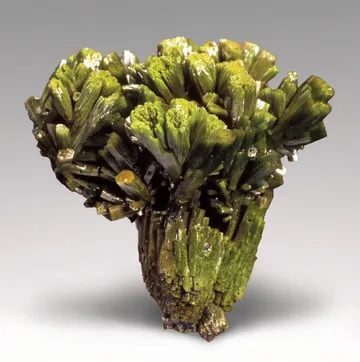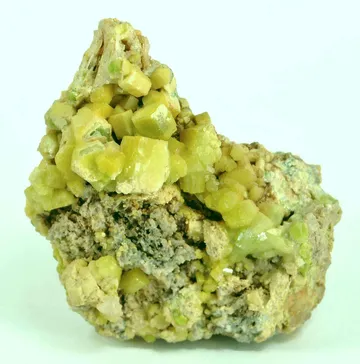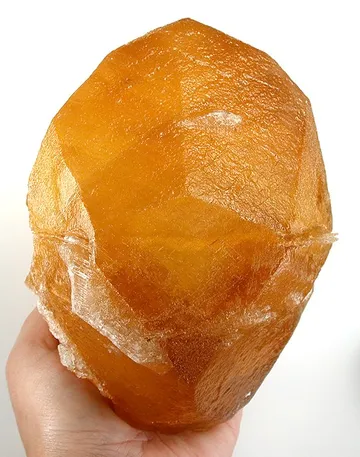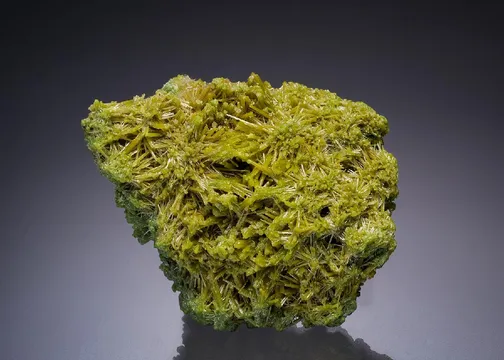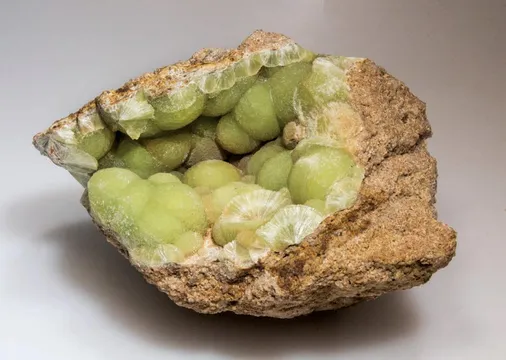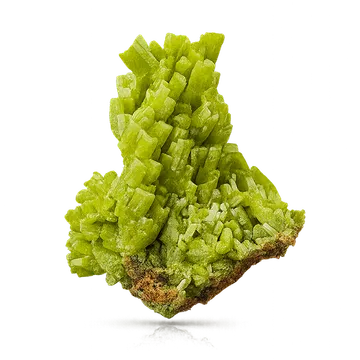
Pyromorphite des mines Wheatley - localité classique du nord-est des États-Unis, avec des cristaux vert gazon sur une matrice tachée de fer ; barils hexagonaux nets et attrait de collectionneur.
Key facts
La pyromorphite des mines Wheatley est l’un des classiques américains anciens : pas la pyromorphite oversized, vert électrique de la célébrité idahoane ultérieure, mais un style distinctement du XIXe siècle de l’est des États‑Unis, mine de plomb — cristaux foncés à vert herbe, couramment sur gossan rouillé ou quartz blanc à fumé, avec une lignée qui remonte aux années formatrices de la minéralogie des spécimens américaine. Les plus beaux morceaux présentent des fûts hexagonaux nets, des fuseaux effilés, des terminaisons en escalier, ou des crystals prismatiques courts regroupés dans des vugs ; ils arborent une allure d’époque immédiatement différente des localités modernes produites en grande série de pyromorphite.
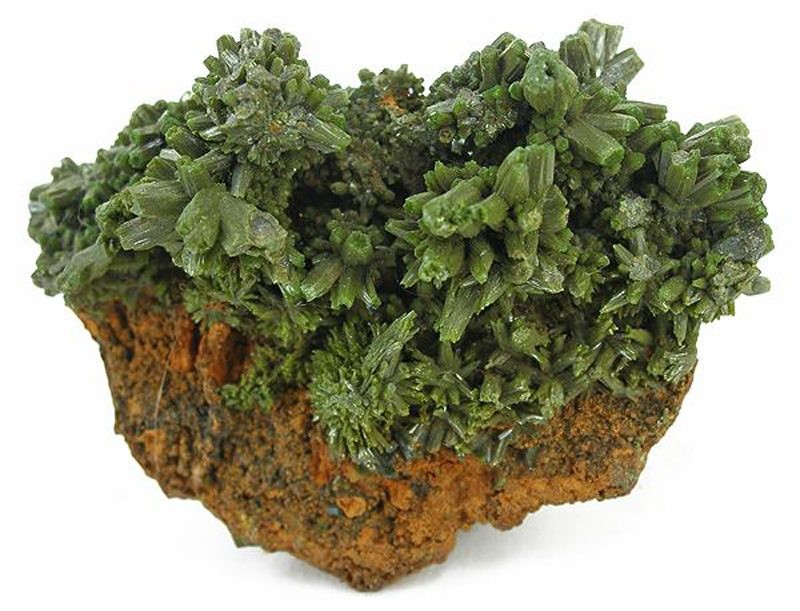
Photo : Rob Lavinsky, iRocks.com via Wikimedia Commons
Le nom de la localité « Wheatley Mines » est mieux compris à la fois comme un groupe de mineshafts historique spécifique et, sur le marché des collectionneurs, comme une étiquette pratique pour le district de plomb-argent Phoenixville, au sud de Phoenixville, dans le comté de Chester, Pennsylvanie. Wheatley, Brookdale, Phoenix, Chester County, Montgomery et les travaux associés exploitaient des veines minéralisées dans la région de Pickering Creek. Wheatley lui-même était le nom le plus célèbre et le plus productif, et Charles Moore Wheatley était un collectionneur de minéraux d’une importance réelle, dont on dit qu’il aurait assemblé plus de 6 000 spécimens à partir de ses mines.
Du point de vue minéralogique, il s’agissait d’extractions oxydées de plomb-argent-zinc où la pyromorphite, Pb5(PO4)3Cl, n’était pas seulement un accessoire du collectionneur mais une partie de l’ensembles des minerais. Les minéraux secondaires du plomb associés incluent la galène, la cérussite, l’anglesite, la wulfenite et la leadhillite, avec la sphalérite, l’hémimorphite, l’hydrozincite, le quartz, la calcite, la fluorite, et plusieurs minéraux cuivreux également enregistrés dans le groupe minier. La chimie d’oxydation est directement gravée sur les spécimens : phosphate de plomb vert sur matrice tachée de fer, crusts et cristaux de cérussite à proximité, et occasionnellement des vugs de quartz lined with small but bright pyromorphite crystals.

*Photo : Rock Currier via Wikimedia Commons*Les collectionneurs apprécient la pyromorphite de Wheatley pour trois raisons qui se chevauchent. Premièrement, l’âge : une grande partie du meilleur matériel est véritablement ancien, du milieu au dernier tiers du XIXe siècle. Deuxièmement, la rareté : les miniatures attrayantes et les petites pièces de cabinet n’apparaissent pas fréquemment, et les exemples majeurs sont rarement rencontrés en dehors des collections établies. Troisièmement, le caractère du lieu : les meilleures pièces de Wheatley présentent des cristaux vert émeraude brillants perchés dans des poches de gossan ou enveloppés sur une matrice limonite, avec des tailles de cristal modestes selon les standards mondiaux mais grandes et importantes pour ce district.## Spécimens en vedette
Rechercher des spécimens : Voir tous les spécimens de pyromorphite des mines Wheatley, USA
Les Mines Wheatley se trouvent dans le district minier de Phoenixville, dans le comté de Chester, en Pennsylvanie, près de Phoenixville et de la vallée de Pickering Creek. Mindat situe les Mines Wheatley dans le township de Schuylkill et les considère comme un groupe de mines, le district plus large de Phoenixville s’étendant sur les townships de Schuylkill et de Charlestown. Les travaux du district ont suivi des filons de plomb-argent qui ont été explorés et exploités de manière intermittente au cours des XIXe et premières décennies du XXe siècle.
Le gisement était une occurrence de plomb-argent-zinc dans des veines coupant des roches cristallines précambriennes, décrites dans les résumés modernes comme des gneiss felsiques et intermédiaires, et localement aussi des siltstones rouges de la formation Stockton du Triasique. Mindat donne comme roche encaissante des Mines Wheatley un adamélite, une roche plutonique granitique d'âge précambrien, avec une minéralisation considérée comme Triassique ou plus ancienne. En termes de spécimens, cette géologie a produit une cuvette primaire de plomb oxydé : la galène comme le sulfure de plomb principal, avec la pyromorphite, la cérussite et l’anglesite comme minéraux de plomb secondaires bien visibles dans les parties oxydées des veines.
La première découverte de veines minéralisées près de Phoenixville est traditionnellement attribuée à Charles Pickering peu après son arrivée en Pennsylvanie avec William Penn en 1682, mais l’exploitation soutenue n’a débuté que dans les années 1850. Charles Moore Wheatley, alors directeur de la mine de cuivre Perkiomen à Audubon, a loué le terrain pour l’exploitation minière en 1850 et a commencé les travaux à la Mine Wheatley au début de 1851. Seulement 11 tonnes de minerai argentifère plombifère ont été extraites cette première année, mais l’exploitation s’est rapidement développée.
En janvier 1852, le puits principal avait atteint 135 pieds et la machine d’extraction originale s’avérait insuffisante. Wheatley a organisé la Wheatley Mining Company en février 1852 et a installé une grande machine Bull à action unique, une machine de 60 chevaux avec un cylindre de 24 pouces et une course de 6 pieds. D’ici 1854, le puits moteur principal, connu sous le nom de puits Cocking, avait atteint sa profondeur finale de 300 pieds. Les travaux ont développé cinq niveaux et, en septembre 1854, la mine aurait produit environ 1 800 tonnes de minerai d’une teneur moyenne en plomb de 60 pour cent. Les reportages contemporains distinguaient le minerai de galène, analysé à 70–85 pour cent de plomb et 15–120 onces d’argent par tonne, du minerai de pyromorphite, analysé à 66–72 pour cent de plomb et environ 5 onces d’argent par tonne.Le groupe de mines s’est développé autour de plusieurs travaux connexes. La mine Brookdale, ouverte en octobre 1852 sur le même filon à un peu plus d’un tiers de mile au sud-ouest de Wheatley, avait sa propre machine d’appoint de pompage de 24 pouces et a finalement atteint une profondeur de puits de 192 pieds. La plus petite Phoenix Mine se trouvait plus au sud-ouest sur le même filon et était une opération mineure. La Charlestown Mine, sur un filon parallèle au nord-ouest, utilisait une machine à beam rotatif de 24 pouces construite par John West de Norristown, Pennsylvanie; cette machine fut ensuite déplacée à Wheatley durant le réaménagement des années 1860.
Les problèmes financiers et juridiques ont façonné la première phase du district autant que la géologie elle-même. L’exploitation minière fut suspendue en 1855 pendant une crise financière, et les mines Wheatley, Brookdale et Phoenix furent fusionnées dans la Pennsylvania Lead Company, qui échoua à réunir le capital nécessaire et fit faillite en 1857. Brookdale fut également arrêtée par une affaire judiciaire impliquant le fermier voisin John Chrisman, qui s’opposait à la déviation et à la pollution d’un torrent utilisé pour l’abreuvement du bétail; la décision fut confirmée par la Cour suprême de Pennsylvanie en juin 1855.
La Civil War a ravivé l’intérêt pour les dépôts de plomb. En 1864, Charles Wheatley racheta les mines et les machines, forma la New York and Boston Silver-Lead Company et vendit la propriété à cette société. Les travaux reprirent à Wheatley en avril 1864. La vieille machine Bull fut nettoyée et réparée, un second adit fut foré sur près de 600 pieds au niveau des 48 pieds, et la machine de Charlestown fut reconstruite entre les puits de machines Wheatley et Brookdale pour aider au pompage, à la manutention et au broyage. En mars 1865, la mine avait été dégagée, retravitée et retournée au développement sous-terrain. Les registres indiquent 25 tonnes de minerai expédiées, entre 65 et 70 tonnes supplémentaires de minerai de plomb extraites, et 12 tonnes de minerai de zinc produites à ce stade.
L’histoire ultérieure fut brève. Le district semble avoir été inactif vers 1870 environ, et la New York and Boston Silver-Lead Company fit faillite en 1873. Eastern Mining and Milling Company réouvrit la Wheatley Mine en janvier 1917, mais les travaux furent interrompus par une pénurie de charbon et repris en novembre 1918. D’ici août 1919, environ 500 tonnes de minerai de plomb et de zinc avaient été extraites, mais la production resta limitée et les opérations pris fin pour la dernière fois en 1920. Une tentative de 1923 visant à lever des capitaux pour une reprise minière échoua.
L’accès à la collecte est une question distincte par rapport à l’identité historique des localités. Le terrain minier d’origine et les dépôts associés ne constituent pas un terrain de collecte public ouvert dans le sens courant. Les collectionneurs ne devraient pas tenter d’entrer sur l’un des sites miniers de plomb-argent de Phoenixville sans l’autorisation explicite du propriétaire actuel ou du gestionnaire de la propriété et sans accord précieux sur les dangers liés aux anciennes mines. Des rapports de collecte plus anciens évoquent la collecte au niveau du dépôt Brookdale dans la zone qui est aujourd’hui le parcours de golf Pickering Valley, mais les dispositions d’accès doivent être confirmées directement et peuvent changer.## Caractéristiques de la pyromorphite des Mines Wheatley, États-Unis
La pyromorphite de Wheatley est caractérisée par sa couleur verte, le plus souvent olive-verte, forêt-verte, vert foncé ou vert gazon. Les meilleures spécimens ne sont pas de simples revêtements verts; ils montrent des cristaux individuels au formé reconnaissable. Les cristaux classiques de Wheatley incluent des prismes hexagonaux courts, des cristaux en forme de baril trapu, des cristaux en forme d’aiguilles effilées, et des cristaux ayant des terminaisons plates pinacoidales. Des terminaisons en encoignure ou creux sont une caractéristique notable de certains échantillons, et la photographie à haute magnification a montré la structure de croissance sur les terminaisons à l’échelle submillimétrique.
La taille des cristaux est généralement modeste. De nombreux spécimens se composent de druses, de microcristaux ou de petits cristaux prismatiques sur quartz ou gossan. Les cristaux dans la plage de 4–8 mm sont assez respectables pour la localité, et les marchands et les descriptions de musées traitent à plusieurs reprises les cristaux approaching ou dépassant 1 cm comme particulièrement grands pour Wheatley. Un miniature avec une couverture riche en trois dimensions et des cristaux jusqu’à 8 mm peut être une pièce de localité très forte ; un petit spécimen de cabinet avec des cristaux nets et brillants, une bonne couverture, et une provenance ancienne est un classique américain sérieux.
La matrice la plus typique est composée de matériel taché de fer, limonitique ou gossané, souvent orange-brun à rouille-brun. La matrice quartz est également importante, notamment pour les spécimens où des cristaux de pyromorphite verte reposent sur des cristaux de quartz rugueux ou bordent des vugs ouverts de quartz. Les associations de cérussite sont particulièrement souhaitables lorsque le contraste est fort : cérussite blanche ou incolore contre pyromorphite verte et matrice rouillée. Anglésite, galène, sphalérite, wulfenite, calcite, hémimorphite, hydrozincite et d’autres espèces secondaires appartiennent à l’ensemble Wheatley/Phoenixville, bien que toutes n’apparaissent pas sur des spécimens de pyromorphite.
La qualité de surface varie beaucoup. De nombreux spécimens Wheatley sont anciens, et beaucoup ont passé du temps sur des décharges ou dans de premières collections, de sorte que des bords ébréchés, des cristaux exposés entraînés par abrasion, des cristaux périphériques incomplets et une matrice salie sont courants. Les meilleures pièces ont des vugs protégés, des cristaux à terminaison nette, un lustre éclatant et des faces d’exposition non endommagées. Certains spécimens présentent une coloration zonée ou des pointes plus claires en vert, et quelques-uns présentent une combinaison de barils nets et de terminaisons en encoignure qui donnent à la matière sa personnalité Wheatley la plus reconnaissable.
Un facteur clé de qualité est la tridimensionnalité. Des druses plates de minuscules cristaux verts sont historiquement intéressantes, mais les spécimens les plus désirables s’élevant de la matrice en éclats, grappes et croûtes entournantes. Les anciennes mines de plomb de Phoenixville ont produit de nombreuses pyromorphites collectionnables, mais les pièces réellement sculpturales se font rares. Un riche miniature peut supplanter une plaque plus grande mais plate ou indistincte.## Notes du collectionneur
Le principal problème d’authenticité n’est pas la pyromorphite fausse ; c’est la précision de la localité. De nombreuses étiquettes du XIXe siècle indiquent simplement « Phoenixville », et des propriétaires ou marchands ultérieurs ont parfois transformé cette attribution régionale générale en « Mine Wheatley ». Comme la Mine Wheatley était le nom le plus célèbre du district, il en est né un raccourci de collectionneur. Cependant, la Mine Chester County, la Mine Brookdale, la Mine Phoenix, la Mine Montgomery et les travaux associés ont également produit des minerais de plomb, et de nombreux spécimens en circulation se décrivent mieux comme des spécimens du district de Phoenixville, sauf si une vieille étiquette, un pedigree de collection ou une chaîne de possession fiable les rattache spécifiquement à Wheatley.
Pour les collectionneurs sérieux, une étiquette du XIXe siècle d’origine indiquant Wheatley, un pédigrée de collection ancienne documenté, ou un enregistrement musée/mékthnique qui préserve une attribution précoce ajoute une valeur substantielle. Des étiquettes indiquant seulement « Phoenixville » doivent être respectées en tant que telles. Une attribution moderne « Mines Wheatley » peut rester utile commercialement, mais elle ne doit pas être traitée comme le même standard probant qu’une étiquette Wheatley de l’époque.
Aucun traitement bien documenté et spécifique à la localité ni aucun problème de contrefaçon ne se démarque pour la pyromorphite de Wheatley dans les sources consultées. Les préoccupations plus réalistes concernent la mauvaise attribution, le nettoyage excessif, la coupe et l’état. Comme la pyromorphite est un phosphate de plomb et que les cristaux peuvent être cassants, un nettoyage négligent ou un affûtage mécanique agressif peut enlever la fine peau de cristaux attractifs des gossans et du quartz. Les vieux spécimens peuvent aussi présenter une tache de fer naturelle, de l’argile dans les cavités, ou des contusions de contact qui ne devraient pas automatiquement être « améliorées » ; une pièce Wheatley trop lumineuse et trop nettoyée peut perdre une grande partie de son caractère de localité.
Les attentes d’état doivent être calibrées en fonction de l’âge et de l’habitude. Des cristaux exposés à l’extérieur des matrices de gossan sont souvent incomplets ou ébréchés. Les cavités protégées doivent être examinées de près avec magnification, car la meilleure valeur réside dans des terminaisons non endommagées, un brillant éclatant et des pulvérisations cristallines intactes. Sur les spécimens à matrice de quartz avec une pyromorphite très fine, recherchez une couverture cristalline réelle plutôt que des traînées vertes ou des grains dispersés.
La disponibilité sur le marché est limitée. Les pyromorphites Wheatley apparaissent chez des marchands spécialistes, dans d’anciennes collections et lors de ventes aux enchères occasionnelles, mais les bons exemples ne sont pas courants. Les descriptions récentes des marchands soulignent à répétition que les pièces Wheatley de qualité sont difficiles à obtenir, en particulier avec des cristaux visibles, une taille adaptée à une exposition, une couverture marquée ou une provenance importante. Les prix augmentent rapidement pour les anciennes étiquettes, les cristaux de grande taille pour la localité, l’esthétique tridimensionnelle et les associations avec des collectionneurs ou institutions classiques.## Stories & Field Notes
Une personne qui se promène aujourd’hui sur les terrains du Pickering Valley Golf Club près de Valley Forge pourrait passer tout près de l’un des vestiges les plus évocateurs de l’histoire Wheatley sans s’en rendre compte. Dans une petite clairière entre les fairways 15 et 16 se dresse une pile cornique solitaire, longtemps connue localement sous le nom de « pile du métal ». Ce n’est pas en réalité la pile d’un haut fourneau. Elle appartenait au petit moteur de pompage et de broyage de la mine Brookdale, perché à côté de la galerie du moteur de Smith — un survivant industriel d’un district de plomb-argent aujourd’hui intégré au paysage du parcours et à la banlieue du comté de Chester.
La mine primitive était une entreprise ambitieuse de style cornique en miniature. Wheatley commença les travaux en 1851 avec un petit moteur de pompage d’environ 50 chevaux, mais dès janvier 1852 la galerie atteignait déjà 135 pieds de profondeur et la pompe ne suffisait plus. Il forma la Wheatley Mining Company et acheta un moteur Bull à simple action : cylindre de 24 pouces, course de 6 pieds, inversé directement au-dessus de la galerie. D’ici 1854, cette galerie-moteur — la galerie Cocking — avait descendue de 300 pieds. Elle fut accompagnée par des galeries d’humeur, des roues à aubes, des stamp et des installations de traitement. Une roue à eau mesurait 30 pieds de diamètre et entraînait six têtes de stamps et une presse; une autre, de 10 pieds de diamètre, actionnait les ateliers de traitement.
L’expansion prévue était encore plus spectaculaire. En 1853, les travaux commencèrent sur la galerie Sanderson, placée entre la galerie Cocking de Wheatley et la galerie Smith de Brookdale. L’idée était de relier les deux mines sous terre et de drainer les deux avec un moteur cornique de pompage de 80 pouces et une course de 12 pieds. L’estimation fut établie, le plan était grandiose, et le moteur ne fut jamais acheté. Le district fut à plusieurs reprises proche d’un développement industriel bien plus vaste, seulement arrêté par l’argent, l’eau, la loi ou le minerai.
En septembre 1854, la mine comptait cinq niveaux et avait extrait 1 800 tonnes de minerai en moyenne avec 60 pour cent de plomb. Les chiffres du minerai rappellent que la pyromorphite ici n’était pas qu’un joli minéral pour les collectionneurs : il s’agissait de minerai. La galène contenait en moyenne 70–85 pour cent de plomb et portait 15 à 120 onces d’argent par tonne; la pyromorphite contenait en moyenne 66–72 pour cent de plomb et environ 5 onces d’argent par tonne. Lorsque les collectionneurs manipulent une pyromorphite Wheatley aujourd’hui, ils tiennent le même minerai que les opérateurs du XIXe siècle comptaient en tonnes et dont l’analyse était du minerai de plomb.L’histoire de Brookdale s’est développée autant autour d’un conflit rural en Pennsylvanie que d’ingénierie. La mine Brookdale ouvrit en octobre 1852 sur la même veine, un peu plus d’un tiers de mille au sud-ouest de Wheatley. Son moteur de pompage pouvait élever 216 gallons par minute à 6 coups par minute. Le puits fut approfondi de 75 à 110 pieds entre mai et août 1853, puis à 180 pieds d’avril 1854 et finalement à 192 pieds. Mais l’activité minière y cessa en 1855 après qu’un jugement ait reconnu Charles Wheatley coupable d’avoir détourné et pollué un cours d’eau utilisé par un paysan voisin, John Chrisman, pour abreuver son bétail. L’assignation fut émise en décembre 1853; un verdict suivit le mois suivant; Wheatley fit appel; le jury donna à nouveau raison à Chrisman en janvier 1855; et la Cour suprême de Pennsylvanie valida la décision en juin 1855. Une mine de plomb-argent avec des machines, des puits et des ambitions fut arrêtée par l’eau, le pâturage et une plainte d’un fermier.
La Guerre Civile réintégra l’histoire des mines. En 1864, alors que la demande de plomb pendant la guerre était élevée, Wheatley racheta les mines et les machines et organisa la New York and Boston Silver-Lead Company. Les travaux reprirent à Wheatley en avril. L’ancien moteur Bull fut nettoyé et réparé sur environ six semaines, mais il ne pouvait pas drainer adéquatement la mine jusqu’au niveau de 60 pieds. Un nouveau adit fut creusé sur près de 600 pieds au niveau de 48 pieds, et le moteur à jarres rotatives de 24 pouces de la Charlestown Mine fut déplacé et réédifié dans une maison fermée entre les puits moteurs de Wheatley et Brookdale. Il actionnait la mine par des tiges plates de va-et-vient et pouvait aussi hisser et broyer le minerai.
En mars 1865, la mine était de nouveau en activité: vidée, re-boisée, avec de nouvelles tables de traitement et des broyeurs en cours d’installation. Les chambres donnaient environ 500 livres de minerai prêt à être exploité par corde, 25 tonnes avaient déjà été expédiées et 65–70 tonnes de minerai de plomb plus 12 tonnes de minerai de zinc avaient été extraites. Parallèlement, le moteur de Brookdale était préparé dans l’attente d’un démarrage de pompage dans les deux semaines. Puis le dossier survivant s’estompe. L’activité de la société devient incertaine, l’exploitation minière cessant probablement vers 1870, et la société fit faillite en 1873.
La reprise du XXe siècle fut plus courte et moins romantique. Eastern Mining and Milling Company rouvrivit Wheatley en janvier 1917, s’arrêta en raison d’une pénurie de charbon, reprit en novembre 1918, et d’ici août 1919 avait extrait environ 500 tonnes de minerai de plomb et de zinc. Les opérations prirent fin pour de bon en 1920. Une tentative de lever de nouveaux capitaux en 1923 échoua. Après cela, Wheatley passa complètement dans le domaine des anciennes étiquettes, anciens dépôts, tiroirs de musée, armoires privées et du spécimen vert occasionnel qui porte encore l’allure d’une petite mine de plomb de Pennsylvanie de l’époque des moteurs à beam et des caprices des chevaux.## Dossiers et Publications Minéralogiques- J. Lawrence Smith, “Reexamination of American minerals: Part V — The minerals of the Wheatley mine in Pennsylvania,” American Journal of Science and Arts, 2nd series, vol. 20, 1855, pp. 242–253 — Premier traitement scientifique de la série minérale de Wheatley, cité dans la bibliographie des localités de Mindat pour la pyromorphite et les espèces associées.
Samuel G. Gordon, The Mineralogy of Pennsylvania, Special Publication 1, Academy of Natural Sciences of Philadelphia, 1922 — Référence classique à l’échelle de l’État incluant le matériel de Wheatley.
Charles Palache, Harry Berman, and Clifford Frondel, The System of Mineralogy, 7th edition, vol. 2, 1951 — Cité par Mindat pour les minéraux de Wheatley, reflétant l’inclusion de la localité dans la littérature minéralogique standard.
Davis M. Lapham and Alan R. Geyer, Mineral Collecting in Pennsylvania, Pennsylvania Geological Survey Bulletin G33, 2nd ed., 1965 — Référence de collecte d’État citée pour les Mines de Wheatley.
Ronald A. Sloto, “Famous Mineral Localities: The Phoenixville Lead-Silver Mines, Chester County, Pennsylvania,” The Mineralogical Record, vol. 20, no. 5, 1989, pp. 369–386 — L’article moderne clé du Mineralogical Record sur les mines de plomb-argent de Phoenixville.
R. Damian Nance, “The Wheatley Mines of Chester County, Pennsylvania,” Pennsylvania Geology, vol. 54, no. 2, Summer 2024 — Compte rendu historique et géologique moderne détaillé des mines Wheatley, Brookdale, Phoenix et Charlestown.
Florence Bascom and George W. Stose, Geology and mineral resources of the Honeybrook and Phoenixville quadrangles, Pennsylvania, U.S. Geological Survey Bulletin 891, 1938 — Rapport régional USGS documentant la géologie et les ressources minérales du quadrangle Phoenixville.
R. C. Rouse, D. R. Peacor, P. J. Dunn, W. B. Simmons, and D. Newbury, “Wheatleyite, Na2Cu(C2O4)2·2H2O, a natural sodium copper salt of oxalic acid,” American Mineralogist, vol. 71, 1986, pp. 1240–1242 — Décrit la wheatleyite, minéral locality-type nommé d’après les mines de Wheatley.
Princeton University Mineral and Gem Collection specimen 4467: Pyromorphite, Wheatley Mine, Phoenixville, Pennsylvania — Specimen de musée décrit comme des couches de cristaux olive-vert sur limonite.
Princeton University Mineral and Gem Collection specimen 4512: Pyromorphite, Wheatley Mine, Phoenixville, Pennsylvania — Specimen de musée décrit comme des cristaux creux verts et des croûtes avec de la cérussite.
Wikimedia Commons / Rock Currier : Cérussite et Pyromorphite, Mines de Wheatley, Collection George Vaux, Bryn Mawr College — Image de spécimen historique documentant l’association pyromorphite–cérussite.## Vidéos et médias
“IRB2024 PYROMORPHITE, Wheatley Mines, USA” — Crystal Classics — Courte vidéo de spécimen montrant une pyromorphite des Wheatley Mines proposée par Crystal Classics.
“Outstanding Phoenixville Pyromorphite” — The Mineral and Gemstone Kingdom / John Betts Fine Minerals — Vue photo d’un spécimen Wheatley Mine de 6,0 x 4,5 x 2,0 cm avec des prismes verts vifs et des agrégats botryoïd rares.
Catégorie Wikimedia Commons : Wheatley Mines — Archives d’images contenant de nombreuses photographies de spécimens de pyromorphite des Wheatley Mines.## Lectures complémentaires et liens externes
Mindat : Wheatley Mines, Schuylkill Township, Chester County, Pennsylvanie — Page localité essentielle avec coordonnées, histoire de la mine, liste des minéraux, photos et bibliographie.
Mindat : Phoenixville Mining District, Chester County, Pennsylvanie — Meilleure page de contexte pour comprendre Wheatley dans le cadre plus large du district de plomb-argent de Phoenixville.
Mindat : Pyromorphite de Pennsylvanie, États-Unis — Référence utile pour les occurrences de pyromorphite et les citations bibliographiques à travers la Pennsylvanie.
Pennsylvania Geological Survey : Pennsylvania Geology, vol. 54, no. 2, Été 2024 — Inclut l’article détaillé de R. Damian Nance “The Wheatley Mines of Chester County, Pennsylvania.”
ResearchGate : R. Damian Nance, “The Wheatley Mines of Chester County, Pennsylvania” — Version web lisible de l’article avec figures et références.
USGS Publications Warehouse : Bascom et Stose, Geology and mineral resources of the Honeybrook and Phoenixville quadrangles, Pennsylvania — Fondation géologique régionale pour la zone de Phoenixville.
Wikimedia Commons : Wheatley Mines catégorie médias — Collection d’images ouvertes de pyromorphite de Wheatley et minéraux associés.
Penn Minerals : Museum of Classic Pennsylvania Minerals — Wheatley Mine section — Vue d’ensemble orientée collectionneur avec des notes sur Wheatley, Brookdale, anciennes étiquettes et spécimens classiques de Pennsylvanie.
McDougall Minerals : Pyromorphite, Wheatley Mines, Pennsylvanie — Archive du négociant documentant une pyromorphite de Wheatley de 9,0 cm avec des cristaux dynamiques vert foncé et provenance de la John S. White Pennsylvania Collection.
The Mineralogical Record : Vol. 20, No. 5, 1989 — Numéro comprenant l’article classique de Ronald A. Sloto sur les mines de plomb-argent de Phoenixville.