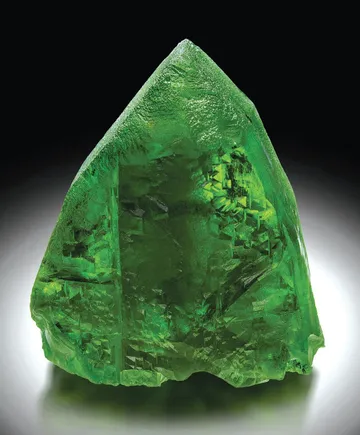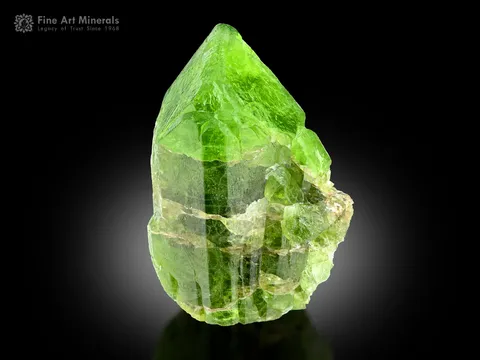
Peridot from Sapat Gali, Pakistan — benchmark forsterite crystals with lime-green color, natural terminations, and a prized Himalayan locality.
Key facts
Peridot from Sapat Gali is one of the modern benchmark occurrences for collectible forsterite crystals. The best pieces have the look serious collectors hope for but rarely see in peridot: saturated lime to grassy green color, real transparency, lustrous natural faces, and orthorhombic crystals that are not merely fragments of gem rough. In fine examples the crystal seems to hold light rather than simply transmit it; backlighting can turn a somewhat silky crystal into a vivid green lantern.

Photo: Wikimedia Commons
The locality sits high in the western Himalaya, in the Sapat Valley/Sapat Gali area of northern Pakistan, commonly catalogued by mineral collectors under Naran, Kaghan Valley, Mansehra District, Khyber Pakhtunkhwa Province. Geological literature places the deposit within the Sapat mafic-ultramafic complex of the Kohistan arc, where gem peridot occurs in pockets and veins along shear zones in partially serpentinized dunite. That setting matters: these are not the loose green grains familiar from basaltic cinders, nor the granular peridot of many mantle xenoliths. The Sapat material is collectible because it can form discrete, display-worthy crystals with shape, size, and color all present at once.
Historically, the locality changed the way the market thought about peridot. In the early 1990s, fine Pakistani material began reaching international gem and mineral markets in quantity, including large clean crystals and rough suitable for important cut stones. Before that, peridot was abundant as a gem in smaller commercial sizes but far less familiar to collectors as a cabinet-worthy crystal species. Sapat Gali showed that peridot could be a serious specimen mineral.
Collectors look first for color and form. A strong Sapat crystal should show fresh lime-green to grassy green color without brownish murk, a natural termination, and enough transparency to reveal internal depth. The most distinctive inclusions are black acicular to fibrous needles of ludwigite-vonsenite, which can run like dark silk through otherwise gemmy green forsterite. Magnetite is the classic association, and true matrix or peridot-on-magnetite specimens are far scarcer than loose singles.
Search for specimens: View all peridot specimens from Sapat Gali, Pakistan
Sapat Gali is a high mountain gem locality in northern Pakistan, usually placed in mineral records as Sapat Gali, Naran, Kaghan Valley, Mansehra District, Khyber Pakhtunkhwa Province. Older gemological and mineralogical literature may use North West Frontier Province, Sapat Valley, Sapat Nala, Sappat, Soppat, Suppat, or Kohistan in the locality wording. For specimen labels, the most useful modern convention is “Sapat Gali, Naran, Kaghan Valley, Mansehra District, Khyber Pakhtunkhwa Province, Pakistan,” with the understanding that the geological frame is the Sapat mafic-ultramafic complex of the Kohistan arc.
The deposit is hosted by dunite within a mafic-ultramafic complex. In the gem-bearing zones, peridot occurs in pockets and veins associated with shear zones in partially serpentinized dunitic rocks. The Sapat complex itself has been described as a layered mafic-ultramafic body at the tectonic base of the Kohistan island arc, exposed near the Indus suture zone and the Main Mantle Thrust. The regional rock package includes ultramafic cumulates such as dunite, harzburgite, lherzolite, chromitite-bearing zones, pyroxenite, and gabbroic rocks.
Mining is small-scale, seasonal, and physically difficult. The mine area has been reported at roughly 4,500 m, or about 15,000 feet, above sea level. One published access description notes a seven-hour horseback ride followed by a two-day hike from the nearest populated area, with the Jalkot Valley route specifically described as dangerous and unsuitable for nonlocals. This is not a casual collecting site. Material reaches the market through miners, local traders, Peshawar and other Pakistani gem networks, and international dealers rather than through routine collector access.
Production began to affect the international market in the early 1990s, with 1994 standing out as the moment when large quantities of fine Pakistani peridot entered wider gem and mineral channels. Dealer records and auction descriptions repeatedly describe the main specimen-production era as roughly 1994 to about 2010, with much less fresh material in the following decade. Small crystals and cuttable rough still appear, but fine sharp specimens—especially matrix pieces, clusters, and large undamaged singles—are no longer encountered with the ease they once were.
Notable finds include loose gemmy crystals, sharp miniatures, crystals with black ludwigite-vonsenite needles, and rarer combinations with magnetite. Mindat records the species at Sapat Gali as forsterite variety peridot, with crystals reported to 15 cm. GIA has illustrated Pakistani examples including a 7.9 cm tall crystal paired with a 64.57 ct cut stone, and the same Sapat Valley production made possible important suites of matched faceted peridot in the early 2000s.
The essential Sapat Gali look is a short to stout orthorhombic prism, commonly wedge-terminated or chisel-like, with a fresh yellow-green to lime-green body color. Many crystals are translucent rather than water-clear, but better examples are gemmy in zones or throughout. Luster ranges from vitreous to resinous or slightly satiny, and the finest pieces keep lively color even without strong backlighting.
Crystal form is a major quality factor. Sapat Gali is valued because it can produce real crystals rather than broken masses: single crystals, parallel-growth pairs, compact clusters, and occasional matrix groups. Loose singles are far more common than clusters. Matrix pieces are substantially rarer and especially desirable when green peridot contrasts with dark magnetite or pale serpentinized ultramafic material.
Typical collector specimens are thumbnails to miniatures, often in the 1–4 cm range for individual crystals. Crystals around 5 cm with good color and form are already significant, and large, sharp, transparent examples are genuinely scarce. Many larger crystals become rounded, contacted, internally fractured, opaque-cored, or only partially gemmy. A smaller undamaged crystal with crisp faces can be more important than a larger dull or bruised one.
The classic inclusions are black, hairlike to acicular ludwigite-vonsenite needles. In specimen crystals these may appear as wispy vertical threads, dense dark sprays, or silky internal lines. They are not a defect automatically; in many Sapat pieces they are part of the locality signature. In a faceted gem they may lower clarity if obvious, but in a crystal specimen they can add identity, depth, and visual contrast.
Associated minerals include magnetite, ludwigite, serpentine-group minerals, talc, chlorite-group minerals, magnesite, chromite, ferrichromite, and clinochlore. Magnetite is the association collectors see most often in specimen descriptions, and it can occur as attractive black crystals or masses contrasting with the green peridot. The rock alteration assemblage—serpentine, talc, chlorite, magnesite, magnetite, and boron-bearing ludwigite-vonsenite inclusions—reflects the fluid-influenced, sheared ultramafic setting rather than a simple unaltered igneous crystallization story.
Quality evaluation should be ruthless. Look for a clean termination, original faces, good color in normal display light, no distracting bruises along the sharp edges, and transparency that is visible without needing theatrical backlighting. The best Sapat crystals show a balance of form and life: enough texture to prove natural growth, enough luster to catch the light, and enough internal green to glow.
Sapat Gali peridot is common enough that modest singles are available, but genuinely fine specimens are not common. The market still offers thumbnails and miniatures, including loose crystals with ludwigite inclusions, but top pieces with sharp form, strong color, and pristine condition are competitive. Matrix specimens, clusters, and large undamaged crystals remain the most sought-after categories.
Condition is the central issue. Peridot is hard enough for jewelry use, but it is brittle, and sharp crystal edges chip easily. Inspect terminations, exposed ridges, and lower contact areas under magnification. Small white bruises on edges are common. Natural contact faces are also common, especially where crystals grew against matrix or neighboring crystals; these should not be confused with post-mining damage, but they do affect display quality.
Because Sapat crystals are often loose singles, authenticity concerns focus less on outright imitation and more on specimen construction and nondisclosure. Glued repairs, reattached crystals, and mounted crystals on unrelated matrix are the main risks to watch for in Pakistani mineral specimens generally. Recent gemological reporting on Pakistani markets has documented reconstructed specimens, glued crystals on host rock, resin-like adhesives, and undisclosed repairs in the broader trade. That reporting was not limited to Sapat peridot, but it is directly relevant to buying any valuable Pakistani matrix specimen.
For Sapat Gali specifically, treat matrix pieces with extra care. A loose peridot crystal is normal for the locality; a convincing peridot-on-matrix specimen is rarer and therefore more valuable. Under a loupe or microscope, check junctions for glossy seams, dust trapped in adhesive, unnatural gaps, repeated broken surfaces that fit too neatly, or matrix that does not match the expected serpentinized ultramafic/magnetite association. Black magnetite and pale serpentinized material make geological sense; a random foreign matrix should raise questions.
Documented gemological treatments are not a major issue for natural crystal specimens, and peridot is not routinely heat-treated or irradiated in the way some other gem species are. However, faceted Sapat/Pakistani peridot should still be bought with normal gem discipline: confirm identity, ask about fracture filling or coatings if clarity seems suspicious, and remember that “Kashmir peridot” is often a romantic trade phrase rather than a precise locality. For collector crystals, “Pakistan” alone is too broad; a good label should specify Sapat Gali or Sapat Valley where appropriate.
Ludwigite-vonsenite needles can help support Pakistani origin, but they should not be treated as a certificate by themselves. Not every Sapat crystal has visible needles, and not every seller describing “rutile peridot” is using correct mineralogical language. The black needles in this material are classically described as ludwigite-vonsenite, not rutile.
Care is straightforward but important. Avoid acids and harsh chemical cleaning, avoid ultrasonic and steam cleaning, and do not expose specimens to sudden temperature changes. Dust with a soft brush and clean only with lukewarm water and mild soap if necessary. Store Sapat peridot away from harder minerals that can abrade its faces, and mount display pieces securely so that a single fall does not chip the termination that gives the specimen its value.
The Sapat Gali story is a mountain story before it is a gem story. Published gemological accounts place the mine in the western Himalaya at about 4,500 m, or 15,000 feet. Access was described as a seven-hour horseback ride followed by a two-day hike from the nearest populated area, Basham Village. The route through the Jalkot Valley was singled out as dangerous and not recommended for nonlocals. That one sentence explains much of the locality’s market character: the crystals may look elegant in a display case, but they came from terrain where altitude, weather, and access control production.
In the early 1990s, peridot’s commercial center of gravity was very different. Arizona material dominated ordinary supply, and much of it cut smaller stones. Then, in 1994, extraordinary quantities of fine, large Pakistani peridot entered international markets. The contrast was dramatic. A manufacturer cited by Robert E. Kane had faceted nearly half a million carats of Arizona peridot over fifteen years and produced only a handful of nearly flawless stones over 10 ct, with the average relatively clean stone around 2 ct. In only three years of Pakistani production, the same operation faceted more than 30,000 carats, with 35 percent of the production over 5 ct and nearly one third of that 5 ct-plus material in the 10–20 ct range. Kane had even seen occasional faceted Pakistani peridots exceeding 100 ct.
The most vivid published journey of Sapat peridot follows an 8 kg parcel purchased in February 2004. Eight kilograms is 40,000 carats—an amount of green rough that would be ordinary for quartz but extraordinary for fine peridot. The parcel contained large pieces of rough up to 35 g, but inclusions and fractures meant the big crystals could not simply be turned into giant gems. The expected recovery was 20 percent, or 8,000 carats of faceted stones; the final yield was about 6,500 carats, or 16.2 percent.
From that parcel came the plan for a matched suite. The rough was sorted by size, examined on a fluorescent light-box, checked with strong incandescent light, and marked for sawing. The cutting was deliberately conservative where it needed to be and ruthless where beauty demanded it. The peridot was trimmed with a high-speed, liquid-cooled saw using a sintered diamond blade only 0.2 mm thick. That thin blade saved weight but could bend and wander off the marked line, a sobering detail when the material on the saw is clean Himalayan peridot.
The chosen cut was Asscher: an early emerald-cut style with broad corners, a high crown, and a deep pavilion. It was a brave choice for peridot because the style emphasizes color and brilliance but also exposes inclusions. Only loupe-clean pieces of rough could be used. As the suite progressed, a trapezoid center stone was added to the necklace design for interest.
The final matched group contained 54 Asscher-cut peridots ranging from 3.57 to 18.30 ct, with a total weight of 350.40 ct. Van Cleef & Arpels in Paris designed the suite, and the New York atelier manufactured the five pieces. The necklace alone used 31 peridots from 3.78 to 13.78 ct, totaling 228.22 ct. The ring held an 18.30 ct peridot. The earrings carried stones from 3.57 to 4.55 ct, totaling 24.31 ct, and the bracelet held 16 matched peridots totaling 79.57 ct.
The craftsmanship details are as precise as the gem story. Five master jewelers worked on the suite for more than 900 combined hours. The mountings were handmade in platinum alloyed with 5 percent ruthenium. More than 90 D-E color, VVS-or-better diamonds totaling about 21 carats were incorporated. A separate setter handled the peridots because they require more care than sapphire: they have respectable hardness, but only fair to good toughness. The setter shortened prongs with a jeweler’s saw while taking care not to let the blade touch the peridot—one accidental contact could scar a stone whose value depended on polish, symmetry, and matched color.
That Fifth Avenue ending is not separate from Sapat Gali; it is the proof of what the locality changed. A remote, difficult, seasonal Himalayan mine supplied peridot clean and uniform enough for haute joaillerie, while the same deposit supplied natural crystals sharp enough for mineral cabinets. Few peridot localities have mattered so strongly to both gem cutters and specimen collectors.