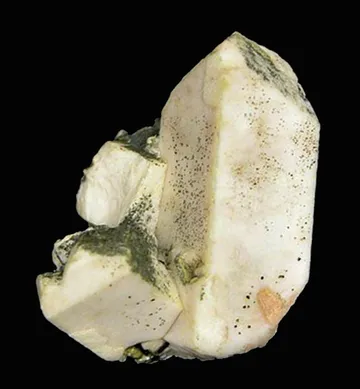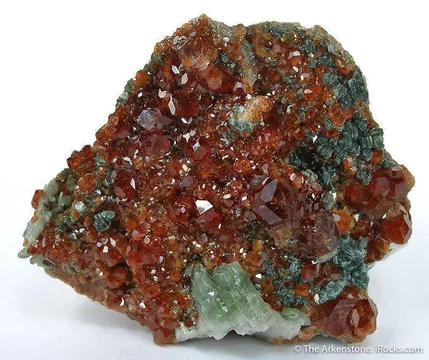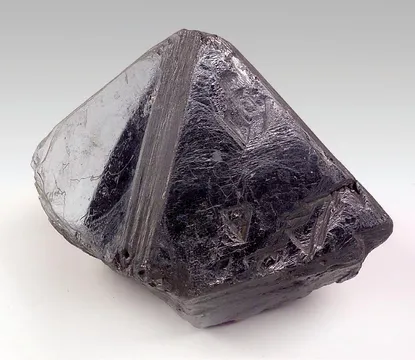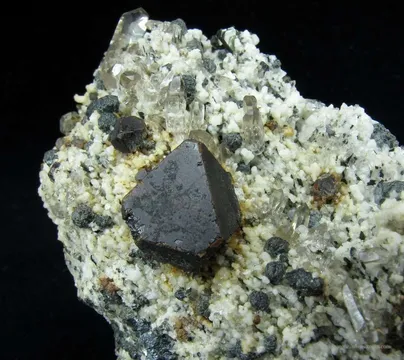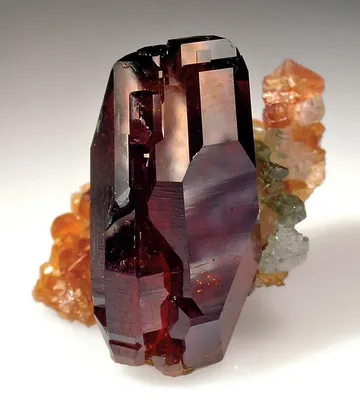
Orthoclase from Baveno, Italy: cream to pink crystals with crisp twins and porcelain luster, prized for architectural geometry and quarry heritage.
Key facts
Baveno is one of the classic names in feldspar collecting: not merely a locality where orthoclase occurs, but the locality that gave its name to the Baveno twin, one of the textbook twin laws of feldspar. The specimens that made the name famous are usually quiet rather than flashy—cream, white, or faintly flesh-pink orthoclase crystals, often blocky to prismatic, sometimes in crisp twins, and commonly set with smoky quartz, albite, fluorite, or zinnwaldite. Their appeal is architectural: balanced feldspar geometry, porcelain to silky luster, clean twin planes, and the unmistakable old-European character of a specimen from the granite quarries above Lago Maggiore.

Photo: Wikimedia Commons, File:Orthoclase-246312.jpg
The mineralogical setting is as important as the crystals themselves. Baveno sits on the western side of Lago Maggiore in Piedmont, where the pink granite of the Baveno pluton has been quarried for centuries. Orthoclase is not an accidental accessory here: white to pink K-feldspar is the mineral that gives the granite much of its characteristic color. In the specimen world, however, the best crystals did not come from the ordinary building stone, but from miarolitic cavities, pegmatitic pods, and aplitic-pegmatitic dikes in the granite. These pockets formed as the granitic melt cooled at shallow, subvolcanic levels, leaving open spaces where feldspar, quartz, albite, fluorite, micas, zeolites, and rare-element minerals could crystallize freely.
Baveno orthoclase belongs to the grand old tradition of quarry minerals: specimens rescued from working stone operations rather than mined solely for collectors. That history gives good pieces a double identity. They are aesthetic mineral specimens, but they are also artifacts of a district whose granite entered major architecture across Italy and abroad. The same quarries that exposed small crystallized pockets also supplied the stone for monumental building, and generations of “picasass”—local quarrymen and stonecutters—made Baveno’s name known far beyond the lake.
For collectors, the strongest Baveno orthoclase specimens show three qualities at once: a convincing feldspar form, a classic color, and a secure locality story. A sharp Baveno twin from Baveno itself is especially desirable, because the form and the place reinforce one another. Fine matrix specimens add smoky quartz or albite without crowding the feldspar. Older labels, especially those placing a specimen simply at Baveno or at the Monte Camoscio–Oltrefiume quarries, add significant interest when they look consistent with the specimen and the period.

Search for specimens: View all orthoclase specimens from Baveno, Italy
The collecting locality is best understood as the Baveno granite quarry district around Monte Camoscio, above Oltrefiume and Feriolo, in the Verbano-Cusio-Ossola Province of Piedmont. Mindat records orthoclase from Baveno generally and from specific sublocalities including the Seula mine, Locatelli quarry, and Cirla Quarry at Monte Camoscio. The Monte Camoscio locality lies roughly west-northwest of Baveno; the mineralized setting is described as pegmatitic pods in granite and miarolitic cavities in aplite and granophyric granite, with quarries on the slopes of the mountain and in outcrop.
Geologically, the Baveno pluton is a late-Variscan, Permian granitic body; published work reports an age of 277 ± 8 Ma by Rb-Sr whole-rock isochron. It crystallized at relatively shallow, subvolcanic levels, which helps explain the abundance of miarolitic cavities and aplitic-pegmatitic bodies. In the Baveno pluton, cavities occur in three principal settings: isolated pockets in the pink facies of the granite, irregular pockets in pegmatitic veins, and cavities within aplitic-pegmatitic dikes. In the latter, small cavities occur in the aplitic portions and larger, vertically elongated cavities occur in the pegmatitic portions. Published observations describe cavities from about 1 cm up to 2–3 m in diameter, with the largest pockets sometimes showing partial collapse.
The deposit type, for collector purposes, is an NYF-type granitic pegmatite and miarolitic-cavity environment: niobium-, yttrium-, and fluorine-enriched, with a notable suite of rare-element species. Orthoclase, quartz, albite, fluorite, zinnwaldite, muscovite, zeolites, and iron oxides are the familiar visible framework. The rare-mineral suite includes bavenite, bazzite, calcioancylite-(Nd), cascandite, jervisite, scandiobabingtonite, thortveitite, xenotime-(Y), gadolinite-group minerals, hingganite-(Y), aeschynite-(Y), and other Y-REE, Be, Sc, Nb-Ta, and F-bearing species. Orthoclase is the structural and visual anchor of many specimens, while the rare species—often microscopic—make Baveno one of the most scientifically important granite-pocket localities in Europe.
The quarrying history is long. There is no single secure starting date for exploitation of Baveno pink granite, but local tradition connects its early recognition with the Borromeo family, and documented use of Baveno granite in important Lombard buildings begins in the early modern period. By the 16th century, Baveno granite was already entering Milanese architecture, aided by lake and river transport routes across Lago Maggiore and onward through the regional waterways. The quarries occupied what local accounts call the “angolo della voltata,” the stretch of the Simplon road between Baveno and Feriolo, shaping the slopes of Monte Camoscio and the nearby Motto del Castello.
The golden age of industrial quarrying came in the second half of the 19th century and the early 20th century. Quarrying families such as the Adami, Bernasconi, Cirla, Della Casa, Galli, Polli, and Tamini made the district famous. Nicola Della Casa began quarrying Baveno granite in 1874, and by 1879 his firm had earned the title of “premiata ditta,” with the right to use the royal coat of arms. He introduced mechanized polishing and modern marketing, opened representation offices in major European and American capitals, and helped transform a local stone into an export material. The Cirla firm later became especially important in the 20th-century trade, supplying monumental stone for projects that included columns for San Paolo fuori le Mura in Rome and material for the Christopher Columbus monument in New York.
Modern quarrying has continued, though the nature of production has changed. Baveno tourism sources estimate that more than one million cubic meters of material have been extracted from the quarries overall. Present-day activity continues at Seula and Scala dei Ratti, managed since 1989 by AGIFIN, with ornamental-stone production accompanied by the recovery of quarry waste and feldspar-rich material for ceramics, aggregates, concrete, asphalt, bituminous membranes, railway ballast, and graded gravels.
Collecting access must be treated seriously. The historic quarries include active industrial sites, private property, steep quarry faces, unstable blocks, and areas where permission is required. Serious collectors should not treat old locality names as an invitation to enter. The appropriate public way to experience the district is the GranUM museum and the Sentiero dei Picasass, an open-air interpretive path leading toward the Monte Camoscio extraction area, with granite blocks, historical photographs, and quarry-worker imagery. Field collecting, where possible at all, requires explicit permission from landowners or quarry operators and current local safety guidance.
Baveno orthoclase is classic potassium feldspar, KAlSi3O8, with the locality’s strongest pieces showing blocky to prismatic feldspar crystals rather than glassy transparent gem material. The typical color is white, cream, pale peach, or flesh-pink. The pink tone is especially characteristic of the Baveno granite itself, where K-feldspar color varies from white to pink and gives the ornamental stone much of its commercial identity.
Crystal form is the main point of connoisseurship. Good crystals show sharp rectangular to wedge-like feldspar geometry, clean terminations, and clear evidence of twinning. Baveno twins are the locality’s signature: contact twins that may show a distinctive diagonal or central twin relationship, depending on orientation and crystal development. Some specimens also show Manebach or Carlsbad-style feldspar twinning, and more complex pieces may display more than one twinning relationship. A Baveno twin of orthoclase actually from Baveno has a special tautological charm that collectors understand immediately.
The luster is usually vitreous to porcelain-like, occasionally silky on the best twinned faces. Fine specimens are not judged by transparency; they are judged by form, completeness, luster, and the balance between the feldspar and its matrix. Cleavage faces can be bright and attractive, but they can also betray damage. Fresh, natural faces should be distinguished from broken cleavage surfaces, especially on loose single crystals.
Size varies widely. Small cabinet and miniature specimens are the common collecting scale. Published and photographed examples include Baveno orthoclase groups around 5–6 cm across, with individual orthoclase crystals in the 1.5–2.5 cm range; dealer examples include single or matrix crystals around 3 cm and better cabinet specimens with orthoclase crystals to about 3.5 cm. Larger feldspar crystals are known in pegmatitic material, but large, sharp, undamaged, well-twinned collector specimens are much scarcer than rough or cleaved feldspar masses.
Associated minerals are part of the locality’s character. Quartz, especially smoky quartz, is the most familiar and visually effective partner. Albite can appear as pale to light blue crystals or as matrix feldspar. Fluorite is an important associated mineral, sometimes present as small purple, greenish, or colorless crystals. Zinnwaldite and muscovite may pepper feldspar surfaces or form mica rosettes; stilbite and other zeolites represent later hydrothermal stages. Epidote, babingtonite, hematite, chlorite-group minerals, bavenite, bazzite, bertrandite, gadolinite-(Y), hingganite-(Y), aeschynite-(Y), and other rare species occur in the broader pocket suite, though many of the rarest minerals are best appreciated microscopically.
Quality factors are locality-specific. The best Baveno orthoclase specimens have a clear Baveno identity: cream-to-pink orthoclase, visible twinning, and associations consistent with the granite pockets. A sharp, intact Baveno twin is usually preferable to a larger but damaged block. Matrix is desirable when it adds smoky quartz, albite, or fluorite without hiding the feldspar form. Old labels matter greatly, especially because “Baveno twin” is a twin law found at many localities; a specimen described as a Baveno twin is not automatically from Baveno.

The principal authenticity issue is locality, not chemistry. Orthoclase and microcline twins occur at many granitic and pegmatitic localities worldwide, and “Baveno twin” is a crystallographic description as well as a locality association. A label reading “Baveno twin” may mean the twin law, not Baveno, Italy. For a specimen to be a true Baveno orthoclase locality piece, the locality should be documented separately and ideally supported by an old label, collection history, dealer record, or a combination of mineral associations consistent with the Baveno granite pockets.
Condition is the other major issue. Orthoclase has two good cleavages, and Baveno specimens often show bruised edges, cleaved contacts, or nicks on terminations. The blocky habit can make damage look deceptively natural at first glance. Inspect all prominent faces under magnification. Natural growth faces should show subtle luster continuity and edge relationships; cleaved or repaired surfaces tend to cut abruptly across the crystal geometry. On matrix pieces, check whether a feldspar crystal has been reattached, especially where a prominent crystal meets quartz, albite, or granite matrix.
Cleaning should be conservative. Iron staining, mica speckling, chloritic coatings, or minor feldspar alteration may be part of the specimen’s Baveno character. Aggressive acid work or abrasive cleaning can dull feldspar luster and remove contextual coatings that help establish authenticity. Because Baveno’s rare accessory minerals may be tiny, heavy-handed cleaning can also destroy the very features that make a pocket specimen scientifically interesting.
Rarity is nuanced. Ordinary Baveno orthoclase is available on the collector market, especially as thumbnails, miniatures, small cabinet singles, and quartz-feldspar combinations. Fine, sharp, undamaged Baveno twins from the actual Baveno locality are much less common. Specimens with strong aesthetics, visible twinning, smoky quartz association, antique labels, or documented 19th- or early 20th-century provenance are substantially more desirable than common feldspar pieces.
Market availability remains steady but not abundant. Recent online listings show small Baveno orthoclase or orthoclase-quartz pieces at modest prices, while older, sharper, or better-documented examples command stronger attention. Collectors should be wary of pieces sold only as “Baveno twin” without an Italian locality; they may be perfectly good feldspar specimens, but they are not automatically Baveno locality specimens.
Long before Baveno became a dealer-label word, it was a quarryman’s landscape. The town’s story is written in street names, blocks of pink stone, and the slope of Monte Camoscio above Lago Maggiore. Local accounts say the earliest fame of the stone was tied to the Borromeo family, who helped place Baveno granite in major Milanese buildings. The practical advantage was water: granite could move by barge across Lago Maggiore and then through the Ticino, Po, and canal systems that already served the Candoglia marble trade. A pocket opened by a quarryman for building stone could become, almost incidentally, a mineral discovery.
The first mineral story has a scholarly air. In the 18th century, Ermenegildo Pini, a Barnabite priest from Milan and an important mineralogical figure, collected Baveno specimens that later entered the collections of the Natural History Museum in Milan. At the end of the 1700s, the Borromeo family sent Baveno crystals to France for examination by early crystallographers. That small act—crystals from a quarry district crossing borders to be studied by the new science of crystal form—helped move Baveno from a stonecutting locality into the language of mineralogy.
The industrial story belongs to Nicola Della Casa. In 1874, he began quarrying granite at Baveno; by 1879 his firm was recognized as a “premiata ditta,” and he had gained the right to use the royal coat of arms. He understood that granite was not only a stone but a product that needed machinery, polish, language, and markets. He introduced steam power to move polishing lathes, experimented with mines in quarry cavities, and opened sales offices in major European capitals and in America. The local stonemason’s craft became an export business.
The Cirla family continued that outward reach. Active in stone work from the end of the 17th century, the family acquired quarries in Baveno and at Montorfano in the 1870s and developed the Gravellona Toce works. In 1883 the firm began producing columns with mechanical lathes for monumental buildings and churches. The list of destinations reads like an architectural itinerary: San Paolo fuori le Mura in Rome, the Christopher Columbus monument in New York, later projects in Central and South America, and the Royal Palace of Bangkok between 1908 and 1913. The feldspar that collectors admire in small crystals was also present, by the ton, in the polished stone of public monuments.
Ettore Artini gives the mineral story its great scientific turn. As curator of the Milan Museum from 1893, he collected extraordinary Baveno specimens and described new minerals from the quarries. Bavenite, discovered at Baveno in 1901, took the locality’s name. Bazzite, described in 1915, honored Eugenio Bazzi, another active and well-known mineral collector in the Baveno area. Later mineralogical work only deepened the locality’s reputation: scandiobabingtonite, described from the Montecatini granite quarry near Baveno, came from a cavity only 10 x 10 x 20 cm, yet that small pocket contained snow-like orthoclase, smoky quartz, light sky-blue albite, stilbite, fluorite, pale mica rosettes, babingtonite, and the new scandium species.
Modern visitors meet the old quarry world on the Sentiero dei Picasass. About twenty minutes from Località Tranquilla, near the camping area, an installation opened in 2018 presents the life and labor of the picasass, the quarrymen and stonecutters of Baveno. Granite seats, blocks in different stages of working, and life-size silhouettes based on historic photographs from Museo GranUM turn the slope into an open-air memory of the trade. It is not a collecting site in the old sense; it is a reminder that the specimens came from work, risk, and industry as much as from geology.