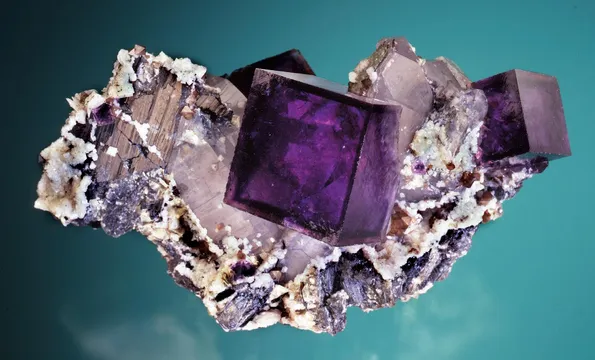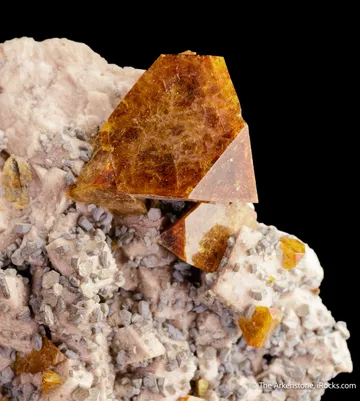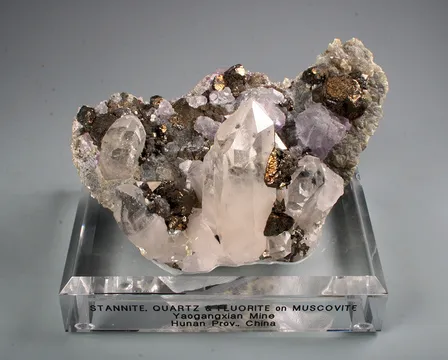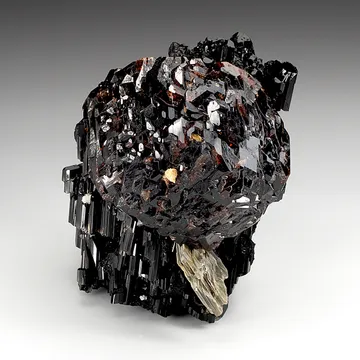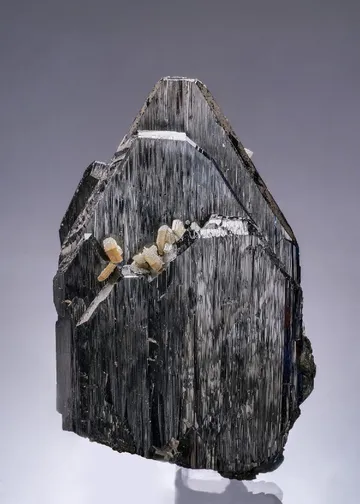
Muscovite de Yaogangxian, Chine : une signature de localité célèbre pour ses veines riches en mica, avec fluorite et scheelite sur mica argenté, prisée par les collectionneurs.
Key facts
La muscovine de Yaogangxian se comprend mieux comme une signature de localité plutôt que comme un minéral isolé, autonome. Les spécimens les plus désirables contenant de la muscovine proviennent de pièces architecturales combinées: fluorite violette, bleue, verte ou miel posée sur une mica étincelante; scheélite incrustée dans des livres de mica argenté; arsenopyrite métallique, stannite, ferberite et sulfosaltes émergeant d’une matrice de veines de quartz riches en mica. Dans ces spécimens, la muscovine apporte la texture qui rend le matériau Yaogangxian immédiatement reconnaissable — druses et rosettes micacées crème, beige, jaune-argenté, jaunâtre ou verdâtre qui scintillent sous des cristaux plus fortement colorés.

Photo : Wikimedia Commons
La localité se situe dans l’un des grands districts métallogéniques de tungstène-étain de la chaîne Nanling, dans le sud de la Chine. À Yaogangxian, des intrusions granitiques mésozoïque et leurs fluides hydrothermaux ont produit un système complexe tungstène-étain dans lequel les veines de quartz, l’altération de style greisen et la skarn jouent chacun un rôle. La muscovine se rencontre dans cet environnement hydrothermal comme gangue et minéral d’altération, notamment dans les veines mica-quartz et les entourages de veines micacées. Pour les collectionneurs, ce rôle géologique est exactement ce qui confère au minéral son importance: la muscovine est la base scintillante et stratifiée sur laquelle de nombreuses fluorites, scheelites, arsenopyrites et minéraux du tungsten se présentent.
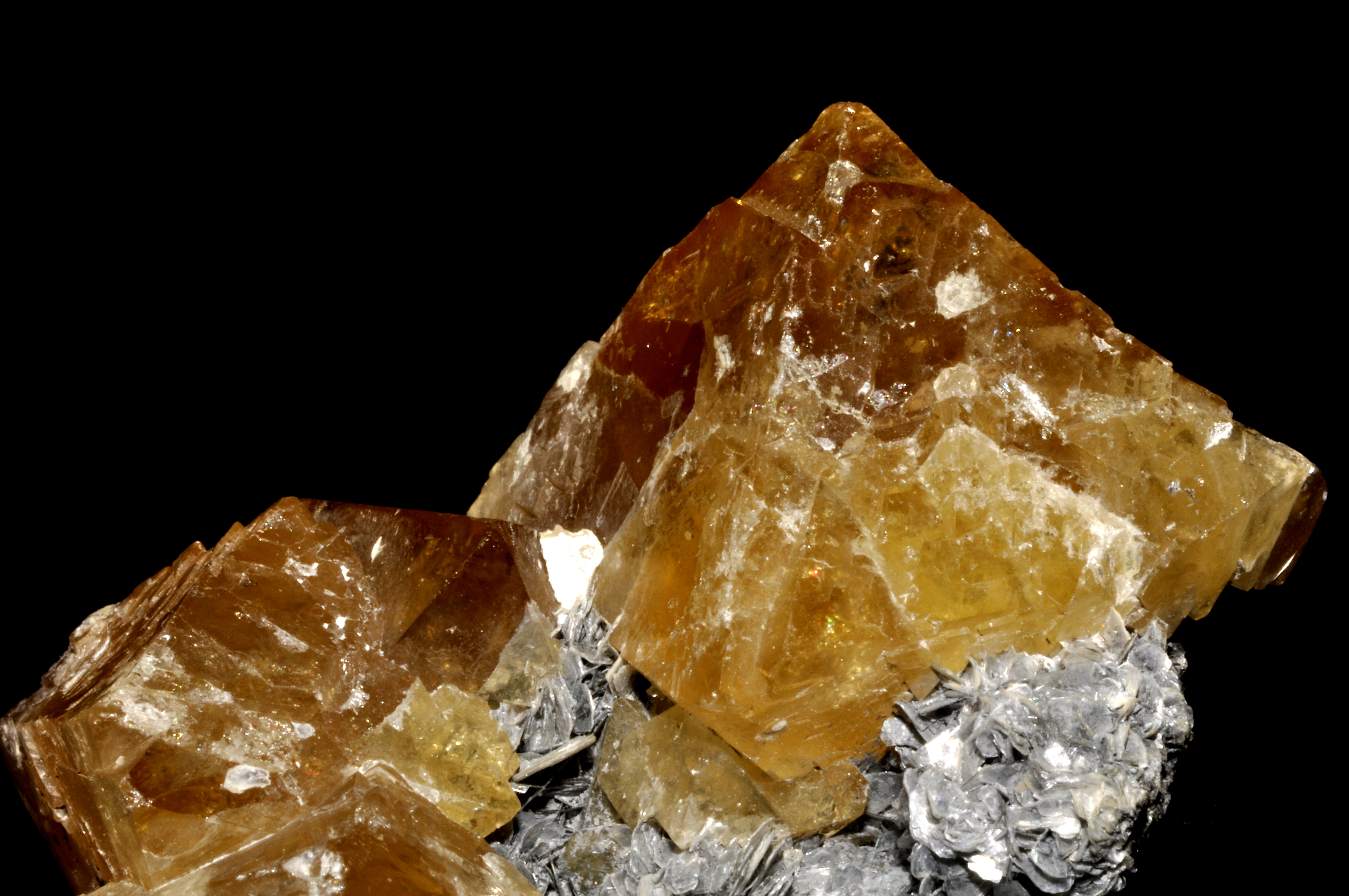
Photo : Wikimedia Commons
L’attrait est partiellement visuel et partiellement historique. Yaogangxian est une ancienne et prolifique mine de tungstène, active depuis le début du XXe siècle, et les collectionneurs occidentaux en vinrent à connaître ses spécimens alors que les exportations minérales chinoises s’étendaient dans les années 1990 et 2000. Les pièces porteuses de muscovine ont aidé à définir le « look Yaogangxian »: des cubes de fluorite nets et vitrifiés avec des fantômes posés sur une mica mousseux; des cristaux de scheélite contre du mica argenté; des combinaisons d’arsenopyrite et de quartz avec une étincelle micacé dans les recoins. Les meilleurs exemples ne sont pas valorisés parce que la muscovine est grande, mais parce qu’elle est fraîche, lustreuse, sans défaut et intégralement constitutive de la pièce.## Specimens en vedette
Rechercher des spécimens : Voir tous les spécimens de muscovite de la mine Yaogangxian, Chine
La mine Yaogangxian se situe dans le champ d’ore métallifère wolframite-étain de Yaogangxian, dans le comté de Yizhang, Chenzhou, province du Hunan, Chine. Mindat situe la mine à environ 25° 38' 35" N, 113° 19' 17" E et enregistre le nom local chinois comme 瑶岗仙矿. La mine fait partie de la zone métallogénique non ferreuse Nanling, une région célèbre pour la wolframite associée au granite, l’étain, le molybdène, le fluor, le béryllium et la minéralisation polymétallique.
Le champ minier n’est pas une simple veine unique mais un système composite wolframite-étain lié au pluton composite Yaogangxian. Le pluton a intrudé des roches sédimentaires du Cambrian au Dévonien, principalement des grès et des ardoises, avec des calcaires jurassiques également impliqués dans le contexte de contact plus large. Le champ minier couvre environ 4 par 2,5 km et comprend deux styles principaux d’oreo: le gisement wolframite-étain de quartz-vein Yaogangxian, avec une minéralisation mineure de type greisen, et le gisement wolframite-étain de type skarn de Heshangtan. Le système à quartz-veine a été exploité depuis 1914. Heshangtan a été découvert en 1947, exploré dans les années 1950 et exploité à partir du début des années 1960.
Dans le système à quartz-veine, les veines se trouvent dans la phase granitique biotitique du pluton et dans ses zones de contact ouest et nord. Elles se présentent principalement en direction nord-ouest à nord-nord-ouest et sont regroupées en blocs miniers Yangmeiling, Luchangping et Hamashi. Des travaux géologiques publiés décrivent plus de 200 veines d’ore, des veines individuelles mesurant jusqu’à 1 200 m de long, jusqu’à 1,5 m de large et s’étendant de 100 à 1 000 m en profondeur. Les minerais d’ore comprennent des minéraux de la famille wolframite et de la molybdénite, avec l’arsénopyrite associée, la cassitérite, la chalcopyrite, la pyrite, la bournonite et d’autres sulfures et sulfoseltes. Les gangues comprennent le quartz, le mica, le feldspar, la fluorite et la calcite.
La muscovite appartient naturellement à ce cadre. Dans les descriptions des veines, la mica est signalée dans les bordures avec la wolframite et la molybdénite, et une muscovite hydrothermale a été spécifiquement documentée à partir d’une veine mica-quartz dans l’ardoise du Cambrian dans l’adit minier Yangmeiling. C’est un repère utile pour les collectionneurs : la matrice micacée observée sur de nombreux spécimens n’est pas un matériel décoratif accidentel, mais fait partie de la même architecture hydrothermale qui a construit le système de veines porteuses de tungsten.La production des spécimens a été particulièrement importante dans les cavités ouvertes des veines wolframate-quartz. Ces cavités ont livré la fluorite d’un lustre brillant, les minéraux de la série ferberite-hübnerite, la bournotite, l’arsénopirite, la scheelite, le quartz, et des pièces associées qui ont rendu Yaogangxian célèbre. La muscovite apparaît le plus souvent en tant que matrice, druse ou mica en rosettes dans ces associations. La localité reste une zone minière en activité ou historiquement exploitée, et non un site public de collectionnement occasionnel. L’accès des collectionneurs doit être traité comme un accès industriel-minier : les spécimens arrivent sur le marché par les mineurs, les exportateurs, les marchands, les anciennes collections et la circulation récente sur le marché plutôt que par le biais du collectionnement ordinaire sur le terrain.## Caractéristiques de la muscovite de la mine Yaogangxian, Chine
La muscovite de Yaogangxian se forme généralement en agrégats microcristallins à petits plutôt que les grands « livres » prisés des localités pegmatitiques. Des échantillonnages publiés provenant de l’adit Yangmeiling décrivent des agrégats de mica euhedriques d’environ 1 à 3 mm de diamètre dans une veine mica-quartz. Les spécimens de collection élargissent cette vision : la muscovite peut apparaître sous forme de cristal lamellaire, de rosettes feuillues, de croûtes micacées scintillantes, d’agrégats bouillonnants ou botroïdaux, et de boules de mica vert pâle ou beige-argenté sur lesquelles sont coiffés de la fluorite et d’autres minéraux.
La gamme de couleurs est l’un des plaisirs discrets de cette localité. La muscovite de Yaogangxian peut être crème, beige clair, beige, argentée blanche, jaunâtre, gris pâle ou verdâtre. Sur les spécimens de fluorite, la muscovite verdâtre est particulièrement attrayante car elle contraste avec la fluorite violette ou bleue tout en conservant une surface granuleuse et scintillante. La muscovite beige et jaunâtre donne un aspect plus chaleureux aux combinaisons fluorite bleue-violette, et la muscovite argentée offre une étincelle plus fraîche et métallique avec la scheélite, l’arsénopirite ou le quartz.
L’habitus le plus familier dans les pièces de cabinet est une matrice micacée : de nombreuses petites plaques de mica parfaitement intergoupées pour former un tapis scintillant. Sur les pièces de haute qualité, cette matrice n’est pas seulement une base mais un champ visuel, avec de petites faces de mica reflétant la lumière autour d’un ou plusieurs minéraux principaux. Les meilleurs exemples présentent des surfaces de mica intactes et fraîches plutôt que des matériaux ternes, argileux, oxydés ou abrasés. La mica trop massive, sale ou visuellement morte est moins désirable à moins que le minéral associé ne soit exceptionnel.
Les minéraux typiquement associés incluent la fluorite, le quartz, la calcite, la dolomite, la scheélite, l’arsénopyrite, la pyrite, la chalcopyrite, le stannite, les minéraux de la série ferberite-hübnerite, la molybdénite, la sphalérite, les minéraux du groupe chlorite, la chamosite, la rhodochrosite et une série de sulfosalts. La muscovite est particulièrement courante dans le vocabulaire des collectionneurs autour de la fluorite de Yaogangxian : des cubes transparents violets, des cubes zonés bleu-violet et des crystals modifiés verts ou violets sont souvent perchés sur une matrice riche en mica. La scheélite sur muscovite est une autre association classique, avec une scheélite pseudo-octaédrique d’ambre à brun sur fond de mica argenté.La qualité est évaluée sur l’ensemble du spécimen. Les meilleures pièces de Yaogangxian contenant de la muscovite présentent une mica fraîche et brillante, un fort contraste avec le cristal principal, un contact naturel et non endommagé entre la mica et les minéraux associés, et un relief tridimensionnel suffisant pour que la mica paraisse faire partie de l’architecture plutôt qu’un fond plat. Dans les pièces de fluorite, les collectionneurs recherchent des cristaux transparents, un zonage net ou des fantômes, un minimum d’éraflures sur les arêtes, et une matrice de mica qui met en valeur plutôt que de masquer la fluorite. Dans les pièces de scheelite, les meilleurs exemples montrent une scheelite nette et brillante qui s’élève clairement à partir d’une matrice mica ou quartz-mica. Dans les associations arsenopyrite ou stannite, la mica doit offrir un contraste vif sans être écrasée ou estompée par l’oxydation du sulfure.## Notes du Collecteur
La principale préoccupation d’authenticité concernant la muscovite de Yaogangxian ne réside pas dans le traitement de la mica elle-même. Les risques mieux documentés concernent la confusion de locality, la confusion d’espèce dans les minéraux associés et des étiquettes minières chinoises trop générales. La muscovite est répandue dans les systèmes hydrothermaux liés au granite, donc une pièce étiquetée simplement « Chine » ou « Hunan » ne suffit pas. Un spécimen convaincant de muscovite de Yaogangxian doit correspondre aux associations connues de la localité : fluorite avec des cubes violets, bleus, verts ou zonés; quartz; scheelite; arsenopyrite; minéraux de la série ferberite-hübnerite; stannite; calcite ou dolomite; et d’autres minéraux connus du champ minier de Yaogangxian.
Plusieurs notes d’avertissement spécifiques à la localité importent pour les collectionneurs. Des sulfosels métalliques fibreux provenant de Yaogangxian ont souvent été échangés sous des noms simplifiés ou incorrects, notamment sous le nom de « bismuthinite », alors que des analyses ont montré que bon nombre de ces spécimens étaient de la stibnite, boulangerite, jamesonite, berthierite, kobellite, cosalite ou d’autres sulfosels. La molybdénite attribuée à Yaogangxian a également été remise en question dans la littérature des collectionneurs, certains spécimens commerciaux probablement originaires d’autres localités. Mindat note en outre que certains « goshenite » attribués à Yaogangxian proviennent en réalité de Pingwu, Sichuan. Ces avertissements ne rendent pas directement la muscovite suspecte, mais ils affectent les combinaisons de pièces où la valeur dépend de chaque minéral et de la localisation exacte.
L’état est le principal souci pratique. La muscovite présente une clivage basal parfait et peut se fendre, se déplanter ou se dégarnir avec une manipulation négligente. Sur les spécimens de Yaogangxian, la matrice de mica se compose souvent d’innombrables petites plaques ; elles accumulent la poussière, subissent des frottements sur les arêtes et peuvent être meurtries si le spécimen glisse dans une boîte. Le nettoyage doit être conservateur. Éviter le brossage agressif, le nettoyage ultrasonique et les trempages prolongés à moins que les minéraux associés aient été soigneusement envisagés. Les arêtes de fluorite s’écaillent facilement; la scheelite peut montrer des marques de contact; les sulfures peuvent s’oxyder ou se détacher de la matrice riche en mica. Un spécimen avec une muscovite vive mais intacte est bien préférable à celui qui a été frotté jusqu’à devenir terne.
La rareté dépend de ce qui est collecté. La muscovite en tant que minéral accessoire ou matrice provenant de Yaogangxian est courante sur le marché. Les spécimens fins dominés par la muscovite sont moins courants, car les collectionneurs valorisent généralement le fluorite associé, la scheelite, l’arsénopyrite, la stannite ou les minéraux tungstèneux. Les pièces les plus attrayantes portant de la muscovite — fluorite transparente sur mica scintillant, scheelite sur mica frais, ou arsenopyrite/stannite métallique avec mica et quartz — sont bien plus compétitives, notamment lorsqu’elles proviennent de collections anciennes ou de productions précoce bien documentées.Les récentes ventes sur le marché montrent des pièces de Yaogangxian portant de la muscovite allant d’échantillons abordables de quartz avec muscovovite à des miniatures en fluorite sur muscovite à quatre chiffres et des petits cabinets. Dans cette localité, le prix est généralement déterminé par l’espèce associée et l’esthétique du spécimen plutôt que par la muscovite seule. Un collectionneur constituant une série Yaogangxian devrait envisager au moins un spécimen où la muscovite est visuellement essentielle: un cube de fluorite zébré reposant sur de la mica bullée, une scheelite sur mica argentée, ou un groupe d’arsénopyrite métallique intégré dans une matrice quartzite micacée.## Stories & Field Notes
L’une des images de terrain les plus utiles de la muscovite Yaogangxian ne provient pas d’une vitrine, mais d’une étude de datation. Dans l’adit minier de Yangmeiling, des chercheurs ont recueilli de la muscovite hydrothermale dans une veine de mica-quartz coupant le schiste cambrien. La veine contenait des amas sulfurés disseminés et la mica apparaissait sous forme d’agrégats euhédrales d’environ 1 à 3 mm de diamètre. Ces cristaux à l’échelle du millimètre n’étaient pas choisis pour leur beauté; ils furent sélectionnés, purifiés et datés pour contraindre l’âge du système tungstène. Or la description ressemble à l’origine souterraine de nombreux spécimens de collectionneurs : roche-murale du schiste, quartz, sulfure et un scintillement de mica cristallisé à l’intérieur d’un système hydrothermal porteur de tungsten.
La même étude décrit une autre veine porteuse de mica dans l’adit de Dayanmen, où la phlogopite formait des agrégats euhédrals orientés perpendiculairement aux parois de la veine. La partie centrale de cette veine contenait feldspath, fluorite, chalcopyrite, quartz mineur et wolframite à grain fin. Cette géométrie — mica aux marges de la veine, fluorite et minéraux du minerai dans l’intérieur de la veine — correspond exactement au type d’arrangement naturel qui, à grande ou petite échelle, devient un bel échantillon : la mica fait le décor, la fluorite ou les minéraux du minerai en constituent le point focal.
Une histoire ultérieure du marché des collectionneurs est conservée dans un enregistrement Mindat pour une pièce de fluorite, muscovite et calcite provenant de la collection Kurt Hefendehl. L’échantillon ne mesure que 5,2 x 4,3 x 2,6 cm, mais sa description capture la formule classique de Yaogangxian : des cubes de fluorite violet transparent et limpide jusqu’à 1,2 cm de côté, reposant sur une muscovite beige-argentée à bulles avec une calcite mineure, suffisamment transparent pour que le spectateur puisse voir à travers la fluorite jusqu’à la matrice micacée en dessous. Hefendehl a commencé à collecter sérieusement à l’âge de 14 ans, a constitué une collection mondiale de plus de 6 000 spécimens, est resté actif jusqu’à peu avant son décès en 2020 à l’âge de 82 ans, et était particulièrement connu pour ses localités classiques et les minéraux de la Forêt-Noire. Une muscovite-matrice fluorite de Yaogangxian survivant dans ce contexte en dit long sur le statut de la localité : ces pièces entrèrent dans de sérieuses collections européennes non comme des nouveautés, mais comme des classiques modernes.
Une autre note révélatrice de collectionneur concerne de mauvaises identifications dans les lots Yaogangxian. Une discussion Mindat en 2026 décrivait un spécimen inhabituel de Yaogangxian portant de la topaz assortie d’arsénopyrite, de cassitérite, de ferberite, de fluorite, de muscovite présumée, de quartz et de topaze. L’auteur notait que c’était le seul topaze qu’il avait personnellement vu de la mine après avoir vu des milliers de spécimens importés et que, à l’époque, des specimens impressionnants de barytine (bournonite) sortaient et étaient vendus dans des lots de ferberite. La leçon pour les spécimens porte-muscovite est plus large que le topaze : Yaogangxian est suffisamment riche en minéralogie pour que des associations rares ou inhabituelles puissent être négligées, mal étiquetées ou simplifiées dans le commerce. Une inspection attentive de la « matrice » est souvent récompensée.## Mineralogical Records & Publications
Ottens, Berthold, and Robert B. Cook. 2005. “The Yaogangxian Tungsten Mine: Yizhang County, Chenzhou, Hunan Province, China.” Rocks & Minerals 80(1):46–57. Un article clé orienté collectionneurs sur la mine et sa minéralogie des spécimens.
Ottens, Berthold. 2011. “The Yaogangxian mine, Hunan Province, China.” The Mineralogical Record 42(6):557–603. Le traitement majeur du Mineralogical Record sur Yaogangxian, largement cité dans les fiches locales.
Peng, Jiantang, Mei-Fu Zhou, Ruizhong Hu, Nengping Shen, Shunda Yuan, Xianwu Bi, Andao Du, and Wenjun Qu. 2006. “Precise molybdenite Re–Os and mica Ar–Ar dating of the Mesozoic Yaogangxian tungsten deposit, central Nanling district, South China.” Mineralium Deposita 41:661–669. Établit le timing de la minéralisation en utilisant le Re–Os de la molybdénite et le datage Ar–Ar des mica hydrothermaux, y compris la muscovite.
Wang, Xiang, and Minghua Ren. 2018. “Constraints of Hydrothermal and Magmatic Zircon on the Origin of the Yaogangxian Tungsten Deposit, Southern China.” Ore Geology Reviews 101:453–467. Discute le zircon provenant des veines de quartz porteuses de wolframite et du granite alkali-feldspathique de la muscovite.
Li, Wen-Sheng, Pei Ni, Jun-Yi Pan, Guo-Guang Wang, Li-Li Chen, Yu-Long Yang, and Jun-Ying Ding. 2018. “Fluid inclusion characteristics as an indicator for tungsten mineralization in the Mesozoic Yaogangxian tungsten deposit, central Nanling district, South China.” Journal of Geochemical Exploration 192:1–17. Utile pour l’histoire des fluides de la minéralisation wolframite-quartz et skarn scheelite.
Li, Wen-Sheng, Pei Ni, Jun-Yi Pan, Stefano Albanese, Benedetto De Vivo, Rosario Esposito, and Jun-Ying Ding. 2023. “The genetic association between vein and skarn type tungsten mineralization in the Yaogangxian tungsten deposit, South China: Constraints from LA-ICP-MS analysis of individual fluid inclusion.” Ore Geology Reviews 159:105544. Étude moderne abordant la relation entre les systèmes de tungsten en veine et en skarn de Yaogangxian.
Lin, Chuanxian, Zheru Zhang, and Donald Burt. 1985. “Phase equilibria of several tungsten deposits in southern China.” Geochemistry 4(3):280–290. Article régional sur les équilibres de phase incluant explicitement Yaogangxian et discutant des assemblages portant de la muscovite dans les systèmes greisen-liés.
Mindat occurrence page: Muscovite from Yaogangxian Mine. Le principal enregistrement d’occurrence en ligne pour la muscovite sur le site, avec photo et agrégation de références.## Vidéos & Médias
“Fluorite-Muscovite-235566.jpg” — Rob Lavinsky, iRocks.com, via Wikimedia Commons. Un cristal violet net de fluorite sur matrice de muscovite venant de Yaogangxian.
“Fluorite-Muscovite-41480.jpg” — Rob Lavinsky, iRocks.com, via Wikimedia Commons. Un cube de fluorite gemmeux avec fantôme violet sur une muscovite verte scintillante.
“Fluorite-Quartz-Muscovite-41661.jpg” — Rob Lavinsky, iRocks.com, via Wikimedia Commons. Une grande association fluorite- quartz- muscovite illustrant le style de matrice mica verte de la localité.
“Scheelite; mica.jpg” — Géry Parent via Wikimedia Commons. Scheélite sur muscovite de Yaogangxian, utile pour reconnaître l’association scheélite-mica.
Page de spécimen EarthWonders : “Fluorite with Muscovite.” Un exemple récent sur le marché d’une fluorite bleu-violet zonée sur une matrice muscovite beige, bubbuleuse.
Page de spécimen EarthWonders : “Fluorite on Muscovite.” Un miniature montrant une fluorite riche en fantômes sur une muscovite jaunâtre translucide.## Lectures complémentaires et liens externes
Page de localisation Mindat pour Yaogangxian Mine — La meilleure référence unique de localisation pour les coordonnées, le résumé du dépôt, la liste des minéraux, les notes historiques et les mises en garde sur les espèces contestées.
Page d’occurrence de muscovite Mindat pour Yaogangxian Mine — Enregistrement d’occurrence ciblé pour la muscovite dumines, avec les espèces associées et les liens de référence.
Article de localisation Minfind : Yaogangxian Mine, comté d’Yizhang, Chenzhou, province du Hunan, Chine — Vue d’ensemble destinée aux collectionneurs avec des références de lectures complémentaires et des exemples de circulation sur le marché.
Rocks & Minerals : « The Yaogangxian Tungsten Mine » — Article classique d’Ottens et Cook sur l’exploitation minière et la minéralogie des spécimens de Yaogangxian.
Peng et al. 2006, Mineralium Deposita, enregistrement de dépôt — Article de géochronologie primaire pour les âges de la molybdénite et de la muscovite du dépôt.
Wang et Ren 2018, Ore Geology Reviews, enregistrement du dépôt UNLV — Étude détaillée des contraintes de zircon sur l’origine du gisement d’uranodet Yaogangxian.
Li et al. 2018, Journal of Geochemical Exploration — Travaux d’inclusions fluides sur la minéralisation en tungstène de Yaogangxian.
Li et al. 2023, Ore Geology Reviews, enregistrement Mindat de référence — Référence moderne sur l’association génétique entre la veine de Yaogangxian et la minéralisation tungstène skarn.
Catégorie Wikimedia Commons : Yaogangxian Mine — Dépôt multimédia libre avec des photographies de spécimens provenant de la localité.