






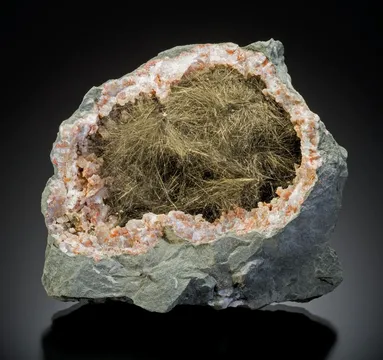
Millerite: gold, needle-like crystals forming delicate sprays; prized for lustrous acicular bundles, fragility, and top localities yielding fine specimens.
Key facts
Millerite (NiS) is the classic “golden needle” nickel sulfide that forms delicate, hairlike crystals and radiant sprays. Its color ranges from bright brass-gold to bronze-yellow with a silky metallic luster; in the best pieces, thousands of ultra-fine needles explode from a point into shimmering hedgehogs or starbursts on pale matrix. The species crystallizes in the trigonal system and commonly develops strongly curved or bent acicular crystals, a hallmark of attractive specimens. Although millerite is widely distributed in low-temperature hydrothermal and diagenetic environments (especially in carbonate and barite veins, ironstone nodules, and geodes), fine cabinet specimens are uncommon because the crystals are extremely fragile and many occurrences produce only micros. The most coveted examples come from geodes and open cavities where undamaged sprays contrast against white calcite, dolomite, barite, or quartz.
Millerite has a devoted following among both aesthetic collectors and micromounters. Its best sprays are unmistakable—feathery, lustrous, and intensely three-dimensional. Historically important finds (such as the golden hedgehogs in Kentucky geodes, or German barite-pocket sprays) set the benchmark for display specimens. Because extraction almost always risks damaging the hairlike crystals, pristine, full, symmetrical clusters are scarce and command strong prices relative to the species’ general abundance. Micromounters prize sharp, undamaged needles and radiating clusters on clean matrix; cabinet-sized, intact hedgehogs are considerably rarer and highly sought after. Subtle iridescent tarnish can add color interest for some, though most collectors prefer bright, untarnished gold.
While millerite occurs worldwide, a handful of localities stand out for producing display-quality sprays with strong contrast and luster.
Halls Gap in Lincoln County is the American classic for millerite. Mississippian limestones here host geodes lined by calcite and dolomite; inside, millerite grows as dense, radiating golden sprays—often symmetrically spherical “hedgehogs.” The best pieces show thousands of hairlike needles with brilliant metallic sheen standing free in cavities, commonly accompanied by white calcite for superb contrast. Because geodes often broke in place or during extraction, intact, undisturbed sprays are prized. Undamaged hedgehogs with minimal shedding and bright color are centerpieces in US sulfide suites.
Color and Luster:
Crystal Form and Aesthetics:
Condition:
Associations and Composition:
Size and Presentation:
Repairs and Stabilization:
Cleaning and Alterations:
Fakes:
Millerite is a sulfide and must be treated gently to preserve its luster and delicate needles.
Handling:
Environment:
Light:
Cleaning:
Long-term Preservation:
By focusing on bright color, silky luster, complete undamaged sprays, and strong contrast on clean matrix, you can assemble a Millerite suite that captures the species’ ethereal beauty—while careful, dry storage will keep those golden needles gleaming for years to come.